Friday, June 3, 2016

Baptism of Fire

Andrzej Sapkowski
Completed 5/20/2016, reviewed 5/20/2016
4 stars

The third book in “The Witcher” series continues the dark fantasy fun of its predecessors.  I thought this was a trilogy, but now it seems the saga is five books, not including the two prequels.  The fourth book is just making its way to my library, and I think I’m the first to place a hold for it.  I was a little disappointed to find that the story did not end here, but the series is just so entertaining that the disappointment didn’t last.  My only regret is that with the books being published annually, I won’t get to the grand finale until next year. 
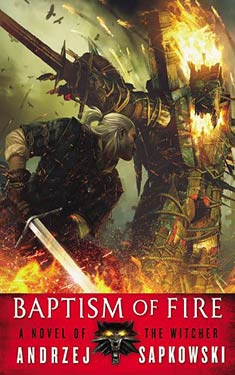
In this installment, the focus is much more on the Witcher himself, Geralt.  He’s seriously wounded at the end of the last book and has to recover in the magical forest of the dryads.  There he meets a woman named Milva who’s an incredible archer.  Once he’s recovered, she joins him on his journey to save Ciri.  Eventually, the twosome meets up with the a few others to form a fellowship on the quest.  Geralt does this reluctantly as he is a lone wolf, but eventually comes to see that it might just be better to have some help on the way.

There’s more war as well as a coming together of the major sorceresses of the nations.  The conclave is in response to the war and to the coup that took place in the last book.  The women decide that magic must survive and must take its place above the pettiness of nations.   Despite my usual complaint of there being too many characters, the scene works well and kept my attention.

It’s tough to come up with more analysis of this book as it is much the same as the previous two, and I expect I’ll have the same problem with the fourth book.  The one thing I really noticed though is that Sapkowski likes his bad-ass women.  Milva is probably the best archer in the land, and she doesn’t take crap from anyone.  And I was beginning to think that the sorceresses were a little to girly initially and that many of their scenes were a little soapy with too many references to, believe it or not, makeup.  But the conclave really drove home for me that Sapkowski created powerful women characters in this novel.  Considering these stories came out of 1980’s Poland, I find it quite remarkable, and very entertaining.

Another item worth mentioning is that Sapkowski introduces a vampire into the mix.  The timing for me was great, having just recently read “Carmilla”.  But this isn’t your run of the mill eastern European vampire.  This one is also a surgeon.  To go into more detail would be a spoiler, but suffice it to say, it makes for a fun read.


I continue to give the books in this series four stars out of five.  There are still times I think the writing, or at least the translation could be better, and the number of characters still makes my head spin, but it’s just so entertaining, I can’t put the books down.  I can see why they made a video game out of the series.

Tuesday, May 31, 2016

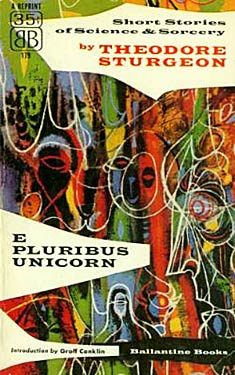
E Pluribus Unicorn

Theodore Sturgeon
Completed 5/15/2016, reviewed 5/15/2016
4 stars

Sturgeon is a master writer.  There’s something about his prose that is truly remarkable without being distracting to the plot.  “E Pluribus Unicorn” is a collection of short stories that are mostly horror, with a little SF and Fantasy thrown in.  Each story is incredibly imaginative and so well written, it’s difficult to move on to the next story without taking a break. 


Several of the stories really stuck with me.  The first was “Die, Maestro, Die”.  It’s about a member of a jazz combo that tries to kill its leader.  He tries not only to kill the man, but the sound.  It’s one of the longer stories and explores the question of what makes a jazz band so great.  It’s sort of the reverse of the usual trope of a band trying to find the sound.  Instead, the protagonist is trying to find what makes the sound of a band that has already found it. 

Another great story was “The Professor’s Teddy Bear”.  It’s a sort of time travel story about a boy and his teddy bear, which talks to him.  The bear makes him dream of his future and coerces him into making decisions which are terrible and which eventually come true.

The third story I’d like to mention is “Bianca’s Hands”.  It’s a very twisted story of a man who becomes obsessed the beautiful hands of a mentally handicapped woman. 


As usual, I don’t always have a lot to say about a short story collection besides naming the stories I liked the best.  I’d just like to leave it that Theodore Sturgeon is one of my favorite writers.  He has a deliciously wicked sense of humor and comes up with the strangest stories I’ve ever read.  I have another collection of his stories that I can’t wait to get to.  I give this collection four out of five stars.  

Friday, May 27, 2016

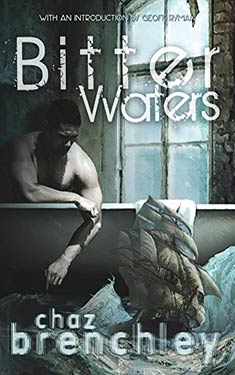
Bitter Waters

Chaz Brenchley
Completed 5/14/2016, reviewed 5/15/2016
3 stars

“Bitter Waters” is a collection of short stories with the common theme of water, from the ocean to islands to the human body, which is 60% water.  The author also intended it for his gay male readers.  All the stories deal in some way with relationships between men, and all have some speculative fiction component.  I liked the book, and the stories are really well constructed.  But this is another case where the prose is so grand it gets in the way of the story telling.  I often got so distracted by the long runs of descriptions and similes that I lost the gist of the story.  I like good prose, but sometimes it can be too much.  In several of the stories, this was the case.


The book can be divided up into different sections; the first part was about mentorship, relationships between young men and older men.  My favorite story in this section was about a enuch and dwarf who steal out of the castle for a night at the public baths.  They have a sexual relationship even though they are the playthings of their mistresses.  Another story that was notable was about a boat that is basically a male brothel.  It comes across another boat with a dead woman and an abandoned child and the captain tries to solve the mystery.

The second section is about Quin, a dying man and the people around him who are taking care of him.  It is never stated what he is dying of.  That’s left up to your imagination.  Being gay, my first thought was HIV, but that isn’t necessarily the case.  And the Quin in one story is not necessarily the Quin in another story, but he has the same basic theme, he’s gay and dying.  Or perhaps he’s the same Quin, but in parallel universes.  The story here that stuck with me was about Quin sending his caretakers out to find the body of a young man he had killed years ago.  It’s chilly and creepy. 

The last section is about Sailor Martin.  Again, he’s not necessarily the same Martin, but perhaps he is, over several centuries or in parallel universes.  My favorite story here was a particularly gruesome tale of Sailor Martin talking with a widow whose son was a cannibal.  It was short, taut, and horrifying. 

My favorite story didn’t quite fit into any of these sections.  It was about a man who comes back after travelling the world for 30 years to find his childhood home being rented out by a vampire with a lair of vampire boys. 


There’s a lot to like about this book.  The stories are very inventive and interesting.  I just found it hard to get past what I felt was over-descriptiveness.  Perhaps if I was in a different state of mind reading it, I would have given it four stars.  Instead, I settled on three.  

Tuesday, May 24, 2016

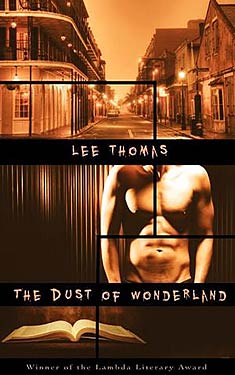
The Dust of Wonderland

Lee Thomas
Completed 5/11/2016, reviewed 5/15/2016
4 stars

“The Dust of Wonderland” is a psychological horror novel about a gay man who is plagued by a long dead evil just when his life was at its most content and stable.  The evil emanates from a horrific incident from his youth at a notorious club called Wonderland in New Orleans.  Now a killer pursues his children, his ex-wife, and his former lover.  Aside from “Carmilla”, it’s the first horror novel I’ve read in over a year.  While it didn’t scare the pants off me, it was suspenseful and exciting.  It won the Lambda Literary Award for SF/Fantasy/Horror in 2008, his first of two.


Years ago, I read a lot of Stephen King, Dean Koontz, and Clive Barker.  Coming back to horror is kind of like homecoming.  If the writing is at least decent, I quickly settle into the suspense and read it voraciously to the climactic end.  Thomas writes decently.  He’s not too prosy, and keeps the action going. 

The main character, Ken, is flawed, but I still rooted for him.  He knew he was gay as a teen, but still pursued the dream of a wife and kids.  He comes out again later in life, finds a good man to settle down with, but then runs away as the haunting begins.  After two years, the haunting turns into a physical attack on his son and he returns to face the demon from his past. 


The book is short, taut and very readable.  To go into too much detail would give away the ending.  Suffice it to say that it is a good thriller and I look forward to reading other books by Thomas.  Horror is my fluff reading and I enjoy returning to it.  I give this book four stars out of five.    

Friday, May 20, 2016

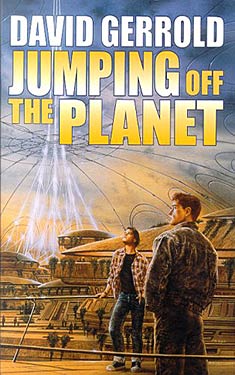
Jumping off the Planet

David Gerrold
Completed 5/10/2016, reviewed 5/10/2016
4 stars

This book won the Gaylactic Spectrum Award in 2001 for positive explorations of LGBT issues in SF, Fantasy, and Horror.  I chose to read it in my own little challenge to read as many of books on the Worlds Without End LGBTQ Speculative Fiction Resource list as I could this year.  Not all books that win awards are my cup of tea, but this one was very tasty.  It’s primarily about the breakup of a family told from the viewpoint of Charles, the middle child.  I found it a very good read, but difficult because of the subject matter.

The plot is that a divorced father abducts his three sons during his visitation period and takes them up a massive elevator to a geostationary space station in an attempt to start again on the moon.  From the science fiction point of view, the idea has been done before in Clarke’s “The Fountains of Paradise” and Robinson’s “Mars” series.  However, being told from the point of view of Charles, Gerrold has the advantage of telling as much about the science as a 13 year old boy would be able to understand and repeat back.  It’s hard SF, but not as hard as it could be. 

The hardest part of the book was that the father was abducting his children.  When I realized that was what was happening, it really affected me emotionally.  It brought to mind how as a child I grew up wishing my parents would get divorced and my brothers and I could live with my father.  Gerrold exacerbated this feeling for me by making the father a rather sympathetic character.  He doesn’t let him off the hook for his actions, and to go into more detail would be a spoiler, but the father isn’t a bad person.  He just makes bad decisions.

The LGBTQ aspect of the book is that Charles’ older brother Douglas is gay.  To divulge much else would also be a spoiler.  His character is handled really well.  But the star of the book is Charles, the middle child and narrator.  Charles has all the anger and bitterness one would expect of a middle child, as well as being a child of divorce.  I could see a lot of my own brothers in the characterizations.


“Jumping Off the Planet” is not a perfect book.  At times, it reads a little like a movie script, which isn’t surprising, as Gerrold was involved with Star Trek and Land of the Lost, and is most noted for writing the teleplay for “The Trouble With Tribbles”.  This makes it a very readable book.  There are times too when I felt like some of the supporting characters were too good to be true.  Nonetheless, I give it four stars out of five, for tackling a tough subject and putting it in an SF context.

Tuesday, May 17, 2016

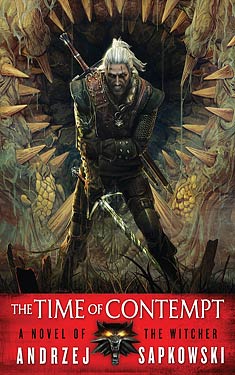
The Time of Contempt

Andrzej Sapkowski
Completed 5/6/2016, reviewed 5/8/2016
4 stars

This is the second book of “The Witcher” series.  It continues the saga of Geralt, the Witcher, and Ciri, the young girl who is an apprentice mage and witcher.  In this book, the tale picks up with Yennifer the sorceress taking Ciri to a school to learn to tame and expand her magical abilities.  Of course, Ciri does not want to go to a school and runs off to find Geralt.  She does, which has the side effect of bringing Geralt and Yennifer back together.  They have a history which is hinted at in the first book.  But amongst all this, there is a coup in the magic world, putting everyone in danger. 


This book was another easy read.  It’s fun, fast, and loaded with action.  Ciri is still the brightest spot of the story.  She’s a strong-willed, stubborn young girl who has a tremendous amount of inner strength, and of course, a penchant for getting into trouble. The series may be named after Geralt, but the star is really Ciri.  In a particularly good sequence, she’s abandoned and has to survive in a desert.  The whole chapter demonstrates what a remarkable and strong character Ciri is.  It was probably my favorite part of the book.

Geralt has a little more page time in this story as well, killing monsters and fighting the bad guys.  One thing about him that’s worth mentioning is his neutrality.  He has always been neutral in the wars and conflicts.  However, this time, he is dragged into it because it has to do with Yennifer and Ciri.  I think that’s an important point because in a lot of Fantasy, and even general literature, there are good guys and bad guys, and there is often moral ambiguity.  But here, the question is about Geralt being neutral and then having to make a conscious decision to take a side. 

Once again, the biggest problem with the book is that there are a lot of characters thrown at you.  This time, it’s during the magician’s coup.  It was hard to keep track of who’s who and on which side they are.  There were so many characters through this section that I’m concerned I’ll be lost when they show up in third book. 


Despite the plethora of characters, I give this book four stars out of five.  I’m really loving this series and looking forward to the final book, as well as the prequels.  

Friday, May 13, 2016

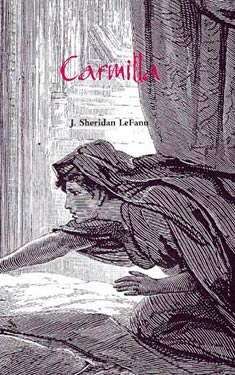
Carmilla

Joseph Sheridan Le Fanu
Completed 4/30/2016, reviewed 5/2/2016
4 stars

This book was first published in 1872.  It is a vampire novella predating “Dracula”.  What makes this book interesting is that it is the probably first lesbian vampire story.  I found this book in Wikipedia when I was doing my research for the LGBTQ Speculative Fiction Resource List for WorldsWithoutEnd.com.  I’m glad I found it and I’m glad I included it in the list.  It’s a very creepy tale of a female vampire preying on young women.  And it gave me goosebumps.


The book is very short, hence novella, or perhaps a novelette.  It recounts the story of a family who takes in a young woman, Carmilla, who falls ill outside the family castle.  The family is happy to help, especially since there is a daughter who could befriend her.  Carmilla’s “mother”, (or more likely, the Renfield of the story) continues on her journey without her.  The family begins by noticing Carmilla’s strange behavior, and the daughter begins to have strange dreams.  Soon she begins to take ill herself but hides it from her family. 

The lesbian component comes with the bloodlust.  Like in any vampire novel, there is a sexual component.  Of course, being written in 1872, there is nothing overt.  However, the seduction of the daughter by Carmilla is very erotic and enhances the creepiness of the story.  I have to admit I haven’t read “Dracula” or any other early vampire stories, so I can’t compare.  But one must conclude that the eroticism of this book set the stage for all the vampire variations now familiar to us. 


I initially had difficulty getting into the rhythm of the Victorian storytelling style.  Aside from that, the story is pretty well written, being told in first person by the daughter.  I give this book four out of five stars for being a creepy page turner despite being over 140 years old.