Sunday, May 22, 2022

Akata Witch

Nnedi Okorafor
Completed 5/22/2022, Reviewed 5/22/2022
4 stars

Nnedi Okorafor is a terrific writer of stories that bring African mythology and traditions into modern settings.  This book is a young adult novel, first of a trilogy, bringing the mythology to an outcast American born African albino girl and her few friends.  The theme may be familiar: young adults with magical abilities, known as Leopards, fighting an evil murdering sorcerer while hiding their powers from the general population, known as Lambs.  Sort of Harry Potter-ish.  But the setting is so different, it feels completely new and exciting, and Okorafor’s prose, even for a YA novel, is simply terrific.  This book was nominated for a couple of YA awards back in 2012.
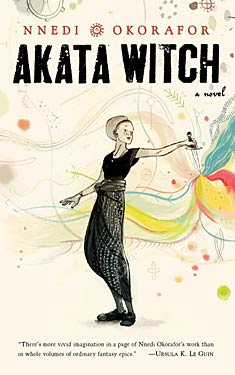
Sunny is the albino girl, living with parents in Nigeria after growing up in the U.S.  Her father is extremely strict and quite abusive.  Her brothers are belligerent and dismissive of her.  She gets along best with her mother.  And there is a mystery about her maternal grandmother, who supposedly was insane.  She’s ridiculed for being different at school, called “akata”, literally “wild animal”.  One day while gazing into a candle, she has a vision of the end of the world.  Then she meets three young people who recognize her as a Leopard and introduce her to the world of magic.  They become students of a magic scholar.  But their powers are soon recognized by the magic community at large and they are tasked with stopping a serial killer who is ritually murdering young children.

Sunny is excellently depicted as the skeptical “Free Spirit”, so named because her parents weren’t magical.  It takes her a while to accept that she’s magical and accept the rules of the magical community of which she is a part.  Orlu, her only friend from school, is the level-headed one.  His main ability is that he can undo other people’s spells.  Chichi is sort of a wild thing.  She doesn’t go to school and lives with her mother in a small hut with tons of books.  She has an eidetic memory, remembering everything she reads.  She has particularly powerful magical gifts, executing some meant for more mature Leopards.  Lastly there’s Sasha, and African-American boy sent to Nigeria because he uses magic in front of Lambs, getting into constant trouble.  What’s particularly great about these kids is that they each have something off about them, like the albinism or severe dyslexia or even ADHD which makes them particularly special Leopards, overcoming their disability once they embrace their magical abilities.  I really liked the whole gang.  Each have distinctive personalities and several of them instigate trouble.  It helps define their characters, making them unique and interesting.

The world building is quite creative.  There are magical places that are hidden from the Lambs where Leopards live apart from them.  There are insect ghosts, which come back to haunt if they are killed by humans during their life.  There’s a blue wasp that only stings if you don’t praise it for the structures it makes out of crumbs.  There’s a red grasshopper that if you’re lucky, sings you to sleep.  There are also Masquerades, terrible spirits that can be conjured but almost always cause serious trouble.  

I found this book to be quite awesome, a fresh take on the training magical youth trope.  The characters were very vivid and the prose is descriptive without be overbearing.  I’ve come to really like Okorafor’s work.  Previously, I loved her Who Fears Death as well as the Binti novella trilogy.  I give this book four stars out of five and really look forward to reading the rest of this trilogy.

Monday, May 16, 2022

A Master of Djinn

P. Djeli Clark
Completed 5/12/2022, Reviewed 5/13/2022
4 stars

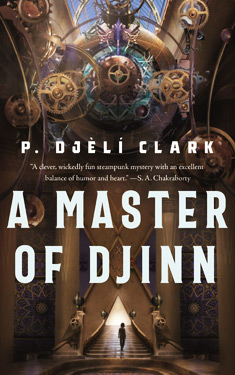
This is the first full novel in Clark’s Djinn in Cairo series.  I really liked the first two, A Dead Djinn in Cairo and The Haunting of Tram Car 015, and I really liked this one too.  It was a fun mystery with a secret society, murders, a Lesbian investigator, and of course djinn.  While I once again didn’t read this quickly because I was preoccupied with my move, I loved the time I got to spend with the book.  The star of the book is, of course, the world-building, but I thought the character development was pretty great as well. 

In this alternate-history Egypt, a secret society devoted to al-Jahiz, the man who opened the portal to the worlds of magic, is wiped out during one of their ceremonies.  The members were mostly English high-born, still living there though Egypt gained its independence from Great Britain.  Agent Fatma from the Ministry of Alchemy, Enchantments, and Supernatural Entities is called in to investigate the mysterious deaths.  At the same time, she gets assigned a new female agent, Hadia, to be her partner.  The murderer claims to be al-Jahiz, returned to aid the downtrodden left behind by technology and the new Egyptian government.  Fatma and Hadia, with the help of Siti, Fatma’s secret lover, try to find and subdue this supposed incarnation of al-Jahiz.

I really liked the three main women in this story.  Fatma was terrific again as she navigated the temples and alleyways looking for clues to the truth behind al-Jahiz.  She’s very good at her job, but at the same time, her youth and inexperience show.  She’s not infallible and occasionally misses important clues.  Hadia was cool as the by-the-book apprentice.  She was a surprisingly deep and insightful character, not just an annoying newbie.  I really liked Siti, who appeared previously under the name of Abla in the last story.  She’s magically powerfully and very mysterious.  She scales the wall to get to Fatma’s bedroom to avoid suspicion of their relationship.  She also has interesting insight into ways of the magic and the djinn who are now a part of the Egyptian cultural scene.  It’s also worth mentioning the character (whose name I forgot) who is slowly turning into the crocodile god of the Nile.  He keeps popping up throughout the story, his transformation a little further each time.  He provides relevant info as the case evolves.  He’s not particularly funny or tragic, just very interesting.

The characters I wish were more prevalent were the two investigators from Haunting, Hamed and Onsi.  They do show up, but I think Clark has more Cairo mysteries up his sleeve and I’m sure we’ll see them again.

I give this book four stars out of five.  I generally have a hard time giving a mystery five stars because I don’t get as emotionally involved as my five-star rating requires.  The same holds true for this book.  It’s excellent, but didn’t tie me in emotional knots.  The prose, world-building, and characterization are all terrific.  And by the way, the plot isn’t a simple murder mystery.  It evolves into a battle for the future of the world.  It’s hard to imagine what Clark will come up with next if he continues this series, but if there’s another book in this series, I’ll definitely read it.


Wednesday, May 4, 2022

The Haunting of Tram Car 015

P. Djeli Clark
Completed 5/1/2022, Reviewed 5/1/2022
4 stars

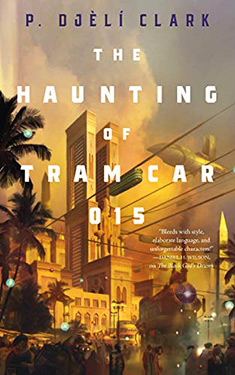
Another terrific story by Clark.  This novella takes place in the same alternate steampunk Cairo of 1912.  In this magic filled Cairo, the suffrage movement is in full swing.  Djinn, angels, and ghouls still abound.  This time, a tram car is haunted and two paranormal detectives are called to investigate.  While Fatma, the detective from A Dead Djinn in Cairo, is only lightly in this one, the two main detectives carry the story well.  This novella was nominated for multiple novella awards as well as the 2020 Mythopoeic Award.  

Hamed is a hardened, experienced detective for the Ministry of

Alchemy, Enchantments, and Supernatural Entities.  He is assigned a case involving a tram car that has a supernatural entity in it.  The entity may or may not be a djinn.  It had been scaring passengers, but the tram was finally taken offline when it attacked a woman.  Hamed is assigned a partner, Onsi, who is fresh out of the academy.  Together they try to determine what kind of entity is doing the haunting and exorcise it while navigating suffragettes, underground religions, and sentient automatons.  

Once again, the characterization is superb.  I found all the characters believable and their dialogue natural.  The story is told from Hamed’s perspective, third person.  He is about as interesting as Fatma from Dead Djinn, but without the quirkiness.  I liked him from the onset, as I did Onsi the newbie.  

The star of this book, though is the world-building.  While we were introduced to it in Dead Djinn, this story takes it in a new direction.  Hamed is sure the haunting is not a ghost or even a djinn.  What it turns out to be is complex and interesting.  The interactions with the suffragettes initially may seem kind of forced into the story, but it crosses paths with the plot later on.  I also liked the delving a little into the underground religions, with the charms and sigils and chanting.  While this story is still short for a novella, it deftly packs a lot into it without feeling like your getting skimped in any one area.

The prose is wonderful.  It has the same manner and style as its predecessor.  It never feels flowery or overbearing.  It delivers just the right amount of description of people and their thoughts, places, and actions.  The reading is smooth, and I’m curious to see how Clark can keep it going in the next installment in the series, a full length novel.  

I give this book four stars out of five.  It’s original, well-written, and wildly entertaining.  I did feel like I could guess how Hamed and Onsi were going to go after the haunter, but it didn’t really matter.  The story was engaging and fun.  I look forward to the next book, which I hope will have the same momentum as these two.


Saturday, April 30, 2022

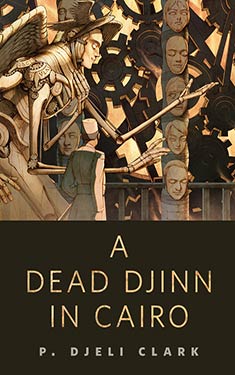
A Dead Djinn in Cairo

P. Djeli Clark
Completed 4/30/2022, Reviewed 4/30/2022
4 stars

A neat little novelette, just under fifty pages.  It’s a mystery set in a post-colonial steampunk 1912 Cairo where the native population was able to expel the British because of the discovery of magic.  I read this little gem in anticipation of the author’s novella and novel, the former being nominated for several novella awards and the latter being nominated for both the Nebula and Hugo this year (so far).  This novelette sets up a world of djinn, ghouls, and angels in a very interesting way and features a female detective.  I enjoyed it, though it felt a little crammed being so short.

Fatma is the detective.  She likes to wear men’s suits in the British style rather than the local Arab garb.  She comes to the scene of a djinn dead from exsanguination.  In fact the body is completely bloodless.  First thought to be a suicide, Fatma thinks there’s something more to this death.  Soon, the remains of an angel are found, confirming Fatma’s hunch.  This leads her to a plot to end the world and bring back ancient gods.  

The best part of this book is the world building.  I’m not much of a steampunk fan, but this was interesting.  The angels are clothed in metal and there are automaton animals running around.  Clocks and gears are also featured.  The author goes into detail describing what a djinn looks like, from yellow eyes to scaly skin.  And Fatma continually reasserts that the angels are not really angels, but other magical beings.

The characterization is decent for such a short book.  The focus is on Fatma, of course.  She’s a smart, sly detective, seeing more than what’s there than her male counterpart.  I liked her and hope she is the main character in the next books.  

Not much more to say about this book without giving away too much, it being novelette length.  I give it four stars out of five.  The prose is really terrific and kept me reading until my eyes simply shut from exhaustion.  I’m looking forward to the rest of the series for the prose and to see what other mysteries the author can come up with.  


Thursday, April 28, 2022

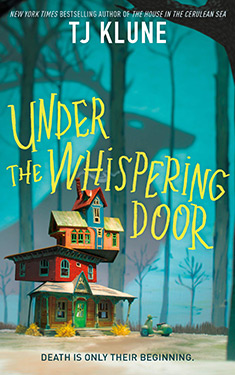
Under the Whispering Door

TJ Klune
Completed 4/28/2022, Reviewed 4/28/2022
5 stars

Another beautiful book by TJ Klune.  This one deals with death, so it may have triggers for some people.  It’s got sparkly prose that’s not overbearing, interesting world building, great characters, and a romance between a ghost and the ferryman who’s supposed to help him cross to the other side.  It has a lot of tear-jerking moments, especially the end, and then again in the epilogue.  I thought it was really well done and not schmaltzy at all.  It hasn’t been nominated for anything yet, but should have been.  I was just enthralled with this book, even though it took me a while to get through it, mostly due to my being distracted by some other life issues.  

Wallace Price is a sleazy, arrogant lawyer.  He’s divorced, has no friends, and is ruthless at work.  One day, he’s at his own funeral and a reaper appears to cull his soul.  This makes him think he may actually be dead.  Mei the reaper drags him to a tea house that’s a sort of way station for souls.  There Wallace meets Hugo, the owner of the tea shop and a ferryman.  Hugo is there to guide him to the next place, but Wallace isn’t having any of it.  He tries to run away but ends up returning.  He slowly accepts that he’s dead and, in the process, falls for the Hugo.

Wallace is a wonderful character.  He starts out a terrible person and ends up an empathetic soul.  The transformation is subtle.  It takes some time for him to come around, just as it did for me to come to like and empathize with him.  Hugo is also wonderful, a gentle person who believes he can bring out the best in people and devastated when he can’t.  Mei is a tough cookie, as one might expect a reaper to be.  The characters are racially diverse, but it’s so natural and organic that it does not feel forced.  It just is, as is the queer content.  

The story telling style is simple but eloquent.  The dialogue is very natural and realistic.  It never gets preachy, morose, or overly philosophical, especially considering the story is about death, dying, and the afterlife.  The narration is third person from Wallace’s perspective, but the characterization never lets anyone remain two-dimensional, expect maybe for the annoying psychic and the arrogant health inspector.  

I give this book five stars out of five.  I got teary several times throughout the novel as people had metanoias and took the final walk through the whispering door to the other side.  This book left me with a warm feeling in my heart so much so that I didn’t want the book to end.  I loved the main characters, I loved the style, and I loved the plot.  I’m sure it’s been done before, perhaps not quite like this, but the whole way station for souls trope has been around a while.  But Klune does this so well, it feels fresh and inventive.  Between this book and Klune’s award winning The House in the Cerulean Sea, he’s become one of my favorite authors.  Despite my massive TBR list, I’m going to try to read some of his earlier works soon.


Sunday, April 17, 2022

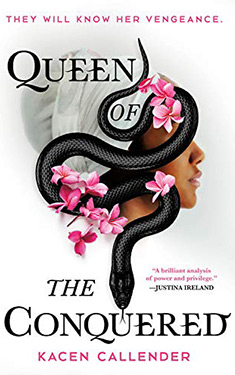
Queen of the Conquered

Kacen Callender
Completed 4/17/2022, Reviewed 4/17/2022
2 stars

I didn’t care for this book.  Only 360 pages and it took me two weeks to get through.  Almost the whole book was exposition.  The main character could enter people’s minds and practically become them, in effect, getting their back stories.  She then proceeded to recount those back stories to us.  There was very little action, even though the book is about colonialism, revolt, and revenge.  I picked the book up every day and had to force myself to stay awake despite the tedium of the back stories.  This book won the 2020 World Fantasy Award.

Sigourney is a black woman on a Caribbean-like nation of many islands dominated by Dutch-like white people from the north.  The white people enslaved the native black people.  One black family was able to buy its way to freedom.  They were able to rise out of poverty and become part of the ruling class.  The Rose family was hated but tolerated by the rest of the ruling whites until they decided to kill the Roses.  Sigourney was the only survivor.  She had the kraft, that is, the gift I described above.  Using her kraft and her wits, she grew up with one goal, to exterminate her family’s murderers and claim the throne to free her people.

The thing about the kraft is that anyone could have it.  It takes many forms: creating illusions, reading people’s minds, blocking mind readers, causing fear.  Sigourney’s kraft allows her to occupy another person’s mind and even control their actions.  However, the whites believe it is a gift from their gods, not for the savage island natives.  So they kill any black person who shows evidence of having the kraft.  Sigourney, to her knowledge, is the only adult black person who has the craft.  

The prose was actually good.  The word choices and descriptions were done well.  It was very readable from that perspective.  However, the content was tedious.  I felt like the main character went on and on about how much she was hated by both the native people and the ruling class.  She was seen as a traitor by her own race for being part of the elite and hated for being a savage who had no right to have the either the craft or her position.  Callender reiterated this again and again throughout the book.

The characterization was also good.  The narration is first person Sigourney.  The other characters we learn of mostly through her entering their minds.  At first, I thought this was an interesting technique to describe characters and their motivations, but as the story progressed, it became tedious.  The book became one exposition after another with only a little bit of movement in between.  Nonetheless, all the characters were very well drawn.  No one was a cardboard cutout.  

I give this book two stars out of five.  I can’t believe it won over the superb The Ten Thousand Doors of January.  The usually engaging and enraging themes of racism and colonialism failed to help this book.  I might say the sum of the parts were greater than whole.  Good prose and characterization, but overall, just plain boring.  I’ll probably give this author another chance, but it won’t be with the sequel.  


Saturday, April 2, 2022

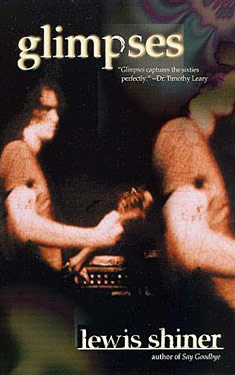
Glimpses

Lewis Shiner
Completed 4/2/2022, Reviewed 4/2/2022
3 stars

This book took me a long time to read.  It was good, but just not terribly engaging.  It’s about a guy who travels in time to try to get famously unfinished albums recorded.  His personal problems are mixed in with that plot.  I found the time travel to be really interesting, but the life story narrative was rather ho hum.  The interactions with the artists were based on interviews, biography, autobiography, and some speculation and created very well-developed characters.  This book won the 1994 World Fantasy Award.  

Ray repairs stereos in 1989.  He lives with his wife Elizabeth.  Their relationship is not the best.  One day, he begins to hear recording sessions of famous recording artists that never took place.  As he hears the songs play out, they get recorded on his tape deck.  He connects with a record company that puts out reissues and compilations and they put out his first recording, of the Beatles, as a bootleg.  It sells like mad.  He begins work on other artists and before he knows it, he’s back in time trying to get them to record their final works before they self-destruct.  The artists are Jim Morrison, Brian Wilson, and Jimi Hendrix.  In the meantime, his relationship with his wife deteriorates, he can’t reconcile his relationship with his recently deceased father, and he begins to fall in love with a woman who was present at his father’s death.  

The narration is first person by Ray who is shut off from his feelings.  This may be why I had trouble engaging with the book.  There weren’t many feelings.  The book just felt cold.  The only time Ray is close to fully engaged is when he is working with the recording artists to get their music recorded.  The rest of the time, he tries to get to the bottom of his problematic relationships with Elizabeth and his dad, but always with one foot in the numb zone.  He starts to open up when he meets Lori, the partner of man who runs a diving expedition in Cozumel where his father died while on a dive.  But Lori has her own problems and their interaction is split between passion and hesitancy.  In the end, this made the book feel like pop best seller about a dysfunctional man who is saved by love.  

Fortunately, the book is interspersed with three intense episodes of time travel to the ‘60s to meet with Morrison, Wilson, and Hendrix.  I particularly liked the episode with Brian Wilson who is coming off the success of the “Pet Sounds” album and trying to make the experimental “Smile” album.  Interestingly, ten years after this book was published, Wilson created a concert version of his original concept and in 2011 released an actual album called “Smile” which was well-received, though he claimed it differed greatly from his original vision.

Based on the synopsis on the internet, I thought I would have liked this book more.  But the synopsis was more engaging than the book itself.  I give the book three stars out of five.  Maybe under different circumstances, I would have enjoyed the book more.  I read this book in the middle of buying a house, which has been pretty stressful.  Normally, I would have found solace in a book, but here, I kept finding excuses not to read it.  It’s not a bad book, just not that great.