Wednesday, January 3, 2024

The Daughter of Doctor Moreau

Silvia Moreno-Garcia
Completed 1/3/2024, Reviewed 1/3/2024
4 stars

Moreno-Garcia is an awesome writer.  Even when I find I’m not really into a book of hers, the writing keeps me going.  That’s what I discovered with this book.  I did not find it quite as compelling as the other books of hers I’ve read, Gods of Jade and Shadow and Mexican Gothic.  But the language is just astounding.   I also liked the premise, the Dr. Moreau story set against the 19th century Mayan revolution on the Yucatan Peninsula in Mexico.  It has other positive qualities, like great character development and excellent world building.  The whole just felt a little less than the sum of the parts.  This book was nominated for 2023 Hugo, Aurora (Canadian Sci Fi/Fantasy) and Locus Fantasy Awards. 
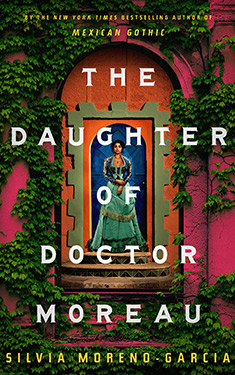
The story begins with the arrival of a British man accepting role of mayordomo at the Moreau compound.  Montgomery was found by the owners of the property and sole benefactor of Moreau’s research, the Lizaldes family.  Montgomery is a ne’er-do-well alcoholic and gambler who has nothing to left to lose and oddly enough, doesn’t bolt when he finds out about Moreau’s human-animal hybrid experiments.  Helping him adjust is Moreau’s daughter, Carlota.  Of course, sexual tension develops between the two.  Everything and everyone remain in a state of balance until the Lizaldes’ son Eduardo shows up and falls for Carlota.  Suddenly, almost every combination of relationship, including between the people and the hybrids, falls to chaos.

Carlota and Montgomery are the main characters.  The book alternates chapters with their points of view.  Carlota is a sweet, caring individual with relatively modern thinking, despite growing up with only the hybrids as companions and her father as her teacher.  She even agrees to her father’s wishes to be open to Eduardo’s advances so that the Lizaldes family will keep funding his research.  Montgomery on the other hand is rough around the edges.  He doesn’t trust the Lizaldes family nor their son’s intentions toward Carlota.  He, of course, is in love with her, but can’t admit it to himself as his own secretive past eats away at him.  I actually liked Montgomery more than Carlota, I think because he’s broken and I could relate to his brokenness.  Carlota is no Mary Sue, but I couldn’t relate to her as well.  I’ll admit though, she was a strong, multi-dimensional character and I did like her.

The secondary characters are also well developed.  Eduardo, his cousin, Moreau, the hybrids, are all interesting and realistically portrayed.  No one is a caricature of good or evil.  There are just a lot of bad circumstances that throws people into difficult situations that evoke passion and bad decisions.  Still, the evils of slavery and abuse of the indigenous population come through.  Ultimately, the Lizaldes are the privileged landowners who represent everything that was bad with colonization in Mexico.    

There are so many things to like about this book, but while reading it, I occasionally found myself struggling to stay interested.  If I could have found it more exciting and perhaps a little less prosy, I might have empathized with Carlota more and experienced a more emotional response at the book’s conclusion.  But this is a good read, and I don’t dissuade anyone from it.  I like Moreno-Garcia and will probably continue to read her output.  She’s a terrific writer with good vision and great imagination.


Thursday, December 28, 2023

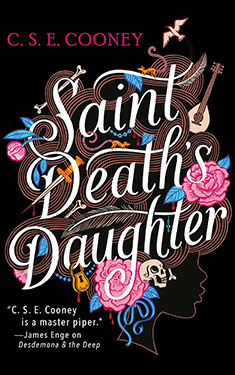
Saint Death’s Daughter

C.S.E Cooney
Completed 12/28/2023, Reviewed 12/28/2023
5 stars

This book won the 2023 World Fantasy Award.  I was predisposed to not liking it because I read three of the other nominees this year and really loved them.  But as I began to read this one, I was pulled in by the immediacy of the plot.  Before I knew it, I was chewing through this 700 page tome.  I really got into it.  It did occasionally feel like it was two or three books in one.  However, it worked, and I felt like this was award worthy.  I think many people will be overwhelmed by the detail of the magic and the world-building.  They may also miss the dark humor sprinkled throughout it.  Even I didn’t realize how uncomfortably funny many parts were because the dramatic parts are so dire.  In the end, I was glad I read it and got so immersed in this world for five days.

The book begins with Lanie Stones trying to get her not-so-nice older sister back from boarding school to help keep their castle since the passing of their parents.  Turns out the parents had many debts and a banking family is coming to demand immediate payment.  The Stones family has a long line of necromancers and Lanie is the last living one.  The family has also been the executioner and assassin for the Royal family since the founding of the kingdom.  The sister decides to come back and take her place as Royal executioner to earn money to pay off the debt.  When their plans are thwarted, the Queen offers her a job to assassinate the parliament of a rival nation.  This works for a while, but the head of the rival nation, the Rook of Rooks, has other plans.  

Lanie is the main character.  As necromancer, she controls Goody, and undead servant bound to the family for generations.  She also practices her own resurrection skills, learning from the ghost of her dead grandfather, the last necromancer in the family.  The problem is, she has an allergy to violence.  When someone speaks of violence, she experiences the trauma.  When someone near her experiences violence, she feels that as well.  It makes being a necromancer difficult and can result in an early death.  Lanie is rather pitiful at the beginning of the book.  But she learns and grows throughout.  Without realizing it, I was rather caught up in her failures and successes, so that by the end, I was devastated by the big twist.

The secondary characters were also very well developed.  There was the sister and her shapeshifting husband who turns into a falcon, their daughter Datu, Goody the undead servant who practically raised Lanie, Lanie’s love interest Canon Lir, and two teachers and Havoc the pub owner.  As you can see, I don’t remember all the names, as there are so many characters.  But they’re easy to remember as they come into the book gradually, not all at once in the beginning.  I was impressed that Cooney was able to develop so many secondary characters, although she did have 700 pages to do it in.  Sometimes they help, sometimes they hinder, often they add dry, dark humor.  

The world building is quite amazing.  There are different languages and dialects.  There are different nations and continents.  Throughout the book and occasionally through the use of footnotes, we learn of the long line of Stones as well as members of the Royal bloodline.  The magic system is amazing, with twelve gods all providing different types of magic.  Lanie’s patron is the goddess of death, as in the title of the book.  There’s even a yoga-like meditation system access the attributes of the different gods.  There’s also a lot of use of birds in this system, with the Rook of Rooks heading her parliament of four and twenty wizards, all given the power of different types of birds.  It’s amazing that this book started out as a short story, then grew into a book during NaNoWriMo.  Later, it was fleshed out into this massive tome.  It took Cooney seventeen years from start to finish, and it shows in the diversity and depth of this magical world.

I give the book five stars out of five.  I found it quite enthralling and I felt a part of Lanie’s journey.  I read this book in five days (vacation days of course), regularly reading deep into the night.  I found out later that day that this is the first in a planned series, so the ending made sense.  It’s not exactly a cliffhanger, but you do see that Lanie’s work is not done.  I don’t know how I feel about delving into another massive tome in this world.  I think I have to see how next year goes with my plan to only read books on my massive TBR pile.  


Thursday, December 21, 2023

Buried Mage

Michael Taggart
Completed 12/20/2023, Reviewed 12/21/2023
4 stars

Another winning entry in the Fledgling God series.  This fourth book wasn’t quite as spectacular as the third book, Gathering Mage, but it still kept me pumped up on Jason and the Louisville Mages.  I felt this one spent a little too much time on build-up.  The significance of the title isn’t apparent until halfway through the book.  But Taggart’s easy prose and the love between the four who live with Jason really make it worthwhile.  It makes it another feelgood romp of an urban fantasy with a masterfully detailed magic system.  And it ends on a cliffhanger, something I’m not generally fond of, but welcomed as it means there will be a fifth book in the series.  Yes!

This book takes place right after Jason and Sandy return from the Gathering of Mages where they established themselves as powerful Mages in their own right.  They brought back newly developed magical abilities and new confidence in their powers.  They share their discoveries of charm creation and rune use with their housemates.  Oh yeah, and Jason and his boyfriend Tyler the incubus have lots of I-missed-you-so-much-sex.  Just when everything seems to settle down, the House is challenged to a Reconciliation battle by the Cincinnati House.  It’s a stylized ritual to pit one House against another to settle a dispute.  Turns out the Cincinnati House had helped the rotten Mages in the first two stories, unaware that everything they were told about Jason’s House were lies.  When it is all settled, all seems right with the world until Karl and Marius, the remaining super-rotten mages return once and for all to destroy Jason and his housemates.

The real star of this book is the magic system.  We learn a lot more about charms and runes.  The House members work to create charms, starting with easy and working up to complicated and powerful.  Jason also works with runes, figuring out how they draw and process power.  Taggart is so detailed, he’s almost scientific in his approach to this magic system.  Where some books assume you understand spells and runes and charms, Taggart defines them like an instruction manual would.  I have to admit, sometimes it got a little tedious, particularly in the first half.  However, when Jason has to actually work with runes and charms as well has his shield and soul creations to escape from being buried alive, all that background makes sense.   

I was startled by the sexual content in this book.  After 800 pages of almost no sex, this installment ushers it back in with intensity and some humor.  To say this book is erotica would be too much.  I would classify it as an urban fantasy with healthy sexual expression.  I’ve read some fantasy and sci fi erotica, and this is tame compared to those books.  But I would classify this as having mature content.  

I must say that I’m very impressed with Taggart’s imagination.  For a set of books with the common trope of “learn an aspect of magic, use it in a life or death fight, repeat”, they are wildly entertaining.  I also still love the fact that everyone in Sandy’s house gets along like a loving, chosen family.  There is very little conflict between the house members.  Sometimes, all the hugging and laughing and partying seems unrealistic.  On the other hand, it saves the conflict for the real bad guys.  It reinforces the idea that one’s chosen family can be supporting and loving, something that many LGBTQ+ people eventually learn and experience.  

I give this book four stars out of five.  It was a little bit of a come down after the exhilaration of the previous book.  I was still very involved emotionally with Jason, Sandy, et al.  Like several other reviewers, I feel sad that Annabeth is the only House member not in a relationship, and it is never noted if she wants one or not.  And it’s not like she’s a fifth wheel.  She fully participates with the others and is never left out.  In fact, she has a pivotal role in the big showdown.  I’d just like to see the love spread out a little more evenly.  As for the next book, I can’t wait to see what happens to everyone.  I can’t wait for it to come out and will probably jump on it as soon as I hear it’s been published.


Friday, December 15, 2023

Gathering Mage

Michael Taggart
Completed 12/14/2023, Reviewed 12/15/2023
5 stars

I adored this book.  It’s 850 pages felt like nothing, making me read over thirty pages an hour (except on the nights when I passed out while reading because I read until super late the night before LOL).  It truly had me engrossed.  I loved the main characters, the intricate magic system, the world building, and the excitement of the setting.  Unlike the previous two books in the series, Misfit Mage and Melee Mage, this had a lot more substance even though I could still argue that this was fluff.  This one just came together for me in so many ways, and I realized I had missed being in this world that Taggart created.  I also found out in the afterward, that this and the fourth book were written as one huge epic, which he split into two books.  So that was all the motivation I needed to jump into the next one without taking a break with a different author.

This book is quite a different setup than the first two.  It continues the story, which began only a few months ago, of Jason Cole, a young gay man who has just discovered he’s a mage.  He lives with Sandy, the head mage of the magical House, her husband John the mountain troll whom she just married, and another mage named Annabeth who’s magic is linked to music.  Jason is in love with an incubus named Tyler, and they’ve just declared their relationship status as boyfriends, not just friends with benefits.  Jason has a cat named Bermuda who is recognized by other mages as a revered Celestial Guardian.  

In this book, Sandy and Jason go to week-long gathering of mages.  It’s kind of like a convention where the mages of the world come together to share the experiences in their respective Houses.  Both are young mages: Jason only a few months old, and Sandy only about 70 years old.  They’re there to learn as much as they can.  Jason grows in many ways, particularly in his understanding of his own magical nature and in how he accesses this magic.  But besides the usual fun and education of going to a convention, the two run into trouble.  There is a growing movement that wants to cast out the new mages, whom they call rats, from the Houses, claiming they are draining their resources, physical and magical.  This eventually leads to a showdown between the forces of good and the rat haters.  In between, there is a ton of fun and excitement that leads up to this final showdown.  

You’d think that a story about a convention would be kind of boring, but Taggart makes it unbelievably fun.  Beginning with the opening ceremonies, for which Sandy and Jason create an ad hoc show to represent their House that blows away all the participants, there are tons of new aspects of magic for Jason to discover and explore.  There are new friends to meet and new enemies to avoid.  In particular, there are the centaur llamas, beings from another plane who act as servants because they lost their magic generations ago.  Jason befriends one of them and opens a whole new relationship between the centaurs and the mages that all had thought disappeared ages ago.  There are also the tree creatures, mages who are also from another plane.  After a misunderstanding between Bermuda and a giant dragonfly, the trees and Jason and Sandy also become fast allies.

I just loved Jason in this book.  Perhaps one can argue he’s a male Mary Sue (sometimes called a Gary Sue).  Jason is almost certainly a fictional Taggart, and he’s a little too perfect at times.  And after all, the series is called “The Fledgling God.”  Jason is just so adorable and naïve and vulnerable that I can’t help but love the character.  I cheered for him throughout the book, felt like I was him, and at the end, I wished it wasn’t over (thank heavens for the fourth installment).

I really got into the magic system in this book.  It is quite complex.  Taggart almost makes a science of the way that Jason visualizes, stores, and access his magic.  There were times where Jason works and grows his internal magic for pages and pages (and pages).  I think it could have been boring, but I found it totally intriguing.  When he actually uses his magic to heal or in combat, it all makes complete sense.  

The only complaint I had was there’s a deus ex machina towards the end.  However, after I acknowledged it, I completely bought into it.  After all, Jason is a fledgling deus himself.  And there’s foreshadowing of it when Jason meets the All-Rune in a powerful sequence earlier in the book.  

I am so glad I took the chance on this self-published series.  I got it because the guy on the cover of the first book was hot.  And what began as fun fluff turned into something a little more meaty but no less fun.  I give this book five stars out of five for being an intense page turner, thoroughly entertaining, and highly addictive.


Sunday, December 3, 2023

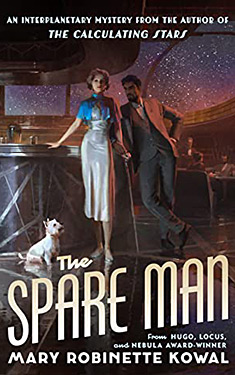
The Spare Man

Mary Robinette Kowal
Completed 12/3/2023, Reviewed 12/3/2023
3 stars

This was an okay book by a writer who has written some terrific stuff, including the Hugo and Nebula Award winning The Calculating Stars.  It’s a murder mystery aboard a spaceship traveling between the Moon and Mars during the ultra-rich main character’s honeymoon.  Reading this book felt like a throwaway, kind of fun, kind of suspenseful, a little science fiction-ish; certainly not up to par with the Lady Astronaut series.  The best part about the book was the characterization.  I didn’t get lost in the number of characters and there was a cute service dog that distracted me when the plot got boring.  I’m guessing this got a 2023 Hugo nomination on the strength of her previous books rather than on the quality of this one.  Of the four of the six nominees I read so far, this one was the weakest.

The main character is Tesla Crane, a brilliant engineer and one of the richest people in the world.  She’s on her honeymoon with the new husband.  Tesla was in a horrible space accident that left her permanently in pain from a severe spinal injury.  Fortunately, she has a device implanted in her that can prevent her from feeling the pain.  She sets it to varying levels depending on how much she needs her sense of touch.  She has an extremely cute service dog that everyone falls in love with.  On this trip, she’s using a digital masking device so she’s not recognized and swamped by fans.  Everything goes smoothly until someone is murdered and she and her husband are first on the scene.  The ship’s inept security suspect her retired private detective husband and take him into custody.  Tesla’s mission is to prove her husband’s innocence and find the killer before they strike again.

The characterization was quite good.  I had clear pictures and impressions of most of the characters.  The story is told from Tesla’s perspective in third person.  Through her we see the inept security team, the other ultra-rich passengers, her super-intense lawyer, and several of the service employees.  Almost everyone of these characters in her eyes is a suspect.  And she’s out to find out who the murderer is.  She’s really a good character:  determined, independent, successful despite being in paralyzing pain.  

I also really liked how the author portrayed Tesla’s PTSD.  It was very enlightening.  It included a terrible flashback and Tesla’s process for staying grounded.  The PTSD was the reason for Gimlet, her adorable service dog.  Gimlet could sense when the panic attacks were coming on and helped ground her as well.  Of the things that were right about this book, this was probably the most profound.

What I didn’t like about the book was that it felt like a standard murder mystery.  I don’t know how mystery fans would like this book, but I was often bored.  I didn’t feel like the story moved well until the last hundred pages or so.  I liked bits and pieces, like the introductions and interactions with some of the suspects.  I liked that the some of the suspects were guilty of other things, making them look suspicious.  But the time between these was not fast-paced.  

I give this book three stars out of five.  It was okay, but nothing special.  The prose was nice and world building decent.  The spacecraft’s concept was interesting, with different levels having different gravities:  Earth’s, Mars’, and the Moon’s.  Also, the descriptions of the Coriolis effect on movement in the ship were interesting.  But it just didn’t work as a whole for me. I found myself not really motivated to finish the book until the last quarter, and that because I just wanted to know who the murderer was.  


Sunday, November 26, 2023

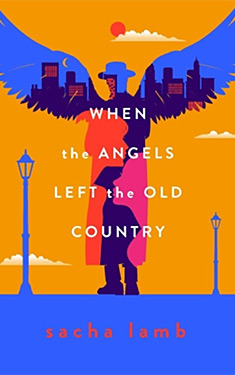
When the Angels Left the Old Country

Sacha Lamb
Completed 11/25/2023, Reviewed 11/26/2023
5 stars

This was an incredibly delightful novel about a Jewish angel and demon at the turn of the 20th century who travel from the old country to America in search of a missing emigrant from their shtetl.  This book won the 2023 Mythopoeic Award as well as several young adult fiction awards, the latter I was surprised by because this book didn’t read YA.  It simply had a queer sixteen-year-old girl as one of the major characters.  This book is immersed in Jewish tradition and mythology and has the occasional Yiddish words thrown in.  Fortunately, at the end of the book, there’s a Glossary of Terms to help with the words.  This was one of those books where I fell in love with the main characters and was sad to see it end.  But I read it voraciously, in just over two days.  

Little Ash is a Jewish demon who studies the Talmud with a Jewish angel.  The reason for noting them as Jewish is because there are demons and angels from all the other faiths, a few of whom pop up later in the novel.  Little Ash and the angel live in a tiny shtetl (village) that doesn’t even have a name.  One day, they hear about a young girl who left for America but her family hasn’t head from her since she left Europe.  Since the family can’t afford to go to America, Little Ash decides to go and convinces the Angel to accompany him.  In a nearby larger town, a young girl named Rose emigrates to America, even though her best friend who was supposed to go as well, stays in the town because a boy proposes to her.  Little Ash, the angel, and Rose cross paths on the ship and end up hanging out together.  In addition, Little Ash names the angel Uriel for forged papers purposes, causing a transformation in the angel, for good or for worse.  Along the way, they find that the missing girl is just one of many emigrants from the Jewish area of Russia who have been tricked into indebtedness and forced to work for a pittance in factories in New York.  

I loved Little Ash and Uriel.  They are study partners, but having been studying so long, they are basically in a relationship, albeit, a non-sexual one.  But they certainly act like they are an old married couple.  Little Ash, despite being a demon, is not your Christian idea of a demon.  He’s more of mischief maker than anything else.  Uriel, before accepting the name for itself, is kind of an airhead, not remembering much and naming itself for whatever circumstance it’s in.  When Uriel accepts the name, at the prodding of the ghost of rabbi, it begins to take on more human characteristics, including remembering things, and having a more difficult time with circumstantial good vs. evil.  Both Little Ash and Uriel go through many changes on their journey, including that of their relationship as Uriel becomes more aware of itself and the world.  One of my favorite scenes is when the two go to a dance hall with Rose and Uriel develops an intense desire to dance with Little Ash.

Rose is also a great character.  She is in love with her best friend, even though she doesn’t understand the feeling, let alone have a name for it.  When her friend decides to stay in their hometown to get married, Rose is crushed.  Being a strong young woman, she picks herself up and emigrates to America on her own.  When she teams up with Little Ash and Uriel, the trip begins to feel more like an adventure, helping her get over her misplaced feelings.  

The world building is terrific.  It was a little reminiscent of the setting for The Golem and the Jinni in that much of it takes place in immigrant-heavy areas of New York City.  The scenes at Ellis Island are devastating, dispelling any fanciful myths about the process of immigration during the European exodus.  The scenes on the ship are intense as well, with the overcrowding and the contagious coughs and fevers.

Reflecting on the book a day after finishing it, I realize that it’s not a light book.  There are many dark scenes as the experience of immigrants was very difficult.  At the same time, there’s a lightness to the book in its supernatural foundation.  The banter between Little Ash and Uriel, and subsequently, with Rose, relieves some of the heaviness.  The book is not simply depressing, nor is it hysterical.  But it is funny and sad and dark and heartwarming.  It evoked many emotions in me which I did not expect.  It was simply a joy to read.  I give this book five stars out of five.


Thursday, November 23, 2023

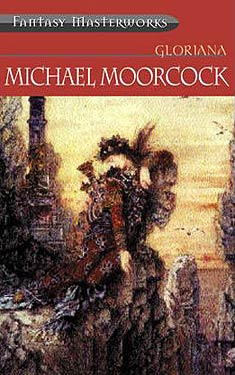
Gloriana

Michael Moorcock
Completed 11/23/2023, Reviewed 11/23/2023
3 stars

This was an extremely well-written novel with terrible content.  It’s a parody of The Fairie Queen as well as an homage to another author.  It’s an alternative universe Great Britain and Elizabeth I, here named Albion and Gloriana, respectively.  It’s full of court intrigue and sex.  Somehow, the sex is done matter of fact and not pornographically.  The original ending was a terrible message and Moorcock was reprimanded about it, so he rewrote the ending.  It’s still not great, but at least a little more palatable.  This book won the 1979 World Fantasy and Campbell Awards, thus concluding my personal challenge of reading all the Mythopoeic and World Fantasy Award winners through last year.  I have yet to read this year’s winners, but they were outside the scope of my challenge.  

Gloriana has ruled over a Golden Age of Albion for thirteen years since the death of her despot of her father, the King.  Her only problem is that she can’t achieve orgasm.  Thus, she is unmarried, determined not to marry until she can be sexually fulfilled.  In the meantime, her Chancellor, Montfallcon, uses spies, kidnappings, and assassinations to preserve Gloriana’s throne.  This leads to some complex and underhanded court politics, namely, the employ of Quire, an extremely successful rogue, by Montfallcon.  After an argument, Quire leaves Montfallcon to work for another kingdom to help bring down Albion and Gloriana.  Suddenly, there are unsolved murders in the Court, destroying the peace within and without, leaving Albion on the brink of war with the Tatars and revolution from within its own borders.

The best thing about this book is the writing.  It is an homage to older literary works, with long paragraphs of prose and soliloquies.  The characters are very verbose, particularly Montfallcon and Quire.  I have to admit that while I can say it was beautifully written, sometimes I got a little bored with the length of some of the passages.  However, I mostly found it engrossing to read complex word choices and sentence structures.  I don’t know if I can say if the world building was imaginative since I haven’t read The Fairie Queen or any of Mervyn Peake’s works (to whom Moorcock dedicated the book).  But in and of itself, it is well crafted.

I also have to say that the characterization was phenomenal.  I had a good sense of who many of the characters were and what drove them.  There were some lesser nobles who blended into one another, but the main characters were extremely well drawn.  Montfallcon’s fall from grace is terrific as is Quire’s dastardly betrayal.  Gloriana herself was rather simple, but Una, her personal secretary, was a terrific, strong female character.  

The whole orgasm plot was pretty weird.  There wasn’t much sex, just a lot of allusions to it, very matter of fact.  As I said above, there was nothing pornographic about it.  However, Moorcock leads you down that path and your mind fills in the details.  

WARNING:  SPOILERS FOLLOW!!

Along this plotline, the ending was pretty weird.  Gloriana finally achieves orgasm by overpowering her would be rapist by asserting herself as authentic self, not as Albion incarnate, as well as with the help of a knife to his crotch.  This is the revised ending.  Originally, she achieved orgasm during the rape, as in being completely out of control.  Fortunately, this ending was quashed by heavy criticism, particularly from Andrea Dworkin, the anti-pornography feminist and friend of Moorcock’s.  If this was written today, maybe Dworkin would have been a sensitivity editor and would have caught this before it was published.  But in 1978, I can see how the original ending would have gotten through the male-dominated publishing industry.  

Besides this major problem with ending, I also didn’t like how everything came together so neatly.  After writing such a complex novel, one would think Moorcock would have had a much more complex ending as well.  

I give this book three stars out of five.  Great writing, lousy sexual plotline, much too-tidy ending.  I’ve only read two other books by Moorcock, Behold the Man, a terrific parody of religion, and The Final Programme, a decent parody of spy novels.  In the next year, I plan to read the Elric Saga, one of his most famous works.  I hope that is equally well written with hopefully a less problematic plotline.