Friday, November 19, 2021

A Midsummer Tempest

Poul Anderson
Completed 11/14/2021, Reviewed 11/14/2021
2 stars

I didn’t like this book.  The concept is great, an alternate Reformation era where Shakespeare was an historian and all the stories of magic and faeries are real.  Unfortunately, the author not only uses 17th century words and sentence structure, but spells out the accents.  It makes for extremely tedious reading.  And it seems like the character with the toughest accent speaks the most.  It cut my reading speed down by over a half and reduced my comprehension as well.  This book won the Mythopoeic Award in 1975 and was nominated for a few others.  If I wasn’t committed to reading all the Mythopoeic winners, this would have been a DNF.
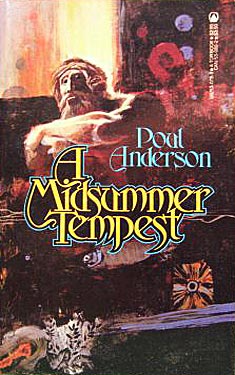
The story begins with Prince Rupert.  He’s been captured by Cromwell’s forces and is being held in a castle of one of the chief supporters of the revolution.  There he falls in love with Jennifer, the supporter’s niece.  She helps him escape with the assistance of one of Rupert’s men, William Fairweather.  In the forest, they meet Oberon and Tatiana, the King and Queen of Faeries from “A Midsummer’s Night Dream”.  They commission the humans to find Prospero’s books to help with the war against the Puritans.  Jennifer returns home only to be beaten and tortured as a whore of Satan.  Rupert and Will keep running, almost getting captured several times before they end up on a boat to Prospero’s island.  

One aspect I did like in this book was that the steam engine had been invented and there were trains crisscrossing England.  The anachronism is noted by alternate-universe-travelers whom Rupert and Will come across at the Phoenix Inn.  The encounter is comical and thankfully fairly easy to read because the travelers speak modern English.  

I didn’t find anything really special about the characters.  I didn’t empathize with any of them, although I cringed during Jennifer’s torture and abuse at the hands of her uncle.  She did have a sly mouth, but despite that, she was pretty much a stock female character.  In fact, she one of the few female characters in the book.  Rupert was not very multidimensional either.  I thought his character was boring.  Will, I liked.  Unfortunately, he’s the character with the thickest accent.  This is an example of what he says:

"Well, I too ‘ud swap theeäzam peärs an’ pomp-granites for a zingle bowl o’ hot oätmeäl topped wi’ cream an’ honey; an’ this zaber o’ miäne ‘ud liefer carve a Cheddar cheese than a traїl to glory."

Now imagine paragraphs of that.  Yeah.  And that’s just one of the accents.  Fortunately, Rupert and Jennifer speak relatively plainly, in an Elizabethan manner.  

The prose was okay.  There were occasionally sentences that would make me stop to consider why Anderson would choose that word or that sentence structure, but not always in a good way.  The world building is good, a direct reflection of the basic conceit.  

I give the book two stars out of five for the premise and the diligence with which Anderson maintained the spelling of the accents.  But it made this book tough going.  I’ve only ever read a short story of his and didn’t care for it either.  I think I’m going to have to find another novel by him eventually to give him one more chance.  I’ll be sure to do some research before I choose because he was very prolific and I want to pick one that’s supposed to be one of his better books.

Tuesday, November 16, 2021

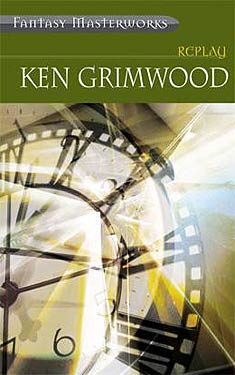
Replay

Ken Greenwood
Completed 11/12/2021, Reviewed 11/15/2021
4 stars

Very interesting book.  It’s sort of a “Groundhog Day” premise except the main character dies at 43 and goes back to age 18, over and over.  I thought it would get boring but Greenwood finds a way to keep the cycles fresh and reader interested.  The main character starts out pursuing wealth and sex and slowly grows as the cycles continue.  He develops real depth as he realizes what’s really important in life and how it all gets swept away at the end of one’s life.  This book won the World Fantasy Award in 1988.

Jeff Winston is the main character.  When he suddenly dies of a fatal heart attack at age 43, he wakes up in his 18-year-old body in 1963.  It takes him a while to realize and accept what happened until he looks in the mirror and sees his younger self.  He struggles with the idea of starting college all over again, knowing what he knows about the rest of his life.  As the first leg of the Triple Crown approaches, he realizes he knows the surprise outcome of the race and makes a bet with everything he has and can borrow.  He makes other bets on outcomes he knows and soon leaves college to become a financial wizard, investing in all the companies he knows will make it big in the coming decades.  When he dies at 43 and has to start over at 18 again, he feels like life is futile and pursues meaningless sex.  The cycles continue and each time, he makes changes to give his life some meaning, until one day, he meets someone who seems to be “replaying” as well.

There have been several stories with this “Groundhog Day” time travel trope.  I know I’ve read at least one before, but I don’t remember the title or the year it was published.  This novel may have been the first.  And unlike the movie, Jeff’s life doesn’t stop replaying when he learns the true meaning of life or when he falls in love.  There’s a twist to the replays which Jeff can’t control.  There’s even one cycle where he tries to get scientists to figure out what is going on, which of course never gets resolved.  The “replay” is a deep well of existential crisis and unforgiving despair.  And when another person gets involved, it becomes that much more complex.  

I liked Jeff’s character even though he comes across as a little old fashioned.  He’s not a chauvinist or very toxically male.  He just says things and hides his emotions in ways that you’d expect of someone growing up in the 50s and 60s.  It made it tough to empathize with him, particularly during his hedonistic replay.  But when he finally meets Pamela who is also replaying, I warmed up to him much better.  

The prose is pretty straight forward.  Unlike most fantasy novels, it’s not warm and fuzzy.  It reads almost journalistically and I found myself zooming through without getting bogged down in the descriptions.  Still, there are details that authenticate the time periods Jeff relives, making each replay that much more interesting.

I give this book four stars out of five.  It surprised me.  I really enjoyed it.  It tugged on my own existential angst, making me reflect on some of my choices in my own life.  Although at sixty, it may not be all that uncommon.  I think it does signify the strength of the book, albeit all good literature, in that it makes one look at themselves with perhaps a new perspective outside of their comfort zone.


Sunday, November 14, 2021

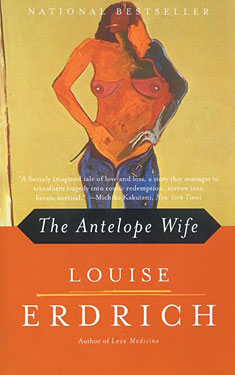
The Antelope Wife

Louise Erdrich
Completed 11/9/2021, Reviewed 11/9/2021
3 stars

This was a very tough book to read.  It has a disjointed and only slightly linear narrative.  It’s about a family of Ojibwa Native Americans over multiple generations and their relationships, myths, ancestors, and cultural struggles.  The prose is beautiful, but the book is simply hard to follow.  I started to get it about halfway through, but it took a lot of concentration.  It won the World Fantasy Award in 1999, although there is very little fantasy.  It’s more like magical realism, but even that is very tempered.

There isn’t much plot.  It’s more like a collection of stories surrounding a large family.  The book begins with a soldier fighting a tribe of Ojibwa, but deserting after killing a woman.  As he runs, he sees a dog running with a swaddled infant tied to its back.  He eventually befriends the dog and raises the child.  The child becomes an ancestor to the main characters.

Fast forward to the present.  In one scene, a trader kidnaps a woman who is part antelope.  He takes her as his wife but it soon becomes evident who the real captive is.  In another scene, we meet a family in chaos as the parents of twin girls begin separating.  In another, one of the twins moves to Minneapolis and works at a bakery owned by the man who had an affair with the twin’s mother.  She’s also searching the city for her grandmothers who also live there.  Another scene is told from the point of view of a dog, an Indian dog, who learns enough lessons to avoid being made into soup.  His name is Almost Soup.  

The prose, as I noted above, is wonderful.  Each story could almost be a standalone short piece.  Eventually, they all intertwine, but getting there is so difficult.  I was lost for a good part of the first half of the book.  Fortunately, one of the main characters, Cally, the twin who leaves for the city, does get a fair amount of narration time.  I did develop empathy for her about the same time I started to piece together who was related to whom and all the disjointed threads started to come together.  

From reading other reviews, these characters appear in other novels by Erdrich, so I might have been missing some character development and backstory.  But once I got it, it mostly made sense.  I really liked Cally and the grandmothers.  Their interactions had some humor to them.  I didn’t care for Cally’s mother.  She’s the type of person who continually makes bad choices and doesn’t get any redemption until the very end.  It was hard to read about the alcoholism of a couple of characters, particularly that of Cally’s father’s descent.  It’s not pretty and it its affect on the other characters is devastating to watch.

The whole myth of the antelope wife was kind of lost on me.  I didn’t see exactly how she related to the rest of the characters.  She appears throughout the book, but I don’t see how she affected everyone.  Mostly she brackets the book, the majority of the interaction with her taking place near the beginning of the book and near its end.  To me she was more of an observer than an influencer.  

I give this book three stars out of five.  The disjointed form was too much for me.  I didn’t like not being able to tell what the point of the book was for over half of it. It made it difficult to appreciate the prose.  I also struggle with this winning a fantasy award, as I didn’t think there was much.  I probably won’t get around to reading other books by her as most of the books about these characters are not considered fantasy at all.


Thursday, November 11, 2021

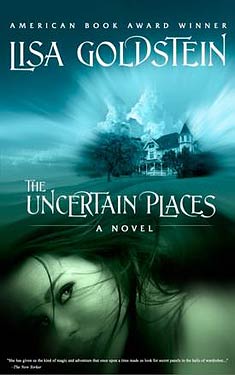
The Uncertain Places

Lisa Goldstein
Completed 11/7/2021, Reviewed 11/8/2021
3 stars

Another book about the realm of Faerie.  This one involves generations of a family where daughters are taken to fight in a never-ending war.  This book feels a little more like fluff than Thomas the Rhymer, probably because the prose is not as scrumptious and there’s a lot more action.  It also is a play on the fairy tale trope of the prince saving the princess, in this case, a young college student trying to save his girlfriend and her family from an ancient bargain with the Faeries.  It won the Mythopoeic Award in 2021.  

Will gets setup on a blind date with his roommate Ben’s girlfriend’s sister Livvy.  They hit is off and everything is going well until she falls asleep and can’t be woken.  Her family acts as if this is normal.  Will and Ben piece together that her condition is caused by a bargain made with the Faeries, as told in a lost Brothers Grimm fairy tale.  Will saves Livvy from the bargain and everything goes swimmingly until their son Nick falls asleep years later.  Then Will, Ben, Livvy, her sisters Rose and Maddie, and her mother Sylvie set off to Faerie to try to reclaim him and break the bargain.

I really liked the plot of this story. There’s a lot of action and the pace is quick and exciting.  In fact, I read this short novel in a day.  But as a consequence, the characterization suffered.  The characters feel a little wooden.  I never felt empathy for Will, despite him being the narrator.  There are times he comes across as a buffoon, thinking he can save Livvy when the family doesn’t even want her to be “saved”. And Sylvie and the sisters are all one dimensional.  Whenever Goldstein tries to introduce depth, it feels forced.  This is particularly true of Rose, who complains that she was ignored as a child because everyone thought she would be the one taken by the Faeries, not Livvy.  It feels more like a surprise reveal than a piece of who she is.

The world building is pretty cool though.  When all of them cross into the realm, it’s full of fractured fairy tale tropes.  One fun one is the frog who when thrown against the wall becomes a dashing prince who is supposed to marry the thrower.  Another more obscure but amusing one is the people who are bound to clean houses in the middle of the night for fifty years.  

Despite its flaws, I really enjoyed the book.  I give it three stars out of five, a solid good.  The complexity and pacing of the plot kept me from groaning at Will and his choices.  I really liked when they all went into the Faerie realm, even though there was a lot of info dumping there.  Having read about seven Mythopoeic winners pretty much back-to-back, I’m starting to realize what is meant by “a book written in the spirit of the Inklings”, the criteria of the award.  (The Inklings were the little society Tolkien and C. S. Lewis had with several other writers at Oxford).  It means that the book is a fantasy based on fairy tales, myth, or folklore.  I look forward to continuing my journey through the winners of the award to see if other patterns emerge.


Tuesday, November 9, 2021

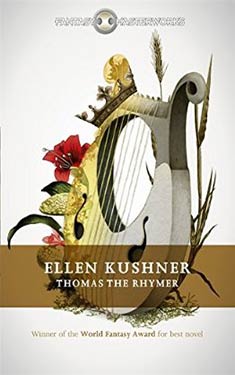
Thomas the Rhymer

Ellen Kushner
Completed 11/7/2021, Reviewed 11/8/2021
4 stars

This book is about the Elves and the realm of the Faerie.  It is based on an ancient legend of a minstrel who is taken by the Elf Queen and returned seven years later with the gift of only telling the truth.  The book is one of the most detailed accounts of going into Faerie that I’ve ever read.  It’s extrapolated from the little that remains of the legend into a surprisingly personal story.  It’s beautifully written, full of excitement and despair.  It won both the Mythopoeic and the World Fantasy Awards in 1991.

Thomas is a minstrel who shows up on the doorstep of Gavin and Meg.  Offering him the traditional hospitality of the time, the three become good friends.  Thomas comes and goes, performing his talents across the region.  In the meantime, he falls in love with Elspeth, though he does not seduce and use her like he does other women.  One day, he seduced by the Queen of Elfland and whisked away as her companion for seven years.  When he comes back, he can only tell the truth as he tries to re-establish his relationships with Meg, Gavin, and mostly Elspeth.  

With only four main human characters, the characterization is simply marvelous.  There are four chapters, one told from each of their perspectives.  So we get very three dimensional characters with whom we can empathize with.  The longest and most detailed chapter is that told by Thomas when he is in Elfland.  There, he is commanded by the Queen to only speak to her unless he is performing a song.  He longs for home, but is under the glamour of the Queen and thus deeply obsessed with her.  His time in Elfland is not without its hazards as he is much taunted and abused by her brother, only known as Hunter.  In addition, he finds a bird that cries blood tears and seems to be another human, or at least the spirit of one.  Without the ability to communicate, he tries to find a way to release the spirit to save it from the Hunter.

The elves are also well-developed, especially the Queen, as you might expect.  But one entity who steals the show is the invisible servant assigned to Thomas.  I really liked how the servant took care of Thomas and tried to protect him from Hunter.  It’s the one bit of compassion that Thomas gets while in Elfland.  It also adds a bit of humor to the story.

It took me a while to get into the story.  We spend a lot of time getting to know Thomas and the others before getting to Elfland.  And even during his time in Elfland, the pacing occasionally lost some traction.  But overall it’s a very entertaining tale.  The prose is wonderful without being overbearing.  I give this book four stars out of five.  This book was much better than Kushner’s Swordspoint, which I didn’t care for at all.  With the magic and the songs and the elves, it was just, well, a magical read.


Sunday, November 7, 2021

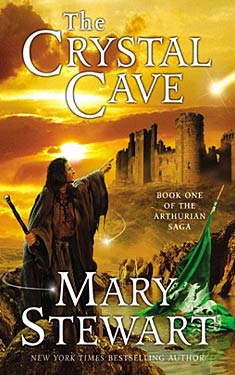
The Crystal Cave

Mary Stewart
Completed 11/6/2021, Reviewed 11/7/2021
4 stars

This was a beautifully written book, but I didn’t really care for it.  It had amazing world-building and prose, with very detailed descriptions of places and peoples and things.  However, I felt it got in the way of the story.  In addition, a lot of it was court intrigue, something I’m hot or cold with.  Here, I was cold.  This book is considered a classic though.  It won the very first Mythopoeic Award in 1971.  It has a huge following.  Perhaps if I had read it earlier in my life, I might have liked it more.  I think I may just have read too many books by authors that were inspired by this one.

The book is about Merlin’s early life, leading up to the conception of King Arthur.  Here, Merlin is presented as a bastard son of a Welsh King’s daughter.  The princess never told him or anyone who the father really was, instead weaving a tale of being seduced by an incubus.  And instead of marrying, her plan is to enter the convent once Merlin is an adult.  His uncle despises him, since he is a potential rival to the throne.  His only refuge is a hermit he meets in a cave who teaches him languages and other subjects, as well as something about his magical gift of seeing the future.  When the King dies suddenly, Merlin flees but is captured by spies from Less Britain (which I think is Brittany) and take him to see their king.  There he grows under King Ambrosius’ tutelage before returning to Wales.

The characterization is quite excellent.  Merlin is a complex character, even at the young age in which the book begins.  He does evoke a lot of pathos, as he is bullied, mistrusted, and mistreated by his family and peers.  When he finally gets to Less Britain, it is a relief to see him appreciated and fostered by their King.  He also gets answers to some of the questions in his own life.  The one thing I didn’t care for was the lack of women in the story.  There’s basically his mother and a novice at the convent.  Oh, and his nurse.  That’s it.  They don’t have much of a role except to better understand Merlin.

The use of magic was interesting.  Merlin has the ability to see the future, as well as see what’s happening elsewhere, the latter most effectively when in the Crystal Cave.  He doesn’t have abracadabra type magic.  However, he does gain notoriety as a prophet and a magician.  The reality is a lot more pragmatic.  What seems to be magic is mostly smart engineering.  I found this engrossing, particularly when moving a large rock from Ireland to Stonehenge.  Seeing the future however is much more unexplainable.  And when it happens, it is very dramatic.  

The story is based a discredited version of Merlin’s life, low in facts, but rich in storytelling.  Stewart credits this account in her book.  And it does make for a good story, just one that didn’t grab me much.  I liked when Merlin was actually doing things and engaging with other characters.  This happens more in the last third of the book, but it wasn’t enough to really hook me.  I give this book four stars out of five because I recognize that this is excellent storytelling with beautiful prose.  And I can see why it became an instant classic fifty years ago.  It just wasn’t my cup of tea.  Her second book in the series also won a Mythopoeic Award, so I will be reading that, but probably won’t read any further.


Tuesday, November 2, 2021

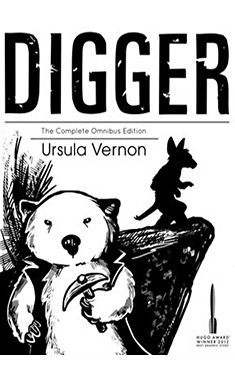
Digger: The Complete Omnibus

Ursula Vernon
Completed 11/1/2021, Reviewed 11/1/2021
5 stars

This book is a Graphic Novel series of six volumes, brought together with some additional appendices in one massive 800-page edition.  The series won the Mythopoeic Award in 2013.  I believe it’s the only GN to ever win the Mythopoeic.  It also won the Hugo for Graphic Story.  And it is a delight!  The black and white drawings come alive in this story about an atheist wombat engineer who loses her way and finds herself in a land of mythology and religion.  She ends up in a quest along side friends who were once enemies.  It’s funny, thought-provoking, light-hearted and intense.  I absolutely loved it. 

Digger is digging underground when she comes upon a gas pocket that causes her to hallucinate.  She keeps going and going until she recovers her senses.  She realizes she is completely lost and decides to dig upward.  She comes out in a temple with a large wooden statue of Ganesh that speaks to her.  She wants to find her way home, but the statue does not know where her home is.  She leaves, trying to find her way and comes upon a hyena who has been exiled from his tribe.  She convinces him not to eat her and they actually become friends.  Along the way, she also meets a small naïve demon she calls Shadowchild, an oracular slug, the tribe that the hyena is from, and an order of veiled priests.  Eventually, Digger ends up on a quest to find a way to kill a nearly dead god.

The book is very long and has lots of twists and turns.  At six volumes and twelve chapters, it’s simply packed with plot.  My above plot summary barely touches everything Digger is up against.  But the writing is tremendous.  It keeps you going even when it gets philosophical and theological.  It’s not heavy-handed either.  It flows quite naturally throughout the book.

Digger is a wombat and there are other talking animals as well.  But they aren’t just anthropomorphic characters, that is, they are not just people disguised as animals.  The wombat has wombat characteristics to her personality, the hyenas likewise.  There are humans and they are very human.  All the characters are relatable.  Digger is pragmatic and industrious, and has a knack of turning dangerous people into friends.  She is tremendous, but Ed, the exiled hyena steals the show.  He’s a tattoo artist.  He speaks primitively, compared to the other hyenas, but is friendly and loyal to a fault.  He always offers Digger warrior tea and listens to Digger’s frustrations.  Ed is a gentle soul and simply lovable.  

One of the great things about this book is that there are so many strong, multidimensional female characters, yet the male characters are also great.  There’s only one bad guy in the bunch, aside from a few demons and the guardians of the nearly dead god.  The characters have flaws, too.  They are not all Mary and Gary Sues.  Perhaps most significantly, there is a young woman who joined the priesthood at a young age but now suffers from crippling anxiety.  But even though she can barely function in dangerous situations, she is on a hero’s journey as well.  The choices Vernon made in designing these characters work amazingly well.

The world that Vernon created is stupendous.  There are gods we know, gods we don’t.  The hyenas are based on real-world indigenous Brazilian tribes and their culture and mythology that Vernon learned about in a college course.  There are also trolls which are very non-Tolkienian.  And they fit right into this amazing world.  It’s so creative, it still blows my mind as I write this review.

I give this book five stars out of five.  The story is beautiful and the art is expressive.  I fell in love with Digger, Ed, and the others and was devastated by a death near the end.  And despite the 800 pages, I wanted the book to keep going.  Fortunately, there are special features at the end, including a short story about the carver of the statue of Ganesh and guides to moles and trolls.  So you get a little more after the story is done.  But this book really had me from the start and found a special place in heart.  I highly recommend it if you can get your hands on it.  My county library system had it, for which I am truly grateful.