Wednesday, February 3, 2021

Falling Free

Lois McMaster Bujold
Completed 2/3/2021, Reviewed 2/3/2021
3 stars

My experience of Bujold is rather mixed.  I’ve loved a few of her books and either disliked or felt meh about the rest.  I’ve read eight altogether.  This one makes nine, and it’s another meh.  It has all the makings of an exciting space opera, and lord knows I have pretty mixed reactions to space opera.  I simply found it uninteresting.  I had to force my way through most of it.  This one even had a good message, but that didn’t help.  The only reason I read it is because I’m trying to finish my quest to read all the Nebula winners, which this one won for 1988.    It was also nominated for a Hugo and she was awarded a Grand Master title in 2020.  She has legions of loyal fans; I guess I’m just not one of them.

This book is about Leo Graf, an engineer who is brought up to a space facility above the planet Rodeo.  It has about 1300 inhabitants, a thousand of which are quaddies, genetically engineered humans who have four arms, two where they’re legs are supposed to be.  This gives them the ability to be very agile in zero gravity.  They are resistant to muscular atrophying and are very strong.  They are also indoctrinated to be highly skilled technicians subservient to the corporation that exploits their labor.  Leo is there to give advanced welding training to the quaddies.  He finds himself appalled that the corporation treats them as property, and eventually leads the quaddies into a revolt against their oppressors.

The characters felt two-dimensional.  I never really felt like I was in the heads of any of them.  The closest I came was to Silver, a quaddie hydroponics tech who helps lead the revolt.  She had a little more of a character arc than the rest, going from subservience to questioning in a rather realistic way.  I could never get into Leo’s head.  He’s a nice, smart guy but I couldn’t muster up any emotional attachment toward him.  And the bad guy, Bruce Van Atta, was very one-dimensional.  He’s pure, stereotypical corporate slime with absolutely no redeeming qualities.  He never questions his motives or actions.  He was so stereotypical that he became cartoonish. 

I thought the writing was sufficient: not much prose, but the dialogue was fairly realistic.  Her writing was definitely better in her later books.  The world-building was good.  The space station and the quaddies were explained well.  I bought into the premise easily.  I actually became invested in the revolt and found myself a little more interested once it happened.  But I never felt fully invested in the book.  And the message of the book is good: you can’t treat people like property or assets, even if they’re different than you, or in this case, genetically modified.

I can’t say the book is bad, just meh.  I give it three stars out of five because of the world-building, the dialogue, and the plot.  I can say that Bujold has a great imagination.  The plots of all nine books I’ve read were smart, if not ingenious.  There’s just something about her writing that often does not enthrall me.  So generally, I don’t seek her out without motivation from a challenge.  I think other people who are more into space opera might enjoy this book.  And note, even though this is fourth book in the Vorkosigan Saga, it takes place two hundred years before the stories of Miles and his mother.  If you want to read the book in order of events rather than publishing order, this would be your starting point. 

Tuesday, February 2, 2021

Dark Matter

Blake Crouch
Completed 2/1/2021, Reviewed 2/1/2021
3 stars

I really struggled with my decision of whether or not I liked this book.  It is a very fast, easy read thriller with very simply explained quantum physics.  It’s about a man who is dragged against his will into an alternate universe and when he figures that out, tries to return home.  The beginning was suspenseful.  In the middle, he enters many of the other alternate universes that were created by different decisions in his past, hoping that each door opened to his home universe.  I got pretty bored with that part.   The last quarter of the book picked up with an unexpected twist that I found quite fun.  And the ending was overly sentimental.  So I ended up with mixed feelings about it.  This was a book club in exile read, and I’m sure there’s going to be a plethora of opinions expressed, because, well, I had a plethora of reactions to it, which is a good barometer of the what the discussion will be like.

The story begins with Jason Dessen, a college physics professor who gave up his career as a brilliant researcher to have a family.  He’s married to Daniela, a brilliant artist who gave up her career to raise their son Charlie.  One night, Jason is attacked by a masked stranger who injects him with a sedative and another drug.  When he awakes, he finds himself surrounded by people he doesn’t know.  He’s not married and doesn’t have a child.  It takes him a while to figure out he’s in a different universe and his self from this universe, whom he calls Jason2, has swapped places with him.  The device for the interdimensional transport is a large box that Jason2 has developed.  He realizes this is what he would have become if he never married.  But all he thinks about is going home.  Yeah, it kind of has a Wizard of Oz vibe. 

The big problem is that the people of Jason2’s universe want to find out the truth as well as protect the secret of the box.  They will go to any length to make this happen.  After an exciting and tragic chase, he gets to the box with the company’s psychoanalyst, Amanda.  The box presents them with an infinite number of doors to alternative universes.  They visit many before they figure out that they have some effect on what’s behind each door, bringing them closer and closer to Jason’s home. 

I liked the premise of there being an infinite number of universes based on the choices someone makes.  It reminds me of a short story a friend told me about, whose title I never got, where every choice the main character made created multiple universes based on every possible choice to every action the character took.  It drove that character insane.  Jason, too, questions his sanity as he and Amanda visit all the different universes looking for the correct one.  I found it a little trite, however, that Jason makes his way back home when he’s down to his last vial of the special compound that creates the quantum effect that gets him to the corridor of doors to the parallel universes.  It’s kind of an easy plot device. 

The opening of doors to other universes started out interesting, but got tedious as Jason becomes more and more morose over not being able to find his way back home.  The author used many scenarios for the alt-unis:  post-apocalyptic, pandemic, and futuristic to name a few.  But after the first couple, I got bored with them despite the book being a fast read.

I thought the character development was okay, but nothing special.  Even though the book is written in first person present tense, I didn’t really feel like I was in Jason’s head.  I was annoyed by his bad decisions in some of the alt-unis.  There are two female characters, Daniela and Amanda.  Amanda is a little better developed than the Daniela, or most of the other characters for that matter.  She has a pretty level head on her shoulders being a psychoanalyst and has good insight into Jason.  It’s a shame when she leaves Jason, never to reappear in the book.  Her absence is definitely missed in the last quarter of the book.

The prose is fair-to-middlin’.  One of the things that makes it a quick read is that there are a lot of paragraphs that are only one sentence long.  There are no long descriptions and most of the dialogue is rather clipped.  Even the action is simply described. 

I give the book three stars out of five.  It’s not great literature. It’s not great pop sci fi.  It’s not even a great thriller really.  The writing style drives you to the end at a breakneck pace.  And that’s what makes the book not too bad.  I really toyed with giving it two stars, but in the final analysis, I was pretty entertained. 

Sunday, January 31, 2021

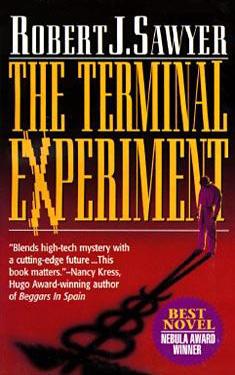
The Terminal Experiment

Robert J Sawyer
Completed 1/30/2021, Reviewed 1/31/2021
4 stars

This is my third book by Sawyer.  The first one I read, Hominids, won the Hugo in 2003.  The second was Calculating God, nominated for several awards in 2001.  This one won the Nebula for 1995.  I liked it this book, even though it’s the same kind of pop-sci fi as the first.  It’s really fast paced and easy reading.  The plot isn’t bad and it’s not quite as soapy as the first.  It also held up fairly well considering it was forecasting the evolution of PCs and the internet sixteen years in the future, which is now ten years in the past.  Primarily, the tech talk isn’t too clunky.  Overall, I found this a very entertaining book.

The plot begins with the brilliant Dr. Peter Hobson who discovers an electrical matrix in the brain that might be the soul.  This causes a worldwide sensation and has all sorts of implications.  This feeds into Peter’s obsessions with life after death and immortality, the later being something that’s being offered with very expensive nanotechnology.  So Peter uses the device he used to record the “soulwave” to map his own neural network and transfer it into a computer using AI software developed by a friend of his.  They create three entities: Spirit, which is supposed to simulate life after death; Ambrotos, which is supposed to simulate immortality; and Control, which is supposed to remain an unchanged copy of Peter.  Everything is going fine until one of the AIs murders someone.

The plot is kind of Crichton-esque, kind of poppy science fiction.  But it works.  Sawyer creates quite a thriller.  The characters aren’t bad either, not wholly three-dimensional, but fairly believable.  Peter, his wife Cathy, his brilliant programmer friend Sarkar, and the detective Sandra Philo, all have some depth, but their relationships are a bit soapy.  The three AIs are a little hard to differentiate, particularly when they are all talking with human Peter.  I think this is intentional, though, reaffirming that they are all copies of human Peter. 

Sawyer does a pretty good job of addressing the idea of morality and what kind of mind would commit murder.  Just what does it take to cross over the line between wishing someone dead and actually causing a death.  Is it Spirit who is already dead and has nothing to lose, or Ambrotos who has all the time in the world, or Control who is the most like Peter?  I found it an interesting exercise to think through these options.  I thought the reveal was a little obvious the way the characters were running through the suspects, but at the same time, it was exciting.

I give this book four stars out of five because I enjoyed it so much.  Is it great literature?  Not really, but I didn’t care.  I was caught up in the story and excited for the reveal and capture of the murderous AI.  I didn’t mind the soapy characters.  Sawyer is considered the “Dean of Canadian Sci Fi” and I can see why.  His stuff is fun, accessible, and thrilling. 

Thursday, January 28, 2021

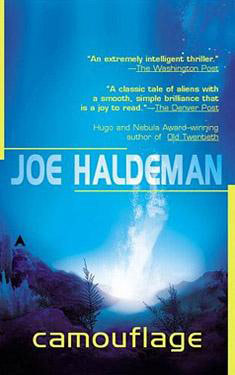
Camouflage

Joe Haldeman
Completed 1/28/2021, Reviewed 1/28/2021
3 stars

This is my third novel by Haldeman.  The first two were The Forever War and Forever Peace.  I loved the former and was mixed on the later.  This book is very different in tone and style.  I liked it, but thought it rambled in the middle.  I think it might have worked better as a novella.  It’s about two aliens on Earth for millions of years that are suddenly drawn to an artifact found by the Americans in an ocean trench in the Pacific.  The two didn’t know the other existed.  One’s a changeling, being able to change into anything, organic or inorganic.  The other is a chameleon who is only able to take on the appearance of a man.  They don’t know what the artifact is, but the chameleon decides it’s a ship back home and he’s determined that he will be the sole occupant.  This book won the Nebula for 2005 and the Otherwise Award for 2004 for its dealing with gender issues.

The book primarily follows the changeling as it changes to a human after centuries existing in the ocean, mostly as a shark.  It doesn’t remember much before that.  It comes to shore in the ‘30s, taking on the form of a teenager on the beach after killing him.  He’s uncommunicative, only slowly learning the English language.  It learns by mimicking.  Its family put him under doctor’s care because of its change in behavior, but is eventually put in an asylum.  Through all this, it picks up human behaviors and a sense of what is and isn’t acceptable.  The book continues his experiences as a human as the years go by, as a Marine who is captured by the Japanese in WWII, as a college student, and as people of different races, genders, and sexualities. 

These chapters are interspersed with the discovery of the alien artifact, a long heavy cylinder of unknown material.  The research team is primarily led by Russ, an engineer, although the project to raise it and get it to Samoa is led by Jack, a wealthy former military man.  Russ is the central character here but is surrounded by some smart men and women.  The chameleon only appears briefly, to give us a sense of his baser disposition.  Unlike the changeling, the chameleon does not learn and embrace a sense of morality as it lives among humans.  Eventually, all three meet up for the final scene in the book.

I was rather disappointed in the character development.  Despite the amount of time we spend with Russ, we only get a two-dimensional character.  He’s likeable and sensitive, but we don’t really get to know him all that well.  Most of the other characters are rather one-dimensional.  The only really development we get is with the changeling as it develops from a robotic teenage boy to an emotionally and morally developed woman.  The journey to humanness that the changeling takes is interesting in the beginning and the end, but the middle is tedious at parts.  There were times when I wished the story would just move on.  It does add to the understanding of its development and it was written well, but it became a little boring. 

I was also disappointed in the ending.  After the chameleon is introduced, I was waiting for the climactic confrontation with the changeling, but it only lasted ten pages.  I thought it would have lasted longer.  And the last paragraph had the punch of a short story ending, not that of a full novel. 

What I did enjoy was how the changeling finagled itself onto Samoa and into the research facility.  Haldeman did this by incorporating a love story.  I thought it worked well.  I can’t go into too much detail because it would include spoilers, but I thought it was well done.

I was impressed that Haldeman let the changeling take on different races, genders, and sexualities.  He did it in a very positive way, illustrating, but not beating you over the head with xenophobia issues.  Particularly, I was impressed that he let the changeling be a gay man.  He tackled that in The Forever War, but this approach was much more organic, not as shocking. 

I give this book three stars out of five.  It was well written and the plot was inventive, but the dragging of the middle part and the quick ending left me a little bothered.  I liked the book, but didn’t love it.  Of the three books, I’d rank this one between his other two.  With regards to the Nebula, I wonder if this was a career award, since Haldeman hadn’t won one yet, despite The Forever War being considered a classic of science fiction.  However, it beat out Jonathan Strange and Mr. Norrell, which I thought was a much better written book.  Well, awards are fickle, and don’t always pick the best book.

Monday, January 25, 2021

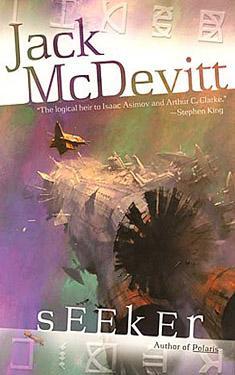
Seeker

James McDevitt 
Completed 1/25/2021, Reviewed 1/25/2021
3 stars

I haven’t read much mystery.  I’ve read a few SF/F mysteries and a few have been good, a few not so good.  This one lands somewhere in the middle.  It was entertaining and I’m quite impressed that it wasn’t just a mystery in a science fiction setting.  The plot was about the fate of missing colony ships from the Earth’s distant past, the 27th century.  There were some standard mystery tropes, like the bad people who are trying to prevent the heroes from making their discovery.  It was entertaining, but this book won the Nebula in 2006.  I would have expected a much higher caliber story and much better writing.


This is the third book about far-future antiquities dealer Alex Benedict and his assistant Chase Kolpath.  In this book, the two come upon a cup that appears to be from The Seeker, one of two ships that left Earth in the 2600’s to flee a repressive theocracy that had gained hold in the U.S.  Alex does his due diligence in making sure that the property isn’t stolen and finds that it was.  The original owners were explorers who may have come across The Seeker in their travels after retirement.  This prompts Alex and Chase to go out on their own and try to find the ship and, perhaps, the mythical Eden that they went in search of.  But someone doesn’t want them to reach their destination and will go to any length to stop them. 

The book is narrated by Chase.  She has a pretty good perspective on her job and her boss.  Alex may have the insight and the instincts, but Chase does the legwork.  We spend a lot of time with her interviewing archeologists, astrophysicists, and relations to figure out the 9000-year-old mystery of The Seeker.  Despite this, there isn’t that much character development of her or Alex.  They both seemed wooden, and many of the supporting characters were pretty standard, dare even say cardboard.

There’s a lot of dialogue in the first half of the book.  That’s what moves the plot, as more and more details of The Seeker and its mission are unraveled.  And I must say, this part was pretty good.  The action in the second half was decent as well.  I’d say, in general, that the writing was effective enough to keep me pretty engrossed in the story.  There just wasn’t anything special about it.  

There are some interesting points made about the difference between archeology and antiquities dealing.  There are people who accuse the dealers of selling out the past when it should be preserved for all.  Alex seems to be a dealer on the cusp of his own metanoia about his occupation in this book.  It would be interesting to see the development of his conscience over the course of the eight books in the series. 

There is also some discussion of xenophobia.  It turns out that after thousands of years of near and faster than light travel, humans have only encountered one alien race.  They are rather gruesome to look at and hard to understand despite their being psychic communicators.  But we are gruesome to them as well.  Over the centuries, we have had war and peace with them.  At this point in time, we are at peace.  This has been accomplished by keeping the races rather separated with preparatory training required to be able to handle being around them. 

This was not a bad book, but it was hardly worthy of an award given by other writers.  I’d call this book fluff, something fun to read, not something that has much depth to it.  Would I read any of the other books in the series?  Sure, but I have many other books on my TBR list that I’m much more interested in.  I’d recommend this book to someone who is looking for some light, fun reading, who likes mysteries, and probably would immerse themselves in the whole series.  This book can be read without reading the first two, with only passing references to things and situations from the previous books. 

Thursday, January 21, 2021

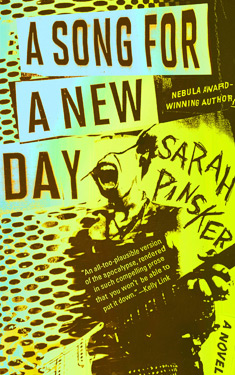
A Song for a New Day

Sarah Pinsker
Completed 1/20/2021, Reviewed 1/21/2021
4 stars

This was a prescient novel, published in 2019 and winner of the Nebula Award.  It predicts a U.S. ravaged by a plague, domestic terrorists, and predatory mega-corporations, which pretty much occurred just one year later.  It’s about the fight to get people to play and hear music live instead of virtually many years after a shelter in place edict has been instituted.  The mega-corporations help keep the mandate in place so that they can control consumerism long after the plague and the terrorism has subsided.  As a musician, I could really relate to the characters and their love of live performance and live listening, but found the fight against the shelter in place order to be a frightening read at a time when in real life, the pandemic is still escalating.  Nonetheless, I really enjoyed the book, finding it a fast-paced, exciting, easy read.


Luce Cannon is a musician who has just seen her song “Blood and Diamonds” become a hit.  She’s on tour with her band just as a sports stadium has been bombed and a highly virulent, deadly, pox-like pandemic has exploded.  The night that the shelter in place order goes out, she performs one last concert and a few of the hundreds of ticket holders actually show up.  Several years after this event, she opens a secret club for people to come to hear live music again, defying the congregation laws.  In alternating chapters, there’s a second character, Rosemary, a 24-year-old woman who lives with her parents on a farm many years after the pandemic event and works remotely for a mega-corporation, not unlike Amazon or Walmart.  She gets the opportunity to go to a virtual concert which changes her life.  She applies for a job with the music mega-corporation that puts on such concerts and gets hired as a new music recruiter.  Her job is to find the secret venues and sign on these small acts to propel them into the virtual world of superstardom.  This leads her to cross paths with Luce.

The characterization was terrific.  Both Luce and Rosemary are queer women, but on different sides of the music industry.  I thought both were fully realized and realistic.  Luce is woke and Rosemary is naïve.  There’s lots of dialogue which I also thought was very realistic.  It is mostly through the dialogue that world-building takes place, the events leading up to the shelter in place and congregation laws and the state of the world fifteen years later.  And it is through their dialogue that we experience Luce and Rosemary’s passion for music, albeit with conflicting goals. 

The prose is sparse.  It’s mostly found in the descriptions of the performances.  Pinsker really captures the concert experience from both the performer’s and the audience’s points of view.  Pinsker herself is a musician, which lends credibility to the emotions the characters have at the concerts.  As a musician and a long-time concert-goer, I can vouch for the high you get from being on either side of the stage lights, although I also had tremendous performance anxiety while Luce has tremendous performance compulsion.  Still I could relate to the rush you get from both performing and attending. 

The near-future world Pinsker created is quite plausible, dominated by interactive hoodies with virtual reality overlays.  Powerful phones are also still a thing in this world.  Drones deliver everything and the economy runs on people’s fear.  You can easily see it happening for real if corporations like Amazon and Walmart have their way.  It’s sort of like a war-time economy, requiring wars to keep the giant corporations and defense industries alive.  In this book, the mega-corporations have a vested interest in keeping everyone sheltering in place to continue reaping their profits. 

I give this book four stars out of five.  I was close to giving it five stars, but my own conflict between the book’s call for freedom versus the current, real-life call for safety kept me from totally giving into it.  I think if we were on the other side of the pandemic, I would have let myself feel Luce’s fight against repression.  I also think the book is a little simplistic in its message.  But overall, the book worked for me.  And having two queer women as main characters made for a wonderful change, especially after reading several old-school straight white male-dominated books. 

Wednesday, January 20, 2021

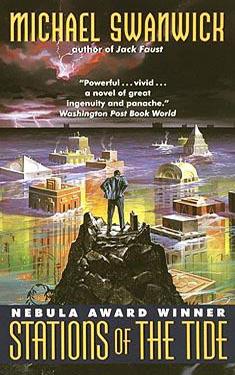
Stations of the Tide

Michael Swanwick
Completed 1/18/2021, Reviewed 1/20/2021
2 stars

I did not like this book.  I had a hard time following the action and reconciling it with what I knew of the plot from the back cover and the online blurbs.  It felt like it was a series of loosely connected vignettes with a mildly interesting premise that sort of tied it all together.  It had sex scenes which felt gratuitous.  The characterization was practically non-existent.  Ultimately, it felt like a pretentious attempt at cyberpunk crossed with the surreal neo-sci fi of the late sixties and early seventies.  It won the Nebula Award in 1991 and was nominated for a few others.


The plot was thin.  It takes place on a planet whose icecaps melt dramatically every two hundred years, flooding all but the highest mountains, leaving archipelagos.  All the people on the planet are either shipped off the planet or taken to some “island” refuge.  The main character, known only as the bureaucrat, is on the hunt for a wizard/magician who is using illegal technology.  He goes from minor character to minor character trying to find clues as to his whereabouts.  He travels with his trusty briefcase, an AI that talks to him, acts as sort of a modern phone/tablet, and can sprout legs and find its way back to him if he is ever stolen. 

The planet is known as Miranda and the plot has many similarities to Shakespeare’s “The Tempest”, or at least according to other reviewers I’ve read.  Although I’ve seen a production of it on Broadway with Patrick Stewart and a strange film adaptation called Prospero’s Books, I remember images more than the story.  So the comparison is rather lost on me (I know, shame on me and my lack of knowledge of classic literature).  I’ve also read that this book has been compared to Joseph Conrad’s “Heart of Darkness”, which I haven’t read but know some of the premise.  But given all these homages, I didn’t find anything deep or satisfying about the story at all.

The cyberpunk aspect is realized in that it’s hard to tell reality from the virtual and truth from hallucination.  There are android-type things that can take the identity of someone, acting as an agent or a double, making it hard to tell whether you’re dealing with the actual person or not.  There are the indigenous creatures of the planet, now mostly extinct, but show up as ghostly, shapeshifting entities known as haunts.  They can appear as human or as animals.  At one point, the bureaucrat is drugged and has a long hallucination with bursts of reality, complicating matters even more.

I never fully engaged with the bureaucrat, or any of the secondary characters for that matter.  The closest I came to liking a character was the witch with whom he has a sexual relationship.  I think this was because she drew some realistic emotions out of the bureaucrat. 

I give this book two stars out of five.  I found it a really tough read because of the disjointed episodes of the bureaucrat’s investigation and because of the androids popping out one, two, and in one case five copies of individuals.  This was a short book, but reading it was a trudge.  I think I was reading about fifteen pages an hour.  I think I read it pretty carefully, but found no satisfaction in the experience.  I didn’t find any layers of deeper meaning.  It was simply a surreal mess.