Friday, September 26, 2025

Together in a Broken World

Paul Michael Winters
Completed 9/25/2025, Reviewed 9/26/2025
3 stars

This is a very sweet book about young gay romance after the zombie apocalypse.  Yeah, it’s a little cliché, but it worked for me.  I was sucked in right at the beginning, and it held me enrapt through most of it.  This is no great piece of literature, but it’s a cool adventure with two gay characters who you just want to fall in love, a few wild zombie attacks, and scary militia chases.  I met the author at Seattle WorldCon and he was a very nice person.  So I picked up two of his books.  I’ll read the second one in a few weeks.  

Zach is a seventeen-year-old Seattle native visiting his uncle in Montana.  While out fishing, phone service and internet go down.  They don’t realize that a mysterious illness is sweeping through the country, killing almost everyone in two to three days.  Those that survive the illness become crazy, bloodthirsty killers.  His uncle is scratched by one and dies, leaving Zach alone.  A year later, he’s holed himself up in a bank, keeping out the remaining zombies and various militia groups trying to dominate the region.  He feels completely isolated until eighteen-year-old Aiden comes through town.  He finds out that Aiden is on a mission to deliver an ingredient for a cure from a scientific collective to researchers in Seattle.  They start to fall in love and come out to each other.  But against Aiden’s better judgement, he allows Zach to travel with him.  They both have deep secrets they are afraid to tell each other, one being the true nature of the vials Aiden is carrying.  Still, they attempt the journey from Montana to Seattle while chased by zombies, a militia group, and someone who wants to stop Aiden from delivering the vials.  

The characters are pretty well developed.  However, I rolled my eyes a lot over Zach.  He’s a junior MacGyver.  He’s a mechanical genius, knowing a ton about cars, guns, and loads of other gadgets.  He’s a little unbelievable, getting himself and later the two of them out of scrapes through the whole book.  Aiden is a little more believable, being a courier for the Collective.  He was chosen for this journey because he’s one of the few immune to the zombie disease.  

My favorite characters, though, were two others who appear along the boys’ journey.  Curtis is a mountain man type who survived the apocalypse because he was living off grid in a cabin in the mountains.  He has a small farm and trades with the few other survivors near him.  He’s also gay, having given up on the world after a devastating breakup.  And then there’s Jo, an older woman who was a mechanic at a nearby amusement park.  She survives on the stores of carnival food.  Curtis and Jo add warmth and safety to the otherwise treacherous journey.  

The form of the book is a little difficult to get used to.  The narration is by both Aiden and Zach, alternating between the two.  It’s a little disruptive at first.  After they meet, it’s roughly linear.  Occasionally I would forget which one was narrating because their voices were a little too similar.  

I thought the world building was good, and the writing was generally decent.  As I said above, this is more about sweet young love than powerful, prosy literature.  It’s fluff, but good fluff, with the gay representation you don’t often get in mainstream genre lit, although that’s been changing in the last few years. (See the amazing gay relationship episode in season one of the “The Last of Us.”)  I look forward to Winters’ other novel which is a gay haunted house romance.  I give this book three stars out of five because the entertainment value offset the faults.  I’m a romantic at heart and could read a dozen of these types of books in a row, regardless of the MacGyvers, the Mary Sues, and the sparse prose.  


Wednesday, September 24, 2025

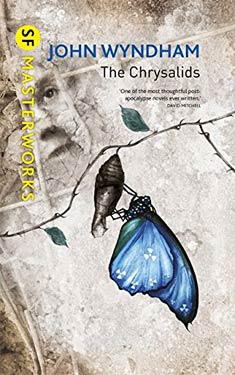
The Chrysalids

John Wyndham
Completed 9/22/2025, Reviewed 9/23/2025
4 stars

This is a golden age Sci Fi story by the man who wrote “The Day of the Triffids.”  I never read that book but the movie scared me as kid.  So when my book club selected this, I was excited.  I wasn’t disappointed.  This book was riveting for being seventy years old.  It had an immediacy that sucked me in quickly and never really let me go.  As many books are from that time period, it’s a post-nuclear war tale of mutations and survival.  Here, anyone who doesn’t have traditional body parts is a deviant in the eyes of God and must be exterminated:  humans through forced sterilization or murder and crops and livestock through burning.  But when a new variation appears in the form of telepathy, a new threat arises that must be exterminated.

David is a ten-year-old in what was formerly Labrador, Canada.  He meets a little girl named Sophie who has six toes, but hides them to avoid scrutiny and persecution from the town’s purity movement, which is led by David’s fire and brimstone puritanical father.  When Sophie is exposed, her family runs into the Fringes to save Sophie from sterilization or worse.  David is beaten for not reporting her.  This is the first time David begins to question the Purity laws and the authority of his oppressive and abusive father.  Fortunately, David has been hiding his telepathy, which he always thought was normal, but has found out he only shares it with seven other children his age.  When his mother bears his new little sister Petra with no physical deformities but a massive telepathic presence, David and his friends try to take care of and train her.  After some years, Petra announces that she can communicate telepathically with someone very, very far away.  But when the townspeople figure out that they are telepathic, David, Petra, and his cousin Rosalind run for the Fringes, while salvation seems to be coming from the very, very far island of Sealand.

While the premise is old hat for a golden age novel, I thought the execution was excellent.  I was riveted by secrecy of the telepathic children and disgusted by the Purity laws.  It felt like the red and lavender scares of McCarthyism and the brown and trans scares of Trumpism.  David’s father Joseph has no tolerance for any deviation from “God’s image,” i.e., the definition of humanity, as defined by one of the few remaining books in Labrador, “Repentances.”  Even when Joseph’s sister-in-law shows up with an infant with a very minor deformity, Joseph rebukes her and she and the child wind up dead.  It is all as heartbreaking and terrifying as the current Christian Nationalist/fascist environment today.

I was impressed by the character arcs of the main players in the story.  One of my favorite characters was Uncle Axel, David’s confidant.  He seems to be the only adult with a healthy but cautious view of life in this post-Tribulation era.  Nothing is really known of the rest of the world, but Axel believes that change is nothing to be afraid of and should be protected.  He provides David with progressive and adult support.  

There are several strong female characters, surprisingly, though the book is narrated by David.  Rosalind, his cousin and love interest; Petra, his young uber-telepathic sister; Sophie, the six-toed girl; and the Sealand woman all have insightful observations and dialogue.  Rosalind is also a kick-ass archer.  One would think that all the wisdom would come from the men considering the publication date of this book.  However, the female characters are portrayed with intelligence, strength, and dignity.

I give this book four out of five stars.  It’s a quick, exciting read.  It feels fresh despite being one of many post-nuclear apocalyptic novels of the post-WWII/Cold War era.  The prose is tight and the world-building well-defined.  Strong characterization and universal themes of competing moralities make this a worthwhile read today for its vision of a near-future full of fear of change and hatred of the other.  


Tuesday, September 23, 2025

Ruby Finley vs. the Interstellar Invasion

K. Tempest Bradford
Completed 9/20/2025, Reviewed 9/23/2025
4 stars

I don’t read many middle school YA novels, but I wanted to read something by Bradford who was one of the co-hosts of Seattle WorldCon this year.  She’s a delightful person known primarily for media criticism and short fiction featuring Black Girl Magic.  This book is a sci fi mystery featuring a young black girl who aspires to be an entomologist.  It has mysterious insect-like aliens and a cast of kids who don’t think their parents will believe their wild claims of an alien invasion.  It is a light book but still satisfying for an adult reader.   It won a 2022 Nebula for middle grade and YA novel. 

One day, Ruby finds a strange bug that is not anatomically correct.  She puts it in a jar, brings it home, takes pictures of it, and posts them on the internet asking for help identifying it.  Next thing she knows, the bug escapes from the jar by drilling a hole through the glass and getting outside by melting a hole in the window screen.  Suddenly, men in black show up looking for the insect, claiming it was an invasive species and needs to be captured.  Then all digital traces of the insect disappear.  Within a week, metal begins disappearing, like parts of chain link fences and playground equipment.  Finally, Ruby sees the strange insect grown to human size attacking the reclusive lady across the street.  Ruby and her friends call 911, but the insect isn’t found.  The lady is saved and the kids begin looking for the insect to destroy it.

Ruby is smart and sweet.  She’s a science whiz and her favorite subject is bugs.  I liked her approach to everything, being mature for her age in some things, but not others.  She felt real.  My favorite part is when she is confronted by her Science teacher who rejects her Science Fair project for being too advanced for such a young girl.  She shouts and pouts but apologizes and argues her case to the principal.  It’s a very satisfying moment in the book.  

I don’t really have much else to say about this book other than the fact that I thought it was delightful.  I didn’t feel like it would talk down to children, nor would it be too childish for adults.  It’s warm, sincere, suspenseful, comical, and endearing.  I give this book four stars out of five.  


Sunday, September 21, 2025

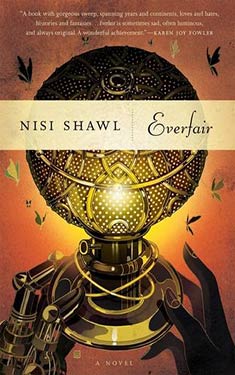
Everfair

Nisi Shawl
Completed 9/18/2025, Reviewed 9/21/2025
4 stars

I really wanted to love this book.  It has an awesome premise.  It’s an alternate history of Belgian Congo colonization where a group of people acquire part of the territory from Leopold II and try to turn it into a haven and utopia for the native peoples, the slaves of Belgium, the slaves of the US, Chinese forced laborers, and white people from Europe and the US.  Their economy is based on steam and dirigibles.  And they all fight against the oppression of the colonizers.  Unfortunately, the book suffered from too many characters, POVs, and jumps in the timeline.  While I liked many characters, I found it hard to love and empathize with them.  Still, the book is impressive for the topics it tackles, the grand sweep of alternate history, and the detail of the characters’ personalities.  This book was nominated for a 2016 Nebula Award, among others. 

Lisette is a young Belgian woman who has fallen in love with a man who is part of the Fabian society.  The Fabians join with missionaries to purchase land in the Congo from the despotic Leopold II.  Lisette finds out that her amour actually has a wife named Daisy, another lover, and several children.  Nonetheless, she enters this little non-traditional household.  They move to the acquired land in the Congo, which they call Everfair and begin to found a new country.  Tink, a Chinese man and tinker, helps Everfair with his amazing mechanical talent, creating metal prostheses for people who have lost limbs to Leopold’s cruelty and creating an engineering infrastructure for the country through the use of steam.  There is the king and queen of a local tribe.  There is Martha, the missionary, though black, tries to impose Christian doctrine and principles on the population.  Through changing POVs, the story follows their progress keeping the forces of Leopold out, enhancing their own society, and dealing with the outside world from the late 1800s through World War I.  

My biggest problem with the book was that the characters were all richly developed.  However, because the book followed so many POVs, it was hard to completely empathize and feel intimate with them all.  The closest I came was with Lisette, particularly when her lover goes back to Europe with his other lover and his youngest son, she finds solace in Daisy.  The two women have a short affair, but events separate them physically and emotionally.  Still, they both end up being founding mothers of Everfair.  Tink was also intriguing, building the dirigibles and all the prosthesis limbs.   He falls in love with One of Daisy’s daughters, causing ripples in their society over their interracial relationship.  The same goes for Daisy’s son George who falls for the older black missionary Martha.  Despite Martha’s initial protestation, they marry.  The King and Queen were also interesting as they come to grips with a modern society over their traditional African tribal society.  

Despite trying to have a utopian society, there is still systemic racism present.  There’s the cringeworthy effort by Daisy to establish a national holiday for a white, British man who was one of the architects of Everfair.  There are the interracial relationships between Africans, Europeans and Americans, and the Chinese laborers that are met with varying degrees of acceptance and disdain.  There’s Martha’s efforts to establish Christianity among the “heathens”.  Lastly, there is the adoption of English as the national language rather than a local language.  

Still, the book is an incredible fifty or so year epic boiled down to a little under four hundred pages.  Did Shawl bite off more than she could chew here?  Perhaps.  However the prose is sumptuous without being pretentious, the world building amazing, and the alternate history sweeping.  I give the book four stars out of five because it is better than a three star “good” but lacking the emotional response I get from five star books.  I saw and spoke with Shawl a few months ago at Seattle WorldCon.  She’s sharp and witty.  I know she is more known for her short fiction, but I wanted to try her first novel.  I will read the sequel in a month or so, but I also want to find her short works as they are regarded so highly.


Thursday, September 11, 2025

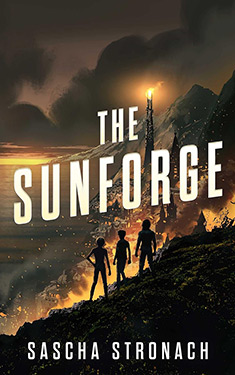
The Sunforge

Sascha Stronach
Completed 9/10/2025, Reviewed 9/10/2025
2 stars

Ugh, I did not enjoy reading this book.  It is a mess of characters and mangled plots.  Reading the first book in the series, The Dawnhounds, only barely prepared me for this one.  Despite the fact that I only read the first book about month ago, I had the damnedest time trying to cognitively get from the end of that book to this one.  The timelines jump all over the place, new characters are introduced, and most of the chapters are so short, I wasn’t able to sit with any one plotline long enough for it to stick in my head.  The end has big flashback reveals that help piece together the world building, but it was too little too late.  I wanted to DNF this book so many times in the five days it took to read it.  I’m glad I kept with it though because now I can give an honest review.  This book is a 2025 Lambda Literary Award nominee.  If I was voting, it wouldn’t have been on my shortlist.  

Yat was the main character of the first book.  Here, she has been taken over by a god.  Sometimes Yat speaks, sometimes the god speaks.  This was something I did not put together for a long time.  It wasn’t until late in the book that I realized the two were fighting for control over Yat’s body.  I’m not positive, but I think Yat was located on the Kopek, the lesbian pirate ship from the first book.  Here it is stuck in port as there is a blockade by an invading enemy.  This enemy also has some kind of microwave weapon that burns anything in its rays’ paths.  The weapon nearly destroys the capital city.  Sen was previously a major character who was searching for Yat.  Here, he’s trying to help save the country with Kiada, another pirate.  They band with Ari, a thief and black-market dealer, to help stop the invading army as well as someone named Auntie, who is also know as Spider.  Amidst all the fighting, there are dopplers, which I eventually figured out are android doppelgangers.  They were supposed to be helpers but now seem to be nearly sentient soldiers in the battle to obliterate the city and the country.  

The main characters in this book are Kiada, Sen, and Ari.  Perhaps the most confusing character arc was Ari’s.  His story begins a few years before the rest of the action.  He’s interspersed between chapters in the present to catch us up on him.  I found this very confusing.  The chapters were short, so just as I was getting what was going on, the POV would change in the next chapter.  Eventually, I came to like his character.  He seemed like a sweet young man who was just trying to survive.  The best part of his arc is that he interacts with a very young woman who turns out to be a sixteen-year-old boy.  He helps the boy establish manhood while still keeping his secret so he can present as a woman.  They both fight the invading enemies, helping the local population acquire such things as food and medicine.  

I was rather impressed with the last third of the book.  Some major characters give their back story, revealing they have lived a very long time, back to the apocalyptic event that got the world to where it is now.  While this revelation was too long in coming, it did help me put together some of the pieces of their relationships and motivations.  Up to that point, I was so lost, I nearly put the book down for good at least once a day.  

I give this book two stars out of five.  I don’t like not having any idea what’s going.  Having a lot of characters compounds that dislike.  The payoff in the end was interesting, but not good enough to have made it a satisfying read.  This book ends in a more obvious cliffhanger than the first.  I knew this was supposed to be a trilogy, but it made me angry anyway.  I have no intention of reading the next book.  I can’t imagine putting myself through this again.  


Saturday, September 6, 2025

The Other Valley

Scott Alexander Howard
Completed 9/6/2025, Reviewed 9/6/2025
3 stars

This is an interesting time travel story.  The premise is that there’s a self-contained valley where the narration is taking place.  To the west, there are an infinite number of identical valleys, each 20 years in the future from the previous valley.  To the east, the infinite valleys each go back 20 years into the past.  Because travel between the valleys is possible, there is a Conseil and a heavy guard presence to prevent such travel.  However, they do allow people to petition to visit the past or future if the reason is good enough, usually mourning.  This brings up a whole bunch of unresolved questions about the world building.  However, the story is good enough to balance out the negative issues.  

Odile is an aimless, shy sixteen-year-old who tries to get accepted into the Conseil apprentice program.  She has a small group of friends, one of which, a brilliant composer and violinist named Edme, may have a crush on her.  One day at the park, she accidentally sees people on a mourning tour.  She recognizes them as Edme’s parents, indicating that Edme dies in the near future.  After the accompanying gendarme spots her, he whisks the parents off.  Shortly after that, Edme’s parents demand unreasonable curfews on him.  She reports this to her apprentice program instructor who tasks her with keeping an eye on Edme and his parents to make sure they don’t interfere with the inevitable.  The inevitable happens and she is thrown into despair.  She becomes a gendarme instead, hoping to never have to deal with such an issue again.  However, such opportunities keep popping up, throwing her into continual cognitive dissonance over the restrictions on interfering with the past and future.  

The first major issue I want to point out is that the author does not use quotes to signify dialogue.  This makes reading difficult, as the reader must constantly be on guard for dialogue blending into Edile’s first person prosy narration.  It makes for a cumbersome experience, requiring care while reading.  I really hated this throughout the book.  

The second issue I had was that the character names, occupations, and places are French.  No explanation is given for this.  The author is not French and the country within which this takes place is not given (France or Canada or some other French-speaking location).

Third, the valley is self-contained and self-sustaining.  However, they have cars, trucks, and buses without factories; food without mention of farms and ranches; and power without gas or electricity generation.  You get the impression that this is not a big city but rather something suburban.  Where do they get all this from?

Lastly, I never felt connected to Odile.  She’s distant and stoic, almost to the point of severe social anxiety.  When she makes friends, it’s more like they make her their friend.  Her narration is cold and unfeeling, as is my response to her.  She doesn’t get that Edme likes her, or why her friends are her friends.  But rather than feel sorry or develop empathy for her, I remained distant.  I was fortunate that I found the story and the potential for time crises engaging.  This isn’t to say that the story is fast paced.  In fact, it’s a slog at the same points where she herself is slogging through life.  On the other hand, it is the methodical distancing from human emotion that makes Odile a good candidate for a position on the Conseil.  She would be able to make wise travel decisions for petitioners based on reason rather than emotion.  

What kept me engaged were the themes.  The one most at play for me was the cognitive dissonance of doing what is expected from society, i.e., allowing bad things to happen versus disrupting the social order and timeline to take action to prevent them.  Should a future self visit the past to prevent herself from marrying an abusive man?  Should Odile allow Edme’s best friend Alain return to the past to stop his death?  Doing such things wink the future into a different reality.  Is that the right thing to do?  

I give this book three stars out of five.  I liked it but wasn’t engaged enough to read this relatively short book quickly.  I liked the ending, but that’s just the last five percent of the book.  And the unanswered questions of the closed valley kept nagging at my brain.  Where does the food come from?  Who makes the clothes?  Is the whole world set up like this or is this an isolated situation?  Too many unanswered questions to allow myself to be fully immersed.  I get the sense that Howard’s work falls more under the category of generalized speculative fiction than traditional or even contemporary science fiction or fantasy.  Still, this being his first novel, I’d be open to reading something else by him.  


Monday, September 1, 2025

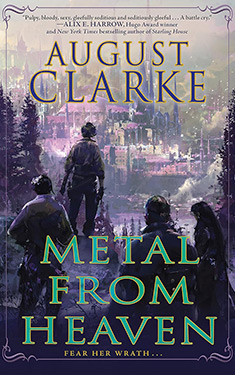
Metal From Heaven

August Clarke
Completed 9/1/2025, Reviewed 9/1/2025
3 stars

Blurbs about this book say, “If you like Gideon the Ninth and Princess Bride, you’ll love…”  Well, I hated the first, loved the second, so I went in hesitantly.  The Princess Bride similarity was the obsessive devotion of the main character to her childhood love.  The Gideon the Ninth similarity was the incomprehensibility of what was going on.  A lot happens to Marney, the main character.  Through it all, she keeps her eye on the prize: revenge on the magnate who ordered the shooting into the crowd of protesting factory workers, killing her whole family and her lover.  Unfortunately, this plot takes a wild, meandering road to achieve its climax.  And then the book gets weird.  Some found this book brilliant.  I found it confusing yet strangely intriguing.  This is another 2025 Lambda Literary Award nominee for Speculative Fiction.  I don’t find this book particularly worthy, but it feels like the author really, really tried their best.

The book begins with the massacre at the protest.  Marney, age thirteen, is the only survivor.  She goes into hiding and meets up with strangely considerate train robbers.  They take her with them after she liquifies the hinges on the engine’s door, helping the robbers.  The robbers turn out to be a giant clan of brigands and pirates that have made a distant barony their home.  They’ve killed the baron and his heir, but have been acting as if they were alive to outsiders, communicating with other baronies and kingdoms as the baron, the introverted, isolationist luddite.  They train Marney as a brigand in their utopia.  Eventually a call goes out that the mining magnate, Yann Industry Chauncey, wants to marry off his heir.  The brigands come up with a plan to send Marney as the heir of their own barony to trick the magnate’s daughter into marrying Marney so that Marney can murder Chauncey and prevent the invasion of the barony by Chauncey’s company.  

The book is narrated by Marney.  She is a very unreliable narrator.  She is obsessed with revenge on Chauncey.  At the same time, she still holds a devotion to her murdered lover.  Marney also talks to someone in second person.  It sounds like she’s breaking the fourth wall, talking directly to the reader, using “you” as she speaks.  But it quickly becomes apparent that it’s her lover.  The transitions between narrating first person and then speaking directly to her lover/the reader are jarring.  In fact, most of the transitions between scenes are jarring and hard to follow.  That’s my biggest complaint with this book, it was very hard to follow.  For three pages, you may be in one scene, then in the next paragraph, the scene changes or the prose begins flowery expounding on something not in the previous scene.  It often made the book confusing and often tiring.  I regularly didn’t know what was going on.  Add way too many characters I didn’t care about and, Voila! I’m swimming in comprehendible prose. 

The myriads of characters and Marney’s laser focus on her revenge made hard work of finding differentiation between everyone.  The brigands are a rowdy bunch of hot butch lesbians who all blend with each other.  I could remember some of the names, but not much about them.  And her tenure with the brigands takes up half the book.  During that time, she becomes known as the Whip Spider, a very successful train robber, and a full member of the commune of brigands and pirates, known as the Choir.  It is basically a lesbian utopia full of very strong, powerful women who work hard and love harder.  Collectively it’s very interesting.  However, I found it hard to remember who was who and who Marney was sleeping with.  It even had me wondering if this should have been the whole of this book, the bringing up of Marney as a brigand, and the revenge part left to a sequel.  

When we finally get to the revenge part, we’re introduced to a whole new set of characters: the friends, lovers, and suitors of Yann I. Chauncey’s heir.  Gossamer, aka Goss, is about the same age as Marney is now, early to mid-twenties.  She is Chauncey’s adopted daughter.  Marney poses as the daughter of the murdered baron from the commune.  She wears lots of clothes to hide her tattoos that would identify her as non-aristocratic.  She plays the game that is expected of her, claiming to fall in love with Goss.  Through this process, though, she has hot, steamy sex with Goss’s friend who sees through Marney’s disguise.  They establish a sexual relationship during the courting process with Goss.  This makes for all sorts of confusion as we are not sure who the other characters are hooking up with.  Like the brigands and pirates, these mostly lipstick lesbians blend together, making the competition for Goss’ hand a very chaotic read.  

Another aspect of the book I had trouble with was the glorious prose.  It is very flowery and provides fantastic world building, but it is also very disruptive.  It makes following the plot exhausting.  Yes, the world is in late-stage capitalism with Chauncey’s magical metal mining and manufacturing monopoly, filled with different subjugated peoples and their religions.  War is looming between baronies for the acquiring of land by Chauncey for more mining of ichorite.  The workers are oppressed.  Some of them who started mining as children, like Marney, absorb too much ichorite and are slowly poisoned, becoming allergic to it, but also developing the magical ability to control the metal.  But the descriptions of all of this and the exposition providing the back story of everyone and everything is simply overwhelming.  

I give this book three stars out of five.  It’s sort of a compromise between being a five-star book for imagination and the amazing world building, and one star for being nearly incomprehensible and frustrating.  The book consists of very long paragraphs.  Everyone thinks, acts, and speaks in meandering soliloquies.  Any back-and-forth dialogue is accompanied by paragraph long asides.  As intrigued as I was by everything going on, I had a tough time picking the book up each day.  And worst part was I never felt like I knew who Marney and the large cast of characters were.  Despite being narrated by Marney, I never felt engaged with her.  There are twists and wild turns which keep you going, but it is a struggle.  There is also some gender fluidity as some women are called “he” at various times.  Even Marney is occasionally called he.  And the end is nearly incomprehensible.  I think I got it but it was very esoteric.  I believe this is another book which stands a good chance of winning the Lammy this year.  However, it would not be one of my top picks.  Props, though, to the author for trying to create a powerful and unabashedly lesbian masterpiece.