Sascha Stronach
Completed 8/20/2025, Reviewed 8/20/2025
2 stars
This book is being touted with: If you loved Gideon the Ninth, you’ll love this. Well, I hated Gideon and its sequel Harrow the Ninth. I didn’t quite hate this one, but I certainly didn’t like it. I found it a confusing, overwrought, noir fantasy/sci fi with mind-boggling magic and technology. I was looking forward to this for its basis in Māori culture, its queer protagonist, and women pirates. Unfortunately, I was lost through most of the book, only putting together the main plot in the last fifty pages or so. Even so, I didn’t get who all the characters were, what their relationships with each other were, and what their journeys were throughout the book. This book is the first of a series, the second of which is nominated for a Lammy this year for LGBTQ+ Speculative Fiction. I read this so that I would understand the main characters and world building enough to not be lost next time. Considering how lost I felt in this book, I only hope it will be enough to appreciate the sequel.
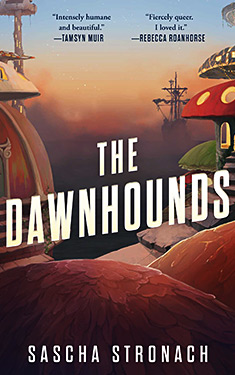
Yat is a cop who is demoted because she was found in a gay bar. Queer people are seen as degenerates that undermine the provisional post-war government. While walking along the river, she is killed after finding a dead body there. However, she comes back with special powers that enable her to draw and use energy from other people, mycelium-based houses, and spore-created monsters. Like other readers and reviewers, I understood mycelia (mushrooms) a little from Star Trek: Discovery. After nearly killing the one sergeant that more or less has her back, she goes off alone, meets up with some lesbian pirates, and confronts spore-based monsters bent on destroying the city.
Yat is a typical anti-hero. She’s a drug-addicted, self-destructive cop trying to be honest in a corrupt system. She hates herself for being gay. It’s not until she meets up with the pirates that she sees healthy relationships between women. She almost kills Sen, her sergeant, which makes her run from the police force, especially since she’s already on the outs because of her sexuality. There are a lot of chapters devoted to Sen, but I didn’t quite get him as much as I thought I should have from the narrative. I think I liked him, as he goes in search of the runaway Yat, not as a cop, but as her friend. I kind of liked the pirates, including Ajat who is in an open, loving relationship with another woman, and Sibbi, the female captain. Unfortunately, the narrative was very hard to follow, so I didn’t always catch the changes in character focus. I’m pretty sure I confused the background of many of the characters because of this.
The prose was generally rich, just very convoluted. I didn’t get most of the Māori references and was confused by the ethnic mix of the characters. It seemed that most of them were not Māori, though this may be more representative of the diversity of people in New Zealand, the author’s home. I guess I was looking to be educated about the culture, more like Rebecca Roanhorse’s “Beneath Earth and Sky” series, the first book of which was Black Sun, featuring a pre-Columbian culture. This book is compared to Roanhorse’s as well, but it was a far cry from it.
I give this book two stars out of five. I think it would have benefited from more beta reader feedback and editing. I’m not impressed by the number of reviews that tout, “I loved this book even though I didn’t understand a thing.” That doesn’t do it for me. And I don’t always appreciate the noir subgenre. This book was an intersection of too many things that push bad buttons. However, the prose and the fact that I more or less got the mycelium-based magic system in the end saved this book from a one-star review. Hopefully, I’ll be more prepared for book two.

No comments:
Post a Comment