Eric Flint
Completed 8/11/2025, Reviewed 8/14/2025
3 stars
This book left me with a feeling of cognitive dissonance. I was torn between the interesting premise and the great, tough, female characters versus the slimy national populist ideology where America is so great that it has the answer to all of history’s problems. I’ve read that Flint identifies as liberal and there are very strong elements of that in the story. But it also has a strong manifest destiny theme that left me uncomfortable in my own skin. It’s basically a military SF story and lots of enemies are slaughtered as the main characters protect their land.
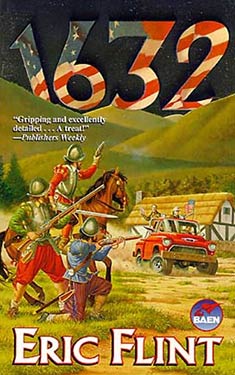
So in the year 2000, a whole coal mining town in West Virginia is fantastically transported to the middle of the Thirty-Year War in a part of the Holy Roman Empire in 1632, apparently due to alien intervention. Completely stunned, the people of the town soon figure out that they are in the past in German land. First, they rescue an older Jewish doctor/philosopher and his headstrong daughter from some soldier-brigands. When they come to realize where and when they are, they begin to fortify the town and try to figure out how to survive by generating their own food and energy for electricity and vehicles. As they encounter the local peasants, they become known as a refuge from the war, taking in many Germans and many soldiers fighting for the King of Sweden, who is seen as a good ruler. Integration and intermarrying begin, to the dismay of some of the rich, right-wing residents. The town declares itself as the United States, although it only has one state, and is tasked with naturalizing all the refugees and soldiers who’ve immigrated into the city. They also must defend themselves against the armies of the Holy Roman Empire to maintain their independence.
The bright spots of the book are the main characters. There’s miner Mike, the likeable leader who soon becomes president. He realizes the necessity of war and the wiping out of the huge, attacking HRE armies, while trying to keep the town a bastion of peace and equality. He falls in love with the Jewish woman he saved, Rebecca, who is a strong, brilliant, independent woman, who believes in the values of living in a democracy of diversity and equity. She takes to modernism with little convincing, even hosting her own TV talk show about topics affecting the town. Jeff is a virtuous young man who marries Gretchen, the resilient soldiers’ camp prostitute, to save her and her family from her fate. James Nichols is the only black character. He’s a brilliant doctor who came from a life of crime as a young man, and falls for the town radical activist and teacher, Melissa. And we can’t forget Julie, the cheerleader who is the best sniper ever. So yes, I guess they are all Mary Sue’s (as other reviewers have pointed out), but I liked them. They had good character arcs. I also need to note that there were strong, rich, businessmen who spend their time trying to make policy to Americanize the refugees in a right-wing, exclusionary way. This causes some conflict as the town tries to determine how to govern themselves.
I enjoyed the parts of the story which described how the town figures out how to survive in the 17th century. I like the interaction with the UMWA, the mine workers’ union, which helped employ many refugees to make them feel part of the town and help them rise above peasant status. This survival tale is interspersed with scenes from the outside kings, cardinals, and generals who try to figure out what these strange Americans are and how to stop them from interfering with their attempts to control this part of Germany. This all leads to a major showdown between multiple armies and the Americans.
As I noted above, the part that got to me was the massive number of casualties and the rah-rah patriotism that accompanied the slaughters. That’s what made me feel slimy, particularly with Julie the sniper and her cruel, focused assassinations. All the battles were very one-sided as the Americans had modern weapons and vehicles while the invading armies had horses and buckshot rifles with little accuracy. Their main advantage was their determination to slaughter the Americans, particularly by the Croat army.
I give this book three stars out of five. It’s entertaining but also disturbing for all the violence. I did appreciate that the Americans were open to learning German and didn’t force all the Germans to learn modern English. It was a reciprocal effort. The freedom of religion, including acceptance and integration of the Jewish people, was significant in this war which emphasized the conflict between Catholics and Protestants. There were parts of the book which surprised me for its left-leaning decisions and other parts that disturbed me for its slaughter at all costs for survival. This balances out to a middling rating. I probably won’t read any of the other books in the series, which I believe is at seventeen, but I’m glad I got the chance to read this book for my book club, even though I missed the meeting to attend Seattle WorldCon.

No comments:
Post a Comment