August Clarke
Completed 9/1/2025, Reviewed 9/1/2025
3 stars
Blurbs about this book say, “If you like Gideon the Ninth and Princess Bride, you’ll love…” Well, I hated the first, loved the second, so I went in hesitantly. The Princess Bride similarity was the obsessive devotion of the main character to her childhood love. The Gideon the Ninth similarity was the incomprehensibility of what was going on. A lot happens to Marney, the main character. Through it all, she keeps her eye on the prize: revenge on the magnate who ordered the shooting into the crowd of protesting factory workers, killing her whole family and her lover. Unfortunately, this plot takes a wild, meandering road to achieve its climax. And then the book gets weird. Some found this book brilliant. I found it confusing yet strangely intriguing. This is another 2025 Lambda Literary Award nominee for Speculative Fiction. I don’t find this book particularly worthy, but it feels like the author really, really tried their best.
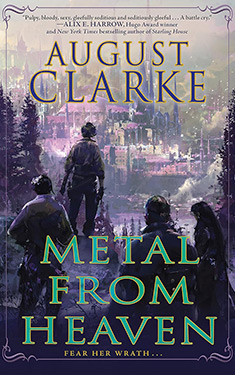
The book begins with the massacre at the protest. Marney, age thirteen, is the only survivor. She goes into hiding and meets up with strangely considerate train robbers. They take her with them after she liquifies the hinges on the engine’s door, helping the robbers. The robbers turn out to be a giant clan of brigands and pirates that have made a distant barony their home. They’ve killed the baron and his heir, but have been acting as if they were alive to outsiders, communicating with other baronies and kingdoms as the baron, the introverted, isolationist luddite. They train Marney as a brigand in their utopia. Eventually a call goes out that the mining magnate, Yann Industry Chauncey, wants to marry off his heir. The brigands come up with a plan to send Marney as the heir of their own barony to trick the magnate’s daughter into marrying Marney so that Marney can murder Chauncey and prevent the invasion of the barony by Chauncey’s company.
The book is narrated by Marney. She is a very unreliable narrator. She is obsessed with revenge on Chauncey. At the same time, she still holds a devotion to her murdered lover. Marney also talks to someone in second person. It sounds like she’s breaking the fourth wall, talking directly to the reader, using “you” as she speaks. But it quickly becomes apparent that it’s her lover. The transitions between narrating first person and then speaking directly to her lover/the reader are jarring. In fact, most of the transitions between scenes are jarring and hard to follow. That’s my biggest complaint with this book, it was very hard to follow. For three pages, you may be in one scene, then in the next paragraph, the scene changes or the prose begins flowery expounding on something not in the previous scene. It often made the book confusing and often tiring. I regularly didn’t know what was going on. Add way too many characters I didn’t care about and, Voila! I’m swimming in comprehendible prose.
The myriads of characters and Marney’s laser focus on her revenge made hard work of finding differentiation between everyone. The brigands are a rowdy bunch of hot butch lesbians who all blend with each other. I could remember some of the names, but not much about them. And her tenure with the brigands takes up half the book. During that time, she becomes known as the Whip Spider, a very successful train robber, and a full member of the commune of brigands and pirates, known as the Choir. It is basically a lesbian utopia full of very strong, powerful women who work hard and love harder. Collectively it’s very interesting. However, I found it hard to remember who was who and who Marney was sleeping with. It even had me wondering if this should have been the whole of this book, the bringing up of Marney as a brigand, and the revenge part left to a sequel.
When we finally get to the revenge part, we’re introduced to a whole new set of characters: the friends, lovers, and suitors of Yann I. Chauncey’s heir. Gossamer, aka Goss, is about the same age as Marney is now, early to mid-twenties. She is Chauncey’s adopted daughter. Marney poses as the daughter of the murdered baron from the commune. She wears lots of clothes to hide her tattoos that would identify her as non-aristocratic. She plays the game that is expected of her, claiming to fall in love with Goss. Through this process, though, she has hot, steamy sex with Goss’s friend who sees through Marney’s disguise. They establish a sexual relationship during the courting process with Goss. This makes for all sorts of confusion as we are not sure who the other characters are hooking up with. Like the brigands and pirates, these mostly lipstick lesbians blend together, making the competition for Goss’ hand a very chaotic read.
Another aspect of the book I had trouble with was the glorious prose. It is very flowery and provides fantastic world building, but it is also very disruptive. It makes following the plot exhausting. Yes, the world is in late-stage capitalism with Chauncey’s magical metal mining and manufacturing monopoly, filled with different subjugated peoples and their religions. War is looming between baronies for the acquiring of land by Chauncey for more mining of ichorite. The workers are oppressed. Some of them who started mining as children, like Marney, absorb too much ichorite and are slowly poisoned, becoming allergic to it, but also developing the magical ability to control the metal. But the descriptions of all of this and the exposition providing the back story of everyone and everything is simply overwhelming.
I give this book three stars out of five. It’s sort of a compromise between being a five-star book for imagination and the amazing world building, and one star for being nearly incomprehensible and frustrating. The book consists of very long paragraphs. Everyone thinks, acts, and speaks in meandering soliloquies. Any back-and-forth dialogue is accompanied by paragraph long asides. As intrigued as I was by everything going on, I had a tough time picking the book up each day. And worst part was I never felt like I knew who Marney and the large cast of characters were. Despite being narrated by Marney, I never felt engaged with her. There are twists and wild turns which keep you going, but it is a struggle. There is also some gender fluidity as some women are called “he” at various times. Even Marney is occasionally called he. And the end is nearly incomprehensible. I think I got it but it was very esoteric. I believe this is another book which stands a good chance of winning the Lammy this year. However, it would not be one of my top picks. Props, though, to the author for trying to create a powerful and unabashedly lesbian masterpiece.

No comments:
Post a Comment