Wednesday, May 28, 2025

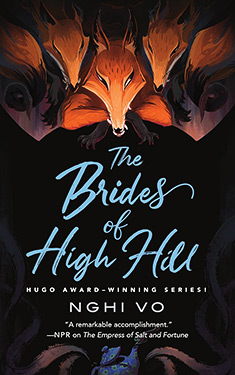
The Brides of High Hills

Nghi Vo
Completed 5/27/2025, Reviewed 5/28/2025
3 stars

I was rather meh on this fifth novella in The Singing Hills Cycle.  It didn’t grab me until the end.  The beginning was rather muddled, although I realize that was intentional, as our favorite non-binary Cleric Chih is also muddled in this short adventure.  The previous three novellas, including the wonderful Mammoths at the Gates, were all much more lovely and interesting.  Nevertheless, the prose was gorgeous and Chih is such a wonderful character.  This novella was nominated for the 2025 Best Novella Hugo Award.

The story begins with Cleric Chih accompanying a family caravan on the way a rich ruler’s estate to their daughter to the ruler.  When they arrive, things are not as they seem.  There is no information about what happened to the ruler’s previous wives.  The ruler has a son who seems quite out of his mind, though he seems to try to communicate to Chih and the daughter.  As the three-day courtship progresses, things get stranger and stranger until Chih is certain the daughter and her family are in mortal danger.

While I was excited to be back in the Singing Hills setting, I was disappointed by the first half or so of the book.  As I said above, it felt disjointed.  However, I guess it was necessary because we are experiencing this book from Chih’s perspective (from a third person narrator) and they are confused by this arrangement as well.  In fact, Chih doesn’t remember how they came upon the family caravan in the first place.  Chih’s neixin, Almost Brilliant, is missing from the story as well.  Chih (and I) regulary notices the spirit-bird’s absence from their shoulder and the lack of banter and insight.  However, Chih is intrigued by the daughter who is afraid of ghosts and bad spirits and this ruler’s estate seems chock full of them.

I finally got through the first half of the book when the plot starts to take turns, resulting in a big twist ending.  It was very satisfying, but not enough to give this book a higher rating.  I give it three stars out of five.  I really like Vo as a writer, from this cycle of novellas to her novels like Siren Queen.  Each book has beautiful prose and great world building.  But like most authors, not every book is a winner.  Still, I look forward to her releases and probably will continue reading her output for the foreseeable future.


Monday, May 26, 2025

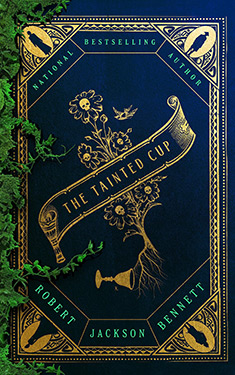
The Tainted Cup

Robert Jackson Bennett
Completed 5/26/2025 Reviewed 5/26/2025
4 Stars

I was very surprised by this book.  It’s a murder mystery wrapped in a fantasy world with giant sea creatures which attack the city during the rainy season.  I think this is the first murder mystery I thoroughly enjoyed.  I was able to follow the progression of the investigation, was surprised by the big reveals, and really liked the two main characters.  The world building is great, although the names of the cities, regions, and other characters had me a bit confused at times.  Many times during murder mysteries, regardless of the genre or setting in which it takes place, I get lost in the details.  There was just something about the way this book was written and the premise of the investigators that kept me from getting lost, and kept me completely engrossed.  This book is nominated for a 2025 Hugo Award.

Dinios Kol is an engraver, a person altered to have an eidetic memory through the use of scents to record and play back the information in his mind.  Recently commissioned, he is apprenticed to Ana Dolabra, a disgraced investigator, to find the murderer of an influential military leader.  His death was due to contagion of plague spores that rapidly grow trees out of a person’s body.  It’s a quick but exceedingly painful death and the spores can proliferate rapidly in a humid environment.  Dinios is perplexed by his employer, a goofy woman who needs to be blindfolded to avoid too much visual stimulation from her environs.  So Dinios does the legwork and Ana puts the pieces together.  When ten engineers are found to have died the same way, shortly before a leviathan from the sea attacks the city, the mystery explodes into huge investigations, putting Dinios and Ana’s lives in danger.  

Dinios is a wonderful character. I instantly liked him.  He’s quiet, introverted, and very respectful of Ana, despite her reputation and quirks.  But he has secrets, some that he keeps, and some that he is not even aware of himself.  Din is the narrator as well.  This gives us a lot of insight into him despite his being staid and socially awkward.  I really enjoyed his progression from novice to confident assistant, although he is rather naïve throughout the book.  

Ana, on the other hand, gave me the feeling of an old hippie cat lady.  Wandering around with a blindfold on most of the time, and revealing only as much of her deducing to Din as is needed for him to be successful on his assignments, I could see her whirling around in tie-dye or 80’s southwest dress with a lighted chili pepper necklace and a perm.  While I would say this book is a comedy, she adds a lot of levity to the grave situations she and Din face.  

I was impressed at how much personality the other characters had, as there were many of them.  This is some of the best character development I’ve read from Bennett, even better than his Foundryside from the Founders’ Trilogy.  Most of the characters were multi-dimensional, with ranges of emotions rather than just being a good or bad person.  Even the vile head of the most powerful family in the city had depth in her manipulative ways.  

I’ve read in the blurbs for this book that this has a “Holmes and Watson” feel to it.  Unfortunately, I’ve never read any, so I can’t compare.  However, the relationship between Din and Ana is simply marvelous, with engrossing interactions and fun banter.  I’m thinking I will need to read the next book in the series to see where Bennett can go with them.  Din is also a quietly gay man, or at least bisexual, so I’d like to see how he develops as a person beyond his social awkwardness.  This is definitely a four star book out of five.  Thoroughly enjoyable.


Saturday, May 17, 2025

The Ministry of Time

Kaliane Bradley
Completed 5/17/2025 Reviewed 5/17/2025
5 Stars

I rate this book very high although I know that many people may not like it as much.  It’s a time travel/thriller/romance set in the near future.  There isn’t that much science in it.  It was the emotional and thriller aspects that captured me.  I only guessed a few of the mysteries of who was doing what, but even with that, I was simply enamored with it.  I guess I really am a romantic at heart, as was evidenced in previous book reviews.  I read the bulk of the book in two days, including a 140-page marathon that kept me up until 1:30 this morning, LOL.  It’s filled with humor and intrigue and yes, some naughty bits.  This book has been nominated for the 2025 Hugo and Arthur C. Clark awards.  I don’t think this is my top pick for the Hugos, but it is pretty close. 
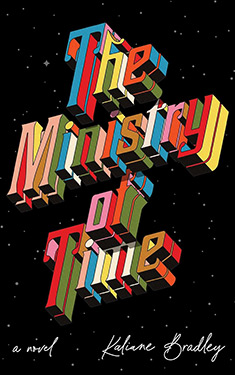
The main character is an unnamed narrator.  She is part British, part Cambodian (like the author).  She is a civil servant translator who applies for a job which pays a lot and requires high security clearance.  She gets the job in the Ministry of Time, finding out that she will be a “bridge” to assist people transported from the past assimilate into present society.  She is assigned to Commander Graham Gore who supposedly died on a nineteenth century Arctic expedition to find the Northwest Passage.  Also known as “1867”, Gore is a handsome, upright, uptight, chain-smoking Victorian who eschews many modern inventions, though he loves Spotify.  The narrator rather successfully brings him into the present, while navigating her growing feelings toward him.  At the same time, she appears to be a target of a mysterious “Brigadier” who is systematically trying to assassinate the participants in this Ministry experiment.   

Despite having read a fair number of time-travel books, romances, Victorian period pieces this past year or so, I thought the premise of the book was very intriguing.  The group of ex-pats from the past are monitored for their being accepted by our time, as well as vice versa.  One ex-pat seems to be rejected by the present while at the same time, rejects her “hereness”.  Others, like Margaret who died from the Bubonic Plague in the 1600s, and Arthur who was killed during WWI, balance their “hereness” and “thereness,” and take to the present like champs.  They don’t always show up on modern scanning devices unless concentrating on their hereness.  They work hard on assimilating.  The romance is a little predictable, but I thought the progression was well done.  And of course, I was thoroughly frustrated by Gore’s stiff upper lip, but have become quite used it, especially coming off the Victorian romance of Spectred Isle.  

I didn’t know until I finished the book that the author was Cambodian and British, as was the narrator.  So the themes of genocide, refugees, and assimilation were very present and well done.  They pertained to the narrator as well as the ex-pats.  I really identified with her, as a gay man who spent most of his life trying to assimilate into straight society.  She was “white-passing,” a concept many people who feel different or “other” spend excessive energy on.  This made her relatable, even as her sister embraced her otherness and worked to make sure mainstream society got what she went through growing up being ridiculed and bullied for.  

The ex-pats were incredible.  Gore, with his Victorian reticence, suffering under the weight of doing what he thought was acceptable versus his own feelings.  Arthur, the WWI soldier who was gay, trying to figure out what he wanted out of assimilating in the present.  Margaret, the 17th century woman who finally explores life as an out lesbian, embracing Tinder and film and feminism.  They are all loveable.  Margaret provides a lot of great comic relief.  Arthur is simply the sweetest guy ever.  

I thought the thriller part was also pretty well done, although I saw some things coming, while completely missing others.  But that’s pretty par for me.  Many of my friends in book club often figure out the mysteries well before the end.  I think I liked it because it wasn’t as convoluted as many time travel thrillers are.  Having read the book in two days, the twists and turns were fresh in my mind as they unfolded toward the reveals at the end.

I give this book five stars out of five.  I was thoroughly engaged with the characters and the time travel.  I thought it ended with excellent reflections on living life in the present with hope and forgiveness to get through the future.  The ending also left you hanging a little, not necessarily for a sequel, but to make you think about the implications of what decisions you make in the present may have on the future.  I think if this were read in my book club, the other members might find it schmaltzy or trite.  I thought it was one of the best sci fi romances I’ve read in the recent past.  

Friday, May 9, 2025

Spectred Isle

KJ Charles
Completed 5/5/2025 Reviewed 5/9/2025
3 Stars

This book was enjoyable romantasy fluff.  This is my first book by KJ Charles, a British woman with quite a prolific M/M romantasy body of work.  This, like many of her works, is a period romance taking place after WWI.  It is very British in its emphasis on manners and reputation.  Charles has a very large following despite being mostly self-published.  This book actually won a paranormal romance award when it was published.  I won’t say it’s great, but I had a hoot with it and particularly enjoyed the Green Man mythos it drew from.  And I am a sucker for gay romances, being a romantic at heart myself.  Alas, no sequels have been written yet despite two more being planned.

Saul Lazenby was disgraced and discharged from the army for having an affair with an enemy civilian and possibly leaking military secrets, though nothing was ever proven.  He does not know if his lover was a spy or not, or whether he loved him or not.  Formerly an archeologist in the Middle East, he now is an assistant to an older man who is obsessed with the occult.  Saul, a skeptic, goes on what he feels are wild goose chases to confirm paranormal areas for his boss.  At each step, he meets Randolph Glyde, a mysterious man who turns out to be truly involved with paranormal activity.  At first, they hate each other, but it turns into an enemies-to-lovers tale as the story unfolds.  Together, they try to uncover the source of strange occurrences around London while trying to avoid a newly formed government agency trying to rein in all the experts on the occult.

The character development of Saul is pretty good.  He starts out a nay-sayer, trying to avoid any interaction with people in general.  He’s sullen and withdrawn, having been cut off from everything he held dear in his life.  When he meets Randolph, he very slowly begins to open up, allowing himself to feel attracted to someone.  Since being expelled from the army, he has only been having anonymous hookups, feeling guilty about everything.  That changes with Randolph as they keep on having chance encounters and actually begin talking to each other rather than bickering.  Saul doesn’t come bursting out of the closet by the end of the book, but he does let himself fall in love.  

Randolph, on the other hand, carries a lot of his own guilt and grief.  His whole family were killed during a ritual during the war, a ritual to combat the paranormal war that was being waged behind the scenes.  Now, as the sole inheritor of the family’s magical responsibility, he tries to figure out all the paranormal activity happening around London and avoid bringing the unknowing Saul into it.  Randolph started out a little too foppish for me, but I relaxed my opinion of him as Saul’s interest and involvement grew.  Before I knew it, I was biting at the chomp for them to finally have their moment.

The prose is pretty good, as is the world building.  The paranormal stuff was strange, with monsters climbing out of the fen.  These swamp beast-men were definitely scary but also rather bizarre.  What I liked most when Randolph called the power of the Green Man to him to fight these creatures.  I would have liked more background on the Green Man mythos though, as it is rather esoteric.  We know it’s ancient and earth-based, but really little else.  

I give this book three stars out of five.  I think Charles could have done a lot more, but maybe that’s what she’s planning in the rest of the trilogy.  If she ever returns to finish it, I’ll definitely read it.  In the meantime, I have another trilogy by her that I got on sale with similar themes.  So I have my work cut out for in the field of gay romantasy.  I hope to get to those by the end of the year.  And this book was a nice break from the heavier reading of the Hugo and Nebula nominees.  


Friday, May 2, 2025

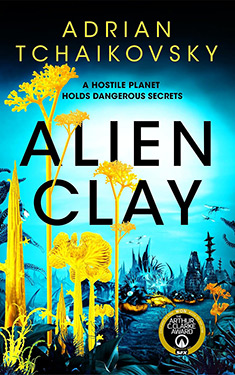
Alien Clay

Adrien Tchaikovsky
Completed 5/1/2025, Reviewed 5/1/2025
3 stars

I’m not a big fan of this book.  In the past, I really enjoyed Tchaikovsky’s prose, as in Made Things and Service Model.  In fact, I thought the latter was brilliant.  This book, however, was slog.  The prose got in the way of the action and the dialogue.  While not as pretentious as Chabon’s The Yiddish Policeman’s Union, the interruption of statements and conversations made for an immense lack of continuity.  I often had to go back and read the sentences in quotes to remember what the conversation was about.  The only good thing about it was that it reiterated facts about the planet on which it takes place so that I got an excellent sense of it.  This book was nominated for 2025 Hugo and PDK awards.  I would have thought a book like this would have been more likely a Nebula nominee considering how often prosy books are nominated.  However, since the author has been generally ignored by the Hugos throughout his prolific career, I wouldn’t be surprised if this won.

The book is narrated in first person by Arton Daghdev, a xeno-ecology professor and dissident who is sent to the penal colony on planet Kiln by the fascist Mandate, the political power on Earth.  There with many of his associates from academia, he is looked upon as someone who ratted out the others.  While life in the penal colony means almost certain death, Daghdev is fascinated by the ancient ruins near the colony which contain hieroglyphs, undoubtedly written by some earlier civilization.  The commandant of the facility takes a liking to him because he may have the knowledge to help break the code of the writings.  He gets assigned to work that brings him in proximity of the ruins, though he is not actually part of the Science team.  Of course, a rebellion is being plotted of which he becomes part, feeling it’s his only way of possibly surviving his sentence as well as overthrowing everything he doesn’t believe in.  He struggles to survive the planet, the forced labor, and the rebellion, all the while trying to solve the riddle of the writings on the ruins.

I thought the premise of the book was fascinating and timely. It was pretty clear to me that Tchaikovsky is extrapolating on the present, perhaps after seeing how easily we could topple into a dictatorship, despite being British.  The Mandate is ruthless in its weeding out dissents, particularly among the intelligentsia.  I was surprised at all the parallels to what is going on in our society now.  After reading a few other reviews, I found out that this could also be a nod to Great Britain relocating their undesirables to the prison colony of Australia.  Either way, this wasn’t enough to keep me engrossed in the story.

Nor was the character of Daghdev.  While somewhat interesting, I could not stay focused on his thoughts and actions as they were so tediously drawn out by the prose.  By about fifty pages, I wanted to put the book down because I was simply not interested in him anymore.  Whether it was the conflict with his fellow dissidents, his acts in the rebellion attempts, or his forced labor on the planet, I could not keep focused.  I occasionally became interested in the other characters, particularly Primatt, the lead of his labor group.  She had some redeeming qualities despite not being a captive.  Rather, she was there as a scientist and could appreciate Daghdev’s potential.  I also liked the scientist who was kept in isolation for seemingly going insane from unprotected exposure the planet’s environment.  While her story isn’t revealed until the end, she presents a warning of what the future of the prisoners will be.

Needless to say, the most interesting character is the planet Kiln itself.  Its flora and/or fauna (it’s not clear which is which) is actually made of symbiotic creatures coming together to create larger ones.  Whether it’s the tree-like things or the elephant-like things, they all exist because smaller things come together to feed from as well as support every other smaller thing in the collective entity.  The whole planet has learned to live in communities of non-similar things.  Still it isn’t clear what could have possibly made the writings on the ruins as none of them seem sentient.

I give this book three stars out of five.  This will be many people’s cup of tea, but it wasn’t mine.  I had to force myself to continue reading this book.  It didn’t grip me until the last fifty or so pages.  Even then, the prose got in the way of my enjoyment of it.  I think I would have given it two stars, but clearly, Tchaikovsky can write some unpretentious prose to fill out his world.  I just wish he would have been a bit more concise or at least not have such huge paragraphs separating each sentence of a conversation.