Adrien Tchaikovsky
Completed 5/1/2025, Reviewed 5/1/2025
3 stars
I’m not a big fan of this book. In the past, I really enjoyed Tchaikovsky’s prose, as in Made Things and Service Model. In fact, I thought the latter was brilliant. This book, however, was slog. The prose got in the way of the action and the dialogue. While not as pretentious as Chabon’s The Yiddish Policeman’s Union, the interruption of statements and conversations made for an immense lack of continuity. I often had to go back and read the sentences in quotes to remember what the conversation was about. The only good thing about it was that it reiterated facts about the planet on which it takes place so that I got an excellent sense of it. This book was nominated for 2025 Hugo and PDK awards. I would have thought a book like this would have been more likely a Nebula nominee considering how often prosy books are nominated. However, since the author has been generally ignored by the Hugos throughout his prolific career, I wouldn’t be surprised if this won.
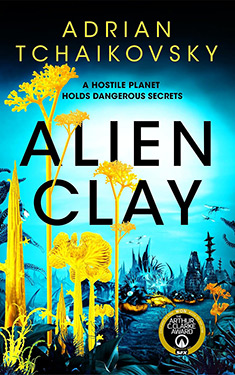
The book is narrated in first person by Arton Daghdev, a xeno-ecology professor and dissident who is sent to the penal colony on planet Kiln by the fascist Mandate, the political power on Earth. There with many of his associates from academia, he is looked upon as someone who ratted out the others. While life in the penal colony means almost certain death, Daghdev is fascinated by the ancient ruins near the colony which contain hieroglyphs, undoubtedly written by some earlier civilization. The commandant of the facility takes a liking to him because he may have the knowledge to help break the code of the writings. He gets assigned to work that brings him in proximity of the ruins, though he is not actually part of the Science team. Of course, a rebellion is being plotted of which he becomes part, feeling it’s his only way of possibly surviving his sentence as well as overthrowing everything he doesn’t believe in. He struggles to survive the planet, the forced labor, and the rebellion, all the while trying to solve the riddle of the writings on the ruins.
I thought the premise of the book was fascinating and timely. It was pretty clear to me that Tchaikovsky is extrapolating on the present, perhaps after seeing how easily we could topple into a dictatorship, despite being British. The Mandate is ruthless in its weeding out dissents, particularly among the intelligentsia. I was surprised at all the parallels to what is going on in our society now. After reading a few other reviews, I found out that this could also be a nod to Great Britain relocating their undesirables to the prison colony of Australia. Either way, this wasn’t enough to keep me engrossed in the story.
Nor was the character of Daghdev. While somewhat interesting, I could not stay focused on his thoughts and actions as they were so tediously drawn out by the prose. By about fifty pages, I wanted to put the book down because I was simply not interested in him anymore. Whether it was the conflict with his fellow dissidents, his acts in the rebellion attempts, or his forced labor on the planet, I could not keep focused. I occasionally became interested in the other characters, particularly Primatt, the lead of his labor group. She had some redeeming qualities despite not being a captive. Rather, she was there as a scientist and could appreciate Daghdev’s potential. I also liked the scientist who was kept in isolation for seemingly going insane from unprotected exposure the planet’s environment. While her story isn’t revealed until the end, she presents a warning of what the future of the prisoners will be.
Needless to say, the most interesting character is the planet Kiln itself. Its flora and/or fauna (it’s not clear which is which) is actually made of symbiotic creatures coming together to create larger ones. Whether it’s the tree-like things or the elephant-like things, they all exist because smaller things come together to feed from as well as support every other smaller thing in the collective entity. The whole planet has learned to live in communities of non-similar things. Still it isn’t clear what could have possibly made the writings on the ruins as none of them seem sentient.
I give this book three stars out of five. This will be many people’s cup of tea, but it wasn’t mine. I had to force myself to continue reading this book. It didn’t grip me until the last fifty or so pages. Even then, the prose got in the way of my enjoyment of it. I think I would have given it two stars, but clearly, Tchaikovsky can write some unpretentious prose to fill out his world. I just wish he would have been a bit more concise or at least not have such huge paragraphs separating each sentence of a conversation.

No comments:
Post a Comment