Monday, November 20, 2023

The Songs of Distant Earth

Arthur C. Clarke
Completed 11/19/2023, Reviewed 11/20/2023
3 stars

As loved and prolific as Clarke was, I never found his books to be that amazing.  I often found them a bit tedious with so much time spent on the science and so little effort spent on the characters.  The Fountains of Paradise, one of his Hugo winners, was a yawner.  His other Hugo winner, Rendezvous with Rama, was like Space Odyssey, full of wonder, but lacking character development.  This book is not really full of wonder, but full of interesting science.  It questions why there are so few neutrinos from the Sun striking the Earth and devises a 20% of the speed of light form of propulsion.  There are a lot more characters than usual, and a lot more time with them.  There’s not much development, but at least we get some human interaction.  
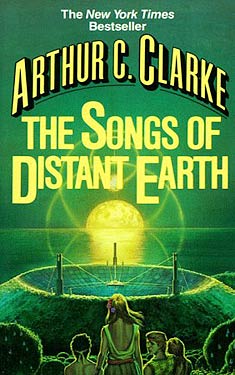
Thalassa is a near-utopian colony inhabited by one of the early missions to escape the destruction of Earth from the Sun’s pending nova.  When they landed, they had communication with Earth for a while until a volcanic event destroyed their comm link.  About 700 years later, the spaceship Magellan approaches hoping to find the colony still alive.  The ship carries almost a million people in suspended animation and is one of the last colony ships to leave Earth.  A small delegation comes down to meet with the Lassans and offer to trade technology and art from the last centuries in exchange for millions of tons of ice from the ocean to use as a shield for their ship.  Of course, intermingling occurs between the Lassans and the just over a hundred awakened crew.  A few fall in love with the locals.  A few want to stay rather than continue on to the ship’s original destination, Sagan 2.  Several want to end the mission at Thalassa all together.  This all causes some strife and human drama.

What I enjoyed most about the novel was that human drama.  The characters are rather two-dimensional, but I actually liked them and empathized with them a little.  They had some normal interaction and dialogue, though the emotion was sparse.  One could say it was a little soapy and melodramatic, but I thought it wasn’t too bad.  One thing I didn’t care for with the characters were some of their names.  Some were borrowed from science fiction writers.  Some were a little too close to other fiction, like Mutiny on the Bounty.  Clarke even gives one of the characters who wants to abandon the mission to Sagan 2 the name Fletcher and has him reflect on whether his ancestors came from Pitcairn Island.  The familiarity of the names was just a little too, well, cute.

I also enjoyed the discovery of a possibly sentient sea creature during the Magellan’s stay.  It was a nice little scientific subplot that kept the book interesting.  I found that part more interesting than the vacuum drive Clarke describes.  

Like his other books, I give this three stars out of five.  It’s simply too devoid of feeling.  Even when one of the characters dies, there is little emotional response.  One of the main characters from Thalassan asks her lover from the ship to explain the need for grief.  Just too academic and stoic.  I did like the brief allusion to a bisexual encounter, but again, not much in the way of emotional description.  I’d say I liked this book about as much as Rama.  It was entertaining, but ultimately, I felt hungry for something more substantial.


Wednesday, November 15, 2023

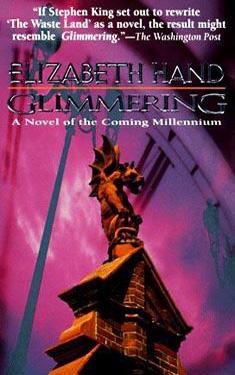
Glimmering

Elizabeth Hand
Completed 11/13/2023, Reviewed 11/15/2023
4 stars

Finishing this book completes my challenge of reading a dozen books by the prolific Elizabeths of Science Fiction and Fantasy.  This is the third book by Hand I read for the challenge.  While her other books were fantasy and horror, this was science fiction.  It concerns an apocalyptic event which sets the atmosphere on fire, creating a glimmering of colors.  The society begins to decay and rival groups vie for power.  It is a rather depressing book, but Hand takes it interesting places with a mix of gay and straight characters trying to survive in a nightmarish world.  This book was nominated for a 1998 Arthur C Clarke award.

The book takes place at the turn of the 21st century as the glimmering begins.  Jack is an HIV positive gay man living at his family’s large ancestral home with his grandmother and housekeeper.  He owns a literary magazine which once rivaled the New Yorker, but as resources become scarce, he barely gets any issues published and distributed.  The magazine comes under the gaze of major world corporation from Asia, offering Jack several million dollars as long as he stays as the main power behind its publishing.  But he doesn’t know if he should take the offer as the world slowly decays and his supply of life saving medication dwindles like other resources.  But then an old friend and lover offers him a miracle drug from Asia that actually seems to work.

At the same time, Trip is a young Christian rocker on the verge of massive stardom.  However, his fame is threatened by temptation that comes from a sixteen-year-old Polish refugee and the popular new drug IZE, more addictive than heroine and on the verge of getting FDA approval for general distribution.  Trip and Jack’s paths cross as the world approaches New Years Eve and the doomsday cults are poised to rip the power out of the megacorporation that may have an answer to ending the glimmering.

This book is not long, but it packs a lot of punch into its 350 pages, as you can tell from the complex plot.  But Hand handles it deftly.  I was never confused by all the events taking place and was impressed by how she brought the characters across each other’s paths.  The science of the glimmering is a little vague, but its effects on the main characters and the general population are terrifyingly specific.  As usual, Hand’s prose is wonderful without being overbearing, creating a gritty wasteland of New York City and its suburbs and even the mess left of rural Maine.  

The characterization is terrific.  I felt like I was living inside both Jack and Trip, as different as they were from each other.  I didn’t care for either of them at first, but clearly empathized with them.  Jack’s ex, Leonard, is deliciously creepy.  He’s probably the most interesting character, being a Warhol-like photographer who specializes in species going extinct.  He also has his hand in various other ventures including AI and the music business, which introduces him to Trip.  He pops up throughout the book, and while not necessarily a bad guy, he has quite a few antagonistic traits.  

The book is clearly dated, with it forecasting the events of the change of the millennium, and its punk and grunge influence, but it still rings true in many ways for society today.  Near future apocalyptic books often do, the good ones, anyway.  And this is one of the good ones.  It’s a tough read, with minimal humor and lots of despair, but I found it engrossing and chilling.  I give this book four stars out of five.  


Sunday, November 5, 2023

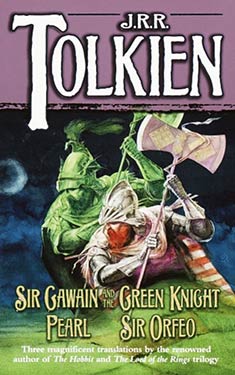
Sir Gawain and the Green Knight, Pearl, and Sir Orfeo

JRR Tolkien
Completed 11/5/2023, Reviewed 11/5/2023
4 stars

I’ve never had much of a fondness for poetry.  I was usually too caught up in the mechanics to understand or appreciate the story, emotion, or sentiment.  That changed when I began to read Tolkien’s poetry.  For some reason, I got it.  This book is a collection of 14th – 15th century poetry that Tolkien studied and translated into modern English, keeping the form of the originals as close as possible.  The result in the case of Sir Gawain and the Green Knight is a phenomenal alliterative tale of morality and courtesy in Arthur’s Court.  Pearl is a dream-like fantasy of ABAB poetry, and Sir Orfeo is a variation of Orpheus and Eurydice again in ABAB style.  I enjoyed them in varying degrees.  

For the most part I enjoyed Sir Gawain’s tale.  I find alliterative poetry a little tough to get into, but generally can get used to it after about ten or so pages of it.  Alliterative means that there is a recurring sound in the line.  For example, “Attend the tale of Sweeny Todd” has three T’s.  When each line is like that, I find myself looking for the recurring sound rather than paying attention to the story.  But I did get into the story, which is basically a morality play.  

Sir Gawain, the nephew of Kind Arthur, takes a challenge to fight the mysterious Green Knight in a one-stoke only game.  Gawain gets the first stroke, with the Green Knight’s return stroke coming a year later.  Thinking he’ll kill the Green Knight, he cuts off his head, but the Green Knight gets up, takes his head and rides off.  Now Gawain is bound to find the Knight to let him have the return stroke. During the interim year, the young knight ends up in a castle where the lord engages him in another game of gift giving and chastity.  

I found it strange the Gawain naively takes up these games without thinking of the catches, but was able to suspend disbelief to enjoy the story.  The only real hindrance to my enjoyment was the somewhat archaic structure of the poetry, with subject, verb, object being bounced all over a line.  Like Shakespeare, you get it after a while, but it occasionally made it difficult to follow.  

Sir Orfeo was a cakewalk by comparison.  He is a king with a queen who is stolen by fairies.  He goes into a self-imposed exile to mourn her disappearance only to find a secret way into the faerie realm to bring her back.  It was very easy to follow the story, which is short and to the point.  Gawain on the other hand is nearly one hundred pages long.  

I didn’t enjoy Pearl at all.  It a story about a man mourning a deceased child.  He dreams she returns to him in a dream, appearing from heaven.  The narrator then sees images derived from John’s Apocalypse and David’s Psalms.  Mixing religious symbols in a dream state with poetic form made for tough reading.  If Christopher Tolkien didn’t have a forward to this piece, I would have been totally lost.  I felt this story was a blemish to an otherwise very good example of the erudite poetry that Tolkien excelled at.  

I give the book four stars out of five on the strength of Sir Gawain and Sir Orfeo.  The translations from middle English to contemporary poetry keeping the flavor and form of the original and still be able to tell a comprehensible story amazes me.  From other reviews, I heard that listening to the audio book is not as enjoyable, which makes sense.  I would think it would be much easier to read and listen to the poems at the same time.  Anyway, I’m glad I finally read this book, which had been sitting on my Kindle for a few years.  Hopefully next year, I’ll read another one of his translation books.  There are still one or two out there which I haven’t read yet.


Sunday, October 29, 2023

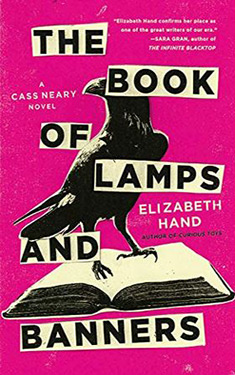
The Book of Lamps and Banners

Elizabeth Hand
Completed 10/28/2023, Reviewed 10/29/2023
4 stars

Elizabeth Hand is always a good read.  This one surprised me in that there is very little fantasy or sci fi in it.  But the premise is that there’s a book with fantastical powers that has been found and subsequently stolen.  A common premise, but Hand couches it within a mystery thriller with a drug-addled female anti-hero.  The result is a taut mystery that takes you from the crowded streets of London amidst neo-Nazi nationalists to the desolation of a Swedish island on the Baltic Sea.  This book is the 4th in a series featuring the protagonist, which I didn’t know when I got the book, but it reads very well as a standalone.  I slipped into the story and was immediately hooked on this mess of a middle aged woman searching for something that will provide her with a windfall to make her life easier.

The book begins with Cass trying to figure out what happened to her old boyfriend.  In the meantime, she runs into Gryffin, an old flame from her bookstore days.  He’s a dealer in antiquarian books now and has come across an amazing find.  The Book of Lamps and Banners was only ever rumored to exist.  It was written by multiple people over the centuries, perhaps even by Aristotle.  Filled with drawings as often seen in ancient books, it may also be the ultimate code.  Gryffin has sold the book to a woman who is writing software that would help people with PTSD and other traumatic events heal from it.  She purports that the book is the final piece of code she needs for her software.  Suddenly everyone around them begins being murdered in a mysterious way and the book is stolen.  Cass thinks if she could recover the book, she could sell it and make a fortune that would let her retire in Greece.  But actually doing that is a dangerous path.

Hand does a tremendous job with character development.  I felt like I was completely in the Cass’ head, right there with her as she snorts crank and drinks anything alcoholic she can get her hands on.  When she finally does meet up with her old boyfriend, she drags him into her chaotic life and quest.  If anything, I questioned myself on why I was so drawn to her.  It’s like watching a train wreck.  She somehow balances on the verge of OD, and her obsession with the book is ridiculous.  However, I was in it hook, line, and sinker.

The setting is also pretty amazing, between London and the remote Swedish island.  The world is on the verge of the COVID pandemic.  Nazi nationalists are on the move, and the Book of Lamps and Banners ties into their occult obsession.  When we move to the desolation of the island, that’s even more exciting than the bustle of London.  The writing is awesome, with the perfect balance between prosy descriptions and smart dialogue.  

I give this book four stars out of five.  It’s a terse thriller, and a great read in a genre I usually don’t get into much.  I think Hand is underrated as a fantasist although she’s won multiple awards for her shorter works.  I’ll be reading one more book by her before the year is out, a sci fi piece, which I’m really looking forward to.


Saturday, October 21, 2023

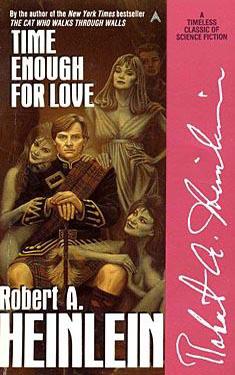
Time Enough for Love

Robert A Heinlein
Completed 10/21/2023, Reviewed 10/21/2023
3 stars

This book is extremely well written.  Despite my taking nearly two weeks to finish this longest of Heinlein’s works, I felt like I sped through it.  Unfortunately, I didn’t enjoy what I read.  I found the constant proselytizing about the benefits of polyamory, free love, and community childrearing to be tedious after a while.  The science fiction in the story was an aside.  In fact, there was very little science fiction in the book at all.  Sure it had computers, time travel, space ships, and DNA manipulation, but it was all just a platform for Heinlein to preach his sexual utopian ideas.  

Lazarus Long is a man who is at least 2000 years old.  He is the patriarch of a huge family which keeps records of him and his descendants.  When he is pulled by one of his descendants from a brothel where he’s contemplating finally dying, he’s rejuvenated and given the will to continue living.  During that time, he tells stories of his past to help fill in his historical gaps.  Then he goes back in time to see his family when he was a child, but instead of going back after the end of WWI, he goes back at the beginning, and gets involved with the war as well as his family, and most disturbingly, his mother.

I have to say that the characterization is quite excellent.  I had pictures in my head of almost all the characters, between their looks and their dispositions.  I was quite amazed that I kind of liked Lazarus and the members of his commune.  I used to think Heinlein was misogynistic.  After reading this, I believe he wasn’t.  He believes women are made to be fully realized humans.  He just happens to be obsessed with having as much sex with them as he can, as Lazarus did.  And Lazarus finds all the women who want to have sex with him, so it’s a win-win situation.

There were some things that made me cringe a bit.  The most glaring one is that there are a fair number of jokes about rape that wouldn’t made it past an editor or publisher of a book written today.  On the other hand, there were some surprises as well.  Galahad meets Ishtar for the first time after deciding they were going to have sex.  When she takes off her helmet he says, “Oh, you’re a woman.”  Ishtar replies, “Does that matter?”  Galahad says, “I guess not.”  I thought that was a decent nod to sexual fluidity, more than I would have expected from Heinlein and the early 1970s.

The part of the book I liked the best was where he goes homesteading on a planet with his new wife Dora.  They have lots of children together and create a sexual utopia.  However, this really reminded me of the quote I once heard which irked me at the time but felt relevant here.  If you take the science fiction out of a story and you still have a story, it’s not science fiction.  While I still don’t buy it completely, I did feel like this book wasn’t really science fiction.  It was merely the background in which Heinlein gets to espouse his utopian fantasies.

I gave this book three stars out of five because I thought it was really well written.  The characters were great, even though Lazarus Long is clearly Heinlein.  However, I didn’t really enjoy it.  There wasn’t much of a plot and I felt like I was getting hit over the head with the sex, even more so than some sci fi and fantasy erotica I’ve read.  I think I’d rather read about sex than the philosophy of sex. 


Sunday, October 8, 2023

An Apprentice to Elves

Sarah Monette and Elizabeth Bear
Completed 10/8/2023, Reviewed 10/8/2023
3 stars

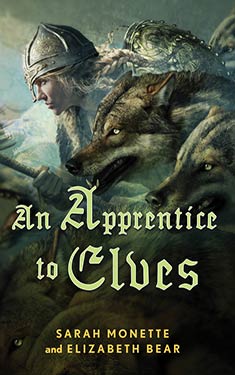
Finally got to the conclusion of the Iskryne trilogy.  It was okay.  I thought it better than the middle book, A Tempering of Men.  But what I realized with this volume is that I felt that the prose was generally uninteresting.  And by prose, I mean the descriptive parts of the book.  Usually, the descriptions of the characters and the world fill out the missing parts and make world and the characters come alive as much as the dialogue.  In general, though, I simply wasn’t interested in how the authors were describing anything.  I just wanted the plotlines to keep moving.  I think all three books suffered from this, but it was most evident in this volume because I actually liked the plot and wanted to see what happened next.

The main plot concerns Alfgyfa, the daughter of Isolfr from the first book.  Being a woman, she can’t bond with the wolves.  So Isolfr sends her to the Elves to apprentice as a blacksmith rather than having her become a housewife-ish person.  The book picks up where she goes to the Elves and of course, being human, gets into a lot of trouble.  She excels at smithing, but her ideas and actions don’t mesh with the behavior of the underground society of Elves.  So Tin, her mastersmith, takes her back to her father, where the Northmen are trying to figure out how to deal with the Rhean invaders.  Alfgyfa becomes somewhat of an ambassador to the Elves.  There are two factions of Elves, the ones who metalsmiths and the stonesmiths.  The two had a schism millennia ago, but now both are needed to help fend off the Rheans.  Alfgyfa has a relationship with both and tries to help reconcile the division before the Northmen go to war.

Alfgyfa was generally a likeable character.  I enjoyed her feistiness.  Tin was also interesting, and in general, the smiths were interesting in that they were female Elves.  So if you find the wolf-bonding of the human men a bit misogynistic, you get a reprieve in the women doing traditional masculine work.  It made for interesting relationships, particularly between Alfgyfa and other apprentices.  I also liked  Otter, the woman slave of the Rheans who is rescued by a Northman and taken in as his daughter.  Her perspective is interesting as an outsider looking into this wolf-centric society.  

I thought this book was better than Tempering in that the characters who were featured were much more definable.  There were still too many men and their names, their wolves’ names, and other pseudo-Nordic names still ran together.  But the introduction of Elven names as well as the Rhean pseudo-Roman names helped keep from drowning in the similar sounds.  And the major points of view were from the women:  Alfgyfa, Tin, and Otter.  

All in all, I thought this wasn’t a bad book, and it ended the trilogy pretty well.  In general though, I don’t think this is that good of a series.  Despite giving A Companion to Wolves four stars, I’d give the trilogy as a whole only three stars.  Once past the novelty of the human/wolf relationships wears off, it’s just another fantasy, with not much that’s really special. 


Tuesday, October 3, 2023

Oath of Gold

Elizabeth Moon
Completed 10/3/2023, Reviewed 10/3/2023
5 stars

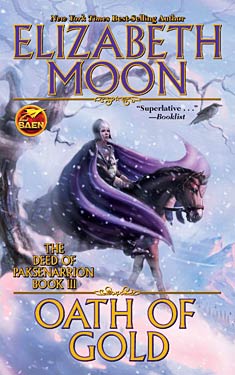
This book is the best out of the three in The Deed of Paksenarrion series.  I loved the first two, but this one is full of character development and magic all wrapped up in an exciting conclusion.  The book starts with Paks at her lowest point and builds her way back to being a king maker.  It’s like Moon saved up all her best ideas for this book.  The series reminded me of Lord of the Rings in its imagination and execution.  It’s like Moon took LOTR, deconstructed it, and from the remains constructed something original told from a female perspective.  This series is that tremendous.

This book begins with Paks wandering the countryside begging for work and food.  She makes her way back to Master Oakhollow, guardian of the trees, who is able to heal her from the torture by the evil forces of the spider demon.  She then joins a group of ranger elves where she builds back her skill and confidence as a warrior.  She also finally accepts that she is meant to be a paladin, acknowledging all her magical gifts, including the ability to heal.  Finally, as a paladin of Gird the saint, she begins to get messages from the gods which eventually put her on a quest to find and restore the lost heir to a nearby kingdom to his rightful throne.

Reading this book was like a homecoming, even though I had just read the first two in the last two months.  When I opened this book, I realized just how much I loved the character of Paks.  Reading how she traveled the land trying to survive to making her way back to Master Oakhollow’s grove and finding healing there was so moving for me.  This followed by the journey of accepting her paladin gift simply stole my heart.  There were a few things in this book that I could see coming from a mile away, like who the missing king was.  But the journey to that moment was exhilarating.  

This is going to be a rather short blog entry, as I already feel like I’ve given away too much.  Suffice it to say, I loved this book.  Five starts out of five.  It is one of the best high fantasy trilogies I’ve read in a long time.  The prose is wonderful as is the world building.  Paks growth from being a Sheepfarmer’s Daughter to warrior to spiritual pilgrim in Divided Allegiance to paladin in this book is marvelous.  I also felt that many of her other characters were pretty well developed as well, with only a few one-dimensional baddies.  

(You should be aware of the trigger warning:  this book has some graphic torture and allusions to rape.  It is hard to read.)

This series deserves to be named among the best fantasy series ever.  I think Moon is quite the master story teller.  I think she really needs to be made a Grand Master.  These books plus Speed of Dark and Remnant Population are among the best I’ve ever read.  I think Moon is up there in my top five favorite authors now.