Wednesday, August 27, 2025

Lucky Day

Chuck Tingle
Completed 8/27/2025, Reviewed 8/27/2025
5 stars

Chuck Tingle is right up there with my favorite authors these days.  I recently saw him at Powell’s Books in Beaverton, OR and he gave a hysterical presentation.  He still wears his trademark pink bag and sunglasses on his head and still goes anonymously by his pen name.  His latest book is another tour de force in horror, with a wild probability- and statistics-based premise, large numbers of gruesome deaths, and Cthulu-esque creatures.  And it is all grounded in amazing first-person existential narration by a bisexual math professor who has just released her first book.  It’s more cerebral than his previous books, Bury Your Gays and Camp Damascus.  But it is also more riveting.  

On the day that Vera is having a book release celebration, she decides to come out to her mom as being bisexual and engaged to a woman.  Her mother storms out of the restaurant, saying that bisexuals don’t exist.  Vera runs after her.  Just as she catches up to her, it begins raining fish.  Large fish.  A one-in-a-million accident sets off a chain reaction which kills eight million people, including Vera’s mom.  Known as the Low-Probability Event, this day of freak accidents throws Vera into a four-year long depression.  Out of the blue, Special Agent Layne shows up on Vera’s doorstep to convince her to help him bring down a Vegas casino with improbably good payouts as being linked to the massively unlucky events of the LPE.  Despite her inability to care for herself, she agrees, leading her on an investigation into probability, statistics, and unknowing nothingness.

What I liked most about this book was that Tingle could make Vera’s depression as riveting as the LPE (Low-Probability Event) and subsequent unlucky catastrophes.  I completely succumbed to her isolation and existential despair.  And she is still believable as Layne drags her out of her pigsty of a house and she begrudgingly helps him track down the casino’s manager, management company, and the land deals they’ve accumulated.  She fights him the whole time, feeling that everything is pointless when randomness can off you in a moment.  Slowly, her fighting spirit comes back as she finds she may be the only one who can stop the waves of random catastrophes.  Her character arc is amazing and convincing.  

Layne is alternatingly comic relief and deadly serious.  Just when you think things cannot spiral down more for Vera, he pops in with cheerful motivational pleadings that draws her out of herself.  Because Layne is a special agent for a commission that seems to be above normal law enforcement, he gets away with a lot of things during the investigation.  It’s the cognitive dissonance of his actions versus Vera’s personal values that slowly draws her into caring about life again.  

Having been a math major, despite failing probability the first time around, I really got into the theory behind the story.  However, I think it is explained in layperson’s terms that all readers should understand.  Basically, if a lot of good luck happens, there’s going to be a backlash of bad luck somewhere else.  Throw in some Lovecraftian horror, a high body count, and a couple of great twists, and you end up with this riveting horror novel.  

I have yet to read Tingle’s queer, absurdist, sci fi/fantasy/horror erotica, but I believe he must have really honed his craft during that time to produce these well written mainstream books.  I give this book five stars out of five.  I could barely put it down.  It’s short, just over novella length, but it packs a punch.  And if you want to read about how he joined the movement against the science fiction alt-right known as the rabid puppies, check out the excellent non-fiction work Speculative Whiteness.  Tingle is a great voice in the queer speculative fiction community and I love seeing him succeed with such imaginative books.


Tuesday, August 26, 2025

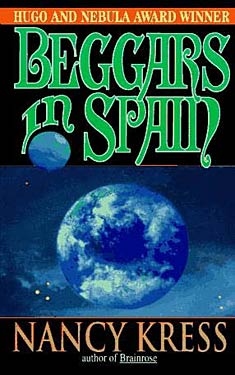
Beggars in Spain

Nancy Kress
Completed 8/24/2025, Reviewed 8/24/2025
4 stars

I had mixed feelings about this book.  The first chapter was originally an award-winning novella, and I thought it was amazing.  The next three chapters are snapshot stories that take place several decades later.  These three chapters have a different feel, tending more towards the melodramatic.  They also felt a little forced, with fascinating premises that were spread out over too many pages.   But overall, the book works as a satisfying whole, presenting a scenario which almost resembles some of the ruptures in society today.  This book was nominated for the Hugo, Nebula and Campbell awards when it was first released as a complete novel in 1993. 

Leisha was a genetically modified embryo.  She was made so that she wouldn’t need sleep.  It had been discovered that sleep was not necessary for humans and may be the cause of many mental and emotional maladies.  As a child, Leisha became mentally superior to her unmodified fraternal twin sister, Alice.  Eventually, it is discovered that the sleepless really are far superior to the sleepers, excelling in all the top fields like law, business, and science.  They also discover their bodies have self-healing properties, making them virtually immortal.  The sleepers develop a deep animosity toward the sleepless, creating a world of terrible bigotry, with violence regularly perpetrated toward them.  Leisha, however, believes that people can overcome the prejudice and integrate into society.  Others, like Jennifer, believe that the sleepless must find a sanctuary to escape the violence and hatred.  Jennifer becomes the leader of the sleepless and they emigrate to an orbiting sanctuary, preparing for the invasion that clearly will come to destroy them. 

As I mentioned above, the first chapter, the original novella, was very compelling.  The subsequent chapters are mixed.  The part that I did really like was how the sleepless created a new genetic modification which affected how quickly the brain processes information.  The resulting children could make connections far faster than normal, although they had a severe stutter as a side effect.  This created another superior class, causing conflict within the sleepless community.  This becomes very relevant towards the end of the book.  

I thought the characters were a mix of well developed and wooden.  Leisha was the best character, the easiest to empathize with.  Jennifer, the head of the Sanctuary orbital, was ruthless and less empathetic.  Granted, she became more maniacal as the book progressed, but I thought she lost all semblance of humanity by the end.  Miri, Jennifer’s granddaughter and one of the first of the supers, was a great character.  I thought she saved the end of the book by being very human while at the same time fighting Jennifer with her own stoic coldness.  

I give this book four stars out of five because the first chapter and the buildup of the super sleepless was so good.  I forgave the middle part feeling like filler because of the messages about prejudice it conveyed.  Overall, a worthwhile read, but not enough to continue through the rest of the trilogy.  I was satisfied with the ending but felt it was enough for me.  


Wednesday, August 20, 2025

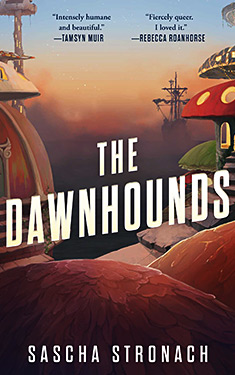
The Dawnhounds

Sascha Stronach
Completed 8/20/2025, Reviewed 8/20/2025
2 stars

This book is being touted with: If you loved Gideon the Ninth, you’ll love this.  Well, I hated Gideon and its sequel Harrow the Ninth.  I didn’t quite hate this one, but I certainly didn’t like it.  I found it a confusing, overwrought, noir fantasy/sci fi with mind-boggling magic and technology.  I was looking forward to this for its basis in Māori culture, its queer protagonist, and women pirates.  Unfortunately, I was lost through most of the book, only putting together the main plot in the last fifty pages or so.  Even so, I didn’t get who all the characters were, what their relationships with each other were, and what their journeys were throughout the book.  This book is the first of a series, the second of which is nominated for a Lammy this year for LGBTQ+ Speculative Fiction.  I read this so that I would understand the main characters and world building enough to not be lost next time.  Considering how lost I felt in this book, I only hope it will be enough to appreciate the sequel.

Yat is a cop who is demoted because she was found in a gay bar.  Queer people are seen as degenerates that undermine the provisional post-war government.  While walking along the river, she is killed after finding a dead body there.  However, she comes back with special powers that enable her to draw and use energy from other people, mycelium-based houses, and spore-created monsters.  Like other readers and reviewers, I understood mycelia (mushrooms) a little from Star Trek: Discovery.  After nearly killing the one sergeant that more or less has her back, she goes off alone, meets up with some lesbian pirates, and confronts spore-based monsters bent on destroying the city.

Yat is a typical anti-hero.  She’s a drug-addicted, self-destructive cop trying to be honest in a corrupt system.  She hates herself for being gay.  It’s not until she meets up with the pirates that she sees healthy relationships between women.  She almost kills Sen, her sergeant, which makes her run from the police force, especially since she’s already on the outs because of her sexuality.  There are a lot of chapters devoted to Sen, but I didn’t quite get him as much as I thought I should have from the narrative.  I think I liked him, as he goes in search of the runaway Yat, not as a cop, but as her friend.  I kind of liked the pirates, including Ajat who is in an open, loving relationship with another woman, and Sibbi, the female captain.  Unfortunately, the narrative was very hard to follow, so I didn’t always catch the changes in character focus.  I’m pretty sure I confused the background of many of the characters because of this.  

The prose was generally rich, just very convoluted.  I didn’t get most of the Māori references and was confused by the ethnic mix of the characters.  It seemed that most of them were not Māori, though this may be more representative of the diversity of people in New Zealand, the author’s home.  I guess I was looking to be educated about the culture, more like Rebecca Roanhorse’s “Beneath Earth and Sky” series, the first book of which was Black Sun, featuring a pre-Columbian culture.  This book is compared to Roanhorse’s as well, but it was a far cry from it.

I give this book two stars out of five.  I think it would have benefited from more beta reader feedback and editing.  I’m not impressed by the number of reviews that tout, “I loved this book even though I didn’t understand a thing.”  That doesn’t do it for me.  And I don’t always appreciate the noir subgenre.  This book was an intersection of too many things that push bad buttons.  However, the prose and the fact that I more or less got the mycelium-based magic system in the end saved this book from a one-star review.  Hopefully, I’ll be more prepared for book two.  


Thursday, August 14, 2025

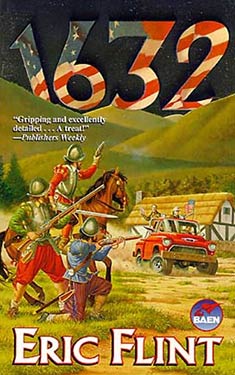
1632

Eric Flint
Completed 8/11/2025, Reviewed 8/14/2025
3 stars

This book left me with a feeling of cognitive dissonance.  I was torn between the interesting premise and the great, tough, female characters versus the slimy national populist ideology where America is so great that it has the answer to all of history’s problems.  I’ve read that Flint identifies as liberal and there are very strong elements of that in the story.  But it also has a strong manifest destiny theme that left me uncomfortable in my own skin.  It’s basically a military SF story and lots of enemies are slaughtered as the main characters protect their land.  

So in the year 2000, a whole coal mining town in West Virginia is fantastically transported to the middle of the Thirty-Year War in a part of the Holy Roman Empire in 1632, apparently due to alien intervention.  Completely stunned, the people of the town soon figure out that they are in the past in German land.   First, they rescue an older Jewish doctor/philosopher and his headstrong daughter from some soldier-brigands.  When they come to realize where and when they are, they begin to fortify the town and try to figure out how to survive by generating their own food and energy for electricity and vehicles.  As they encounter the local peasants, they become known as a refuge from the war, taking in many Germans and many soldiers fighting for the King of Sweden, who is seen as a good ruler.  Integration and intermarrying begin, to the dismay of some of the rich, right-wing residents.  The town declares itself as the United States, although it only has one state, and is tasked with naturalizing all the refugees and soldiers who’ve immigrated into the city.  They also must defend themselves against the armies of the Holy Roman Empire to maintain their independence.

The bright spots of the book are the main characters.  There’s miner Mike, the likeable leader who soon becomes president.  He realizes the necessity of war and the wiping out of the huge, attacking HRE armies, while trying to keep the town a bastion of peace and equality.  He falls in love with the Jewish woman he saved, Rebecca, who is a strong, brilliant, independent woman, who believes in the values of living in a democracy of diversity and equity.  She takes to modernism with little convincing, even hosting her own TV talk show about topics affecting the town.  Jeff is a virtuous young man who marries Gretchen, the resilient soldiers’ camp prostitute, to save her and her family from her fate.  James Nichols is the only black character.  He’s a brilliant doctor who came from a life of crime as a young man, and falls for the town radical activist and teacher, Melissa.  And we can’t forget Julie, the cheerleader who is the best sniper ever.  So yes, I guess they are all Mary Sue’s (as other reviewers have pointed out), but I liked them.  They had good character arcs.  I also need to note that there were strong, rich, businessmen who spend their time trying to make policy to Americanize the refugees in a right-wing, exclusionary way.  This causes some conflict as the town tries to determine how to govern themselves.

I enjoyed the parts of the story which described how the town figures out how to survive in the 17th century.  I like the interaction with the UMWA, the mine workers’ union, which helped employ many refugees to make them feel part of the town and help them rise above peasant status.  This survival tale is interspersed with scenes from the outside kings, cardinals, and generals who try to figure out what these strange Americans are and how to stop them from interfering with their attempts to control this part of Germany.  This all leads to a major showdown between multiple armies and the Americans.  

As I noted above, the part that got to me was the massive number of casualties and the rah-rah patriotism that accompanied the slaughters.  That’s what made me feel slimy, particularly with Julie the sniper and her cruel, focused assassinations.  All the battles were very one-sided as the Americans had modern weapons and vehicles while the invading armies had horses and buckshot rifles with little accuracy.  Their main advantage was their determination to slaughter the Americans, particularly by the Croat army.  

I give this book three stars out of five.  It’s entertaining but also disturbing for all the violence.  I did appreciate that the Americans were open to learning German and didn’t force all the Germans to learn modern English.  It was a reciprocal effort.  The freedom of religion, including acceptance and integration of the Jewish people, was significant in this war which emphasized the conflict between Catholics and Protestants.  There were parts of the book which surprised me for its left-leaning decisions and other parts that disturbed me for its slaughter at all costs for survival.  This balances out to a middling rating.  I probably won’t read any of the other books in the series, which I believe is at seventeen, but I’m glad I got the chance to read this book for my book club, even though I missed the meeting to attend Seattle WorldCon.


Wednesday, August 6, 2025

The Palace of Eros

Caro De Robertis
Completed 8/6/2025, Reviewed 8/6/2025
5 stars

This sapphic and trans retelling of the Greek myth of Psyche and Eros was a tour de force of feminist and sexual liberation.  Scouring the reviews online, this book received a varied mix of love and disappointment, mostly because of the prose.  It’s very flowery prose.  At times it feels stream of consciousness, filling up the scant plot with tons and tons of pretty sentences over-describing the thoughts going through Psyche’s head at any point in the story.  I found it annoying at first but quickly came to appreciate and eventually drown in the sensuousness of the prose.  I love good prose but sometimes it can get annoying and cloying.   Here, I reveled in it.  It made the passionate scenes between Psyche and Eros real and erotic while almost never mentioning body parts.  This book was nominated for a 2025 Lambda Literary Award for Speculative Fiction.  Making a guess based on reading so many of the winners and nominees over the life of the Award, I would place bets that this is the one to beat.

The story begins with Psyche bemoaning the efforts her father makes to find husbands for his three daughters.  When word spreads of her astounding beauty, men come from all over to gaze at and lust over her.  This soon seems like a curse, with her sisters becoming resentful and jealous over the attention she gets and Psyche herself feeling used and emotionally abused.  Combined with a summer drought before the normally dry fall and winter plus his lack of sons, the father believes this to be a curse upon his house.  He goes to an oracle who cryptically says that Psyche must be delivered to a monstrous husband to remove the curse.  Bound to a rock on a cliff, she is left for this fate, only to be saved by the goddess Eros.  She takes Psyche to palace made especially for her and offers herself to her, practically worshipping at Psyche’s feet.  Eventually, Psyche comes to agree to this and is awakened to pleasures she never knew existed and thoughts about womanhood she never dared allow herself to consider.  However, they must hide their relationship from the gods of Olympus, especially Eros’ mother Aphrodite, as the pantheon is just as misogynistic as the parochial humans.  For Eros is a goddess who can present as either a woman, a man, or a combination of both.    

This book is really a masterful thesis on self-discovery, self-acceptance, and what it means for a woman to be free in society.  Psyche’s sisters’ marriages illustrate all the negativity towards women having their own lives and being chattel of men.  The relationship between Psyche and Eros provides an ideal alternative to that, where Eros does everything possible for Psyche to let her be free to choose her own destiny.  However, this freedom soon has a cost as Psyche realizes that the Eden Eros has provided is also a cage.  Eros only visits her at night and does not allow her to see her face.  If Psyche discovers her true identity, the gods will see them and will bring down their wrath on them, especially Aphrodite.  This is analogous to the hiding queer and trans people have had to enforce upon themselves to keep from being ostracized.  Psyche wants to reject this cage now that she has been empowered to be true to herself.  

The sensuousness of Psyche and Eros’ relationship is a force to be reconned with.  At first, I thought I’d have trouble appreciating it, being a gay man.  But the prose is what did it for me.  It was so beautiful, illustrating all the highs and lows of an almost obsessive relationship between the god of erotic love and a naïve but highly intelligent young woman.  The book alternates between a first person narration by Psyche and a third person perspective of Eros and her experiences as the winged goddess known to the Romans as Cupid, with her mother, and with the petty, lewd, and jealous Zeus.  This gives us amazing insight into both main characters.  I was blown away by how much I came to empathize with both of them, despite their idealism and their faults.  I really didn’t know this story from my own experiences with Greek mythology, but it didn’t stop me from getting completely immersed in their relationship.  

I give this book five stars out of five.  I know it’s not for everyone.  People averse to lengthy prose may find this book intolerable.  Others will say it is too erotic, though from my limited experience, this is more like the sensuousness of the writings of Anaïs Nin as opposed to the romantasy that is being published today.  I think it is a glorious exploration of personhood for queer and trans people as represented by Psyche and Eros, respectively.  It speaks to oppression, self-destructiveness, and eventual true freedom of being one’s authentic self.   


Saturday, August 2, 2025

Markless

C.G. Malburi
Completed 8/1/2025, Reviewed 8/2/2025
4 stars

This YA sapphic fantasy of magic and extreme classism evoked a mixed bag of feelings in me.  It was very age appropriate, in the 12 – 18-year-old range, featuring an unrequited love between the heir to a throne and a witch from the despised bottom class of society.  The prose was good, but the world building was a little uneven.  The plot was very good, but I couldn’t tell if I liked the ending or not.  Still, when I actually closed the book, I realized I enjoyed the whole thing, especially the character development.  It’s just been nominated for a 2025 Lambda Literary Award for Speculative Fiction.  

Ruti is Markless.  She doesn’t have a magical mark on the palm of her hand that bestows certain magic on a person.  The minority of people who aren’t born with the mark, or develop it within a few years of birth, are despised and eschewed by society.  However, she has the special power of singing to the gods for their intercession of earthly happenings, from small things such as healing a wound to large things such as driving enemies back with gale force winds.  Ruti lives in the slums and takes in a little Markless girl who can’t speak, only sign with her hands.  One day, the little girl steals a ring from a person who turns out to be the Heir to the throne.  The Princess Dekala takes them in for trial, but releases them under the condition that Ruti uses her powers to prevent Dekala from bonding with a mate.  Dekala does not want to marry, but rule as Queen alone.  She does not want the vulnerability of loving.  Ruti tries, but ultimately it looks like Dekala is going to have to bond with a devious prince from a neighboring country.  In the meantime, Ruti is falling in love with Dekala.  Ruti must figure out what to do as the bonding ceremony between Dekala and the prince approaches. 

I really liked the Markless concept.  It’s a great metaphor for any sort of discrimination against the other.  And that Ruti is Markless but still wields great magic is a powerful point.  Then bridging the gap between the Marked and the Markless through the relationship between Ruti and Dekala makes for a great plot.  However, it seemed like the magic of the Marked was not well defined while Ruti’s magic through singing to the gods was described in great detail.  It doesn’t really affect the story much, it just left me a bit confused.  

Ruti was a great character.  She’s a strong young woman who had to survive in the dangerous slums, not only fearing the Marked, but also the other Markless who do anything to survive.  Most Markless don’t make it to adulthood.  So when Ruti takes in the little girl who has survived on her own so far, it’s downright tear-jerky.  Ruti became protective of the girl as if she were her sister.  In the palace, she becomes a voice for all the Markless to the ear of the Heir.  She doesn’t acquiesce to the power of Dekala, standing up for herself and what is right.  Dekala is also a force to be reckoned with.  She refuses to submit to bonding as dictated by her uncle the Regent.  She goes to great lengths to stomp on any notion of acquiescing.  I also thought her refusal of love was well played and the very end was believable.  

I give this book four stars out of five.  I was thinking three stars through much of it, but after reflecting on it after a good night’s sleep, I realized I really enjoyed the book.  It’s fast paced.  The conflict between the Marked and the Markless as well as Ruti and Dekala is very well done.  My only other problem with the book was the secret scheme in the penultimate scene.  I wasn’t too sure it was conveyed to the reader in the right way.  My thought was, “Wait, how were we misled when the narrator is third person omniscient?”  I don’t know if it was me or clunky writing, but it left me a little annoyed.  Despite this, the writing overall is really terrific.  Not too prosy, but conveying a lot of emotion and information.