Sunday, February 26, 2023

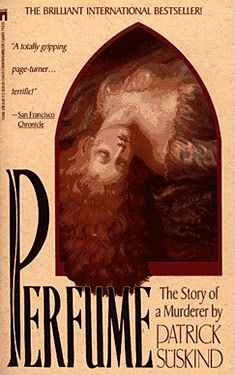
Perfume: The Story of a Murderer

Patrick Suskind
Completed 2/26/2023, Reviewed 2/26/2023
5 stars

This was a beautifully written, intensely creepy book.  It was sort of a fantasy, perhaps a little more magical realism.  I was struck most by the amazing prose of this translation from the German.  There’s very little dialogue, it’s almost all description, mostly from the murderer’s point of view.  It’s about smells and the power they have over us.  I’m not much of a fragrance person.  I used to be terribly allergic to flowers, trees, grass.  I never liked the smell of a freshly mown lawn and perfumes and colognes usually made me gag.  But this book was able to override that guttural reaction and make me believe in the power of the scent.  This book won the 1987 World Fantasy Award.  It was a huge best seller in Europe and obviously had an impact on the English-speaking fantasy community.
Jean-Baptiste Grenouille was born without a scent.  He smells like nothing.  With no father and mother that dies of consumption, he is taken in by the state and given to a series of women to nurse him.  However, none of them can handle him because he eats voraciously, leaving no milk for their own child.  Eventually, he is abandoned to a monastery and then to an orphanage.  Despite having no scent himself, Grenouille has an almost supernatural sense of smell.  He can actually walk around in the dark because he can smell everything and everyone in his way.  After a traumatic childhood, he realizes what he must do.  He becomes an apprentice perfumier.  There he learns the components of every smell that exists and how to extract it to then combine it into a perfume people will love.  However, he also finds that the most amazing smell is that of a virgin girl.  This leads him to unspeakable acts trying to create the perfect scent.

I didn’t know what to expect with this book, sensing that it was another non-traditional fantasy.  What immediately grabbed me was the prose.  It is astonishingly beautiful.  When there isn’t much dialogue, the prose needs to be outstanding to hold me as a reader for very long.  This book did it.  It’s not very fast paced.  In fact, it could have dragged in several places, especially during Grenouille’s apprenticeship, but Suskind kept me reading with descriptions that moved the story along.  

I didn’t feel the empathy I usually do for characters in a book I rate this high.  But I felt like I knew Grenouille with an intimacy that’s almost scary.  He’s not a particularly likeable character, especially when you know what’s coming from the book’s blurb.  Still, I became consumed in wanting to know what makes up this character.  You learn that from his interactions with others as well as his interactions with the scents of the world.

I give this book five stars out of five.  It goes against my usual reasoning for rating a book so highly.  Normally, I need a pretty deep visceral reaction to the character or the storyline.  In this case, it was prose and the process of revealing how Grenouille made it through life.  And the ending was shocking.  This book is not a light read.  It’s very dark and very brutal.  It’s not for everyone.  But if you want an intimate account of a strange murderer’s mind, this is the book for you.  


Tuesday, February 21, 2023

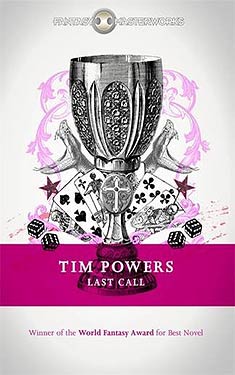
Last Call

Tim Powers
Completed 2/21/2023, Reviewed 2/21/2023
3 stars

I felt pretty meh about this book.  I think it was mostly because it was about something I’m not much interested in…poker.  It had an additional complexity of the Tarot mixed in the game, a variation called Assumption which I never really understood, and so many bad guys I lost track until a bunch of them got killed off.  It’s basically an urban fantasy/magical realism tale with an alternate history bent.  It’s written well with decent prose.  But with all this, it never hooked me.  It won Powers the 1993 World Fantasy Award.

The story is about Scott Crane, a professional gambler.  His bizarre childhood left him an orphan with a prosthetic eye.  He was raised by Ozzie and had a foundling sister Diana.  In 1969, he played a game of Assumption poker in which he apparently lost his soul.  Now, twenty years later, someone is coming to claim it unless he can figure out how to stop him.  The story takes him on a journey to Las Vegas with his cancer-fighting neighbor Arky and his estranged sister Diana to prevent him from becoming the new King and Diana the new Queen of an empire of gambling.  All they while, they are chased by a myriad of bad guys wanting to kill or protect them for their own gains in this empire.

That’s the best I can do summarizing it.  It’s really so much more complex than I can describe.  But to start to describe that complexity gives away all the twists in the story.   There are some things I think I can tell that won’t be spoilers, because they’re revealed relatively early on.  Like the reimagining of Bugsy Seigel from plain old gangster to king of a magical gambling empire.  Or the ghost of Scott’s deceased wife trying to tempt him to embrace her and relinquish his quest.  Those were two highlights that peaked my interest a little.

Part of what kept me from being drawn into the story was adult Scott.  I didn’t empathize with him.  He was simply a character in a story.  I felt no life from him.  Usually, I can identify with characters with self-destructive tendencies, but not Scott.  I had similar mediocre feelings for Diana.  Nothing really drew me to her.  On the other hand, I did like his neighbor who believed that near-continuous drinking of Coors beer would help reduce the tumors growing on his lymph nodes.  He was less morose than Scott.  Arky was colorful, interesting, and hopeful.  

As far as the bad guys go, they all ran into one another, except for one crazy guy who believed Scott and Diana were his parents.  I think he represented the Fool in the Tarot’s major arcana.  He spouted gibberish and danced on ledges like in the depiction on the card.  

I give this book three stars out of five.  I think if you’re more intrigued by Las Vegas and gambling, you’d get more out of this book than I did.  The book has pretty high scores on various review sites.  Powers is a very popular author, writing in various subgenres of fantasy.  The previous book of his which I read was The Stress of Her Regard, an interesting twist on the vampire trope.  However, I found that to be also a middlin’ three stars.  I have one more chance in this Mythopoeic/World Fantasy Award challenge to read Powers.  We’ll see if that book hits a homer, or if it’s the third strike.


Monday, February 6, 2023

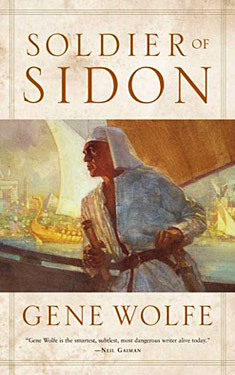
Soldier of Sidon

Gene Wolfe
Completed 2/6/2023, Reviewed 2/6/2023
4 stars

I really liked this third entry in the Latro series, much more than Soldier of the Mist and Soldier of Arete.  But, like his first two novels, I was occasionally lost.  In this book, I somehow missed that Lucius (known as Latro to many of his adventuring acquaintances) had made it home before going on a third outing.  As with the first two books, there are many spots where I got a little lost, which I think is intentional on Wolfe’s part.  It’s part of the conceit of the book.  Latro still has severe memory loss, not remembering the past and forgetting the events of each yesterday.  So we only know as much as Latro writes down on his scroll and he doesn’t write everything as a fluid narrative, but as a tool to help him remember what has happened from day to day.  By this third book, I totally bought into the conceit and was happy to be back in this world where every day is completely brand new.  This book won the 2007 World Fantasy Award.

Captain Muslak from the previous books finds Latro and asks how his memory recovery is progressing.  When he finds out Latro hasn’t recovered anything, he offers to take him to Riverland (Egypt) in search of a god who can cure his memory loss.  Latro agrees and Muslak puts together a crew to accompany them.  The gods still speak to Latro, and this time it’s the Egyptian gods who task Latro with a mission to a shrine in Nubia near the source of the Nile. Along the way, they pick up temple singers, aka prostitutes, to keep Muslak and Latro happy.  On the way, Latro encounters gods and magical creatures who sometimes threaten, sometimes help him in his mission.  

One thing I really liked about this book was that Wolfe used the actual names of the Egyptian gods and place names.  It made it easier to keep which gods were helpful and which were not, compared to the Greek Pantheon of the first two books.  And there was a lot more interaction with the supernatural in this volume.  One character which was quite the surprise was a woman made of wax who normally only appears when called by her husband.  However, for some unknown reason, Latro also makes her stir.  She wants to be Latro’s lover or wife, having him eschew the prostitute.  Besides trying to get Latro for herself, she needs the blood of a human woman to stay young.  

Latro himself is a wonderful character, an innocent due to his mental condition.  Latro is relatable and I empathized with him.  Whenever he had a slave, he wanted to free him or her.  He had a general kindness toward people and pets.  He suffered from blood guilt, feeling guilty for murder of people, real or imagined.  He didn’t trust many people, and from day to day, his level of trust would change.  Somehow, he was always able to feel love.

Wolfe’s fans waiting 17 years for this book, and having read it, were ready to wait another 17.  Unfortunately, Wolfe died in 2019, so a fourth book was never written.  There isn’t exactly a cliffhanger in this volume, but it doesn’t end neatly.  Rather, it ends abruptly, leaving the reader wanting more.  I guess that’s one of the signs of a good book, leaving the reader wanting more, and I did.  I give this book four stars out of five.  I think Wolfe, like Robert Silverberg, are two underrated authors in genre fiction.  I always keep an eye out for their books at used bookstores and on sale for the e-reader.  They both have great imaginations, and are terrific writers.  They belong to a category of sci fi/fantasy writers who should have been more accepted by the wider public. 


Monday, January 30, 2023

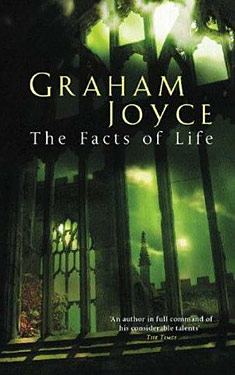
The Facts of Life

Graham Joyce
Completed 1/29/2023, Reviewed 1/29/2023
5 stars

This is one of those books that really is general fiction with just a touch of fantasy or perhaps magical realism.  And yet that touch brought it to the forefront of readers enough to win it the 2003 World Fantasy Award.  The book is about a large, quirky family, some of the members being able to see ghosts.  It takes place during and shortly after WWII in Coventry, England.  Joyce has been compared to many authors, but I’d say he reminds me most of early John Irving.  The prose is luscious and the characters are, well, quirky.  And I found it to be one of the most entertaining, engrossing, and tear-jerky novels I’ve read in a long time.

Martha is the matriarch of a family of seven daughters: Aida, Evelyn, Ina, Olive, Una, Beatie, and Cassie.  The youngest, Cassie has just had her second baby out of wedlock, this time, by an American GI in England during the war.  But this time, she can’t give the baby boy up.  Martha and the sisters are worried about the welfare of the boy because Cassie has “blue” periods where she sees her dead dad and goes off for days.  She’s clearly bipolar.  But it’s the mid- to late-40s, and some issues are kept in the family.  Martha figures a way of keeping baby Frank out of harm’s way, by having Cassie and Frank live with her, then with the families of the other sisters.  

At first Cassie is a little off-putting.  I was disturbed by her keeping the baby when she clearly has mental health issues.  However, Martha, with her pipe and stout beer, is like a conductor, orchestrating the care of Frank amongst all the sisters.  Not only does it give us insight into all the sisters, but also Cassie and Frank and how they live and react to the changing environments.  Frank gets to live on a farm with Una and her husband, with the spriritualist twins Evelyn and Ina, with the anarchist Beatie, and with the prim and proper wife of an embalmer Aida.  And during this, Cassie gets to have blue funks while Frank is cared for.

I really liked all the characters.  I was amazed at how Joyce could fit so much character development in three hundred pages.  I felt I had a really deep sense of each of the sisters.  The husbands got occasionally confusing, though.  The big issue in the family is that Martha, Cassie, and Frank can see and hear the dead.  It’s not overwhelming, but happens every now and then.  For Martha, the occurrences are generally prophetic.  For Cassie, they signal a bipolar swing.  For Frank, well, his experiences are just plain creepy.  

It's a little hard to write about this book.  It’s just a wonderful slice of the lives of a very peculiar family.  It’s executed so well that I loved every minute of my reading and had a few tears at the end.  I was wrapped up in all their dramas and quirks.  There’s even an appearance of the “ghost” of Lady Godiva, who hailed from Coventry.   I give this book five stars out of five.  I may be rating this high because it reminds me of how good general fiction can be.  It’s certainly not the best fantasy out there, but it’s one of the best near-non-genre books I’ve read in a long, long time.


Saturday, January 28, 2023

Suldrun’s Garden

Jack Vance
Completed 1/28/2023, Reviewed 1/28/2023
4 stars

This was a tough book to like, but in the end, I did like it.  It’s the first book in a sprawling fantasy trilogy that takes place on an imaginary isle south of the British Isles, west of France, and north of Spain.  The isle is made up of about ten kingdoms, all vying for a return to a single kingdom.  It has many plotlines and characters, making it occasionally a little difficult to keep up with.  I’d say it’s somewhere between “Lord of the Rings” and “A Game of Thrones” in its hugeness.  I read this book because the third book in the trilogy won the WFA, of which I am reading all the winners.  It took me a while to get through its denseness, but I think it paid off in the end.

The book opens in the kingdom of Lyonesse, ruled by Casmir.  He has a daughter, Suldrun, whom he wants to use to forge an alliance with another kingdom.  She wants none of it, preferring solitude.  So he exiles her to her beloved garden where she often hid from her teachers and minders.  She meets a castaway young man, a prince, who was nearly killed by his cousin, and they fall in love.  She becomes pregnant, much to the consternation of her father, but her son is the subject of a prophesy.  Casmir throws the prince in a pit.  When Suldrun’s son is born, he is hidden away and later swapped with changeling.  And this is just one of the many plotlines, but it lies at the core of the book.  

There are many different storylines in this book.  Vance changes the focus of the narration between all the major players in this book to develop each character.  I found it a difficult form to follow.  Once I got comfortable with a character and his/her plight, the POV changes, making the reader get used to a new character, often in a different part of the isle.  All the characters do come together at various points in the book, culminating in an exciting climax, but the process of getting there bothered me.

Nonetheless, the book is well written, with lovely prose for the most part.  The dialogue is a little medieval, but not boring.  The world-building is fascinating.  It is one of the most well-thought-out fantasies I’ve read in a while.  The complexity of ten kingdoms and its geography, castles, and rivers is superb.  It is a sausage fest, though.  There are only a few women in the book.  The book was first published in 1983, so I can forgive this for the time frame in which it was written.  

I really liked Suldrun.  The plight of the introspective and subversive girl tore at my heartstrings.  When the POV shifts to another character, I was frustrated.  I wanted to story to go back to her perspective.  However, the thoroughness of Vance’s establishing of characters was well done and I did find myself having a lot of empathy for many of the characters, even some of the bad guys.  

The one thing that bothered me the most though was the LGBTQ+ content.  One of the bad rulers has a sexual relationship with a wizard.  I felt like Vance was using a gay relationship as a way to further the evilness of the character.  And often in the story, Vance uses the term sexual perversions, which simply gets under my skin.  Again, I had to step back and say to myself this was the early ‘80s and it was written by an old, straight, white guy.  It didn’t make it better, just a bit more tolerable.

Despite my dislikes of the book, I give it a four star out of five rating.  I think it’s an underappreciated fantasy epic that should have lasted with a little more prominence than it has.  I would recommend this book to fantasy lovers, as it has everything from kings to faeries, wars and magic.  Sometimes the political intrigue gets a little overbearing, but it’s not all politics.  I’ll be picking up the next book in about a month or so, so we’ll see how that one holds up.


Monday, January 16, 2023

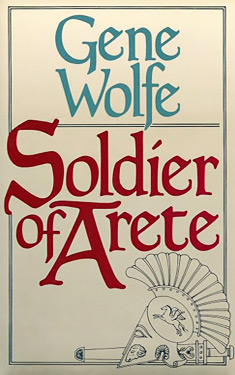
Soldier of Arete

Gene Wolfe
Completed 1/16/2023, Reviewed 1/16/2023
4 stars

For some reason, this second book in the “Latro” series held onto me a little better than the first, Soldier of the Mist.  Perhaps it’s because I read it over one long weekend rather than over a week.  I think it was easier to remember the complicated story line and Greek character names when read all at once.  There are still a lot of characters and their names are often long and complex.  The plot meandered quite a bit, with there being three parts to the book which made me lose the main plot.  But I did like it.  Thankfully, I don’t have to wait seventeen years like his fans did for the next book.  “Soldier of Sidon” came out in 2006 and hopefully brings a conclusion to the story.  “Arete” was nominated for a couple of 1990 awards.

I’m not really sure of the plot.  The overarching storyline is the continuation of the Roman with amnesia and short term memory loss.  He still doesn’t know who he is or where he’s from.  He travels with a group of people, most of whom care about him and try to help him in his quest to get his memory back.  Their progress is regularly interrupted by skirmishes and redirection due to the Latro still being a slave.  This time, he has encounters with Amazons who come to his aid when he is attacked.  His entourage also grows by a lame man, a nymph, a young boy, and a man whose hand he chopped off during a battle.  His travels take him through the Greek coast (I think) to find an escaped convict.   He ends up in Sparta where he participates in athletic games that alternate with the Olympiad.  Throughout the journey, he continues to see gods, ghosts, and this time, mythical beasts.

Latro, whose real name may be Lucius or maybe Lucas, grew on me as a character.  Where in the last book I found him to be a frustrating narrator, I found myself empathizing with him.  I guess I finally accepted the basic conceit of the book.  I also came to like Io, his own slave, a young girl, perhaps a teenager, who might be falling in love with him.  Latro also picks up another slave, Polos, a boy without a family who doesn’t want to be free because he’s afraid that he will be picked up by an abusive master.  I think the thing that really got me about Latro, though, is that he becomes a reluctant hero.  He has no idea what he can or can’t do, so he surprises himself and others as he battles the different enemies they come across.  Everyone in his entourage grows more respectful of him and this reputation as hero spreads throughout the land.  

The prose is very nice, but I think the form of the novel makes the action less dramatic.  Latro writes down everything of significance of the day that night so that he can read it the next morning and have some inkling of what’s going on.  The way he (and of course, Wolfe) writes is that the end of a chapter has something significant happen, but then it is explained the next chapter.  While the events are dramatic, there’s no excitement because we already know what happens.  It’s like exposition, but not quite.  So while I was into the story, it didn’t propel me from scene to scene.  

This certainly is not a series you can read quickly.  It requires a lot of concentration.  One of my friends calls Wolfe’s writing byzantine, and I must agree.  While it doesn’t propel you through the book, you do end up trudging (as in walking with intensity and purpose) through because you want to see what happens next to Latro.  I give the book four stars out of five, which is really a round up from 3.5.  I liked it better than the first book and still want to see what happens in the next.


Saturday, January 14, 2023

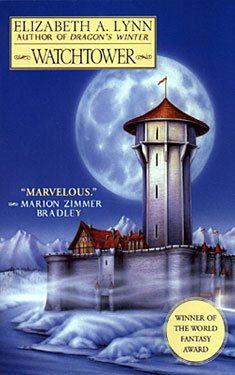
Watchtower

Elizabeth A. Lynn
Completed 1/14/2023, Reviewed 1/14/2023
3 stars

This is the first book of a series called “The Chronicles of Tornor”.  I read the third book several years ago and really liked it.  The Northern Girl had excellent world building and characterization, particularly for the third book in a trilogy.  However, the books are somewhat standalone, taking place in the same universe.  “Watchtower” was not as enjoyable as the other book.  I found the prose to be quite dense and erratic: sometimes long, confusing sentences, other times too short and choppy.  I never quite cared for the main characters.  Still, this book and author are considered big names in feminist and LGBTQ+ fantasy literature.  It also won the 1980 World Fantasy Award.

This book was published in 1979, so the plot over forty years later feels rather tired.  When the northern hold of Tornor is conquered by a southern invading army, the former prince Errel and his trusted man Ryke escape, making their way to a secret southern valley.  There they experience a new way of dealing with life and conflict.  After a short time, Van, the leader of the Valley assembles a small group of his people to join Errel and Ryle to return to Tornor to overthrow the usurper.

The overthrowing of the usurper is such a common trope that I had lots of trouble getting into the book.  It begins at the end of the war.  Prince Errel is made a jester and Ryke is sworn to defend the usurper Col under pain of Errel’s death.  I found this beginning incredibly tedious.  It unfortunately set the tone for the whole book.  I didn’t begin to get interested in it or the characters until they found the secret valley and meet Van and his people.  There, at least, valley’s inhabitants were more colorful and their actions more interesting.  

The narration is from Ryke’s point of view.  It was an interesting choice because he never finds peace in the hidden valley the way Errel does.  Ryke’s mind is solely on revenge on Col the usurper for killing the lord of Tornor and abusing Errel.  This too was tedious.  I never found myself liking Ryke.  I was much more interested in Errel who seemed to have more diverse emotions and was certainly more open to new experiences and ideas.  There’s a sense of an unspoken homoerotic tension between Ryke and Errel that I felt and was glad to see others felt once I read some reviews.  A lesbian relationship is later revealed as well.  And for 1979, this book good, strong female characters.  

I read this book in ebook format, borrowed from the library.  The page count was 113.  What I didn’t realize was that in hard copy form, the book is about 250 pages long.  So as I read, particularly in the first third of the book, every page was two to three swipes.  I would read for an hour and only get through about eight to ten pages.  It added to the tedium of that first part, feeling like a page took forever to get through, achieving no progress.  

I give this book three stars out of five.  I was thinking of giving it two stars, but it does have some neat moments, like the time spent in Van’s valley.  And I have to say, despite not liking Ryke, I did become invested in his revenge.  I don’t know how the second book is, and I don’t know if I’ll get around to reading it, but the third book was quite good.  I’m also interested in another book by the author, “A Different Light”, considered a classic in LGBTQ+ genre literature, so much so that a now famous bookstore in San Francisco was named after it.