Wednesday, March 23, 2022

The Island of the Mighty

Evangeline Walton
Completed 3/21/2022, Reviewed 3/22/2022
3 stars

This final branch of the Mabinogion was actually published first in 1936.  It didn’t do well and thus the others weren’t published at all at that time.  They were all finally published in the 70’s with this one being reprinted first.  Why they were printed at this time out of order I don’t know, but reading it in the order I did made sense.  This one was tough to get into because the heroes of The Song of Rhiannon are beaten by the main characters of this book.  So it begins with you feeling like you’re being manipulated.  By the end of this one, I did like one of the main characters and kind of liked another.  But getting from beginning to end was difficult mainly for this reason.  
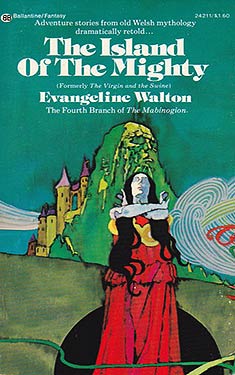
The branch is divided into three sections.  “The Pigs of Pryderi” takes us to King Math and his nephews, one of whom, Gwydion, is the crown prince.  They discover that Pryderi from “Rhiannon” has been gifted pigs from Fae, animals that never existed on the Island of the Mighty.  They get it in their heads to steal the pigs from Pryderi, which instigates a war.  In addition, the nephew Gilvaethwy forces himself upon a virgin attendant of King Math.  So lots of trouble ensues.

In “Llew”, Gwydion offers his sister Arianrhod as the new virgin attendant of the Math.  The King discovers she’s pregnant and forces the baby out of her.  The baby, Dylan, is a child of the water and swims away.  In addition, something else comes out of Arianrhod which Gwydion saves and incubates.  The result is Llew, whom Gwydion raises as his son, hiding him from Arianrhod.

In “Loves of Blodeuwedd”, Arianrhod hates her children and curses Llew.  Gwydion finds ways to circumvent the curses, but nothing happens without consequences.  In the last curse, Arianrhod prevents Llew from falling in love with a woman.  So Gwydion creates a woman, Blodeuwedd, for Llew from magic.  But even this goes awry and Gwydion must save Llew.  

The first story didn’t endear me to Gwydion because I had spent so much energy developing a relationship with Pryderi in “Rhiannon” who I was rooting for.  It took most of the second part to come to sort of like Gwydion.  Fortunately, Llew was pretty likeable and Gwydion’s caring for him softened me up to him as well.  It was too bad the only women in the book are portrayed negatively, Arianrhod particularly.  She represented the attempt to uphold the matriarchal values amid the conversion to a patriarchy.  She’s the only strong woman in the book and all her energy is for evil.   And in the end, she’s punished for it.  

I give this book three stars out of five.  The stories are good, intense, and dark.  I just never felt completely immersed in them.  The prose is good, but still felt archaic, and the world building is good.   But I had no emotional connection with any of the characters.  I wonder if this retelling were written today, with a more modern sense of prose and character development, would I have liked it more.  I think the answer would have been yes.  


Tuesday, March 15, 2022

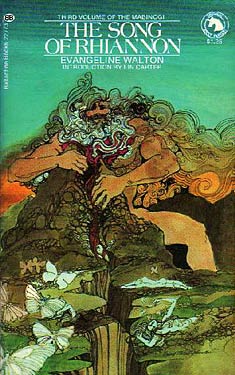
The Song of Rhiannon

Evangeline Walton
Completed 3/14/2022, Reviewed 3/15/2022
4 stars

This book completes my reading of the Mythopoeic Award winners.  It won in 1973.  It’s the third branch of the Mabinogion Tetralogy.  It begins with a tale that is actually a part of the first branch in the original epic.  Then it jumps ahead to the time shortly after The Children of Llyr.  It’s about the only survivors of the royal family of Dyved after the great war with Ireland and their interaction with the Fae.  It’s not as dark and intense as the second branch, but still, any dealing with the Fae does not a happy book make.  I liked this book a lot even though the middle dragged a bit.

The book begins with the story of the birth of Pryderi, the son of Prwyll (from The Prince of Annwn).  After the formerly enchanted Rhiannon gives birth to him, he is snatched by some evil force.  Rhiannon’s guardian ladies who had fallen asleep rather than keeping watch make up a story that Rhiannon killed and ate her son.  Because she is fae, the people mistrust her and the Druids don’t like her and so believe this wild story.  She suffers punishment until Pryderi is snatched back from the other realm.  The story jumps ahead to when Manawydan, the brother of Bran the Blessed returns to Dyved with Pryderi after the great war with Ireland.  Pryderi reunites with his love Kigva.  He offers his mother Rhiannon to Manawydan, as Prwyll is long dead.  The two couples more or less live happily for a time.  Then Pryderi makes a decision that wipes out Dyved.  The four are the only remaining people and must figure out a way to survive and eventually find a way to restore their country.

The interaction of the main characters is what makes this book.  Despite the dialogue being wooden in parts, I really got attached to the four of them.  Again, like in the previous books, the writing is readable, but rather old fashioned.  So it would follow that the dialogue would be a little wanting. But all the characters were pretty well-rounded.  I especially liked the treatment of Rhiannon.  She has some essence of the goddess in her.  She is strong, opinionated, and will fight for what she believes in.  Her relationship with Manawydan is one of equals, reflecting the matriarchal society of the Old Tribes.  I like that this branch is named after her.  However, she isn’t the star of the story, it’s Manawydan.  The narration primarily follows him and his trials and tribulations with the forces of Fae.  

Unlike many series, I’ve been enjoying reading these books in succession.  The world building is pretty great, and by this third branch, it feels complete.  This book could be read as a standalone, but I think a lot would be missed because of the building of the world over the previous branches.  I also liked that Walton chose to move the story of Pryderi’s birth, kidnapping, and recovery to this branch.  It helps give a good perspective of the relationships between Rhiannon, Pryderi, and Manawydan.  

I give this book four stars out of five, despite it dragging somewhat in the middle.  After Dyved is destroyed, the little family of four move from town to town trying to survive.  Over and over, they create a business, make lots of money, and then nearly get killed by the jealous competitors.  It was repetitious, but I thought it added insight into the characters.  I’ve already begun reading the fourth branch, which I believe is divided into three parts and is the longest of the branches.  I’ve got about a week left to read it, as this is a library ebook that I can’t renew since there are holds on it.  So I better get on it.  

Oh yeah, and this is the Rhiannon that Stevie Nicks wrote about for Fleetwood Mac.  However, I’ve read somewhere that the naming was a coincidence and she hadn’t read any of these books before writing the song.  Since this info come from the internet, I’m not sure which is apocryphal and which is truth.  Maybe some hardcore Steve Nicks fan out there knows the true story.  


Thursday, March 10, 2022

The Children of Llyr

Evangeline Walton
Completed 3/9/2022, Reviewed 3/10/2022
4 stars

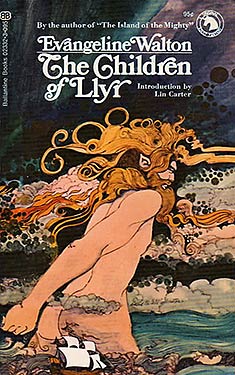
Interestingly, this second book (or branch) of the Mabinogion was published first.  The first book, The Prince of Annwn, was published third.  But I’m reading them in order of the branches, not published order.  This book was much more enjoyable than Annwn.  It’s a darker story, a tragedy that ends terribly.  It reminded me of Shakespeare’s “Titus Andronicus” for the heaviness of the tragedy.  It read better than Annwn as well.  My feeling is that it was told better and much more happens.  This book was nominated for the 1972 Mythopoeic Award.

The story once again takes place in Wales.  It begins with Llyr, married to the sister of the king.  He has two children.  The eldest, Bran, is destined to be king per the matrilineal order of selecting kings.  In a tragic beginning, Llyr is out collecting taxes for the king.  His kidnapped by a tribal leader.  The ransom is that the leader wants to have a night with Llyr’s wife.  She accedes.  Llyr is released and his wife bears twin sons.  Later, she bears a daughter by Llyr, Branwen.  When the children are adults and Bran is king, the king of Ireland arrives and wants to marry Branwen.  She falls in love with him and Bran, Manawyddan, and Nissyen agree to the bargain.  However, the evil twin, Evnissyen, is furious that he wasn’t consulted and that they would let her marry an outsider.  He kills a Irishman and mutilates two of the king’s horses.  Bran rectifies the situation by offering the Irish king a cauldron that brings back the dead.  He agrees, but the relationship between him and Branwen becomes tense.  She bears a child who will become king of Ireland and would also succeed Bran, unifying the countries.  However, the king’s closest men despise Branwen and convince him to make her a kitchen drudge, suffering abuse and despair.  This leads to terrible bitterness and eventual war.

That’s just the bare outline of the story.  There are so many more details in this terrible story of distrust and xenophobia.  And all this tragedy makes for really good characterization.  I felt much more attuned to who the characters were in this book.  I could empathize with Bran, who besides being a wise and gentle king, was also a giant.  I also felt the love and the despair of Branwen as she goes from Irish queen to an abused servant.  Even Evnissyen, the evil twin, has a background that makes his badness understandable.  

While this book is much more readable than its predecessor, it’s still kind of old in its storytelling style.  Walton’s goal was to flesh out the myth, but it reads much more like some of the stories from Tolkien’s Silmarillion than a contemporary fantasy novel.  It’s a little dry.  Still, there’s enough going on that it carries you through the dull parts.  I give this book four stars out of five.  


Sunday, March 6, 2022

The Prince of Annwn

Evangeline Walton
Completed 3/6/2022, Reviewed 3/6/2022
3 stars

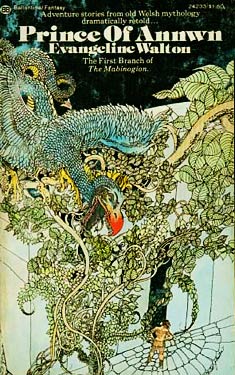
This book is the beginning of a tetralogy written by an American unassuming lover of fantasy and especially the Welsh collection of mythological tales called the Mabinogion.  Walton wrote four books retelling the Mabinogion, but only the last was published at the time and it didn’t fare well.  However, when fantasy grew in popularity in the 70s, that book was rediscovered.  A publisher searched for Walton and found her in seclusion in Arizona.  They found out she had three other books written and all four were published.  She gained fame for the work, being called by many one of the greatest fantasies ever.  This book was nominated for the 1975 Mythopoeic Award. 

This book is divided into two parts.  The first introduces us to Pwyll, the Prince of Dyved.  Dyved is in pre-Christian Wales at a time when the goddess-centered beliefs of the Old Tribes are being muscled out by the male god-centered beliefs of the New Tribes.  Pwyll is of the New Tribes, but doesn’t necessarily hold the old beliefs in complete contempt as his Druids do.  While out on a hunt, Pwyll meets Arawn, King of the Underworld.  Arawn gives him the quest of killing the one being he himself cannot kill.  He exchanges places with Pwyll for a year, though to Pwyll it seems only a few days that he is in the Other world.  While there, he meets his future love interest, Rhiannon, a goddess.  In the second part, Pwyll is being blamed for the bad weather, crop failures, and general despair of Dyved because he does not have a queen.  Rather than abdicate or succumb to assassination by the Druids, he goes in search of a mystical answer.  There he meets a woman who turns out to be Rhiannon, though at first, he doesn’t recognize her as the goddess; she is just a magical being from the Other world.  On his wedding day, he is tricked into giving her to someone else and must somehow find a way to win her back.

I wasn’t overwhelmed by this book.  I’m always up for mythological retellings, but found Walton’s storytelling style to be dry.  The prose is very plain.  Walton said that her goal was to flesh out the basic myths, but it felt like she didn’t go far enough with that.  Apparently, she sticks very well to the original story, which it is believed was first written in the 11th century and translated in the last century.  There just didn’t seem to be much life in the telling.  

In both stories, Pwyll is the main character.  We do get a sense of who he is, but it’s not deep.  We just know that he is an honest man with integrity and a fighting spirit.  Despite being of the New Tribes, he is less dismissive of women than the Druids and many of his peers.  I liked him but never empathized with him.  We don’t get much development of the other characters.  We know that Arawn is Death and is not necessarily a trickster.  And we know that Rhiannon loves Pwyll.  But that’s about it.  

I give this book three out of five stars.  I’ll continue reading through the series since the third book won the Mythopoeic Award and it is the last of the award winners I have yet to read.  I may even read the fourth book, more to complete the series because it is considered a classic.  But I’m hoping that the writing gets better, or I somehow become more attached to the characters.  


Friday, March 4, 2022

The Beast Hunter

Lindsay Schopfer
Completed 3/3/2022, Reviewed 3/4/2022
4 stars

I met Lindsay at the Oregon Science Fiction Convention last year.  He’s a very nice guy and we talked quite a lot about different things.  I’ve bought a few books by authors exhibiting at Orycon before, though not many because I always have personal reading challenges that I’m in the midst of, usually all the winners of some SF/Fantasy/Horror award.  But when I have some extra cash at Orycon, I like supporting the Pacific Northwest authors who come to promote their books.  I was pleasantly surprised by this book, the first of a trilogy about Keltin Moore, a beast hunter.  Sort of a Dresden Files meets Lovecraft, but a lot more serious.

Keltin comes from a small town where he makes his living hunting the strange monsters that roam the countryside.  When a call for beast hunters in the far away country of Krendaria comes, Keltin answers out of duty to his craft and to make some extra money to send to mother and sister.  Upon arriving, he meets members of other humanoid species who have also answered the call.  He also finds that Krendaria is on the verge of revolution because of food shortages due to the destruction by the monsters.  The beast hunters are funded by a Baron and led by a military man.  It soon becomes evident that a military approach won’t work for hunting and killing the monsters.  Keltin steps up, offering a different approach, which is actually accepted by the leaders and proves to be more successful.  However, there are so many monsters that only the southern half of the crops might be saved.  Keltin goes with a small group to the north where the concentration of monsters seems higher to stave off their movement south, hopefully allowing the southern farmers to harvest their crops.  

I really liked Keltin.  He’s a self-made person who has become one of the best monster hunters around.  It is his idea to let hunters use their own tactics rather than follow a military-style organization.  He’s not a leader but finds himself leading a group of hunters.  He doesn’t have the forward thinking of a leader and is wracked by guilt over decisions he’s made that led to harm of his unit.  He may be one of the best hunters in the land, but he’s also very human.

I also like the representatives from the other species that were on the team, particularly the Loopi, as well a nomadic tribe, both of which have to deal with prejudice and mistrust, even among their hunter peers.  The nomadic peoples have a way of calling upon their ancestors for insight and power.  And the Loopi have a psychic-like power that might be the only weapon against an invisible monster that distorts the reality around it and causes intense mental anguish.  

The character development is really good, with interesting backgrounds and experiences.  Keltin himself is great but flawed.  He’s the focus of the third person narration, so we get to know most about him.  The plot is really terrific, though I found it pretty straight-forward.  By that I mean there aren’t multiple threads weaving in and out of each other.  It’s about Keltin’s journey to Krendaria and the killing of monsters.  The prose is quite good, having an immediacy and good pace while still being descriptive and interesting.  Lastly, the world-building is phenomenal, a sort of steampunk wild west sensibility, but you’re not distracted by dirigibles and clockwork mechanisms. 

The one thing I thought was missing was a sense of humor.  This book is very dark and fast paced.  I would have liked to have seen some sort of mild comedy to break up the intensity every now and then.  In that sense, it is more Lovecratian than Dresden.  But I don’t want a Dresden Files clone.  I wouldn’t want this to be too closely compared to that series.  I think the book stands on its own, perhaps more comparable to chasing monsters in role playing games.

I give this book four stars out of five.  It’s a darn good action tale with deep characters and a wild setting.  I’m glad I picked up this trilogy and look forward to reading the next installment. 


Sunday, February 27, 2022

Wojtek the Bear: Polish War Hero

Aileen Orr
Completed 2/26/2022, Reviewed 2/27/2022
4 stars

My first non-fiction in a long while.  This is the true story of a bear who became a mascot for the Polish Army in Iran during World War II, carried ammunition while fighting in Italy, and became a symbol of freedom for the Polish servicemen transported to Scotland.  It’s a heartwarming book about a ray of hope during brutal times.  It’s written by a woman who actually saw Wojtek when he was in the Edinburgh Zoo.  She was the granddaughter of a Scot who regularly visited Wojtek when he was still living with the Polish Army that was relocated to Scotland.  It’s a terrific book, full of true anecdotes and perhaps some myth that grew up around Wojtek.  I really enjoyed it.  It was a nice break from all the fantasy I’ve been reading these past several months. 

The tale begins with a part of the Polish Army that escaped to Iran.  An Iranian boy was carrying a big sack.  Using hand gestures, the soldiers asked what was in the sack.  The boy put it down and out popped a bear cub’s nose.  The soldiers bought it off the boy and raised it as their mascot.  As often happens with animals raised from infancy around humans, it began to think it was human.  Unlike most bears in captivity, it almost never became aggressive.  They named it Wojtek (pronounced Voytek), short for Wojciech (pronounced Voychek with an aspirated k).  Raised among the Poles, it came to recognize and love the Polish language.  When the Army was eventually sent to Italy to fight, Wojtek came along.  The story goes that one day, the soldiers were carrying ammunition.  It was arduous work.  Wojtek watched the men do it.  Always wanting to be part of the men’s activities, it taught itself to carry ammunition as well.  This is depicted in the original cover of the book.

After the campaign in Italy and at the end of the war, the soldiers were sent to Scotland.  They could not go back to Poland lest they be considered spies against the new Bolshevik regime and executed or sent to a labor camp in Siberia.  Wojtek came with them.  They spent a few years there, but soon something had to be done with all the displaced Poles, as well as with Wojtek.  The Edinburgh Zoo offered to take him.  The rest of the book covers Aileen’s efforts built a memorial statue to Wojtek and the Polish soldiers who raised him, primarily as a symbol of the Scottish-Polish relationship.  

The book is wonderful, full of little stories about the bear and the men who were responsible for him.  Unfortunately, there is an epilogue that seemed completely unnecessary.  It was written by someone else who felt that the book needed context with the Second World War.  It recounts in about fifty pages, the circumstances of Poland leading up to WWII, during the war, and the betrayal by the Allies at the end, leaving it for Soviet fodder.  It explains in detail how this part of the Polish Army got into Iran, fought in Italy, and ended up in Scotland.  It’s very informative, and yes, it sets the background for Orr’s story, but it’s written as a hard, quick history.  It’s very depressing, as one would expect, and shares none of the inspiration and hope that’s the point of the book about Wojtek.  

I give this book four stars out of five despite the epilogue.  It is a great tale that has only become known outside of the UK with the publication of the book and Orr’s efforts to have a statue made.  I thoroughly enjoyed the book and almost got a little teary eyed myself towards the end.  The prose is really good, very readable.  I got this and a t-shirt of the original book cover design for Christmas this year.  Now when I wear the t-shirt, I can give a better explanation of the bear that inspired an army and the people with whom they would eventually settle.


Friday, February 25, 2022

Subcutanean 36619

Aaron a Reed
Completed 2/24/2022, Reviewed 2/24/2022
3 stars

This is a weird horror novel, but more interestingly, it’s a permutation novel.  Every copy is different, with different words, sentences, even whole scenes.  So this review is for copy 36619.  The basic premise is pretty inventive.  The basement of a house is a coming together of parallel universes and two college students try to traverse it.  The prose is good and the characterization is really good.  The main character is gay and trying really hard not to be in love with his best friend.  It covers a lot of issues as he reflects on his past, but never detracts from the plot.  This self-published book was nominated for a 2021 Lambda Literary Award.

Orion, aka Ry or Ryan, and his best friend Niko have recently moved into a big house their senior year of college along with quite a few other students.  Ry finds a passageway to a basement through his bedroom floor.  He and Niko explore it a bit, finding it appears to be much larger than the house, with long halls, empty rooms, and lit sconces.  Their curiosity grows and they return to the basement over and over, going farther and farther in.  One day, they find a kitchen deep in the basement with a locked fridge.  But when they come out the other side of it, they seem to be back in the kitchen.  Soon they realize that they’ve entered another universe with little details that are different.  Quickly they start to get headaches and realize they must soon find their way back to their own world.  But that turns out to be a little more difficult than they expected.

Not a traditional horror novel, it’s sort of a cross between a haunted house and a science fiction-y parallel universe.  The horror comes from the guys not being able to find their way back, as well as running into their doppelgangers from the other universes.  Not all are as sweet and average as they are.  Some are zombie like, walking around rather aimlessly.  Others are more coherent, just mirror images of themselves.  And then there are the violent ones, the doppelgangers who have gone crazy from being trapped in the basement and not finding their way back to their own worlds.  The real horror lies in the possibility of never finding the correct universe they need to be in and being lost forever.

I liked both Orion and Niko.  Orion is completely uncomfortable with himself: with his appearance, emotions, his sexuality, and his feelings toward Niko.  He tries to bury everything deep inside himself so he doesn’t have to deal with anything.  The book does take place a few decades ago, in a little more realistically difficult time to be gay.  Niko is a lot more self-assured, though he’s more aimless in life.  He changes his major every quarter, has a tenuous relationship with his traditionally Greek family, and is basically a rather typical young straight college guy.  Still the two fit each other like hands in gloves.  

I really liked the book for the most part.  The introduction to the basement was creepy at first, then was a little boring for a while.  It felt like the author couldn’t keep the level of tension up through the exploration of different hallways and doors.  But then when they get trapped in the alternate universe, it really takes off.  Shortly after that, the doppelgangers appear to them consciously and it gets very creepy again.  I give the book three stars out of five.