Sunday, September 20, 2020

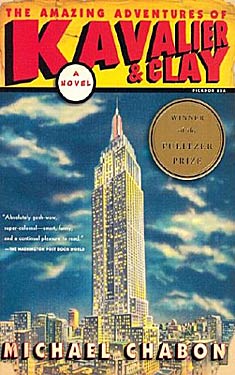
The Amazing Adventures of Kavalier and Clay


Michael Chabon
Completed 9/19/2020, Reviewed 9/20/2020
4 stars 

I didn’t think I’d like this book because I disliked his Hugo and Nebula winning The Yiddish Policeman’s Union.  What I disliked about that book was the prose.  It was overwrought and pretentious.  I had similar feelings with this book.  I found the prose often interfered with the story telling and dialogue, going off on tangents to provide color or context to a thought or scenario.  It still felt pretentious, but not quite as overwrought.  I thought the story was much more interesting and I was able to retain the thought or statement that was interrupted by the prose.  In high school, I went through a phase of reading a lot of Jewish-American literature as introduced by my senior year English teacher.  I loved Bernard Malamud and Philip Roth especially.  This book was right up my alley of this genre.  Speaking of genres this book was nominated for the Gaylactic Spectrum Award in 2001 and won the Pulitzer for 2000.  It’s not science fiction or fantasy.  It’s more meta, being about comic books, sort of in the same vein that Big Bang Theory is about people who love science fiction and fanasy.
The story is about Josef Kavalier, a Czech Jew whose parents send him to America to earn money to get them out of their Nazi-occupied homeland.  After a harrowing escape, he comes to live with his aunt and cousin, Sammy Klayman, in Brooklyn.  Sam discovers that Joe is a talented artist and convinces him to collaborate in creating comic books, a new craze that’s sweeping the country.  They get a job writing a comic book at the novelties company Sam works at, after convincing the owners how lucrative it would be to get into the comic book business rather than just advertising in it.  The comic is a hit and they launch their new careers.  Then life happens:  Joe struggles to raise enough money to get his family out of Prague, he falls in love, Sam struggles with figuring out his sexuality, and the US enters World War II. 

The plot is quite massive.  It covers a span of twenty years with only one leap of years.  It goes back and forth in time to give background on Joe and Sam’s childhoods.  Joe was an apprentice escape artist and magician.  Sam had a distant father who was a vaudeville and/or side-show strongman.  When Joe comes in the US, he and Sam become instant friends.  Together they navigate the world of the late 1930s.  The story continues into the 1940s when Joe joins the navy and is stationed in Antarctica and Sammy gets married to a woman.  Then it leaps to the mid-1950s, with Joe having disappeared and Sam living a suburban lifestyle with a diminishing career.

The characterization is impressive.  I really liked the main characters, Joe and Sam.  I thought they were very well fleshed out.  Joe struggles with his guilt over leaving his family behind in Prague and not becoming instantly rich enough to get them out quickly.  He seems to love his new life, but never feels like he is home.  He falls in love with an artist he meets comically when he breaks into a friend of a friend’s drawing studio.  Rosa is one of the few female characters in the book.  She’s the only major one, besides Sam’s mother who only plays a prominent role at the beginning of the book.  Sam gets a lot of development as the brains behind the duo and as a closeted gay man trying to navigate pre-Stonewall era New York.

I give this book four stars out of five.  I was actually dreading reading this book because of my previous experience with Chabon and his haughty prose.  But I actually was able to get over it within about a hundred pages and found myself only slightly annoyed with it as the book went on.  I don’t know if I would have given it the Pulitzer, but I haven’t read any of the other nominees.  It’s a long book with a sprawling story; it’s over six hundred pages long.  I was captivated by the story:  does Joe get his family out of Prague, does Sam get a guy, do they win fame and fortune from their comic, does anyone live happily ever after.  I wasn’t emotionally devastated by the book, though I had empathy for the characters, perhaps because they were emotionally disengaged a lot of the time, as was stereotypical for men, particularly in the ‘30s and ‘40s.  I would have to say, though, I would give Chabon another chance and read more of his oeuvre, even though it’s not in the science fiction/fantasy genre, or even meta. 

Thursday, September 17, 2020

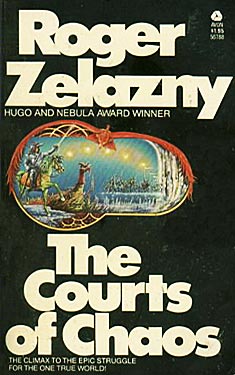
The Courts of Chaos


Roger Zelazny
Completed 9/13/2020, Reviewed 9/13/2020
4 stars

This was a rousing conclusion to the Corwin Cycle of the Chronicles of Amber.  It had action, adventure, magical beings, and a dramatic ultimate scene.  The prose was a little more flowery, but still pretty tight.  All the characters were well established and acted in keeping with who they are.  My only complaint was that the pacing was a little uneven in the middle.  There’s a long set of scenes where Corwin has to journey from Amber to the Courts of Chaos.  He meets many magical beings, but in between these scenes, the descriptions of the lands Corwin was going through as well as his state of being got a little dry.  Otherwise, I really enjoyed this book and found the ending to be quite exhilarating. 


Warning:  Spoilers from the previous books follow!

The book picks up with Corwin back in Amber with his father Oberon back under the guise of Ganelon.  Oberon gives orders for all his children on what to do while he tries to repair the Pattern that Brand has corrupted.  The Pattern is the design from which all realities and shadows emanate.  Oberon offers Corwin the throne of Amber, but he refuses, realizing he doesn’t really want it anymore.  So Oberon sends him off to the Courts of Chaos to do battle using the Jewel of Judgement once Oberon is done with it in his quest to repair the Pattern.  Oberon believes whether he succeeds or fails with the Pattern, the task will kill him.  Corwin begins his journey, eventually receiving the Jewel from a red raven his father created.  Thinking his father failed, he realizes he must try to create a new pattern and return the universe to normalcy.

One of my favorite parts of this book was Corwin coming across the magical beings.  In one scene, he meets a cave of leprechauns who are about to eat his horse.  In another, he makes a staff from the talking tree named Ygg, an allusion to the Yggdrasil, the tree of life, of Norse Mythology.  Then he meets and accompanied by a talking raven named Hugi, an allusion to Huginn, one of the ravens of Odin, also of Norse Mythology.  I’ve always liked how Zelazny borrowed from different religions for his books, like Greek Mythology in This Immortal and Hindu and Buddhism in Lord of Light. 

I also liked the dramatic ending of the book.  I won’t give it away, of course, but I thought Zelazny’s descriptions were very vivid for the fantastical events that took place.  The action was tightly written as well. 

Overall, this series was quite a thrill ride.  There’s definitely a change in tone as the series progresses.  The first two books, Nine Princes in Amber and The Guns of Avalon, are very typical Zelazny.  The Sign of the Unicorn, however, is the book that feels different, becoming more philosophical in nature, and a little slower paced.  The Hand of Oberon continues this philosophical tone but picks up with the action and the tightness of the prose, continuing and culminating in this final book.  My understanding is that the second half of the Chronicles, the Merlin Cycle, again has a different tone and feel, it being published after a seven-year gap, between 1985 and 1991.

I give this book four stars out of five.  The book is a worthy conclusion to an amazingly complex and imaginative work.  I’m glad I finally read it.  I think I’m going to save the Merlin Cycle for next year, giving myself a break and a chance to be open to the differences in its tone and style compared to these books. 

Tuesday, September 15, 2020

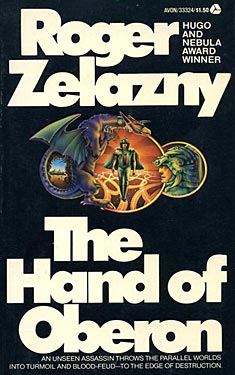
The Hand of Oberon

Roger Zelazny
Completed 9/10/2020, Reviewed 9/11/2020
4 stars

The fourth book of the Chronicles of Amber was better than Sign of the Unicorn, the third.  It combined the action of the first two with the introspectiveness of the third.  It’s prosy but fast-paced.  A lot happens in this book, and the intrigue is fairly intense.  Many of things we learned in book three are corrected as more of Corwin’s brothers and sisters finally begin to talk to him.  And the intrigue surrounds the possible apocalyptic end of Amber.  I really liked this book and am looking forward to the conclusion of the Corwin Cycle of the series. 


Warning:  Spoilers from the previous books follow!

In the last book, Corwin, Random, and Ganelon find the primal Pattern on which all of Amber and the Shadows are derived.  They discover that it has been damaged and this is what has created the Black Road that allows the creatures of Chaos to come through.  The damage has been caused by spilt blood.  They conclude that it was the blood of Martin, Random’s son, because they find a tarot card with Martin’s picture on it with a dagger through it.  They also realize by the style of the card that it was Brand’s card.  Random and Ganelon go searching for Martin to see if he’s still alive and Corwin tries to find out how to mend the Pattern.  He goes back to the dungeon where he was once held captive, finds the design drawn on the dungeon wall and used by the sorcerer Dworkin to teleport.  Corwin goes through the design and finds Dworkin who is in a moment of lucidity.  He presses Dworkin to explain how to fix the Pattern.  It requires the Jewel of Judgement.  Corwin goes after the Jewel, hoping to get it before Brand who seems bent on destroying Amber and recreating it so he can rule reality. 

This book is definitely intense and very complex.  I’m grateful there was a detailed summary on Wikipedia to refresh my memory on some of the details.  The book’s strength is its prose, which is still very tight, even with all the exposition.  And despite being the fourth book in the Cycle, there’s still more character development of the secondary characters.  We finally begin to get a better feel of Julian and Fiona as they explain their roles in the intrigue surrounding Brand and Eric’s battle for the throne of Amber.  There’s also a big exposition by Martin who gives us the backstory on how he grew up away from the family and then stabbed by Brand. 

One thing I missed until I read the Wikipedia article is that Zelazny makes a cameo appearance in the book.  Corwin comes upon a guard smoking a pipe and writing a book.  As the guard describes the book, it sounds a lot like a general description of the Amber books.  I had gotten that part, but missed that the guard’s name was Roger.  I guess I was reading too fast.  In retrospect, it’s pretty obvious. 

I don’t have much else to add, as is common for me when I read a series, especially one as long as this one.  I’ll just say that I give this book four stars out of five and that I look forward to reading the last book today.  Then I think I’ll take a long break before I read the Merlin Cycle, which is the last five books of the series. 

Sunday, September 13, 2020

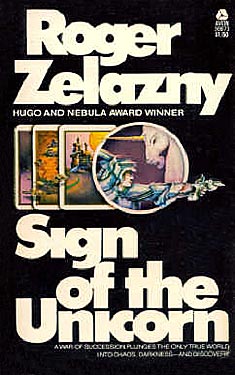
Sign of the Unicorn


Roger Zelazny
Completed 9/9/2020, Reviewed 9/9/2020
3 stars

The third book of Amber has less action than the first two.  It’s set up as a murder mystery.  It has a lot of explanations, conversations, and meetings.  I found it much slower paced and tougher to get into.  There’s a lot of tell me versus show me going on, and while it is written well, it didn’t have the excitement of the first two books.  The Amber universe is pretty much built, so there is not as much wonder.  The writing also did not seem as tight, a lot wordier in the expositions and ruminations.  I felt like Zelazny was much more introspective in this book, even being (comically) self-referential in one scene.


Warning:  Spoilers from the previous books follow!

With Eric dead from wounds acquired in the battle with the creatures of Chaos, Corwin has become the regent of Amber.  Life is still not easy for him, as he has found the body of his brother Caine, and feels that he is being set up for the murder.  He confides in Random, who gives us the back story of how he was living in a Shadow called Texorami when he received a cry for help from brother Brand.  Random went to save Brand, but was stopped by a dragon-like creature and spined human-like creatures.  Random escapes from them and hides with Flora and Corwin, as we had seen in the first book.  One of this type of spined creature is the same type that killed Caine.  Corwin gathers the remaining siblings and tries to rescue Brand, only to have him stabbed by someone as soon as they bring him back.  The siblings try to figure out who plotted Caine’s death and stabbed Brand, and possibly who killed their father Oberon.  

Although there is a lot of exposition in this book, it does provide some additional characterization.  Through it, we learn a lot more about Random and Brand.  We also get insight into Gerard during an altercation with Corwin and as he cares for the stabbed Brand.  We get a little more exposure to the sisters, but still not much.  I also felt like we lost Ganelon, Corwin’s sidekick.  He only has a few scenes, the largest of which is as a device to get Corwin to explain the complex line of succession of the siblings to the throne of Amber. 

In terms of wonder, there is one item that receives a lot of attention, the Jewel of Judgement.  It was worn by King Oberon, as well as by Eric when he claimed the throne.  Now Corwin has it.  Among its many powers is the control over the weather.  But sister Fiona warns Corwin that not all the powers are known and some are deadly.  It seems to be powered by the life force of the wearer, making people and things around him to appear to slow down.  It is said that when people turn to stone, the wearer is near death. 

I was a little disappointed with this book, perhaps because I’m reading the Corwin cycle consecutively and this book has a much different flavor than the first two books.  There are more dreams, visions, and traveling between Shadows.  I had trouble discerning these from reality several times.  And I had to read the last few pages twice to understand the setup for the next book.  Because of this as well as because of all the exposition, I give this book three stars out of five.  I’m hoping in the next book, the action picks up, now that this book has filled a lot of the knowledge gaps from the previous books.


Friday, September 11, 2020

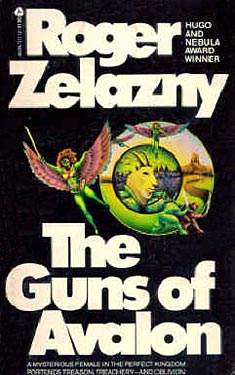
The Guns of Avalon


Roger Zelazny
Completed 9/8/2020, Reviewed 9/8/2020
4 stars

The second book of Amber is almost as good as the first.  It has a little more exposition than I like, but overall, it delivered.  The writing is still tight, even during the exposition, and the imagination going into this universe is still impressive.  Corwin, the protagonist, is still believable as an average person despite being immortal, with relatable emotions and reactions.  He acquires a sidekick in this book and we meet a few more brothers.  The sisters don’t make a reappearance, but there are a few more women introduced.  I’m really enjoying the series so far and am glad I’m giving it a go.

Warning:  Spoilers from the previous book follow!

The book begins with Corwin sitting in the deepest dungeon and blinded by order of his brother Eric.  He spends four years, only getting out, cleaned up, and made presentable for Eric’s annual anniversary of his ascension to the throne of Amber.  During his fourth year, his eyes complete their regeneration and he tries to devise a plan of escape.  This plan accelerates when he’s visited by the great wizard of his father’s reign who is also imprisoned.  Through the wizard, he transports to a distant lighthouse where he receives hospitality and care from the attendant.  After rehabilitating for a while, he sails off for Avalon, one of the Shadows.  There he meets his brother Benedict and devises a plan to import guns from our Shadow using jewelers’ rouge since gunpowder doesn’t ignite in Amber. 

I really liked how this story continued.  It doesn’t start out happy and it doesn’t end happy.  It’s all rather dark.  The darkness is exacerbated by a menace growing in Amber and in many of the Shadows.  This Chaos was brought about by a curse Corwin placed on his brother Eric at the end of the first book.  So besides dealing with trying to gain the throne of Amber, he also has to deal with the monsters that are coming out of Chaos. 

There are some light points in the book, however, including meeting a kindly woman as well as a mysterious woman who seems to know a lot about Corwin.  There’s also the sidekick that Cowrin acquires, Ganelon, a man he exiled from Avalon when he lived there many years ago.  But time, like space, is fluid between Shadows, and Ganelon exists in this Shadow, a self-made man after Corwin caused him to lose everything. 

Considering there are five books in the Corwin cycle of the Chronicles of Amber, I don’t know how informative these next reviews are going to be.  In this book, the writing style and the characterization are similar to Nine Princes in Amber.  I expect the succeeding reviews are going to be shorter, mostly plot summaries and maybe some highlights of things I liked and didn’t like, if they are different from the preceding books.  This book I give four stars out of five.  Despite the couple of expositional scenes, the book is exciting and action packed.  The world-building continues to be excellent.  And I just really like Corwin. 


Wednesday, September 9, 2020

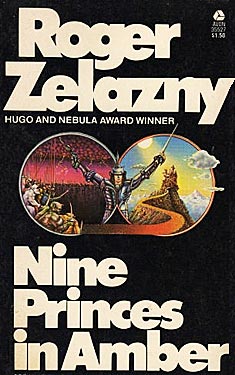
Nine Princes in Amber


Roger Zelazny
Completed 9/7/2020, Reviewed 9/7/2020
4 stars

I really like Roger Zelazny.  Even when I don’t care for a book of his, I still like the writing and the imagination that went into it.  So it was high time I started the Amber series, his magnum opus.  This is his first book of the series and I wasn’t disappointed.  As I’ve come to expect, it features a main character who is heroic, or maybe a little anti-heroic, who may have great powers but also has an average person sensibility to him.  It also has the beginnings of great world-building.  The edition I have was only about 155 pages, and there are ten books in the series, so I realize that a lot more world-building will go on.  The writing, as always, is tight, and is generally dialogue driven. 

Corwin is a Prince of Amber, one of nine surviving sons and four surviving daughters of the last King of Amber.  The story begins in our world, though.  He wakes up to find himself with in a hospital with amnesia, though he remembers a terrible car wreck.  He’s told he has many broken bones and other internal injuries, but he finds he can walk around.  He forces his way out, with clothes, money, and a gun he’s stolen from the hospital accountant.  He also got from him the name and location of the person who admitted him into the hospital, a sister.  He goes to the house of his sister, Florimel, playing as if he knows who he is and tries to piece together his memory.  Then a brother, Random, shows up, and he gets more memory back.  He realizes he is a Prince, and in opposition to his brother Eric who will be ascending the throne of Amber.  As he remembers more, he realizes he must return to Amber to overthrow Eric.  But the question is how to do that.

Corwin is that every man but with special powers that Zelazny writes so well.  He’s a well-developed character that I empathize with, even though he’s not so squeaky clean.  He’s rather self-absorbed, smokes and drinks too much, and wants control of Amber as much as any other of his conniving brothers.  Yet he’s likeable and relatable.  I really liked the plot device of the amnesia, giving backstory on him without it feeling like exposition.  Random is pretty well-developed as well, I think because Corwin begins his journey to Amber with him.  Florimel on the other hand is rather one-dimensional.  Even though she is Corwin’s first family contact after the hospital, I didn’t feel like she was very real. 

Published in 1970, this book is a typical sausage-fest of the era, focusing on Corwin’s brothers.  They’re the ones who seem to have power.  We only meet two of his sisters, Florimel and another, Deirdre, I think, who had such a small role in this book, I didn’t even remember if that’s her name.  There is another female character, Moire, who is the Queen of the underwater realm.  She has a major role in getting Corwin back to Amber, but has only a short appearance in the book.  It will be interesting to see if any of the sisters or Moire comes back later in the series. 

The world of Amber is pretty imaginative.  Amber is the real world, while the Earth we know is just a shadow, one of many.  Corwin and his brothers and sisters can travel between Amber and the Shadow worlds.  In fact, several of the siblings are on our plane of Earth, where the story begins, a few like Eric are in Amber, but the whereabouts of the others is unknown.  They are able to communicate with each other through decks of Tarot-like cards with pictures of the siblings as the major Arcana (I think I’m using that term right in this context).  And the Shadow worlds Zelazny creates are great.  I particularly liked the travel sequence through some of these worlds with Corwin and Random as they try to get to Amber via a Mercedes. 

I give this book four stars out of five.  I really enjoyed it, despite wincing over the female characters.  I’m going to jump right into the next book.  The books in this series are short, as are many of Zelazny’s works, so I don’t feel like I need time away from the world he built, but rather, I need to read more to get more of it. 

Monday, September 7, 2020

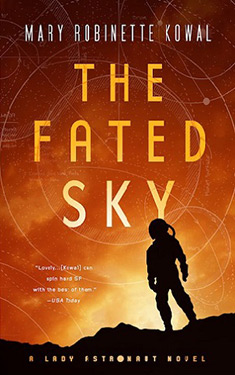
The Fated Sky

Mary Robinette Kowal
Completed 9/3/2020, Reviewed 9/4/2020
4 stars

This is the first sequel to The Calculating Stars in The Lady Astronaut series.  It takes place several years after the events of the first book.  It took me a little while to get into it, but after about fifty pages, I was gripped.  It’s still in the alternative history of an international space program, this time in the early ‘60s, after the eastern seaboard of the US has been nearly wiped out by an asteroid collision.  The climate is changing, a base has been built on the Moon and the race is on to colonize Mars.  And it is told from the point of view of Elma, known worldwide as the Lady Astronaut.  I liked this book about as much as its predecessor.  I thought it was a little melodramatic after the opening sequence, but the trip to Mars was really well done, fraught with peril, and suspenseful.

Elma has just come back from the Moon base after three months.  The ship bringing them home lands about 270 miles off target.  They are boarded by “Earth Firsters” who hold them hostage.  Elma and Helen convince them to let everyone else go and keep Elma to be their spokesperson, giving their demands to the press.  Eventually, the Firsters are subdued and everyone returns home.   Because of her publicity with handling the Firsters, and because after all, she is the Lady Astronaut, she is asked to join first team going to Mars.  She struggles with the idea of being away from her husband Nathaniel for three years, and postponing starting a family.  She acquiesces, but then finds out her coming on kicked a friend of hers off the mission.  This causes tension between her and the crew.  In addition, the mission is being led by Stetson Parker, the sexist pig from the first novel.  She goes with them to Mars anyway.  It being an international crew, the members are from several countries, including a white South African who doesn’t want to be on the same ship as two African-American astronauts and is not so keen on the Arab medic either.  There being three ships going together on the mission, the solution is to have a whites-only ship.  Needless to say, the issues of race and gender play a prominent role in the success or failure of the mission.

Elma is simply a terrific character.  She’s very human, with disabling anxiety and doubts about leaving her husband and missing out on raising a family.  She narrates the story in first person so we feel first-hand her stresses and conflicts.  While she’s very progressive, she doesn’t get that she unwittingly can be condescending to the Leonard and Florence, the African-Americans on the crew.  In a great scene, Leonard says to her “Don’t tell me what my experience is,” which really wakes her up.  She still battles with Stetson Parker, but he does have an actual character arc in this novel.  He’s not as much of a jerk as he was in the first book, but he’s still sexist.  In fact, all the characters on Elma’s ship have good arcs.  The only character who doesn’t is the South African who is simply a bad guy.  But he does serve a purpose to exacerbate the very real tension between the races in the crew.

I was also impressed that there was a gay relationship in the crew.  It was expected that there might be hookups in the crew on such a long journey, but the thought never crosses Elma’s mind until much later in the story.  There’s also a transgender character which I completely missed until I read the Kowal’s notes at the end.  But it did make sense when I sat back and reflected on it.

The only part that I thought was a little melodramatic was when Elma was debating going to Mars versus having a family.  I thought it was a little soapy.  In general, I thought the writing was very tight, but this part didn’t feel the same.  But it brings up an important issue that women face in life.  It’s a tougher choice here because it’s still the ‘60s in the story and there isn’t day care, and well, being en route to Mars without her husband for three years isn’t a day job. 

I give this book four out of five stars.  It was very nearly five stars.  I know the trope of the flight to Mars has been done many times in the past, but putting it in the context of the racially, sexually, and homophobically turbulent ‘60s gave it a unique spin, as is having a main character with mental health issues.  This is another series I’ll probably keep reading.  I believe it’s the first duology in a planned pair of duologies featuring Elma.  The third book is out and the fourth is forthcoming.  I’m really looking forward to them.