Friday, November 9, 2018

Arabella of Mars


David D. Levine
Completed 11/06/2018, Reviewed 11/06/2018
3 stars

This was a fun little novel with regency era and steampunk flavoring.  It harkens back to older science fiction where there is air in space between the planets and space travel is accomplished with boats that can sail the interplanetary distances in relatively short amounts of time.  Mars has a British colony, not unlike India where the Brits own and cultivate the land and the native Martians are relegated to servant and nanny positions.  And the Napoleonic Wars occur in space as well as on Earth.  The book is pretty well written, but this is basically a fluff novel with little substance.
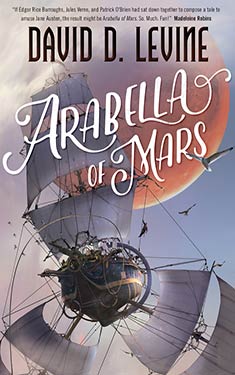
The year is 1813 and sixteen-year-old Arabella lives on Mars on her father’s plantation.  After playing on the Martian plains in her Martian trousers, Arabella sustains a slight head injury.  Her mother takes extreme issue with the way she is not being brought up as a proper young English lady should and brings her and her sisters back to Earth.  While on Earth, her father back on Mars dies suddenly, leaving her beloved brother Michael to run the family business.  She is sent to a cousin’s house to grieve.  Her cousin Simon gets a wild idea to murder Michael to steal the inheritance.  To stop Simon, she poses as a boy and gets a job as an airman aboard the Diana bound for Mars.  Can she hide her gender among these rough and tumble airmen long enough to make it back to Mars and save her brother?

There are some spoilers in this paragraph, so be forewarned.  Arabella is a good character, but a bit of a Mary Sue, that is, an idealized and seemingly perfect fictional character.  She’s a tomboy, the only girl breaking out of the English lady mold that all the other woman are stuck in.  She’s smart, creative, adventurous, and understands the inner workings of automatons, which is a hobby of her father.  It’s that knowledge of automatons that gets her the job on the Diana.  Even though times are tough, everything she touches seems to turn to gold, even single-handedly stopping a mutiny.  She seems to constantly save the day.  It requires a lot of willing suspension of disbelief that one person can have so much good luck.  It gets to the point where you just know that everything is going to work out in the end one way or another, and that was a little disappointing.  She doesn’t have much of a growth arc, but I still liked her.

The plot itself is pretty good as well.  The time on Mars and on Earth were interesting and often exciting.  My biggest complaint was that I thought much of her time aboard the Diana was boring.  It is filled with details of ship sailing that might excite other people, but didn’t excite me.  A lot of it felt like filler.  Fortunately, it was easy reading.  I am guessing that it harkened back to the pre-SF adventure novels which featured sailing to exotic locations. 

I give this book three stars out of five.  It’s good, but nothing groundbreaking.  The trope of women hiding as men has been done a lot as has the counter-cultural woman in the 19th century.  Still, the book was basically fun, with a simple but exciting ending.  It was easy to guess what was going to happen in the end.  I’d recommend the book as a light, fluff read.    

Wednesday, November 7, 2018

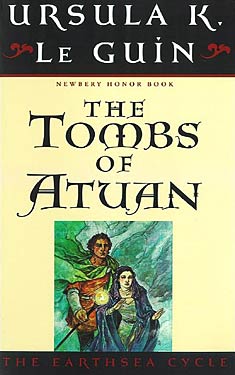
The Tombs of Atuan


Ursula K LeGuin
Completed 11/3/2018, Reviewed 11/3/2018
4 stars

This is the second book in the Earthsea Cycle.  It’s a standalone novel, though Sparrowhawk from “A Wizard of Earthsea” is a major character.  Again, it’s beautifully written, and this time, there’s a female protagonist.  It again has a theme of good versus evil, but it is subtler in this book.  LeGuin writes subtle very well.  The book is short, the prose is tight and the characterization is really good. 


Tenar is a little girl who is taken at the age of five to be the reincarnation of the High Priestess to the gods of Atuan, the Nameless Ones.  She becomes the Eaten One, gaining a new name Arha.  Being taken at such an early age, she forgets her past life and learns the ways of being a priestess.  She does ritual dances, decides the fates of prisoners, is the sole heir to the catacombs beneath the temple which are guarded by the Nameless Ones.  One day she finds Sparrowhawk in the catacombs.  She locks him in, and reports this treasonous act.  Of course, it is she who must decide his fate.  For some reason, she decides not to kill him, but hides him there, slowly learning about the rest of the world.  Sparrowhawk asks Arha to leave with him, and she must decide if she will stay and let him die, or leave and learn a whole new way to live.

Arha is a wonderful character.  She starts out a simple child.  She is taken in by the priestesses where she learns her new role.  She slowly becomes indoctrinated into the order and becomes as corrupt and ruthless as the other priestesses.  But when Sparrowhawk shows up, she’s intrigued by him.  She slowly comes to realize the futility of her present situation.  It’s amazing how she has this metanoia so believably in such a short book.  It’s a tribute to LeGuin’s power with words and storytelling. 

I don’t have too much else to say about this book.  If I did, I would just be repeating myself from the previous book’s review.  It has the same style and tone.  I’m guessing the next book in the series will also be short, as it was written so quickly after this one.  I give the book four stars out of five. 

Monday, November 5, 2018

Sacred Band


Joseph D. Carriker Jr.
Completed 11/01/2018, Reviewed 11/02/2018
4 stars

This book is an interesting take on the superhero trope.  It’s set in a world after superheroes have had their heyday.  Now they are not vigilantes making things right.  In fact, they’re trained by the government to control their gifts and live normal lives, having them redirect their gifts towards being productive members of society.  Of course, this doesn’t last long when LGBTQ and other disenfranchised youth start disappearing around the world and nobody else is helping to look for them.  This is a really good first novel by a local Portland author.  Though I thought the writing was a bit weak and some of the dialogue a little hokey, the plot and the humanity of the characters really made up for it. 


The story introduces us to Rusty, a young gay man living in Portland who has a superpower of sensing and manipulating magnetic fields.  He’s called an Echo, someone who has found themselves with a superpower after a strange natural event.  There are lots of Echoes, as strange natural events keep happening around the world.  They are normal like everyone else except for this one power.  Rusty’s best friend is Deosil (pronounced JESH-il), a transgendered woman who has the power to channel the earth’s energy.

There are also Originals, the first twenty-two people with superpowers.  They have multiple powers and are more like Superman.  The last group are the Empowered, people whom the government turned into superheroes.

Everything is basically going fine for Rusty until he realizes that a Facebook friend in the Ukraine has gone missing.  He believes that some terrible fate has befallen him because the Ukraine has been recriminalizing homosexuality and not pursuing the perpetrators of hate crimes.  Rusty enlists the help of Sentinel, a retired Original who also happens to be gay to go clandestinely to the Ukraine to find out what happened to his friend.  What they uncover is far more nefarious and leads to an ultimate showdown of good versus evil. 

What I liked best about the book was the portrayal of the characters.  They were all very human even though they have special powers.  They were all on the LGBTQ spectrum and all had struggled with coming out in some form or another.  Most of them were reluctant heroes as well, not really wanting to be in the spotlight, and certainly not intending to be role models for LGBTQ youth, but ending up that way.  I particularly could identify with Sentinel, whose real name is Mitch.  He’s came out in the eighties when his partner Radiant, another one of the Originals, was killed by an evil Original.  After a terrible media storm, he goes into seclusion trying to live his life as a normal human, until Rusty calls on him to help him in his quest to find the missing Ukrainian man. 

I liked the plot.  It’s very comic-bookish, with lots of action.  You can easily see this being translated into a graphic novel or a film.  But there’s also a lot of world-building and character development.  The first chapter was a little difficult, with a detailed explanation of the origins of the Originals, Empowered, and Echoes.  That’s followed by a fairly long buildup introducing Rusty and Deosil.  But it all works well and is highly readable.  That said, I thought the writing was a little lacking.  The prose was a little too basic, with no real style per se.  It’s told in third person omniscient following Rusty, but it could have been a little tighter with better word choices. 

I give the book four stars out of five.  I had a lot of fun with the book.  The entertainment value helped me forgive the weak prose.  It doesn’t have a tight ending, leaving it open for a sequel, which I would definitely read.

Friday, November 2, 2018

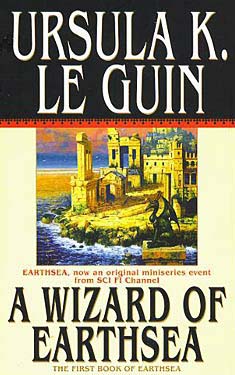
A Wizard of Earthsea


Ursula K LeGuin
Completed 10/30/2018, Reviewed 10/30/2018
4 stars

“A Wizard of Earthsea” is the first book in the Earthsea Cycle.  It is a beautiful book about a young magician coming to know himself.  It was written for a young adult audience before YA was a genre.  But it is more than simply a YA novel.  It’s themes of the hero’s journey, good versus evil, and embracing the shadow self speaks to all ages.  It is a fantasy novel without a war or some other “us versus them” trope. 

Duny is a young goat herder on a small island in the Earthsea archipelago.  Duny is his birth name.  As he grows up, he shows a propensity for magic under the tutelage of his aunt, a witch.  During this time, he comes to be known as Sparrowhawk.  But neither Duny nor Sparrowhawk is his true name.  He only finds that out once he becomes an apprentice to the local wizard.  Sparrowhawk however is impatient with the slowness of his studies, so the local wizard sends him to a school for wizards (thirty years before Harry Potter).  There, on a dare, he awakens the ghost of a long dead woman, which also unleashes an evil shadow into the world of the living.  His mission becomes to find and conquer the shadow before it conquers him. 

That is just a barebones overview of the plot.  It is much more textured and nuanced than that.  In typical LeGuin form, the plot is not very exciting save for a battle of wits with a dragon and an enchantress.  Like her much later “Annals of the Western Shore” novels (Gifts, Voices, and Powers), it is heavy on world building and mood.  There is a lot of detail about the nature of magic and the power of words and names.  Magic takes energy and can take its toll on the wielder.  It should not be wielded without understanding the implications of its execution.  For example, stopping a storm in one place can cause a flood somewhere else.  Regarding names, once you know the true name of something, it gives you power over that thing.  It’s all very sophisticated and well developed for such a short book.

The prose is interesting.  It is sparse, but beautiful.  It’s one of those books where you feel like nothing written could be thrown away.  It isn’t full of similes to pad up the novel.  LeGuin simply uses strong nouns and adjectives. 

Being such a short book, there isn’t much character development except for the protagonist.  And even that is minimal.  We don’t really get into the head of Sparrowhawk.  His story is told almost as if performed by a storyteller around a campfire, with a lot of exposition and little dialogue.  Still, it is easy to relate to him as he succumbs to the prodding of a young girl, accepts a dare to show off to his colleagues at wizard school, and wallows in despair as he makes his journey to find the evil shadow.  It’s interesting to note that Sparrowhawk and most of the characters are not white.  LeGuin very subtly made the characters people of color at a time when fantasy was dominated by European derived races. 

I give this book four stars out of five.  It’s a classic from which many authors have gotten inspiration, like the Harry Potter series and anything with a school for magic.  I read what was then just the Earthsea Trilogy back in college and loved it.  Rereading this first book, it felt fresh as ever, despite the lack of women in the story.  The second book’s protagonist is female, though.  I really look forward to reading the rest of the cycle, which is now a total of six books. 

Tuesday, October 30, 2018

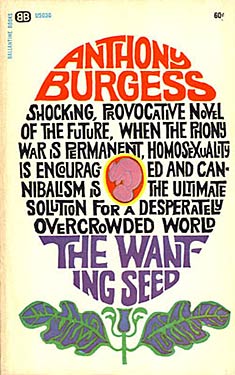
The Wanting Seed


Anthony Burgess
Completed 10/27/2018, Reviewed 10/27/2018
2 stars

I did not like this book.  Written in 1962, it’s a “comedy” about overpopulation and the resulting in a degradation of society: famine, reproductive control, cannibalism, and war.  This is known as a Malthusian comedy, derived from the theories of population versus resources by Thomas Robert Malthus (Yes, I had to look it up, though I did remember it from high school social studies after reading a few sentences about it).  I didn’t find it remotely funny, not even in a satirical sense.  Being nearly sixty years old, this book is full of the prejudices against race and sexuality, using them for satirical purposes, but ends up coming across as racist, sexist, and homophobic. 

The story is set in a dystopian future.  It’s about Tristram and Beatrice-Joanna, a married couple living in an overcrowded world with strict rationing of food, propaganda against having more than one child, and government promotion of homosexuality as a further means of birth control.  Tristram and Beatrice-Joanna’s first child has died.  Now officially, they can’t have any more children.  Beatrice-Joanna is having an affair with Tristram’s brother Derek, who is posing as gay man to advance in the government.  She gets pregnant by him causing a rift in the marriage.  Tristram, a social studies teacher, goes out for a drink, for what passes as alcohol.  He ends up in jail after happening to be at worker’s strike that turns violent.  From there his life goes from bad to worse.  He then escapes from jail, only to be tricked into conscripting with the British Army.

I thought the characters and basic plot were rather soapy and were merely present to convey the message.  No thought was put into making the characters anything but cardboard stiff upper-lip Brits.  Tristram’s experience is Kafkaesque, but it doesn’t have any of the profound absurdity of Kafka’s “The Trial”.  It’s simply tedious.  Beatrice-Joanna is just a character out of a soap opera.  Her life is simply being a wife, mother, or a lover.  Not that that’s a bad thing in and of itself considering the time it was written, but she has no depth and nothing else defining her except that she goes for walks and talks to the sea. 

I found the homosexual content of the book to be deeply insulting.  It’s meant to be a joke that the world is promoting homosexuality as a means of birth control.  It implies that it is a choice rather than an orientation.  It’s lumped into the same category as the cannibalistic content of the book.  And once the government falls, the people go crazy sexually, with heterosexual orgies and bizarre fertility rites.  Even Derek, Tristram’s brother, “switches” his sexuality to maintain his position in the new government.  It’s all rather disgusting and I was pretty deeply offended by it.

By the same token, racism is rampant throughout the book as well.  Black, bi- and multi-racial people abound in the book, but they are the butts of the joke as much as the sexuality is.  I think it would have been less offensive if the book had no people of color at all, rather then use them to get a satirical point across.

I give this book two stars out of five.  I don’t think this book could have been published today.  It’s supposed to be satire.  I get that.  But I found it merely offensive.  This is an example of the sort of novel that would be widely read for its scandalous ideas, setting any sort of human rights struggle back fifty years.  I gave it two stars instead of one because at least the prose was decent. 

Saturday, October 27, 2018

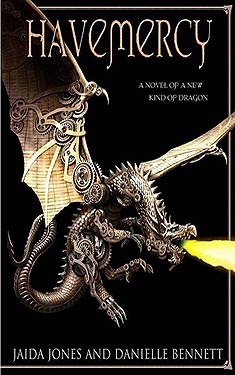
Havemercy


Jaida Jones and Danielle Bennett
Completed 10/25/2018, Reviewed 10/27/2018
3 stars

This was a novel about mechanical dragons that run on fuel and magic.  It was pretty good, though the relationships between people were far more in the forefront than the dragons were.  I read this book because it was nominated for a Gaylactic Spectrum Award for positive LGBTQ content in SF and Fantasy.  It had decent prose, character development, and plot, but there was nothing really new or outstanding about it.  It was sort of a steampunk take on “The Dragonriders of Pern” crossed with Victorian England in a magical setting with a gay romance. 


The plot follows four characters, Royston, Thom, Hal, and Rook, as their lives intersect during a lull in a hundred years war.  Royston is a magician who is exiled for having had an affair with a neighboring countries crown prince.  Hal is a tutor to the children of Royston’s brother, where Royston has been exiled.  Hal and Royston fall in love.  Rook is the best dragon rider on the ruler’s Dragon Corps, but has been reprimanded for having had an affair with another country’s ambassador’s wife.  Thom is the university student who is brought into the Dragon Corps to give the rowdy riders sensitivity training.  Their lives cross when Royston is called back to the capital to help with the war.  He brings back Hal with him.  At the same time, Rook and the other riders begin noticing strange things happening to their dragons as fighting begins erupting again with their enemy.    

The book is told in first person narrative alternating between all four characters.  At first this was tough to follow, but each character was developed pretty well.  I’m guessing that each author had two characters and they wrote around each other.  It worked, and moved the plot nicely.   

I liked all the characters except Rook.  He was a vile, amoral person with no redeeming qualities.  Even as an antagonist to Thom, he was just way too over the top.  It was actually hard to read his passages, because he was so distasteful.  My favorite character was Hal.  He was a country bumpkin who is just coming into his sexuality.  He’s meek, honest, and wears his heart on his sleeve.  Thom was also good as the university student trying to make the Dragon Corp palatable to society.  Royston the magician was rather lackluster.  There wasn’t too much to his character to make him outstanding.  The one thing that’s really noticeable about the book is that there are no female characters to speak of.  It gives the book an unbalanced feeling as there is no female perspective to anything going on.

There isn’t much more to say about the book because there isn’t that much to it.  It’s kind of fluff, but I found it entertaining.  I give the book three stars out of five.  I think the book would have benefited from having a little more action interspersed through the first half of the book, which is almost exclusively about the relationships between the characters.  Considering the book has magical mechanical dragons and is entitled with the name of Rook’s dragon, there isn’t all that much going on with them. 

Wednesday, October 24, 2018

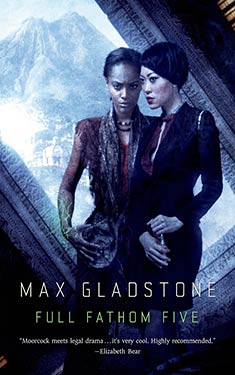
Full Fathom Five


Max Gladstone
Completed 10/21/2018, Reviewed 10/22/2018
3 stars

I read this book because it was nominated for a Lambda Literary Award, even though it’s the third in a long series.  The story is fairly self-contained.  There are some characters who appeared as secondary characters in one or both of the first two novels, but you don’t really need to know that to appreciate them.  Its world building, however, depends a lot on the history already described in the first two books, which I gleaned from reading synopses and reviews of the first two.  Still, it was enjoyable on its own.  I didn’t think it was great, but it was a decent mystery-fantasy.

Kai makes idols for people.  They are non-sentient entities which people use sort of like talismans.  Kai is a priestess and worships them for her clients.  The novel opens when one the idols is dying.  Kai attempts to save it, but is badly hurt in the process and rescued by her boss and coworkers.  She is labeled as unstable because she heard it speak, which these non-sentient idols are not supposed to do.  She tries to get to the bottom of this strange occurrence to prove she’s not going crazy and uncovers a plot to keep control of the idol industry in the hands of a sinister force.

The narrative is third person Kai, and interwoven by another perspective, that of Izza.  Izza is a young runaway who worships a goddess that apparently has died.  She was the storyteller for the goddess for a group of street urchins who are all devastated by the goddess’ death.  Eventually Izza and Kai’s paths cross and together they try to get to the bottom of the mystery of the dying idols. 

The characterization is good.  I liked both Kai and Izza.  I got into both characters and the supporting characters were all pretty well created as well.  Everyone was believable and didn’t seem cardboard at all.  I appreciated that the author created two lead female characters.  Kai is actually transgender, though I thought that it was mentioned too passingly.  The fact could easily have been missed if you were not reading carefully.  

The world building is actually pretty awesome, despite not having read the first two books.  The world of gods and idols is very interesting.  There was also a form of punishment for criminals called penitence.  The criminal is put in a golem-type creature where they are tortured until their will becomes the will of the golem.  Called the penitents, they are a sort of strong arm police force that chase after other criminals, bringing them in for punishment.

My biggest problem with the book was that it was a slow burn.  It took a long time for plot to kick into gear.  The start is supposed to be exciting, but I thought it was confusing.  And I was confused during the middle where it made references to Deathless Kings and God Wars.  I think that’s where not having been immersed in this world before was really detrimental.  The book finally picks up steam in the last eighty pages or so. 

I give this book three stars out of five.  It was a good mystery within a fantastical world.