Monday, January 15, 2024

Queen

JS Fields
Completed 1/14/2024, Reviewed 1/14/2024
4 stars

I have picked up quite a few self-published books by local authors at the Oregon Science Fiction Convention.  This is one of them.  I’ve shied away from this author in the past because she mostly writes space opera, touted as “pew-pew” action (hold your fingers like laser guns and go pew-pew).  But I’ve always enjoyed them on panels at the convention and thought I’d give one of their books a try.  Sure enough, there’s a lot of pew-pew, but after warming up to it, I found myself caught up in the action of the unique, crazy world that Fields created.  There’s giant lightning bug-like creatures, a massive bunny population, and lots of special sand that big business wants to exploit, all on a Dune-like planet.  It’s an all-woman planet where all you need to immigrate to it is a vulva.  However, emigration is not permitted.  Lots to think about, lots of fun, and decent character development as well.  I enjoyed it more than I thought I would.

The book begins with Ember on patrol duty outside the colony on the planet Queen.  The planet is tidally locked to its sun, meaning one side always faces it, one side never does.  In her flyer over the habitable zone, she grieves the recent death of her wife Taraniel from cancer.  She is ambushed by the pirates where she finds out that before her death, Taraniel disappeared into the wastelands, met with the pirates, and with them built a spaceship to take Ember and the pirates back to Old Earth.  Taraniel even uploaded her personality to the ship’s AI.  Ember does not handle this revelation well.  

When Ember’s sister Nadia goes looking for her, she comes across a secret conference where she finds out that Queen is going to be sold to the highest bidder for its special sand.  When they are finally rejoined, they use the planet’s beetles who have a strange symbiotic relationship with the invasive bunny population to fight the forces at the conference so that they can return to old Earth.  They initially left the home planet because of its environmental collapse.  Now they want to return based on Taraniel’s belief that after the massive diaspora, Earth has been renewed, mostly from the plant research done on Queen.

It's quite a wild plot with a lot of crazy ingredients, but it works.  From the giant flying beetles with the phosphorescent tails that can be tamed and ridden like flying horses to the bunnies guarding the fungi that exude the pheromones that can help tame the beetles, it’s loads of fun.  But amidst that fun is a lot to think about.  Specifically, Ember and her dealing with the death of her wife.  First, she must deal that Taraniel died alone in the desert, of her own free will.  Then she finds out that she actually survived, lived for a while longer with the pirates when she could have still been living with Ember.  Lastly, she uploaded her memories and voice to the ship’s AI, so now Ember has to deal with hearing her dead wife’s voice again.  It’s a hell of a lot to take in and Ember remains bitter and angry for a while.  Eventually she makes peace with the past and moves on.  She even develops a mild crush on one of the pirates.

While Ember is the main character, I also enjoyed her sister Nadia who tries to keep an eye on her.  So when Ember goes missing, Nadia goes after her without qualms about the rules of the colony.  Asher, the head pirate, is also very likeable, especially with her ability to handle Ember’s reaction to the ship’s AI.  

The world building is phenomenal.  One might think it’s a Dune rip-off, but even the author pokes a little fun at their own use of a desert planet.  The bunnies add a special touch.  One might think it’s simply a case of overrun invasive species, but here they’ve formed a strange relationship with the beetles.  The only thing I thought was a little weak was the prose.  The description of the action was good, but overall, I thought the prose sounded the same way the characters talked.  It was a little disappointing during the less exciting points in the book.  

Still, I give this book four stars out of five.  It’s a fun and exciting action-packed adventure.  It’s the first of a series, so it ends on a giant cliffhanger.  I didn’t mind it, because I’m sure I’ll read the next book when it comes out.  It also plays around a little with gender, which of course it would need to being an all-women planet.  But it’s not heavy handed like the gender-based utopian and dystopian novels of ‘70s women authors.  It’s much more organic.  I actually would have liked a little more gender and sexuality discussion in the story, though there are still two more books that might cover it in more depth.

Sunday, January 7, 2024

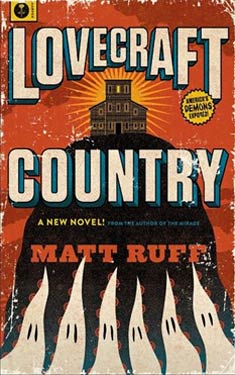
Lovecraft Country

Matt Ruff
Completed 1/7/2024, Reviewed 1/7/2024
4 stars

I had trouble getting into this book at first.  I didn’t like the writing.  I thought it was pedestrian, lacking any emotional force.  But as I continued on, I came to really love the characters and feel terrified for them by the supernatural and natural horrors in their lives.  It probably didn’t help that I saw the mini-series before reading the book, so I had an expectation of the emotional impact it should have.  But after the first story, any qualms I had over the prose dissipated and I could enjoy the stories.  

This book was initially pitched as a series like The X-Files.  When it came to novel form, it ended up as seven interconnected vignettes, or episodes, featuring the main characters and an eight story that ties them all together.  It was a great way to introduce everyone, giving different perspectives and experiences with the horrors of Jim Crow and the Lovecraftian supernatural.  The overarching plot is that Atticus Turner is the last surviving descendent of a powerful “natural philosopher,” i.e. a magician or alchemist, from the 1700’s.  Caleb Braithwhite is also a descendent and has supernatural powers.  He plans to use Atticus and his family and friends to try to take over and unite all the houses/lodges of the Sons of Adam.  The result is the seven episodes in the book.  I liked all of them, but the two I liked most were about Hippolyta, Atticus’ aunt, and Horace, his nephew.  

All three families in the story work or are associated in some way with the “Safe Negroes Travel Guide”, a fictional version of the Green Book, which lists restaurants and hotels and other travel related businesses that serve blacks without harassment or danger.  In the story featuring Hippolyta, she goes to Minneapolis to research some entries in the guide, but makes a stop at an observatory on the way.  It turns out to be related to one of the now deceased but immensely powerful Adamites, H. Winthrop.  She enters it one night, hoping to see the stars and discovers an interdimensional traveling device that reveals the fate of the black staff of Winthrop. I loved this story because the main character wanted to be an astronomer, but being poor and black and a woman in America in the early 20th century didn’t lend itself to that type of opportunity.  I, myself had other reasons why I didn’t become an astronomer, but I empathized with the longing.  

The other story featured Horace, an asthmatic tween who creates his own comic books.  He’s being hounded by white detectives to spy on his parents because they may lead the detectives to Braithwhite.  They put a curse on him that worsens his asthma to the point that he cannot speak whenever he tries to tell someone about the investigation.  In addition, he’s being chased by a “devil doll”, not unlike the scary tribal doll come to life from “Trilogy of Terror.”  I empathized with Horace as a young person struggling with asthma.  

The other stories were really good as well, such as the ones about the haunted house that Leticia buys and the potion that turns her sister Ruby into a white spy for Braithwhite.  All the stories are hard to read, though, because the Jim Crow prejudice and segregation is so prevalent and severe that it makes you wonder how black people survived the era as they did.  Reading it made me uncomfortable in my own skin, the same way watching the film “KKKlansman” made me so uncomfortable.  On the lighter side, it inserts black people into the speculative fiction fandom during a time when the authors weren’t black, and there were no black characters. 

I give this book four stars out of five.  I recommend reading it before seeing the series.  If you get a copy of the book with the interview of the author, I highly recommend reading that to get a perspective of the actual events that Ruff directly included or fictionalized within the book.


Wednesday, January 3, 2024

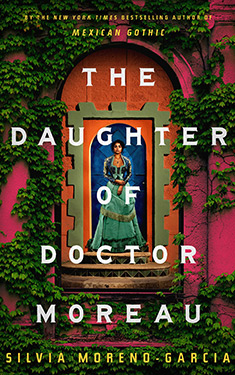
The Daughter of Doctor Moreau

Silvia Moreno-Garcia
Completed 1/3/2024, Reviewed 1/3/2024
4 stars

Moreno-Garcia is an awesome writer.  Even when I find I’m not really into a book of hers, the writing keeps me going.  That’s what I discovered with this book.  I did not find it quite as compelling as the other books of hers I’ve read, Gods of Jade and Shadow and Mexican Gothic.  But the language is just astounding.   I also liked the premise, the Dr. Moreau story set against the 19th century Mayan revolution on the Yucatan Peninsula in Mexico.  It has other positive qualities, like great character development and excellent world building.  The whole just felt a little less than the sum of the parts.  This book was nominated for 2023 Hugo, Aurora (Canadian Sci Fi/Fantasy) and Locus Fantasy Awards. 

The story begins with the arrival of a British man accepting role of mayordomo at the Moreau compound.  Montgomery was found by the owners of the property and sole benefactor of Moreau’s research, the Lizaldes family.  Montgomery is a ne’er-do-well alcoholic and gambler who has nothing to left to lose and oddly enough, doesn’t bolt when he finds out about Moreau’s human-animal hybrid experiments.  Helping him adjust is Moreau’s daughter, Carlota.  Of course, sexual tension develops between the two.  Everything and everyone remain in a state of balance until the Lizaldes’ son Eduardo shows up and falls for Carlota.  Suddenly, almost every combination of relationship, including between the people and the hybrids, falls to chaos.

Carlota and Montgomery are the main characters.  The book alternates chapters with their points of view.  Carlota is a sweet, caring individual with relatively modern thinking, despite growing up with only the hybrids as companions and her father as her teacher.  She even agrees to her father’s wishes to be open to Eduardo’s advances so that the Lizaldes family will keep funding his research.  Montgomery on the other hand is rough around the edges.  He doesn’t trust the Lizaldes family nor their son’s intentions toward Carlota.  He, of course, is in love with her, but can’t admit it to himself as his own secretive past eats away at him.  I actually liked Montgomery more than Carlota, I think because he’s broken and I could relate to his brokenness.  Carlota is no Mary Sue, but I couldn’t relate to her as well.  I’ll admit though, she was a strong, multi-dimensional character and I did like her.

The secondary characters are also well developed.  Eduardo, his cousin, Moreau, the hybrids, are all interesting and realistically portrayed.  No one is a caricature of good or evil.  There are just a lot of bad circumstances that throws people into difficult situations that evoke passion and bad decisions.  Still, the evils of slavery and abuse of the indigenous population come through.  Ultimately, the Lizaldes are the privileged landowners who represent everything that was bad with colonization in Mexico.    

There are so many things to like about this book, but while reading it, I occasionally found myself struggling to stay interested.  If I could have found it more exciting and perhaps a little less prosy, I might have empathized with Carlota more and experienced a more emotional response at the book’s conclusion.  But this is a good read, and I don’t dissuade anyone from it.  I like Moreno-Garcia and will probably continue to read her output.  She’s a terrific writer with good vision and great imagination.


Thursday, December 28, 2023

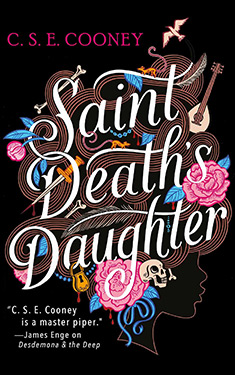
Saint Death’s Daughter

C.S.E Cooney
Completed 12/28/2023, Reviewed 12/28/2023
5 stars

This book won the 2023 World Fantasy Award.  I was predisposed to not liking it because I read three of the other nominees this year and really loved them.  But as I began to read this one, I was pulled in by the immediacy of the plot.  Before I knew it, I was chewing through this 700 page tome.  I really got into it.  It did occasionally feel like it was two or three books in one.  However, it worked, and I felt like this was award worthy.  I think many people will be overwhelmed by the detail of the magic and the world-building.  They may also miss the dark humor sprinkled throughout it.  Even I didn’t realize how uncomfortably funny many parts were because the dramatic parts are so dire.  In the end, I was glad I read it and got so immersed in this world for five days.

The book begins with Lanie Stones trying to get her not-so-nice older sister back from boarding school to help keep their castle since the passing of their parents.  Turns out the parents had many debts and a banking family is coming to demand immediate payment.  The Stones family has a long line of necromancers and Lanie is the last living one.  The family has also been the executioner and assassin for the Royal family since the founding of the kingdom.  The sister decides to come back and take her place as Royal executioner to earn money to pay off the debt.  When their plans are thwarted, the Queen offers her a job to assassinate the parliament of a rival nation.  This works for a while, but the head of the rival nation, the Rook of Rooks, has other plans.  

Lanie is the main character.  As necromancer, she controls Goody, and undead servant bound to the family for generations.  She also practices her own resurrection skills, learning from the ghost of her dead grandfather, the last necromancer in the family.  The problem is, she has an allergy to violence.  When someone speaks of violence, she experiences the trauma.  When someone near her experiences violence, she feels that as well.  It makes being a necromancer difficult and can result in an early death.  Lanie is rather pitiful at the beginning of the book.  But she learns and grows throughout.  Without realizing it, I was rather caught up in her failures and successes, so that by the end, I was devastated by the big twist.

The secondary characters were also very well developed.  There was the sister and her shapeshifting husband who turns into a falcon, their daughter Datu, Goody the undead servant who practically raised Lanie, Lanie’s love interest Canon Lir, and two teachers and Havoc the pub owner.  As you can see, I don’t remember all the names, as there are so many characters.  But they’re easy to remember as they come into the book gradually, not all at once in the beginning.  I was impressed that Cooney was able to develop so many secondary characters, although she did have 700 pages to do it in.  Sometimes they help, sometimes they hinder, often they add dry, dark humor.  

The world building is quite amazing.  There are different languages and dialects.  There are different nations and continents.  Throughout the book and occasionally through the use of footnotes, we learn of the long line of Stones as well as members of the Royal bloodline.  The magic system is amazing, with twelve gods all providing different types of magic.  Lanie’s patron is the goddess of death, as in the title of the book.  There’s even a yoga-like meditation system access the attributes of the different gods.  There’s also a lot of use of birds in this system, with the Rook of Rooks heading her parliament of four and twenty wizards, all given the power of different types of birds.  It’s amazing that this book started out as a short story, then grew into a book during NaNoWriMo.  Later, it was fleshed out into this massive tome.  It took Cooney seventeen years from start to finish, and it shows in the diversity and depth of this magical world.

I give the book five stars out of five.  I found it quite enthralling and I felt a part of Lanie’s journey.  I read this book in five days (vacation days of course), regularly reading deep into the night.  I found out later that day that this is the first in a planned series, so the ending made sense.  It’s not exactly a cliffhanger, but you do see that Lanie’s work is not done.  I don’t know how I feel about delving into another massive tome in this world.  I think I have to see how next year goes with my plan to only read books on my massive TBR pile.  


Thursday, December 21, 2023

Buried Mage

Michael Taggart
Completed 12/20/2023, Reviewed 12/21/2023
4 stars

Another winning entry in the Fledgling God series.  This fourth book wasn’t quite as spectacular as the third book, Gathering Mage, but it still kept me pumped up on Jason and the Louisville Mages.  I felt this one spent a little too much time on build-up.  The significance of the title isn’t apparent until halfway through the book.  But Taggart’s easy prose and the love between the four who live with Jason really make it worthwhile.  It makes it another feelgood romp of an urban fantasy with a masterfully detailed magic system.  And it ends on a cliffhanger, something I’m not generally fond of, but welcomed as it means there will be a fifth book in the series.  Yes!

This book takes place right after Jason and Sandy return from the Gathering of Mages where they established themselves as powerful Mages in their own right.  They brought back newly developed magical abilities and new confidence in their powers.  They share their discoveries of charm creation and rune use with their housemates.  Oh yeah, and Jason and his boyfriend Tyler the incubus have lots of I-missed-you-so-much-sex.  Just when everything seems to settle down, the House is challenged to a Reconciliation battle by the Cincinnati House.  It’s a stylized ritual to pit one House against another to settle a dispute.  Turns out the Cincinnati House had helped the rotten Mages in the first two stories, unaware that everything they were told about Jason’s House were lies.  When it is all settled, all seems right with the world until Karl and Marius, the remaining super-rotten mages return once and for all to destroy Jason and his housemates.

The real star of this book is the magic system.  We learn a lot more about charms and runes.  The House members work to create charms, starting with easy and working up to complicated and powerful.  Jason also works with runes, figuring out how they draw and process power.  Taggart is so detailed, he’s almost scientific in his approach to this magic system.  Where some books assume you understand spells and runes and charms, Taggart defines them like an instruction manual would.  I have to admit, sometimes it got a little tedious, particularly in the first half.  However, when Jason has to actually work with runes and charms as well has his shield and soul creations to escape from being buried alive, all that background makes sense.   

I was startled by the sexual content in this book.  After 800 pages of almost no sex, this installment ushers it back in with intensity and some humor.  To say this book is erotica would be too much.  I would classify it as an urban fantasy with healthy sexual expression.  I’ve read some fantasy and sci fi erotica, and this is tame compared to those books.  But I would classify this as having mature content.  

I must say that I’m very impressed with Taggart’s imagination.  For a set of books with the common trope of “learn an aspect of magic, use it in a life or death fight, repeat”, they are wildly entertaining.  I also still love the fact that everyone in Sandy’s house gets along like a loving, chosen family.  There is very little conflict between the house members.  Sometimes, all the hugging and laughing and partying seems unrealistic.  On the other hand, it saves the conflict for the real bad guys.  It reinforces the idea that one’s chosen family can be supporting and loving, something that many LGBTQ+ people eventually learn and experience.  

I give this book four stars out of five.  It was a little bit of a come down after the exhilaration of the previous book.  I was still very involved emotionally with Jason, Sandy, et al.  Like several other reviewers, I feel sad that Annabeth is the only House member not in a relationship, and it is never noted if she wants one or not.  And it’s not like she’s a fifth wheel.  She fully participates with the others and is never left out.  In fact, she has a pivotal role in the big showdown.  I’d just like to see the love spread out a little more evenly.  As for the next book, I can’t wait to see what happens to everyone.  I can’t wait for it to come out and will probably jump on it as soon as I hear it’s been published.


Friday, December 15, 2023

Gathering Mage

Michael Taggart
Completed 12/14/2023, Reviewed 12/15/2023
5 stars

I adored this book.  It’s 850 pages felt like nothing, making me read over thirty pages an hour (except on the nights when I passed out while reading because I read until super late the night before LOL).  It truly had me engrossed.  I loved the main characters, the intricate magic system, the world building, and the excitement of the setting.  Unlike the previous two books in the series, Misfit Mage and Melee Mage, this had a lot more substance even though I could still argue that this was fluff.  This one just came together for me in so many ways, and I realized I had missed being in this world that Taggart created.  I also found out in the afterward, that this and the fourth book were written as one huge epic, which he split into two books.  So that was all the motivation I needed to jump into the next one without taking a break with a different author.

This book is quite a different setup than the first two.  It continues the story, which began only a few months ago, of Jason Cole, a young gay man who has just discovered he’s a mage.  He lives with Sandy, the head mage of the magical House, her husband John the mountain troll whom she just married, and another mage named Annabeth who’s magic is linked to music.  Jason is in love with an incubus named Tyler, and they’ve just declared their relationship status as boyfriends, not just friends with benefits.  Jason has a cat named Bermuda who is recognized by other mages as a revered Celestial Guardian.  

In this book, Sandy and Jason go to week-long gathering of mages.  It’s kind of like a convention where the mages of the world come together to share the experiences in their respective Houses.  Both are young mages: Jason only a few months old, and Sandy only about 70 years old.  They’re there to learn as much as they can.  Jason grows in many ways, particularly in his understanding of his own magical nature and in how he accesses this magic.  But besides the usual fun and education of going to a convention, the two run into trouble.  There is a growing movement that wants to cast out the new mages, whom they call rats, from the Houses, claiming they are draining their resources, physical and magical.  This eventually leads to a showdown between the forces of good and the rat haters.  In between, there is a ton of fun and excitement that leads up to this final showdown.  

You’d think that a story about a convention would be kind of boring, but Taggart makes it unbelievably fun.  Beginning with the opening ceremonies, for which Sandy and Jason create an ad hoc show to represent their House that blows away all the participants, there are tons of new aspects of magic for Jason to discover and explore.  There are new friends to meet and new enemies to avoid.  In particular, there are the centaur llamas, beings from another plane who act as servants because they lost their magic generations ago.  Jason befriends one of them and opens a whole new relationship between the centaurs and the mages that all had thought disappeared ages ago.  There are also the tree creatures, mages who are also from another plane.  After a misunderstanding between Bermuda and a giant dragonfly, the trees and Jason and Sandy also become fast allies.

I just loved Jason in this book.  Perhaps one can argue he’s a male Mary Sue (sometimes called a Gary Sue).  Jason is almost certainly a fictional Taggart, and he’s a little too perfect at times.  And after all, the series is called “The Fledgling God.”  Jason is just so adorable and naïve and vulnerable that I can’t help but love the character.  I cheered for him throughout the book, felt like I was him, and at the end, I wished it wasn’t over (thank heavens for the fourth installment).

I really got into the magic system in this book.  It is quite complex.  Taggart almost makes a science of the way that Jason visualizes, stores, and access his magic.  There were times where Jason works and grows his internal magic for pages and pages (and pages).  I think it could have been boring, but I found it totally intriguing.  When he actually uses his magic to heal or in combat, it all makes complete sense.  

The only complaint I had was there’s a deus ex machina towards the end.  However, after I acknowledged it, I completely bought into it.  After all, Jason is a fledgling deus himself.  And there’s foreshadowing of it when Jason meets the All-Rune in a powerful sequence earlier in the book.  

I am so glad I took the chance on this self-published series.  I got it because the guy on the cover of the first book was hot.  And what began as fun fluff turned into something a little more meaty but no less fun.  I give this book five stars out of five for being an intense page turner, thoroughly entertaining, and highly addictive.


Sunday, December 3, 2023

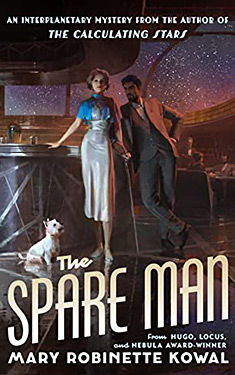
The Spare Man

Mary Robinette Kowal
Completed 12/3/2023, Reviewed 12/3/2023
3 stars

This was an okay book by a writer who has written some terrific stuff, including the Hugo and Nebula Award winning The Calculating Stars.  It’s a murder mystery aboard a spaceship traveling between the Moon and Mars during the ultra-rich main character’s honeymoon.  Reading this book felt like a throwaway, kind of fun, kind of suspenseful, a little science fiction-ish; certainly not up to par with the Lady Astronaut series.  The best part about the book was the characterization.  I didn’t get lost in the number of characters and there was a cute service dog that distracted me when the plot got boring.  I’m guessing this got a 2023 Hugo nomination on the strength of her previous books rather than on the quality of this one.  Of the four of the six nominees I read so far, this one was the weakest.

The main character is Tesla Crane, a brilliant engineer and one of the richest people in the world.  She’s on her honeymoon with the new husband.  Tesla was in a horrible space accident that left her permanently in pain from a severe spinal injury.  Fortunately, she has a device implanted in her that can prevent her from feeling the pain.  She sets it to varying levels depending on how much she needs her sense of touch.  She has an extremely cute service dog that everyone falls in love with.  On this trip, she’s using a digital masking device so she’s not recognized and swamped by fans.  Everything goes smoothly until someone is murdered and she and her husband are first on the scene.  The ship’s inept security suspect her retired private detective husband and take him into custody.  Tesla’s mission is to prove her husband’s innocence and find the killer before they strike again.

The characterization was quite good.  I had clear pictures and impressions of most of the characters.  The story is told from Tesla’s perspective in third person.  Through her we see the inept security team, the other ultra-rich passengers, her super-intense lawyer, and several of the service employees.  Almost everyone of these characters in her eyes is a suspect.  And she’s out to find out who the murderer is.  She’s really a good character:  determined, independent, successful despite being in paralyzing pain.  

I also really liked how the author portrayed Tesla’s PTSD.  It was very enlightening.  It included a terrible flashback and Tesla’s process for staying grounded.  The PTSD was the reason for Gimlet, her adorable service dog.  Gimlet could sense when the panic attacks were coming on and helped ground her as well.  Of the things that were right about this book, this was probably the most profound.

What I didn’t like about the book was that it felt like a standard murder mystery.  I don’t know how mystery fans would like this book, but I was often bored.  I didn’t feel like the story moved well until the last hundred pages or so.  I liked bits and pieces, like the introductions and interactions with some of the suspects.  I liked that the some of the suspects were guilty of other things, making them look suspicious.  But the time between these was not fast-paced.  

I give this book three stars out of five.  It was okay, but nothing special.  The prose was nice and world building decent.  The spacecraft’s concept was interesting, with different levels having different gravities:  Earth’s, Mars’, and the Moon’s.  Also, the descriptions of the Coriolis effect on movement in the ship were interesting.  But it just didn’t work as a whole for me. I found myself not really motivated to finish the book until the last quarter, and that because I just wanted to know who the murderer was.