Friday, April 15, 2016

The Eyre Affair

Jasper Fforde
Completed 4/8/2016, reviewed 4/11/2016
3 stars

I was disappointed with this book.  It had such a strong buzz for being comical like Monty Python and Douglas Adams, and for being meta- with people walking in and out of novels.  However, I found the humor to be sporadic and mundane and the meta- aspect to be rather boring. 
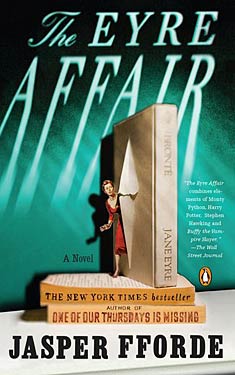
This is basically a mystery set in an alternative past England where corporations hold the power, the Crimean War has lasted over 100 years, and society revolves around literature and the arts.  People know Shakespeare’s works by heart and go to Rocky Horror-like productions of Richard III.  There are Baconians who go door to door passing out pamphlets about Francis Bacon being the real author of Shakespeare’s plays.  And some people get magically transported in and out of the great works of English Literature.

Thursday Next is a Literatec, a literature detective.  She’s on the trail of Ascheron Hades, a Voldermort-like evil-doer who is deleting characters from the original manuscripts of great works, thus removing them from all copies of the works.  Can she stop Hades in time to save Jane Eyre from being permanently removed from Bronte’s book?

The summary makes the book sound like it should be a lot of fun, and it is at times.  However, the writing style is not very good.  It’s mostly told in first person by Next, but there are too many third person omniscient scenes that throw you off balance when you’re reading it. 

There doesn’t seem to be much tension buildup either.  Nothing gets exciting.  I think that has to do with the character development.  I feel like I never really get to know Next.  I know what happens to her, but nothing much about her.  I tried to convince myself that she was supposed to be a hard-boiled detective, but her narration is too plain.  I found the most interesting scenes to be the ones where the Shakespearean authorship conspiracies are discussed, rather than the action.  Even when Next’s aunt and uncle are kidnapped by Hades, she’s rather nonplussed about it. 

This is just a personal taste thing, Jane Eyre isn’t in peril until well into the second half of the book.  If I were the author, I would have entitled it something else, or brought the Eyre plot further to the front of the book.  Because the book is titled “The Eyre Affair”, everything in the first half of the book feels like treading water, waiting for the main plot to begin.  Again, this is personal taste, but the title set up my expectation and left me hanging for two hundred pages.

I give this book three stars out of five.  The saving grace of the book is that the end is pretty exciting.  I was worried that with the boredom I felt through most of the book, I wouldn’t care about the ending, but it proved me wrong.  I just wish rest of the book had the immediacy and tension that Fforde conveyed so well at the end.


Tuesday, April 12, 2016

Point of Dreams

Melissa Scott and Lisa A Barnett
Completed 4/3/2016, reviewed 4/4/2016
3 stars

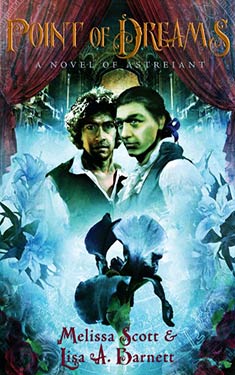
“Point of Dreams” is the second in the Astreiant series.  In this installment, there are a series of murders associated with a play to be staged at a great masque for the queen.  Nicolas Rathe is once again called on to get to the bottom of this mystery.  His leman, or lover, Philip Eslingen, is involved with the play and helps Rathe investigate the murders.  This book won the Lambda Literary Award for LGBT Science Ficton/Fantasy/Horror novel.  I found it to be a fairly good book, with some interesting fantasy, and much more readable than the first book, “Point of Hopes”. 


What I liked most about the book was the search for the murder weapon of several of the victims.  All the murders seem to be tied to a book called the “Alphabet”, a compilation of flowers that when arranged in specific ways have magical properties.  I found this to be highly imaginative, taking something like flower arranging and infusing it with the power to heal, kill, and everything in between.  On top of that, because the Alphabet is being referenced in the play, people are going crazy over buying flowers bulbs.  It seems inspired by the tulip craze in Holland when the tulip effectively became the currency of the country. 

Another very interesting aspect of the book is that it takes place at the time of the year called “ghost-tide”, when the spirits of those who have died normally and moved on are close.  This is different from the rest of the year when only those spirits who are bound to the earth for some reason can be seen or felt.  It’s reminiscent of the original concept of Halloween, Samhein, when the veil between our world and the spirit world is thinnest.  And it provides us with an unusual side investigation for Nicolas.  It seems that a lawyer’s deceased leman’s spirit is not around during this time when he should be.  This implies that the leman did not die a natural death, but was murdered. 

The relationship between Nicolas and Philip is further developed as well.  What I found out through a little research is that there’s a novelette that was written after this book that goes back to fill in the gaps of how the two men move from being thrown together for the mystery in the first book to being lemans (yes, that’s the plural) in this book.  It’s kind of cool that the relationship is still understated, reinforcing the fact that gay and lesbian relationships are just a normal part of the society. 


This book gets another three star review from me, although the quality was much more even throughout the book.  I didn’t have the trouble I had in the first volume.  This one pulled me in right from the start.  But basically, it is mystery fluff, and good fluff.  It keeps me wanting to continue the series:  the connector novelette, and the Spectrum Gaylactic Award-winning most recent volume “Fairs’ Point”.  

Friday, April 8, 2016

334

Thomas Disch
Completed 3/27/2016, reviewed 3/28/2016
3 stars

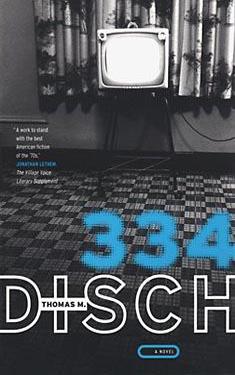
This is the first time I read a book where I thought the prose was great but the story was hard to follow.  Based on this one book, I feel Thomas Disch is one of the best writers I’ve read in a while.  Unfortunately, the structure of the book is what threw me into general disarray.  The book is actually a collection of interrelated short stories about people, particularly the members of one family, who live in the population controlled near future in subsidized housing with the numeric address of 334.  It’s faintly reminiscent of the interrelatedness of J.D. Salinger’s Wise Child stories (“Franny and Zooey”, “Seymour”, “Raise High the Roof Beam, Carpenters”, etc).

The first half of the book is composed of actual short stories.  They are fairly easy to follow.  My favorite was the first story, about a young man madly in love with a young woman who finds out he doesn’t score high enough in his life analysis to qualify for having children.  It sets the mood for the government-controlled near future that the rest of the stories take place in.  The story also gives us a sample of one aspect of the future which is positive.  Same-sex and interracial relationships are normal and unremarkable.  But in general, many of the sexual relationships, as well as interpersonal relationships are dysfunctional, if not downright depraved.  And racism still abounds despite the normalization of the relationships. 

The last part of the book is entitled 334 and follows the lives of several members of one of the families in the building.  It was very confusing to me despite the fact that I did a little research on the book before reading it.  It follows Mrs. Hanson and two of her daughters over seven years.  The chapters are arranged so that you bounce back and forth in the time line and it’s difficult to tell if it’s fantasy or reality.  Looking at it from the outside and contemplating the structure, it’s pretty brilliant, but the reading of it is not pleasant experience.  This is where the conflict arose for me between the prose and the form.  Disch provides a graph to help you navigate through the stories, but I still found it very difficult to figure out what was going on.  Simultaneously, reading the prose was still enjoyable.  I just couldn’t piece it all together.

I should give a warning that some of the stories in this book pretty depraved.  There’s one story about a morgue worker who sells the hospital’s unclaimed dead to a necrophiliac agency.  There’s also a story about a group of pre-teens who plan a murder.  On a less depraved but just as strange note, there’s a story about a couple whose life is meaningless without children, but it’s the husband who needs to have the maternal experience. 


There’s a lot going on in this book and the best thing about it is that it’s well-written.  It’s just not the most pleasant book to read from the content and form perspectives.  This is a book I’d like to read again at some point, to see if I understand it better.  So from my initial experience, I can only give this book three stars out of five.

Tuesday, April 5, 2016

The Color of Magic

Terry Pratchett
Completed 1/16/2016, Reviewed 1/21/2016
3 stars

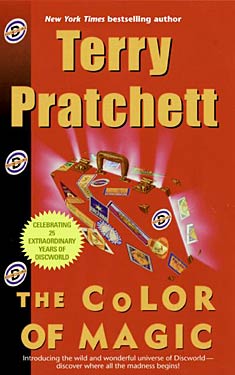
I’ve been meaning to read the Discworld series for a long time.  With Pratchett’s passing last year, I decided that this year would be the year to begin it.  “The Color of Magic” is the first book in the series.  Some people had warned me that the first book wasn’t that good and to start with the second book.  Since “Color” is the only book in the series I have, I read it anyway.  It started a little rocky for me, but once I got through the first chapter, the rest of the book went pretty smoothly.  I enjoyed it.  It left me wanting more for the reason that the books get better as the series progress.

The book is basically 4 short stories or novellas rather than a fully linear plot.  The first story introduces Rincewind, a failed magician, and Twoflower, Discworld’s first tourist.  They meet in the capital city where Twoflower inadvertently causes an innkeeper to burn down his inn, and the fire spreads throughout the city.  Now on the run, they go on a journey which is actually controlled by the gods.  The journey takes them first to a town with a Lovecraftian secret, then to an upside-down mountain of dragons and their riders, a clear parody of “The Dragonriders of Pern” series.  Lastly, they go to a land of hydraphobes who want to send a rocket to the underside of Discworld to find the gender of the giant Turtle that supports the elephants that hold up the Disc.  The whole way, Rincewind is pursued by Death, who of course is a hooded skeleton carrying a scythe.

Perhaps the most fun part of the book is looking for the jokes.  They are most obvious with some of the names, like the capital city of Ankh-Morpork.  Some are more subtle, like the dragon rider names with punctuation in the middle of them, parodying the Pern names like F’lar and J’xom.  I’m sure there are many jokes I missed, but what I found was often laugh out loud funny.


However, I’m giving this book only three stars out of five, which still means I think it’s good.  It just wasn’t that remarkable for me.  Maybe I’m getting more cynical in my old age, or perhaps I’m just reading too much and it takes more to actually draw me in.  I’m hoping that subsequent books are better, mostly because I know that this is a beloved series, and I want to be on the Discworld bandwagon.  I look forward to the next books, knowing I need to read at least a bunch more before I decide on the whole series.  

Friday, April 1, 2016

Empire of the Senseless

Kathy Acker
Completed 3/23/2016, reviewed 3/24/2016
2 stars

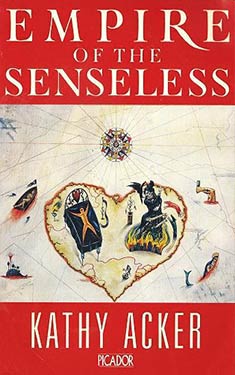
I never had a class in postmodern literature, so my ability to understand it has been hit or miss.  “Empire of the Senseless” is a miss.  It’s sort of a novel about a post-apocalyptic Paris narrated by Thivai and Abhor, a pirate and a half- robot.  But it isn’t really a novel.  It’s a dark, transgressive, deconstructed look at society told in something akin to stream of consciousness narration, made to shock rather than entertain.  It’s a very hard book to read.  I found myself trying to simply take in the words and sentences as images and not worry myself with the nearly non-existent plot.  In the end, I didn’t get it.

Kathy Acker was big in the underground art scene of New York in the 60s and 70s.  She was a playwright, novelist, essayist, and punk poet.  Some of her works are semi-autobiographical, drawing on experiences ranging from the suicide of her mother to a brief stint as a stripper.  She taught classes at universities and she is taught in post-modernism English classes.  Her point is to traumatize the reader into thinking about society, politics, money, language, and sexuality.  In reading the reviews of this book, I find that what some people hate about the book is what others find brilliant. 

The plot of course is thin.  Thivai and Abhor narrate the book.  They are sometimes lovers, sometimes not, who traverse Paris after it is overthrown by a revolution by Algerians.  The story is told with lots of references to sex, death, suicide, and scatology.  It had the most impact for me when the characters tell the stories of their dysfunctional childhoods.  The language is bizarre, it’s hard to tell what’s real and what’s hyperbole.  The style ranges from non-sequitor to alliteration.  And there’s a lot of profanity.  Again, the point is to not make for a pleasant read, but to force the reader to think about life from different perspectives. 

Unfortunately, I didn’t find the experience to be as profound as it’s supposed to be.  As a wordsmith, I thought Acker was quite lacking.  At times I thought that this is the kind of book John Waters could have written if he tried to be serious and wanted to emulate Jean Genet.  Most of the time, I thought that Waters was the better literary wizard. 

I know that there are many people who would disagree with me, as is evidenced by the glowing reviews that are out there.  There are also many people who would say I went too light in my review.  But I can appreciate the author’s intent.  That’s the one part of post-modernism I do understand.  What I don’t get is the execution.  I have yet to read Burroughs, Genet, and “Ulysses” so I don’t have anything to compare (though I have seen a Genet play that I sort of got).   


I give this book two stars out of five.  I only recommend it for people who want a literary experience or were English majors, and aren’t easily shocked.  I’m glad I read it, mostly because it took me out of my reading comfort zone.  But I still feel John Waters is my preferred master of shock.

Tuesday, March 29, 2016

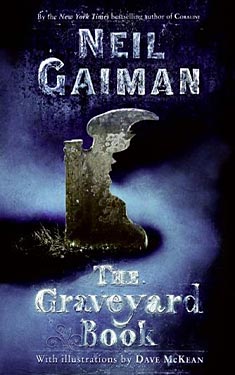
Hugo Winner 2009: The Graveyard Book

Neil Gaiman
Completed 3/2013, reviewed 5/24/2013
5 stars

The Graveyard Book is a wonderful horror novel for young teens.  The story follows the young life of an infant whose parents are murdered.  He is found, reared, and protected by the ghosts of a graveyard.  At various times in my reading of it, I thought the premise of the book was too dark for the targeted age group.  But not being a parent, I eventually gave up my concerns and just enjoyed a great story.

The ghosts in the graveyard are wonderfully endearing.  They work together to protect and raise Bod.  They are an eclectic group from different eras, different classes, and different temperaments.  They are a joy to meet.  I wished the book was longer so we could spend more time with the ghosts and get more development of their stories. 

I have to say I loved every chapter of the book.  I want to particularly mention the Danse Macabre.  It is an incredibly bizarre and engrossing sequence.  It reminded me of some of the bizarre scenes from Clive Barker.  Now that I am writing about it, I don’t quite know what to say about it.  I think I just loved the bizarreness of it, how the living and the dead can be bewitched into a dancing frenzy, and afterwards not be remembered by living, or spoken of by the dead.

I loved Bod’s attempts to become integrated with the living, walking through town, going to school, and meeting a girl.  Yeah, it’s kind of the typical disaffected teenager story, but I really enjoyed it.

It’s been a while since I read the book, so I don’t have that many specifics anymore.  What comes to me when I reminisce about the book is the warm feeling I had while reading it.  It is easily a 4 star book, with great characterization and imaginative scenarios. 


Postscript 3/1/2016:  A few months after writing this review, I had the opportunity to listen to the book on CD read by Gaiman.  When we got to the end, I had tears rolling down my eyes.  I had to be careful though because I was driving back from Alaska, and simply breaking down wasn’t an option.  Because of this I elevated the rating from 4 stars to 5.  Now when I think back on the book, I just don’t get a warm feeling inside, I get a very powerful emotional response.  

Friday, March 25, 2016

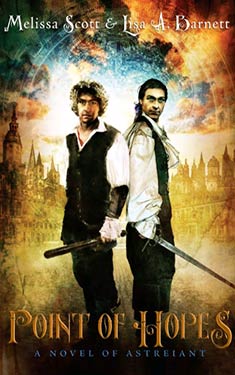
Point of Hopes

Melissa Scott and Lisa A Barnett
Completed 3/20/2016, reviewed 3/21/2016
3 stars

“Point of Hopes” is the first in a cross genre series.  It is a mystery set in a fantasy world where astrology is real.  It plays an important role in everything from the politics of kingdom to helping people determine the job best suited for them.  It also can be used to help Nicolas Rathe find the missing children of Astreiant.  I picked this book up because the sequel, “Point of Dreams” won the Lambda Literary Award, and the fourth book “Fair’s Point” recently won the Spectrum Award.  I had high hopes for this book, but I had a lot of trouble getting started with it, leaving me with a mediocre experience.

I often have trouble getting started in books.  It’s partly why I’ve had problems with short stories:  it takes too long to get into the story, then its over.  “Hopes” took a lot longer than usual.  There was a prologue that was incomprehensible.  It was vague and too out of context to give me any hint as to what was coming next.  When I got to the first chapter, I felt lost, disorienting me for the rest of the book.  Once the story started, the authors throws tons of minor characters at you in a short period of time.  Everyone has a first and last name, and most are hard to pronounce.  Then, referring to the characters by either the first or last name made it hard to follow conversations as well as develop decent pictures of the characters.

Another problem I had with the book was the prose.  It was quite dense in many places and broke a rule I have for decent writing.  The rule is not to break up short sentences with line upon line of description and simile.  If you read my review of Michael Chabon’s “The Yiddish Policemen’s Union”, I give an example of this (which I made up myself and of which I am very proud).  Basically, it’s:  Begin a statement comma lines and lines and lines of descriptions and similes comma end the statement.  It’s one of my pet peeves.  After reading a few pages of that, I often had to go back and read only the dialogue just so I could follow it better.  About halfway through the book, either I got into a better groove or the authors were doing it less, but I didn’t have to go back and reread nearly as much. 

Having gotten about halfway through the book, I started to enjoy it.  It seems pretty obvious who is stealing the children, but the why and who’s behind it all is the greater and more fun part of the mystery. At the same time, I also began to care about the main characters and some of the minor ones.  The series touts a gay romance between the main characters, but it barely even buds in the first novel.  There’s just a hint of interest between them.  But there are same-sex relationships in the culture and they are simply matter of fact and unremarkable, which is a good thing. 


I give the book three stars because it got good after the tedious two star start.  I’m looking forward to the second book because it is the award winner, and I’m hoping that means it is written better.