Xiran Jay Zhao
Completed 12/4/2025, Reviewed 12/5/2025
2 stars
I returned to this sequel after reading Iron Widow. I restarted it, not trusting my memory and judgement of the first two hundred pages from my original attempt. It began well, making much more sense having the full background on Zetian, the MC. However, I found most of the book to be tedious filler to get to the end goal. It spends most of its time in her head, rehashing all her fears and neuroses every time someone spoke with her or whenever something happened. Then at the end, I found out that this is a trilogy and groaned. I don’t know if I have it in me to get through another iteration of Zetian’s mental state. This book was nominated for the 2025 Lodestone Award, which is the non-Hugo award for YA novel at WorldCon.
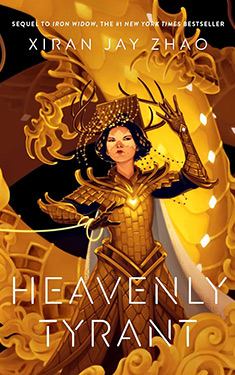
For the plot summary, be forewarned of SPOILERS for the first book.
So in this book, Zetian returns with the Emperor, who she revived after over two hundred years in a deep freeze to prevent his death by the pox. She claimed the title of Empress at the end of the last book. She is both loved and hated by the people. The Emperor sees the benefit of keeping her around for the revolution he started before being put to sleep. He declares that he will marry her, ensuring her title and begins a kind of cultural revolution, putting to death the oligarchs who kept the poor downtrodden and abused as well as the counterrevolutionaries. His ultimate goal, like Zetian’s, is to bring down the gods who are in orbit around the planet, controlling and punishing them for deviating from the heavenly edicts. While they wait to strike, Zetian convinces the Emperor to make many radical changes to society, including elevating women from being nothing more than the property of men. In addition, he tries to consummate their marriage, but Zetian wants no part of it. She also discovers the true nature of the alien Hunduns and the purpose of their war with them. The majority of the book is Zetian’s mental gyrations over every interaction with the Emperor and the people around her as the plot slowly progresses toward the attempt to attack the gods.
By about page 100, I had it with Zetian. I couldn’t stand all the time we spent in her head. She is the narrator again and she goes on and on and on about her hate for the Emperor, men, the oligarchs, and the existing cultural paradigm. That all worked well in the first book. Here it is simply tedious. Every interaction with the Emperor is the same, rehashing her same issues of revenge and the terror of trust, sex with the Emperor, and pregnancy. There were some good parts, like her starting a non-profit to help women and her softening the Emperor to repeal the witch hunts and death penalty for the rebels. She does learn a lot about what makes a revolution successful and how to lessen its heavy hand. Amazingly enough, the Emperor actually listens to her.
What struck me as most interesting about her is that she is self-aware. In response to how to act as Empress, she says, “Becoming likable. Now that is the most daunting challenge I’ve ever faced.” Regarding the Emperor, “It shouldn’t be possible to drift off to sleep in the arms of someone who represents so much of what I hate, but the throne room is very cold and he is very warm.” And the brilliant realization, “Every oppressor, through their denial of humanity, sows the seed of their own destruction.”
The Emperor is interesting. It is hard to tell if he is good or bad. He shares many of the same values as Zetian, but he’s also quick to anger and retribution. It’s difficult to tell if we can trust him since we only see him through Zetian’s lenses. Yizhi, who featured prominently in the first book, appears in this book, though not to the same extent. He is elevated to the Emperor’s secretary. Of course, he can no longer be in a relationship with Zetian. In addition, she feels she can no longer completely trust him. This creates a lot of tension in the book, adding to the tension with the Emperor. Shimin, the third person in the polyamorous relationship between Zetian and Yizhi, seems to be with the gods being kept alive after nearly dying at the end of the first book, apparently like a hostage to control Zetian’s wild, reforming nature.
This book makes many good points, but it’s all lost in the delivery. Zetian is only 18 or 19, but after everything she’s gone through, she should have matured at least a little. She is still the bitter, angry child who won’t grow up. The only positive is the help she provides women through her non-profit. Granted, she has to constantly fight the public’s perception of her as a usurper, and she does learn a little from some of the people around her, but it wasn’t enough to get me to empathize with her like I did in the first book. I give this book two stars out of five. The prose and world building is fine. The themes are good. But in the end, I was just so glad to be done with it.

No comments:
Post a Comment