Oliver K. Langmead
Completed 7/3/2025, Reviewed 7/3/2025
4 stars
This is a novel in poem form. It uses different formatting for the different character POVs. In the past, I’ve always said I didn’t get poetry very often. Since then, I’ve read books that played with form and I’ve read most of Tolkien’s poetry, including his alliterative epics. All that literary experience helped me greatly appreciate this book. It’s standard sci fi tropes: generation ship, terraforming, space opera. But it’s written so beautifully, if feels fresh. This book was nominated for the 2025 Hugo for Best Poetry. I think is also helped that I read all the short two-page poems that were also nominated first. It prepared me for reading a novel in verse form.
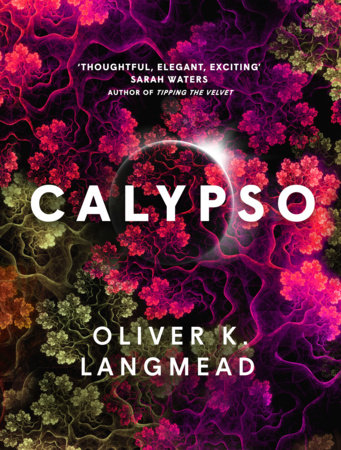
The story begins with Rochelle awaking alone from cryo-sleep aboard the Calypso. She finds herself alone with all the other engineers’ pods empty. While exploring the ship, she finds Catherine, a genetically modified biologist, and eventually the crew and their apparent leader Sigmund. They are orbiting the new home planet which will be terraformed for all the colonists asleep in uterine-like sacs. Rochelle discovers that during the journey, there was a rebellion by the people guarding the sleeping engineers against “king” Charles and the support crew about the meaning of establishing “paradise.” And Rochelle seems to hold the balance of power between them.
The majority of the book is told from Rochelle’s POV. Her narrative is told in standard quatrain form. She reminisces about the past she left behind, her husband and children, for this adventure to establish a colony on a distant world. She often refers to her religious upbringing by her pastor father, although her faith is based more on their relationship than his sermons. She is an engineer, the last remaining on the ship, as the rest left to establish an engineer-based society on one of the planet’s moons. She doesn’t know what to make of everyone who remains but is sure something is not right with Sigmund. Rochelle only feels close to Catherine, who seems to be some kind of human/plant/animal hybrid.
Catherine is in charge of the terraforming of the new planet. She is also kind of an earth mother, in more ways than one. She is gentle and kind and takes care of the plant and animal life on the Calypso. Her POV narrative is told in an undulating sinusoidal pattern. The varying length of each line together with the story she is telling is simply mind-blowing. I don’t know what it takes to create words in comprehensible narration that fits into the undulating format. When Catherine descends to the planet and performs the terraforming, combined with the form, it’s like divine creation.
Sigmund’s narrative is third person, reflecting on his past life as the brains behind the building and execution of the Calypso. His text is right justified. The narrative gives some insight into what got him on the path that leads to the ultimate showdown between engineers and rest of the crew of the Calypso. He isn’t portrayed as a bad guy initially, but it becomes clear that he is not forthcoming and perhaps a bit megalomaniacal and definitely narcissistic.
Overall, I was very impressed with this book, more so than I thought I’d be. I give this book four stars out of five. I highly recommend this book if you’re looking for something different and are not afraid of prosy writing. It’s quite beautiful, although, like regular, highly prosy novels, it can be too lulling, which makes me zone out and lose track of when the plot kicks back in. Still, I found it a wonderful read.

No comments:
Post a Comment