Anne McCaffrey
Completed 6/13/2025 Reviewed 6/14/2025
4 Stars
The book that created the modern dragon tropes of science fiction and fantasy. This was a book club read and I was looking forward to rereading this book again. I read this book and many of the McCaffrey Pern books at least once before, the last time being about fifteen years ago. This time, I had a lot of trouble getting into it, partly because I was late in beginning reading it (starting only two days before), and partly because I realized how some parts did not hold up with time. Fortunately, book club discussion helped me understand some of the antiquated parts. I finally finished it a few days after book club, enjoying it with new insight. This is basically a bodice-ripper romance, written with a Victorian mindset, but still featuring a strong, independent woman. A lot of the men are pigs concerning sex and sex roles. And adverbs abound.
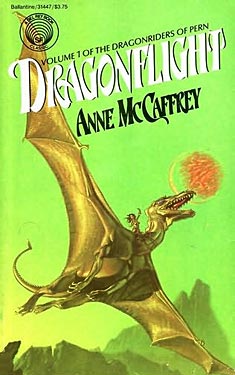
Lessa is kitchen drudge in Ruatha, which has been conquered by a corrupt lord and his army. Lessa is of the original ruling blood and she can secretly talk to dragon-related creatures. F’lar arrives on an official search for a young woman to bond with the new, soon-to-hatch queen dragon. After killing the corrupt lord, he finds Lessa, senses something strong under the layers of servitude, and bringing her back to Benden Weyr. There, the egg hatches and the new queen impresses upon Lessa, forming the all-important psychic bond. When the queen dragon mates, it is with F’lar’s bronze dragon. This means Lessa and F’lar will also become lovers, much to Lessa’s chagrin. Over the next few years, they more or less fall in love, just in time to fight the terrible Threads, spores that fall from the sky and eat all living matter in their path.
The antiquated part of this book is the male-female relationship. It’s very Victorian. Lessa and F’lar are basically bound to mate as their dragons have. However, Lessa does not allow herself the pleasure of the act. While we don’t see these scenes, we find out that F’lar feels like he’s raping her, but believes that if they do it enough, Lessa will come to enjoy it (ick). In addition, whenever he’s upset with her, which is often, he shakes her. There’s even a scene where she cries and quivers, explaining to other people that she knows F’lar is going to shake her again when he finds out she disobeyed a direct command. All these scenes turned my stomach. I can’t believe these are parts I did not remember, considering my sensitivity to sexual violence. But after the book club discussion, I understand that McCaffrey really was writing a ‘50s Victorian romance, complete with abusive, haughty men and rebellious women. In fact, she had written several standard bodice-rippers before this one. Fortunately, McCaffrey’s writing and imagination grew over the years, and in light of the sexual revolution of the ‘60’s, the relationships became much less creepy.
Despite my above paragraph, Lessa is a very strong character, taking matters into her own hand, defying the authority around and above her. I liked her from the start. F’lar and the other men take some getting used to. They are not used to a woman being self-willed, thinking on their own. F’lar does grow dramatically in this short novel and by the end, he respects the decisions and risks Lessa takes.
Before this reading, I would have given this book five stars, but this time, I give it four out of five. I was more cognizant of the prose, finding it clunky, especially early on. It was not as smooth as most books you read today. However, she does great world building despite this. Her writing does become better. By the time she got to “Dragonsdawn,” she was a much better writer. Surprisingly, she won the Hugo and Nebula when the first chapter of this book was released as a novella. That’s the chapter I found hardest to read. But it did set in motion one of the greatest series of all time, inspiring imitators even today, as is evidenced by the wildly popular romantasy series which began with Fourth Wing. I probably won’t reread the rest of the series soon, but I would like to eventually. I loved it at 19, and I loved it at 50. And I’ll probably love it again, particularly since women take on larger roles and men become less cruel in their relationships as the series goes on.

No comments:
Post a Comment