Sunday, June 29, 2025

2025 Best Graphic Novel or Comic Hugo Nominees

Completed 6/28/2025 Reviewed 6/29/2025

In this blog entry, I review and rank the six Hugo nominees for Best Graphic Novel.  This has been a very tough category to review.  Some works are pretty standard fare and others are remarkable.  A couple of the books are later volumes.  So I wasn’t clued in to the plot and character development at this point.  I’m definitely sad about this.  And one book was only an excerpt.  This is typical in some of the categories, especially for Best New Writer.  I ended up getting that book from the library and reading the whole thing.  I’m so glad I did.  This is my ranking of the books from favorite to least favorite:


My Favorite Thing Is Monsters, Book 2 by Emil Ferris – This is the most remarkable work.  The art is reminiscent of Linda Barry of “Ernie Pook’s Comeek” fame, but a lot of it is very detailed.  The story is about a young girl named Karen, probably early teens, of Puerto Rican descent beginning to question her family situation and explore her sexuality.  She imagines herself a werewolf and a detective.  She lives with her much older brother in the late sixties after her mother died of cancer.  They live in the slums of Chicago.  She’s an artist like her brother, hence the resulting graphic novel.  She uncovers the truth about the death of her brother’s twin, their father, their ties to organized crime, and the mysterious life and death of the Jewish woman from the apartment upstairs.  The story is both beautiful and brutal, so much more than a thirteen-year-old should have to deal with.  She processes it all through her art and storytelling.

The Deep Dark by Molly Knox Ostertag – This is the book that was only an excerpt, and for some reason, wouldn’t load on my e-reader.  So I got the book from my library and was so glad I did!!  It’s about Mags, a young Latina lesbian living with her mother and sickly grandmother.  She’s out to her family and is having a secret affair with one of her friends who has a boyfriend.  Out of the blue, an old childhood friend comes back to town to visit.  She was still a boy when they were young but now is a trans woman.  She wants to kindle a romance with Mags out of their close relationship as children.  However, Mags has a supernatural secret that she’s not supposed to share with anyone, a dragon-like killer creature she was born with.  Mags has to deal with her growing love for her childhood friend and the lonely life she envisioned for herself because of the creature. Gut wrenching and and very imaginative.

We Call Them Giants written by Kieron Gillen, art by Stephanie Hans, lettering by Clayton Cowles – I believe this is just the first of a series, as it left some questions for an ongoing story.  One day a rather sardonic young woman wakes up to find everyone else has disappeared.  She finds another teen, a girl from school, and eventually, a violent gang of other survivors.  Lori and Annette search for food and try to hide from the gang.  One day, they see several meteor-like things plummet to the Earth and find they are inhabited by giant beings, one red, one green.  The red one ignores them until it begins leaving food out for them.  Figuring this as a lure, they are hesitant but hungry.  Eventually, they are captured.  The red giant doesn’t cause any harm, but Lori doesn’t trust them while Annette does.  Still, the cognitive dissonance makes Lori escape, discovering an evil intent of the green one.  Well drawn and imaginative.  I liked that it was a little different than your typical alien invasion story.

The Hunger and the Dusk: Vol. 1 written by G. Willow Wilson, art by Chris Wildgoose – I really liked this story.  It definitely helps to start at the beginning.  It’s still kind of standard fare, but I got engrossed in the relationships.  There’s an Orc lord who has a marriage arranged with an Orc woman from another tribe.  The marriage is of course political, though there is something beginning to grow between them.  There’s also a Human warrior who leads one of the last groups of surviving Humans.  As a gesture of good faith, an Orc tribe gives him a female healer Orc to take as they try to battle the grotesque mutant Orcs.  All their journeys are just beginning, but if I were a graphic novel person, I’d definitely follow up on this one.

Monstress, Vol 9: The Possessed, written by Marjorie Liu, art by Sana Takeda – Jumping in at volume 9 is definitely difficult.  I had trouble following the multiple story threads but got the general idea.  The story follows a half-wolf young woman has one piece of an ancient powerful mask.  She has found three others, but last one is being held by her maniacal father.  In addition, there is a race of human-like cats.  A group of them have come back from traveling in parallel universes and they are pretty sure they are in their home universe.  They are somehow involved with the half-wolf woman.  I wish I had the time to start from the beginning to catch up on what’s really going on.  The art is good, a little on the anime side.  I felt this was pretty standard fare for a fantasy graphic novel in terms of content and art. 

Star Trek: Lower Decks: Warp Your Own Way, written by Ryan North, art by Chris Fenoglio.  Interesting, but frustrating build your own adventure featuring many of the characters from Lower Decks.  I was really excited about this one, but it felt kid-ified.  The humor of the show was not really there.  The premise is that Mariner wakes up every day and makes choices that all seem to lead to her getting killed.  But then she wakes up and starts all over again.  You, as Mariner, have to keep going back and trying different paths through the story to figure out what’s going on and help her survive.  I spent quite a while on this and eventually did a search on the internet for a cheat tree of all the choices to get to the end.  When I finally did finish it successfuly, I was tired of it. 

That’s my list.  The top four all vied for the top spot as I read them, but Deep Dark stood out as the best, being most intense and thought provoking.  Next up is going to be the YA novels and the Best New Writer awards.  I don’t know if I’ll be able to read everything before the July 23rd deadline, but I’m going to do my darndest. 

Monday, June 23, 2025

2025 Best Related Work Hugo Nominees

Completed 6/22/2025 Reviewed 6/23/2025

In this blog entry, I review and rank the six Hugo nominees for Best Related Work.  These are non-fiction, genre-related articles, books, and one YouTube documentary.  They were all excellent.  A few I did not finish completely, but got a good gist of their content.  Here’s my list in the order of most to least favorite.

Speculative Whiteness:  Science Fiction and the Alt-Right by Jordan S. Carroll – This short book blew me away so much that I already wrote a review for it.  The link to it is here:  Speculative Whiteness.  Seriously, I believe this is something that every sci fi fan should read.  I never knew how the alt- and far-right have been appropriating science fiction for a long time.  It was an eye opener.

r/Fantasy’s 2024 Bingo Reading Challenge by the r/Fantasy Bingo Team (r/Fantasy on Reddit) – The Fantasy subreddit on Reddit has had an annual Bingo game where you read 25 books from different categories to fill your Bingo Card.  This year, they included an interesting and amusing review of the last ten years of the Bingo, following its development from the initial release with about 70 participants to present where there were over 800 participants.  The post also included some of the best posts on the subreddit.  One year, a middle school teacher provided a list of books that could be used for each square if you wanted to read all YA books.  There were about two to five recommendations for each square with a short blurb about the books’ plot and why it would fit that category.

“The 2023 Hugo Awards:  A Report on Censorship and Exclusion” by Chris M. Barkley and Jason Sanford – This was an excellent report on the controversial 2023 Hugos which were held in China.  Through Barkley and Sanford’s investigation, they came to the conclusion that categories for books, stories, new authors, fan writers, etc had exclusions due to the western members of the nominating committee’s self-censorship so as to not rile the Chinese government and Chinese big business sponsors.  The most notable exclusion was the amazing Nebula winner Babel by R. F. Kuang.  However, this also affected other books, authors, and creators who were clearly eligible for nominations.

“Charting the Cliff: An Investigation into the 2023 Hugo Nomination Statistics” by Camestros Felapton and Heather Rose Jones – Another look at the controversy from 2023, this time by using statistical analysis.  The Cliff refers to the top books from the long list receiving the best scores based on the number of nominating votes.  On a graph, they scored extremely high while the rest were very low, creating a visual “cliff.”  Though much of the analysis went over my head (I took probability and statistics in college…over 40 years ago LOL), I still found it pretty interesting.  

Track Changes by Abigail Nussbaum – Nussbaum writes reviews for genre magazines as well as her blog…like me 😊.  However, she is much more skilled at the art of reviewing than I.  She has many comparisons to other works, including non-genre.  Her reviews read much more like English papers, something I was never very good at (dangling preposition).  This book collects her reviews of genre books, stories, and even films, gathering them into categories, like Space, Body, and Tales.  I did not finish this book as I find just reading a lot of reviews to become rather tedious.  Even when I read reviews online, I can only read a couple at a time, especially when they are as brilliantly written and analyzed as these are.  So I skipped around a lot, finding reviews of books I’ve read and others I want to read.  I’m ranking this rather low on the list for that reason.  However, if I rated this book on its own after reading the whole thing, I would probably give it at least 4 stars out of 5.

“The Spectacular Failure of the Star Wars Hotel” by Jenny Nicholson (on YouTube) – This online video review is a very detailed look at the Star Wars immersive experience hotel at Disney World.  Through the smart use of preview videos from Disney and footage filmed from her own experience at the hotel, Nicholson created a four-hour-long review on how the Hotel was a failure.  It wasn’t all bad.  There were certainly some good points, but she was very disappointed considering the steep price tag.  I will admit that I did not watch all of it. Four hours is long for any documentary style video.  I watched the first hour and a half, then skipped around.  Nicholson was very thorough and articulate.  And she comes from the perspective of a theme park and Star Wars uber-fan.  But alas, I ranked this last out of the tough competition in this category.  If I watched it to completion and reviewed her review, I would probably give it four stars out of five.

Well, that’s my list.  I believe it’s a very tight race, with all the works being excellent in their own way.  It’s unfortunate to have to rank them, but this is my list from my perspective.  I’m in the middle of watching the Short and Long Form Video nominees, but will return with reviews for the Graphic Novel category.


Saturday, June 21, 2025

Speculative Whiteness: Science Fiction and the Alt-Right

Jordan S. Carroll
Completed 6/21/2025 Reviewed 6/21/2025
5 Stars

Powerful and terrifying essay on the alt- and far- right’s obsession with fascist and authoritarian utopias in science fiction.  This was nominated for a 2025 Related Work Hugo.  I normally don’t read much non-fiction these days, but I decided to read these nominees, and I’m glad I did.  This study was very eye-opening.  The basic premise is that the fascists and white supremists had found a place in science fiction that supports their idea that only white people have the forethought for space travel and scientific innovation.  Grounded in early science fiction, which was exclusively a white boy’s club, they revel in the ideas that many authors were parodying, criticizing, and ironically depicting.  They ignore the endings where the hero topples or subverts the ruling governments or corporations.  This a la carte reading, which in my opinion is so like the a la carte reading of the Bible by evangelical Christians, is what authenticates their belief that the world belongs to them and only by ethnic cleansing can humanity move to the next level of evolution.

The book follows the timeline of far right and supremist leaders who have appropriated science fiction to support their agenda.  They were bolstered by authors in the golden age of science fiction who did write about authoritarian governments, like Heinlein, but of course ignoring things like in Starship Troopers, the main character Rico is not white.  Even modern day movies are appropriated, like Terminator, where Arnold Schwarzenegger is the Übermensch come back to kill the Jews.  Needless to say, they abhor the modern movement of inclusive science fiction and the diversity of the authors.  In recent times, this was exemplified by the Sad Puppies and Rabid Puppies creating voting blocs in the Hugo nominees to include “old fashioned” stories and exclude “liberal agenda” stories.  

Two noted authors who waged a war of words with the Rabid Puppies were N. K. Jemisin and Chuck Tingle.  They lost the war with Jemisin as the books from her “Broken Earth” trilogy won the Hugo for Best Novel for three consecutive years.  And needless to say, it did not stop the Afro-futurist writing movement.  Chuck Tingle, originally know for queer absurdist science fiction erotica, fought back by creating a fake Breitbart.com after Trump was elected by trying to reverse the “timeline mistake.”  The Rabid Puppies retaliated by getting one of his erotic short stories nominated.  While his fight continued, Tingle began writing mainstream speculative books that are being well received.  

While this book is an academic piece with hundreds of references, I would recommend it to anyone who is horrified by current events.  With people like Trump and Musk pushing a white supremist agenda, they are hand-in-hand with this radical rightist agenda.  The study is frightening and enlightening.  I’m amazed and saddened that a genre I hold dear to my heart can be appropriated and used for racist and fascist propaganda.  I laud all the authors who are writing inclusive stories and the people who read them.  I give this book five stars out of five.


Friday, June 20, 2025

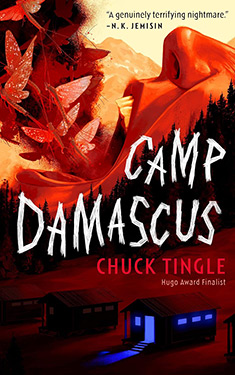
Camp Damascus

Chuck Tingle
Completed 6/20/2025 Reviewed 6/20/2025
5 Stars

I picked up this book as a break between all the Hugo nominees I’m reading.  I loved his Bury Your Gays, and this one is just as amazing.  This book is another horror piece, this time with events surrounding a fundamentalist gay conversion camp.  It’s a powerful piece.  It’s not perfect, but it is so emotionally powerful and poignant that I couldn’t help but be intensely enthralled and moved by it.  It spoke to my experience being gay and Catholic, although the experience I had when I was active in the Church was unusually welcoming and supportive.  That is, until some of my friends turned evangelical.  Fortunately, some of them have learned a lot more about theology and context and we have mended those relationships.  So yes, this was a personally profound book.  Also, it was nominated for a 2023 Bram Stoker award.

Rose is a superiorly devout Christian twenty-year-old in the Kingdom in the Pines denomination in backwoods Montana.  However, she suddenly starts seeing a demon following her around.  It appears whenever she thinks about a friend of hers.  Rose doesn’t have much patient with boys, preferring the company of her female friend.  At a party, the demon appears and brutally murders her friend.  This throttles her, needless to say.  Then she comes across a young woman who screams at her to stay away and that she loves her.  Then she is followed by another demon who was following that woman.  She crashes her car trying to escape it and starts putting two and two together that one, she is gay, and two, demons are tethered to the young gay people in town.  Then she realizes she had been sent to Camp Damascus for gay conversion therapy and her memory of it has been suppressed.  She runs away from home, meets up with another exile, and tries to find a way to break the tether and destroy the camp.

The story is told from Rose’s POV.  She’s unbelievably devout, with the support of her parents and the Church’s therapist.  Then when her world turns upside down, the transformation she goes through is profound and intense.  Rose is also on the autism spectrum.  I was very impressed with how this was portrayed and have heard from other readers on the spectrum that it was very relatable to their experience.  The combination of her being gay and on the spectrum made for quite a multidimensional character.  At first, she’s kind of a Mary Sue, but soon she has a lot of cracks in her composure that break that characterization.

The other characters were also well developed.  Her parents were too nice until their composure cracked.  Her mother was clearly struggling with her religion and her love for Rose.  The therapist was devious, but believable.  And thank goodness for the exile and her girlfriend.  She comes to the conclusion that most of us have, that sometimes, you have to create your own family when the biological one won’t accept you for who you are.  

The horror in the book is quite scary and effective.  I had chills running through me through the first half.  But the real horror is that people can perpetrate evil upon others in the name of God. And it’s so visceral, especially at this time in history when this is happening all around us and is government sanctioned.  This book is timely, honest, and effective.  And with the excellent writing and character development, it is a must read for everyone.  I give this book five stars out of five.  


Tuesday, June 17, 2025

2025 Best Short Story Hugo Nominees

Completed 6/16/2025 Reviewed 6/17/2025

In this blog entry, I review and rank the six Hugo nominees for Best Short Story.  These are stories under about 30 pages in length.  I don’t remember the exact count of words that defines a short story, but the stories range from a page or two flash fiction to what you normally think a short story’s length would be.

Unlike the Novelette nominees, my opinions of the short stories ranged from really like to “huh?”  One story played with format while another was filled with footnotes and historiography (defn: the study of the methods used by historians in developing history as an academic discipline).  So here comes my list from favorite to least favorite:

“Stitched to the Skin Like Family Is” by Nghi Vo – Creepy story about a Chinese woman making her way across the US to find her brother.  She supports herself by sewing.  While sewing, she can feel the most recent events of the life of the wearer.  She ends up at an Inn that was the last address she had of her brother.  She offers family sewing services in exchange for a hot meal and a place to rest.  Little does she know that the clothes she sews will tell her horrifying stories of the Inn’s caretakers.

I love Vo’s work.  This story, through basically a horror story, is a joy to read.  This touching something and getting its history is a frequently used trope, but Vo’s writing elevates the story of racism and serial killers to great heights.  Not for the faint of heart, but profound in its message of family love and courage.

“Five Views of the Planet Tartarus” by Rachael K. Jones – Flash fiction about criminals being sentenced to paralyzed immortality in space.

Being only 3 pages long, I can’t really say much else.  But it punches you in your gut with frightening realism.  The scene with the preparation for being put in space is horrifying.

“Marginalia” by Mary Robinette Kowal – A more traditional fantasy story about Margery, a young woman living with her palsied mother and younger brother in a dirt floor house.  The mother was once the housekeeper at the manor of the Lord John Strange.  The boy, Hugh, wants to be a squire for him.  When a giant snail comes from the forest to attack, Hugh begs to go watch the Lord Strange ride out in defense.  Margery lets him, but after a long while begins to worry.  When the lord’s horse shows up unattended, she runs to look for him.  She finds him guarding the lord who is stuck under a tree.  Then the snail attacks.

I thought this was well written, even though it doesn’t have a strong message.  It’s just good basic fantasy.  The world building is quite amazing for a short story and the characters are very multi-dimensional.  

“We Will Teach You How to Read | We Will Teach You How to Read” by Caroline M. Yoachim – This was the story with played with formatting to get the point across.  I wasn’t positive, but I think it was an alien race that could think along multiple threads trying to train humans to read multiple threads.  

This was definitely experimental.  I don’t know if I actually got it, but it was an interesting concept and execution.  It certainly spoke to me considering I test CPUs that have many threads, so it kind of reminds me of how computers process data.  

“Why Don’t We Just Kill the Kid in the Omelas Hole” by Isabel J. Kim – Strange story of a town of Nice Houses where the people put a child in a hole as a support structure to guard against catastrophe.  If catastrophe strikes, they kill the child and find another one.  If they don’t, the child starves to death.  

This was very weird.  I don’t know if it was supposed to be a metaphor for sacrificing children to the gods for protection or school shootings or child abuse or what.  It certainly raised my hackles, though, and was hard to finish.  It evoked a lot of anger and emotional response from me.  Didn’t really like it.

“The Three Faces of a Beheading” by Arkady Martine – This was the really bizarre one that tells different perspectives of an uprising and beheading of the leader of the rebellion.  

This had lots of discussions about historiography, which basically lost me.  I almost didn’t finish this sixteen page story because at page eleven, I just was so bored and lost.  I did not like this.

That’s my summary and ranking of the six nominees.  They can be found in various sci fi/fantasy publications and often can be found for free on the publisher’s or magazines’ websites.


2025 Best Novelette Hugo Nominees

Completed 6/16/2025 Reviewed 6/17/2025

In this blog entry, I review and rank the six Hugo nominees for Best Novelette.  These are stories about 30 to 50 pages in length.  I don’t remember the exact count of words that defines a novelette, but the stories are shorter than novellas and longer than short stories.

The choices this year were all outstanding.  It was hard to choose my top pick and equally hard to rank the rest.  Here’s the list with a brief summary and some comments.  They are in order from favorite to least favorite, though the margins between them all are so slight.  

“The Four Sisters Overlooking the Sea” by Naomi Kritzer – I love a good selkie story.  This one is about a married couple, both with Ph.D.’s.  The husband continued his research, the wife gave up her research on Grey Seals.  They are near Cape Cod while he’s on sabbatical doing a residency at Harvard. Amazingly, she finds a group of grey seals, many of whom she remembers from her doctoral work in Maine. She tries to restart her research.  Naturally, her husband doesn’t want her continuing her work because it threatens his status quo.  She goes ahead with her plan anyway, only to find some interesting behaviors of the seals.

I loved how this story built up to a fantastic twist at the end.  Most of the story, however, is about her and her daughter trying to integrate into the society of the small town they live in.  They meet other moms and their daughters.  The moms encourage the woman to restart her seal research.  The mother and daughter also discover that there are four standing stones overlooking the bay which legend has it were women who got married and their husbands died.  They lived a very long time and eventually became the stones.  

“By Salt, By Sea, By Light of Stars” by Premee Mohamed – Firion the Wizard has lost her ability to read the old language and thus her magic.  Still, the academy sends her Cane, an apprentice who she trains by making him do everything himself without her showing him.  She says Cane can skip all remaining tests and trials if he can fend off the Bouldus, a giant sea dragon that comes and destroys parts of the town whenever it is awakened by the sound of smaller sea dragons mating.  This year is going to be a Bouldus year.

What I liked about this book is that both Firion and Cane are rather non-traditional.  Firion was once a great magician but has lost a crucial talent.  Cane is a poor, abused boy or young man who can’t get into the academy due to the cost but just might have the talent.  Firion somehow makes the training work for Cane.  Also, the Bouldus scenes were great.

“Lake of Souls” by Ann Leckie – This terrific tale is told from two points of view.  Spawn is a “lobster dog” on a distant planet.  Orbiting the planet is a human anthropologist.  She awakens from cryo-sleep to find the ship empty with lots of blood stains, no ansible for communication, and only one pod that’s not too badly damaged.  She decides to go down to the planet to find the person who committed this tragedy, find the ansible, and get rescued.  In the meantime, Spawn is unnaturally drawn to the water from which it hatched.  The adults are worried that Spawn may not have a soul.  Spawn decides to search for the Lake of Souls to figure out if it has one.  On the planet, Spawn and the anthropologist meet.  

I’m not a huge Leckie fan, but this story was phenomenal.  There are a lot of “human meets alien and become friends” stories, but there was something special about this one.  Spawn and the “lobster dog” culture and spirituality was fresh, interesting, and empathetic.  The anthropologist was brave, resourceful and open minded.  When the two meet, it’s written marvelously, and you love both characters.

“Loneliness Universe” by Eugenia Triantafyllou – This incredibly original parallel dimension story begins with a woman trying to reconnect with her childhood bestie.  However, they seem to be at the same bus stop, but neither can see each other.  The friend thinks the woman is ghosting her like she did so many years ago.  Then after an evening of playing video games with her brother, he goes out for chips and she takes a nap.  When she wakes up, the chips are there but not him.  She can text and email these people, but they cannot see her and she cannot see them.  This continues with other members of her family and even acquaintances she’s trying to get to know better.  Soon the phenomenon seems to spread around the world.

This was really creepy and an interesting statement on relationships in our high tech world. The devolution of the main characters relationships and her attempts at propping them up with texts and emails is frustrating and frightening.  And when it begins to happen everywhere, it’s even more terrifying.  Depressing, but very well constructed.

“Signs of Life” by Sarah Pinsker – This was a wild story of two estranged older sisters who plan to meet after over 40 years apart.  Veronica made the first move, feeling guilty for an old harm she perpetrated on her sister Violet.  When she gets to Vi’s home, she finds her sister looking ragged and worn while Veronica, the older sister, still looks young and vivacious, though she did have one plastic surgery.  Vi was a young widow and her three children all died in their late teens to early twenties.  Now Vi lives with the mysterious Shane.  Vi then shows Veronica the strange art she’s producing and soon Veronica discovers something about herself she never imagined.

Such a strange story, but I loved the progression.  It’s told from Veronica’s perspective and she’s harboring 40 years of venomous guilt.  She was a successful news reporter and anchor while her sister lived a rough life.  As the two slowly reconcile, they reveal more about their past, together and separate.  It all builds up to the strange art decorating the back acres of Vi’s property.  There’s magic in this story, but is strange and inconsistent.  The ending is happy, but so very surprising.

“The Brotherhood of Montague St. Video” by Thomas Ha – In the near future, all books are digital.  There are some old fashioned bound paper books left.  The main character finds one at the library and steals it since it has no stamps, identification, or tracking on it.  He reads it and finds it rather depressing.  Recently his mother had passed and he has been selling her stuff at Montague Street Video.  So he takes the book there to find out how much it’s worth.  The owner says it’s worth a lot but he may not be able to find a good buyer for it.  Instead, he directs him to another Video shop out on Long Island.  Suddenly, the man is approached by a supposed representative a dealer who wants to offer six figures for the book, but the main refuses to sell yet.  Then things become dangerous as the rep begins to threaten the man.

This was my least favorite of the six nominees.  I thought it felt like it was trying to force its point rather than just letting it happen.  Still, it makes a great point about the changing of things to appeal to the lowest common denominator of society.  Great things become watered down to be easily consumed.  And suddenly, the past is wiped out.  Very Big Brother-like.  

Thanks for reading.  I know I wrote a lot.  The stories were short but jam-packed with good stuff.  I wanted to share that good stuff and somehow not give away the awesome endings.


Saturday, June 14, 2025

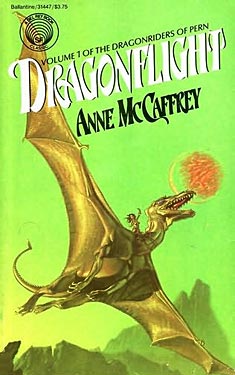
Dragonflight

Anne McCaffrey
Completed 6/13/2025 Reviewed 6/14/2025
4 Stars

The book that created the modern dragon tropes of science fiction and fantasy.  This was a book club read and I was looking forward to rereading this book again.  I read this book and many of the McCaffrey Pern books at least once before, the last time being about fifteen years ago. This time, I had a lot of trouble getting into it, partly because I was late in beginning reading it (starting only two days before), and partly because I realized how some parts did not hold up with time.  Fortunately, book club discussion helped me understand some of the antiquated parts.  I finally finished it a few days after book club, enjoying it with new insight.  This is basically a bodice-ripper romance, written with a Victorian mindset, but still featuring a strong, independent woman.  A lot of the men are pigs concerning sex and sex roles.  And adverbs abound.

Lessa is kitchen drudge in Ruatha, which has been conquered by a corrupt lord and his army.  Lessa is of the original ruling blood and she can secretly talk to dragon-related creatures.  F’lar arrives on an official search for a young woman to bond with the new, soon-to-hatch queen dragon.  After killing the corrupt lord, he finds Lessa, senses something strong under the layers of servitude, and bringing her back to Benden Weyr.  There, the egg hatches and the new queen impresses upon Lessa, forming the all-important psychic bond.  When the queen dragon mates, it is with F’lar’s bronze dragon.  This means Lessa and F’lar will also become lovers, much to Lessa’s chagrin.  Over the next few years, they more or less fall in love, just in time to fight the terrible Threads, spores that fall from the sky and eat all living matter in their path.  

The antiquated part of this book is the male-female relationship.  It’s very Victorian.  Lessa and F’lar are basically bound to mate as their dragons have.  However, Lessa does not allow herself the pleasure of the act.  While we don’t see these scenes, we find out that F’lar feels like he’s raping her, but believes that if they do it enough, Lessa will come to enjoy it (ick).  In addition, whenever he’s upset with her, which is often, he shakes her.  There’s even a scene where she cries and quivers, explaining to other people that she knows F’lar is going to shake her again when he finds out she disobeyed a direct command.  All these scenes turned my stomach.  I can’t believe these are parts I did not remember, considering my sensitivity to sexual violence.  But after the book club discussion, I understand that McCaffrey really was writing a ‘50s Victorian romance, complete with abusive, haughty men and rebellious women.  In fact, she had written several standard bodice-rippers before this one.  Fortunately, McCaffrey’s writing and imagination grew over the years, and in light of the sexual revolution of the ‘60’s, the relationships became much less creepy.  

Despite my above paragraph, Lessa is a very strong character, taking matters into her own hand, defying the authority around and above her.  I liked her from the start.  F’lar and the other men take some getting used to.  They are not used to a woman being self-willed, thinking on their own. F’lar does grow dramatically in this short novel and by the end, he respects the decisions and risks Lessa takes.  

Before this reading, I would have given this book five stars, but this time, I give it four out of five.  I was more cognizant of the prose, finding it clunky, especially early on. It was not as smooth as most books you read today.  However, she does great world building despite this.  Her writing does become better.  By the time she got to “Dragonsdawn,” she was a much better writer.  Surprisingly, she won the Hugo and Nebula when the first chapter of this book was released as a novella.  That’s the chapter I found hardest to read.  But it did set in motion one of the greatest series of all time, inspiring imitators even today, as is evidenced by the wildly popular romantasy series which began with Fourth Wing.  I probably won’t reread the rest of the series soon, but I would like to eventually.  I loved it at 19, and I loved it at 50.  And I’ll probably love it again, particularly since women take on larger roles and men become less cruel in their relationships as the series goes on.


Monday, June 9, 2025

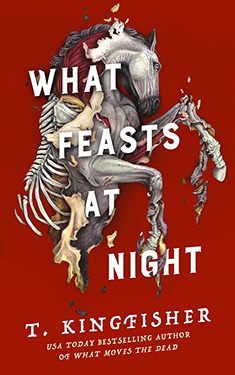
What Feasts at Night

T Kingfisher
Completed 6/7/2025, Reviewed 6/9/2025
4 stars

Another fast read.  This time however, while I loved the book, I loved it a little less than the first, What Moves the Dead.  I probably shouldn’t have read it immediately after What Moves.  Besides, I won’t be able to finish my next read for tomorrow’s book club ☹ .  Oh well, I still love Kingfisher, and this was another wonderfully creepy experience.  While it’s not my top choice for the Hugo Novella category, I have to say that it ranks pretty high anyway.  I’m glad I read the first book though, as the characters of Easton, Angus, and Miss Potter all reappear.  There are references to the events of the first book as well.  The prose was terrific, as always, and there was a good amount of comic relief to give you a break from the creepiness.  

Easton returns to the lodge in Gallacia which he inherited, accompanied by Angus.  They are there to rest after the crazy events at the House of Usher, and to host Miss Potter as well.  When Easton and Angus arrive, they find that their housekeeper has died from an unknown “lung infection.”  They go about trying to hire a new caretaker, but no one wants the job, believing the place is haunted by the moroi, a breath-stealing ghost of folklore.  However, a desperate, cranky widow takes the job and moves in with her loner grandson.  Soon the grandson begins to have nightmares of a woman sitting on his chest, preventing him from breathing.  Easton, Angus, and Miss Potter begin another series of paranormal investigations to figure out why he appears to be dying of the same thing the old caretaker died from.  

The widow housekeeper is the center of the humor this time, for the most part, until she becomes obsessed with superstitious methods for keeping the moroi away from her grandson.  The grandson, whose name I can’t remember, was really sweet.  He may have had a learning disability growing up, but now pitches in around the lodge, giving 110% to help his grandmother and his employer.  When moroi began preying on him, I was aghast.  Why not Easton or Angus?  But Easton does get involved pretty deeply, risking his own life to save the grandson.  

Miss Potter doesn’t feature as much in this book, besides occasional references to the mushrooms of the area.  Instead, we meet the town’s priest.  He appears to be a skeptic, but clearly is worried that they really are being haunted by a moroi.  Some of the best scenes are when Easton, Angus, Miss Potter, and the priest drink the horrible national alcohol, much to the dismay of the prudish widow.  She always has excuses for the others, but condemns Easton for their drunken behavior.

I give this book 4 stars out of five.  While very good, it just didn’t take me to the same place that What Moves did.  Still, it’s a creepy tale based on actual folklore, Kingfisher’s bread and butter.  I still look forward to the third novella, which I’ll probably read later this year.


Saturday, June 7, 2025

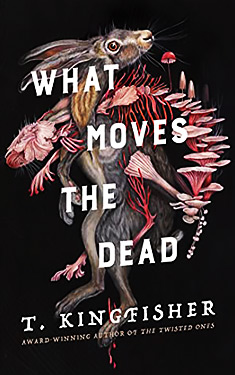
What Moves the Dead

T Kingfisher
Completed 6/6/2025, Reviewed 6/7/2025
5 stars

Whenever I pick up something by T Kingfisher (the pen name of Ursula Vernon), I’m always amazed at the beauty of her prose.  And I’m astounded that she moves so easily between genres.  I may not always love the book, but I never dislike it.  This time, I loved it.  I read this novella in one sitting.  It’s a horror story, inspired by Poe’s “The Fall of the House of Usher.”  I used to read a lot of horror, especially Stephen King and the weird worlds of Clive Barker.  This was a great return, leaving me creeped out on my couch until the end and begging for more.  Fortunately, this novella is the first of three, the second of which is a nominee for this year’s Hugo.  This first was a nominee in 2024.  

Alex Easton is a “sworn soldier,” a career soldier in the Gallacian army who has given up their identity including gender.  After the end of a particularly useless war against Bulgaria, they receive a letter from an old friend, Madeline Usher, who writes that her brother is convinced she is going to die.  Easton travels to the Usher house, finding it decayed, covered in mold and mushrooms.  Roderick, Maddy’s brother who served with Easton, is pale and suspicious, but welcomes Easton in.  Also at the house is Denton, an American doctor friend who is baffled by Maddy’s illness.  When Easton sees her, they can’t believe how gaunt, frail, and cold she is, clearly near death.  Easton and the American, along with a Miss Potter, a plucky older denizen of the nearby town who is an expert on mushrooms, try to solve the mystery causing Maddy’s illness.  What they find is too terrible to imagine.

Gah!  It can be tough giving a plot summary for a novella without spoilers.  I do think I succeeded though.  😊  I really liked Easton.  Despite being a career soldier, they are suffering from what in 1890 is called soldier’s heart; in today’s terms, PTSD.  They often have flashbacks to scenes from the war as well as nightmares and panic attacks.  Needless to say, the strange happenings at the Usher house provoke these episodes.  Still Easton finds a way to cope with the problem at hand, trying to piece together the puzzle of Maddy’s illness.  Told in first person, I easily empathized with them and found them quite likeable.  

Despite being a horror story, there is a lot of humor to relieve the tension.  Miss Potter is a hoot.  She is bitter that the Royal Mycology Society won’t publish papers by women, it being the Victorian era.  But she is perhaps the most knowledgeable person on fungi in all of Europe.  Angus, who also served with Easton and is a sort of gentleman’s gentleman for Easton, comes to the Usher house as well.  An older man who also served Easton father, Angus seems to fall for Miss Potter amidst the creepy happenings on the property, lending some humor of unspoken impropriety.  Denton is not so stereotypically American, having a soldier’s heart as well from treating the wounded during the Civil War.  His job was mostly amputating limbs, leaving him with horrible nightmares.  The humor with him mostly comes from Easton, Potter and Angus’ observations American customs.

On the creepier side lie the Maddy and Roderick.  Maddy is frightening to be around, though she was an occasional playmate of Easton’s when they were younger.  Roderick, their buddy, seems to be on the verge of mental collapse from caring for his sister.  And then there are the weird zombie hares all over the property.  There’s one scene where Easton rides into the nearby woods, only to end up surrounded by these strange, staring, fearless creatures.  It all adds up to creepy good times when you are alone at home at night completely engrossed in the book.

I give it five stars out of five.  The book is very slow paced through much of it.  I did not find this problematic though, it enhanced the creepy atmosphere of the Usher residence.  And not having read Usher, though I’ve read other Poe, I can see Kingfisher emulating Poe with the atmospheric style and gorgeous prose.  I must say, I simply love reading her books, like her current Hugo nominated novel, A Sorceress Comes to Call.  When I finished “What Moves the Dead” last night at ten p.m., I couldn’t wait to begin this year’s nominated novella to see what happens to Easton next.  And I’ll probably read the third in the series whether it’s nominated for a Hugo or not.


Friday, June 6, 2025

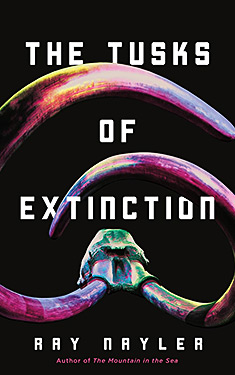
The Tusks of Extinction

Ray Nayler
Completed 6/6/2025, Reviewed 6/6/2025
5 stars

This novella blew me away.  It has all the characteristics of the last book of Naylor’s that I read, The Mountain in the Sea, but I found it worked better for me and at a much higher level.  I haven’t read much eco-sci fi, but Nayler is clearly a profound voice in the subgenre.  He has worked with the State Department and NOAA and was in the Peace Corps for many years.  He is fluent in Russian and speaks many other languages.  I hope he is still employed by the government.  He has an amazing insight into the plight of animals and their relationship with humans.  This book takes the catastrophe of the ivory trade and transports it to a future where the mammoths are brought back through cloning and the poaching they face.  There is also a great twist that lets us into the minds of the mammoths, which I’ll explain in the plot summary.  This book is now my top pick out of the 2025 Hugo Novella nominees, with one more to go.

Damina is a Russian scientist working in the present to prevent elephant extinction through poaching for the illegal ivory trade.  In the near future, mammoths are resurrected by reconstructing the DNA from specimens from the Ice Age.  The DNA gaps are completed from their nearest cousins, elephants, who now only survive in zoos.  The mammoths are set free in the Russian taiga, but are not flourishing as their instincts for survival in the wild have not been taught.  They don’t reproduce and they don’t know how to forage in the winter for food.  In a last ditch effort, scientists transplant the mind of Damina into one of the mammoths, since she had the best understanding of elephants in the wild while she was alive.  As a mammoth, she teaches the pack to survive.  But once again, the poachers are out there.

Like his Mountain in the Sea novel, there are quite a few plotlines which eventually converge.  So there are many characters.  I had a little trouble remembering who everyone was, which is typical, but it wasn’t as bad as usual.  Damina and her plight are amazing.  Part of the story is told from her perspective as she lives with the mammoths.  Intermittently, something brings back a memory of her human life, giving us a detailed characterization.  It’s masterfully done.  It evokes empathy and compassion, but then shows us her darker side as well.  And she takes all of this with her into the mind of the alpha female mammoth she becomes.

We also follow two groups of people, a band of poachers which includes a 16-year-old boy; and a scientist, a guide, a wealthy man, and his husband who are going to hunt a young mammoth bull for the Russian government as part of a deal to receive government protection of the mammoth habitat.  In the little time we have with them, almost all the characters become three dimensional, especially the boy, who eventually tries to help the mammoths.  I was amazed at the emotions their activities evoked in me, as well as those of the mammoths.  Naylor has great insight into the minds of such people, as well as the emotional lives of elephants, which he transposed onto the mammoths.

This is not a cheery tale.  The morality for all the characters is questionable, but the book is highly satisfying.  They all face tough choices, but I eventually felt the most empathy for Damina and her challenges as alpha female.  The book is prosy, with Damina and many of the other characters dealing with their decisions internally.  But it fills in all the gaps in the action to keep you on the edge of your seat.  I give this novella five stars out of five as I felt transformed in my understanding of the poaching and the internal lives of the incredible creatures that are elephants.


Tuesday, June 3, 2025

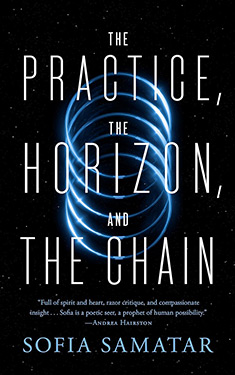
The Practice, The Horizon, and the Chain

Sofia Samatar
Completed 6/2/2025, Reviewed 6/3/2025
4 stars

I was completely surprised at how much I liked this dark science fantasy novella, considering I didn’t like Samatar’s award winning A Stranger in Olondria.  While the prose was lush and similar to her Olondria novel, it worked for me.  Perhaps it was the shorter length.  Perhaps it was the science fantasy fusion.  Most likely, it was those things, as well as the mysticism and self-actualization that were the themes of the story.  It’s about taking chances, breaking bonds, and fighting against oppression.  It spoke to me deeply and it’s reflected in my rating.

On one of a fleet of generation ships whose main goal is the mining of rocks which power them, a boy of about seventeen is taken up from below where he had been chained and forced to work the mines.  The conditions were horrendous, but he formed a bond with a man he called the Prophet.  The Prophet trained him in “The Practice,” a way of centering and dealing with the harsh conditions.  It also taught the boy to embrace his gifts, one of which is drawing.  Once above, he is lost and confused.  He slowly bonds with the woman he knows as the Professor.  She runs the program which brought the boy from below to have an education like the elite class.  However, both he and she have anklets for tracking and controlling, since the elite fear those from below and their descendants, which the Professor is.  When the boy has a vision of the Prophet’s daughter on another ship, he convinces the Professor to take him there to bring her back, igniting a chase as well as a fire within them for freedom from their chains.

The boy is an intriguing character.  He doesn’t want to leave the mining below because that is all he has ever known.  He misses the food, the hard floor, and of course, the Prophet.  The Professor tries to integrate him into the upper deck society, which is the goal of this program she runs.  However, with their anklets, they are still clearly not part of the elite.  Because of her mentoring the boy, her eyes are opened as missteps produce punishments and her relationships fall apart.  She soon realizes that she must do something to put a crack in this horrible caste society.  

The pacing of the novella is rather slow.  There is a lot of prose and minimal dialogue.  With the third person narration, we are almost always in the boy’s and the Professor’s heads.  Despite all the descriptions and inner dialogue, it’s where the transformations occur and it is a most satisfying experience.  I think if this were a longer book, I might have been bored.  Instead, I was captivated by them and completely wound up in the somewhat surreal climax.  

Having read this book, I would give Samatar another chance on a longer novel.  I give this book four stars out of five.  It inspired me and gave me hope in this time when everything seems so dark.  Not a light read, but definitely satisfying.


Monday, June 2, 2025

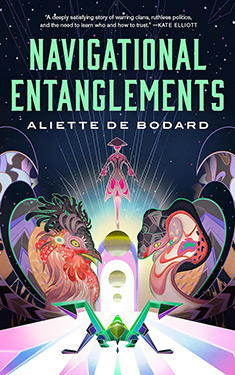
Navigational Entanglements

Aliette de Bodard
Completed 6/1/2025, Reviewed 6/2/2025
2 stars

I had a lot of trouble following this novella.  It is written in a style of xianxia martial arts.  Xianxia, according to Wikipedia, is a form of Chinese Fantasy which blends many aspects of Chinese folklore, culture, and philosophy.  There are many films and television programs which are set in a xianxia world.  Unfortunately, I was completely unfamiliar with this genre and struggled to understand what was going on.  I did eventually catch onto the plot, but never fully felt like I was engaged.  This novella was nominated for a 2025 Hugo Award in this category.

Navigators use the power of their Shadows to safely navigate spaceships through a weird dimension populated by dangerous creatures called Tanglers.  One such Tangler escapes its realm and wreaks havoc in our universe.  The competing clans of Navigators put together a rag-tag team of four juniors under the leadership of an imperial commander to find and destroy this Tangler.  Just as the ship leaves, the juniors find their leader murdered and must find a way to find the monster themselves.  Despite their bickering, they contain the Tangler only to find there’s a much more nefarious plan for the monster devised by the clans while they are the expendable pawns.  

There were many things I didn’t enjoy about the book.  Viet Nhi, along with her shipmates from the three other competing clans, bickered most of the way through the story.  Bickering I can tolerate for a while, but this went on too long for the length of this book.  I also found that much of the dialogue was hard to follow, partly because of the bickering, partly because of the prose in between, and partly because I didn’t always know who was speaking.  The third person narration continually jumped from character to character and I couldn’t always tell who was talking or thinking.  The dialogue also often felt disjointed, not flowing naturally, but terse with abrupt changes in direction.

I was also saddened by the fact that I never really understood the Shadow business.  I got that it’s a life force that the navigators project, but its uses never seemed to clearly describe its nature and effect.  Upon doing a little research, I found out the de Bodard has written a plethora of short fiction in this universe.  Called the Xuya universe, this series has 27 short stories, novelettes, and novellas.  Perhaps if I was introduced to this universe with the earlier books, I’d be able to buy into the components of the xianxia genre.  Instead, I just felt confused.

I give this novella two stars out of five.  Perhaps I’d rate it higher if I understood it better.  Instead, I found it terse and dry.  Even the burgeoning relationship between two of the female characters played out disjointedly.  This one is not going to rank high on my Hugo ballot for the novella prize.


Sunday, June 1, 2025

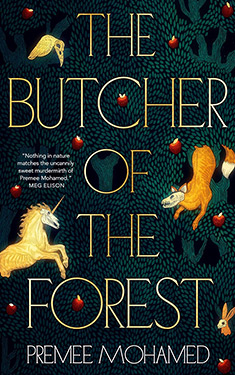
The Butcher of the Forest

Premee Mohamed
Completed 5/31/2025, Reviewed 6/1/2025
4 stars

This was a terrific and very dark novella, nominated for the 2025 Hugo in that category.  I was impressed by the prose, the world building, and how much it pulled me in.  It took me a few days to read only because I was sleeping pretty well for a change.  So I didn’t stay up late trying to finish it, although I would have liked to.  

A terrible tyrant has conquered a country and rules with an iron fist.  In one of the villages lives Veris, a single, world-weary woman who just tries to make it from day to day.  She lives with her aunt and grandfather after her parents were killed by the tyrant.  She lives near a dangerous, other-worldly forest, from which everyone is warned away.  Many children have wandered into the forest, never to return, except for one.  And the one child was saved by Veris, the only person ever to return and with a lost child nonetheless.  Now, the tyrant’s two children have wandered into the forest and the tyrant calls on Veris to find them.  If she fails, either to find the children or return, he will kill her family and raze her town.  She has twenty-four hours to do so.

It's easy to identify with Veris as she trudges through life.  Then when her world is turned upside down by the tyrant, it only makes it worse.  I immediately felt for the rock and hard place she stood between.  She is forced to do something that is dangerous and the chances of success are miniscule.  Yet, I placed all my hope in her to accomplish her task.  That’s how much I empathized with and cheered her.

This had to be the scariest forest I’ve read about in many years.  It goes way beyond the Grimms’ forests, with strange creatures and undead animals.  Perhaps the scariest was the black unicorn that chased her.  Less frightening at first was a horned man who will show her the way to the children if she gives him her saddest, most devastating memory.  Delving in the memory was even scarier than the horned man.  

The book ends on an only somewhat happy ending.  It begins darkly and it ends darkly.  But there is an epilogue that provides some hope.  I liked the whole non-traditional twists on the traditional haunted forest idea, as well as the take on Veris as an independent woman in a world where she is expected to be married and homebound.  I give the novella four stars out of five.  It was just the right length for maximum impact.  This book will land high on my ballot for the novella category this year.