Sunday, January 26, 2014

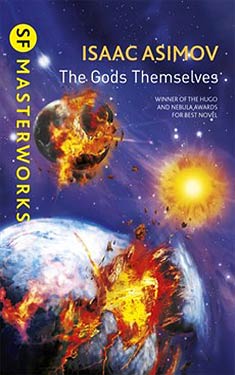
Hugo Winner Review: 1973 The Gods Themselves

Isaac Asimov
Read 2/2013, reviewed 4/21/2013
4 stars

This book is Asimov at his best.  It’s a great premise with fully realized characters, human and alien.  One of my biggest criticisms of SF is the treatment of aliens as cartoonish.  Asimov’s aliens are not.  They are well developed characters, whose world view and morality are appropriate in and challenged by their own circumstances. 

The book is divided into three parallel sections.  The theme is similar in each.  There is an establishment which is flawed.  It is controlled by one or several entities to keep the status quo.  One person recognizes the flaw and its catastrophic implications, works to undermine the establishment, and save the universe.

One of my favorite parts of this book has to do with the way the parallel universes communicate with each other.  The complexity of the communication drives the tension to enormous heights.  The buildup and conveyance of each message, and their deciphering and understanding drives the story. 


I gave this book 4 stars.  I knew I was reading a great book from the first few pages.  It coalesced for me upon beginning the second section.  This book is great SF.

Friday, January 17, 2014

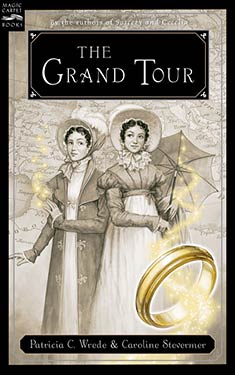
The Grand Tour or The Purloined Coronation Regalia

Patricia C. Wrede & Caroline Stevermer
Completed 1/16/2014, Reviewed 1/16/2014
4 stars

Like the first book, Sorcery and Cecelia, The Grand Tour is a delightful young adult fantasy novel told from the perspective of Kate and Cecelia.  Instead of being epistolary in form, the narrations are drawn from Kate’s diary and Cecelia’s official account written for investigating authorities.  It’s a quick read full of magic and 19th century British manners.  When I began the book, it had been nearly a month since finishing the first book.  Settling in with the first few pages, I was immediately transported to the funny, warm place that is the world of Kate and Cecelia.

In the second book of the series, the cousins are now married and embarking on their joint honeymoon with their husbands Thomas and James.  In the tradition of the time, they are taking The Grand Tour, a trip through some of the loveliest cities on continental Europe.  Along they way, they uncover a mystery of ancient magic and artifacts that may alter the fate of the whole continent. 

As with many sequels, a little of the charm of the first part is missing.  One of the greatest parts of “Sorcery and Cecelia” was two young Victorian ladies discovering a world of magic and intrigue they had never encountered before.  In this book, the focus is on the plot.  The characters are already established and growing in their and relationships to each other and to magic.  The book is still wonderful in its own right.  I wasn’t let down in any way.  I was happy to return to the world created by authors. 

I really enjoyed the development of the mystery.  I have a fondness for Europe and its antiquities, which provide the clues to solving the mystery.  It is not complex, but it is a fun, fast-paced ride.  And as with many books of this genre, there is always some dastardly wizard trying to do great evil.  What’s most fun about this series is that it’s primarily two proper young ladies trying to foil the grand scheme. 


This book and the series in general are simple and enjoyable.  There’s nothing profound here.   I found it a little tough to write this review because I usually comment on the depth of the characters and their relationships.  Instead, I just want to keep repeating what a wonderful experience of escapism this book provides.  As I did with the first book, and as I probably will with the third in the series, I will overuse these three adjectives:  fun, delightful, and fast-paced.  That said (or maybe over-said), I highly recommend this book and give it four stars.  

Wednesday, January 15, 2014

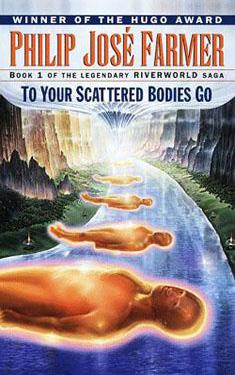
Hugo Winner Review: 1972 To Your Scattered Bodies Go

Philip José Farmer
Read 3/2013, reviewed 4/21/2013
3 stars

I really loved this book.  The premise is awesome.  All the earth’s “human” inhabitants, past, present, and future, are resurrected into a world which seems to be controlled by aliens.  The plot is the struggle of a few of these humans to survive this new environment and figure out what is really going on. 

The key to the story was the struggle to make sense of the new world, and to not fall into the trappings of recreating “tribes” that are as uncivilized or even more savage than that in which they lived while on Earth.  Unfortunately, Farmer focuses on larger concepts such as Nazi-ism and savagery rather than the breaking of social stereotypes. 

The journey of the hero and his community is an amazing one.  The hero is full of machismo, but that is what he comes from.  He relies on this to from his own tribe, interact with other tribes, fight the oppression of evil tribes, even from the 20th century, and find the creators of this world.

It works.  The story is very engaging.  He expects others to rise from their dark pasts, but only up to the late 19th century, the era of his origin.  Since most of those he meets and interacts with are from earlier eras, the challenge feels good.  However, he himself is not challenged to rise beyond that.  Even the people from the future don’t challenge his views of society.  They only help him to understand the history of world from the point of his earthly death forward.

I give this book 3 stars because the premise is so unique.  Some readers take great issue with the machismo, misogyny, racism, and homophobia in the story.  This also bothers me greatly, but having already read most of the pre-1980 Hugo winners, I’ve come to accept that many writers were reflecting the society they knew, and often couldn’t rise from their social myopia.  If this book were written in the last 20 years, I would have had a much more hostile reaction to it.  I realize that if I was an adult in 1972 and read this book at that time, I would have accepted it as being a normal condition.  If Farmer did rise above his social stereotypes, I’d claim this book to be brilliant.  Instead, I’ll call it a really good story.

Monday, January 13, 2014

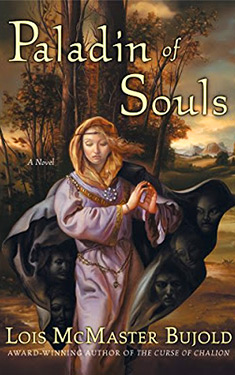
Hugo Winner Review: 2004 Paladin of Souls

Lois McMaster Bujold
Completed 1/9/2014, Reviewed 1/11/2014
3 stars

Ista is the dowager queen of Chalion.  She has lived a cursed life full of heartbreak and despair, and she may just be a little nuts.  She is constantly surrounded by her ladies-in-waiting and guards to keep her safe, presumably from herself.  Tired of this subtle imprisonment, she sets out on a journey under the guise of a pilgrimage, just to get away from her memories, and out from under the thumb of her overprotective staff.  On the way, she has confrontations with enemy soldiers, sorcerers, gods, and demons that give her a chance come to terms with the powers bestowed on her and embrace her destiny.

Ista is a great character.  Like Cordelia in Barrayar, she is smart, headstrong, and has a wicked sense of humor.  But she is also flawed with self-doubt and resentment of her past.  One of the things I like most about her is that she is older than your typical heroine.  She’s forty years old and a widow.  Her daughter is the ruling queen, so she struggles with her lack of role in her society.  So she just decides to take a vacation, as much as you can call leaving a castle in a middle-ages fantasy kingdom a vacation.  Then things turn bad.  There seems to be an epidemic of demons, her band is attacked by enemy troops, and she’s saved by a lord of a castle where bad magic seems to be afoot.  And Ista appears to be the one person who can clean this whole mess up.

This book has some elements a romance novel.  While I am not a big fan of romance novels, I did like the fact that Ista’s sexuality is a part of who she is.  It’s not blatant, it’s just matter of fact, like a real person.  Ista is a celebration of being a person of a certain age.  Being one myself, I think I just enjoy older fictional characters who are strong, funny, and sexual.  There is one sexual scene in the book which was a little freaky-scary-magicky, but it actually adds to the strange, bad magic happenings around the castle.

The world created by Bujold has a fully developed mythology with a pantheon of five gods:  the Father, the Mother, the Son, the Daughter, and the Bastard.  I thought this was great.  It’s an awesome extension of the Christian concept of the Trinity, with a twist.  The Bastard is a god, but is also a trickster, and the keeper of demons.  Because of the heartbreak she suffered in the previous book, which I haven’t read, “Curse of Chalion”, Ista is angry with the gods and resents how they invade her dreams with visions and prophesy.  Some of the gods actually appear to Ista, but religion itself is really the character that Ista has conflict with.  Her conflict is fully realized as she comes into contact with the lord and lady of the castle, more demons, and that marauding enemy from the north.

The supporting characters are also well developed.  There’s the ruggedly handsome lord and his equally handsome brother, the nearly-mad lady, a bumbling monk, and a strong-willed courier-turned-lady-in-waiting. All the characters are wonderfully drawn and add a lot of warmth and depth to the story.

The fault I had with the book was that the writing style was boring to me.  The book seemed to have all the elements that make a great fantasy novel, but it just left me flat.  There were a lot of exposition scenes which took away from the movement of the story.  I can recall three really major exposition scenes which just seemed like cop-outs.

I really wanted to like this book, but the great parts didn’t add up to a great whole.  I give this book three stars.  Despite the rating, I want to read “Curse of Chalion”, the first book in the series, and “The Hallowed Hunt”, the third, because I really liked the mythology Bujold created.


Saturday, January 11, 2014

The Sirens of Titan

Kurt Vonnegut Jr.
Completed 1/2/2014, Reviewed 1/3/2014
3 stars

I loved Vonnegut in high school.  In my Modern American Lit class, we read “God Bless You, Mr. Rosewater”, “Welcome to the Monkeyhouse”, and of course “Slaughterhouse Five.”  On my own, I read “Jailbird” and “Slapstick.  Picking up one of his earliest novels thirty-five years later, I realized I had forgotten what a bizarre, dark writer he was.
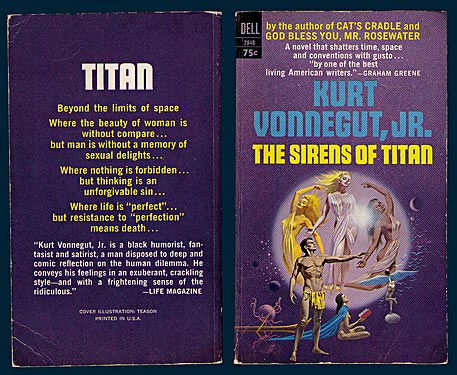
“Siren of Titan” has a crazy, convoluted plot that is quite difficult for me to describe.  It’s about Malachi Constant, one of the richest but also most spoiled and morally bankrupt people on earth.  When his fortunes collapse, he takes an offer to go to Mars to become an officer in their army.  Constant’s adventures on Mars, and later Mercury and Titan seem to be manipulated by Winston Niles Rumfoord, a man who apparently knows the future, and moves through space making appearances on earth every 50-some-odd days.  Besides Constant, Rumfoord manipulates the people of earth, starting a new religion, the Church of God the Utterly Indifferent, turning Constant into a sort of anti-messiah.  Also in this mix is Rumfoord’s suffering and spoiled wife Beatrice, and a robot alien named Salo from the planet Tralfamadore (Vonnegut uses this planet in several of his works).  And, well, let’s just say, you have to read the book to really get it.

Trying to write this review, I’ve realized this book is really hard to write a review for.  The book is short.  I can’t discuss the plot too much because it moves quickly and gives away the ending.  So I’ll focus on the ideas he’s conveying through the story.

Clearly, Vonnegut is making a lot of statements in this book.  First, he talks about the war machine.  From my high school English class, I still remember that Vonnegut was in WWII and survived the fire bombing of Dresden.  He had some pretty intense feelings about war.  At least at the time he wrote the novel, I think it’s easy to say that Vonnegut believes that people are tricked into joining the army with promises of a fresh start, only to become killing machines, nearly devoid of free will.  Any show of thinking on your own gets you punished. 

Vonnegut was also an outspoken humanist.  It’s clear from this story that he believes that if there is a god, he’s indifferent, and doesn’t need our worship.  If there should be a religion, it should be one that dictates having compassion for each other, even the lowliest of us.  In the novel, the only way to do this is to create a war event with such deplorable results that people are mortified into shifting their beliefs to a new paradigm.

Lastly, I think it’s pretty obvious that he despised the rich. That’s obvious from his main characters.  Considering what a short book this is, the characters are pretty fully realized.  And the three main characters, Rumfoord, Constant, and Beatrice, are pretty deplorable people.  There were times where I felt pity for Constant as he is manipulated by Rumford, and for Beatrice and her plight, but that didn’t last very long.  The only character who is likable is Salo, the robot.  It is the only character who seems to have human feelings.  It does not manipulate, or act out of revenge.

The end of the book is great.  There’s an awesome twist which I won’t give away.  And reflecting on it, it makes me mad that at least one other popular author stole the ending.  I won’t give it away, because it will give away the ending.  But if you’ve read popular SF from the ‘80s, you’ll know who it is as soon as you finish “Sirens”.

Whew, getting all that out coherently was tough. 


I didn’t think this book was his best.  But in coming up with a star rating, I had to acknowledge the genius of Vonnegut, creating such a wild, dark ride, jam packed with his philosophies in such a short novel.  I couldn’t give it 4 stars, because at the same time, it seemed forced.  I think he did a much better, subtler job getting his messages across in later works.  So I settled on 3 stars.  It’s definitely worth a read.  I think everyone should read some Vonnegut.  Whether you agree with his beliefs or not, he had a style of writing that should be experienced more than once.
Friday, January 10, 2014

2014 I Just HAVE To Read More Of That Author Challenge

There’s a new challenge for 2014 on the World Without Ends site. 
It’s the “Roll Your Own Challenge”.  It lets you create a challenge of your own and/or join a challenge created by another member.  I’ve created my own.  It’s called the 2014 I Just HAVE To Read More Of That Author Challenge.  Read 12 books by authors you've read once before and thought "I just HAVE to read more of that Author".

If you want to participate in my challenge, read more about it on my challenge page and then join WWEnd and sign up for it.  Join me in the fun!

Friday, January 3, 2014

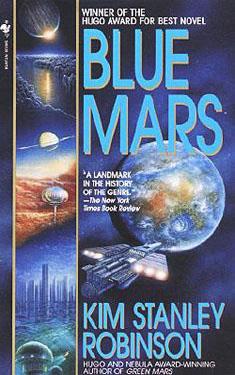
Hugo Winner Review: 1996 Blue Mars

Kim Stanley Robinson
Competed 1/1/2013, Reviewed 1/1/2013
4 stars

Finally, I’m done with the Robinson’s Mars Trilogy.  It was a very long journey.  After being rather nonplussed with Green Mars, I wasn’t expecting much from Blue Mars.  It’s longer than the first two installments, and still full of extremely long landscape, technical, and political ramblings, or rather, prose.  And besides, what else can you say about Mars now that it’s terraformed, a government is established, and people are living to be over two hundred years old?  As it turns out, not that much.  But you can finally really rely on slices of life of your characters to create something like a collection of inter-related short stories to convey the experience of living on Mars.

I don’t know if it’s because I finally gave into the trilogy’s form, or Robinson’s style just grew on me over the course of the trilogy, or if in the starting of this book I was feeling sentimental, like I was visiting old friends, but I felt that Blue Mars was a better character driven novel than the first two.  There is still a lot of prose during which I again found myself losing focus, but I found myself more in touch with the characters than I had in any of the other stories.  They really seemed to have depth.  They no longer existed simply to convey the author’s knowledge of the landscape, neuroscience, global eco-politics, and math.  The author’s knowledge existed to bring you fully developed characters. 

Again, each chapter represents the voice of one character.  There isn’t as much of a plot this time.  So each chapter feels more like a short story in the same universe, rather that a single part of one novel.  And instead of being sad at the end of each chapter, I was looking forward to the being in the next character’s shoes.  Each character finally got to just experience their lives and figure out what to do with themselves now that most of the crises were over, and each one was interesting, and often downright intriguing.  My favorite characters, Maya and Sax, are featured and I found myself finally warming up to Nadia, Nirgal, and Ann.

One of the sections I really enjoyed was where a few of the Martians go to Earth to work on a treaty.  Nirgal, a native born Martian, has to adjust to Earth’s gravity for the first time and becomes the toast of Earth.  Michel, one of the first hundred, struggles with his homesickness for Provence, France.  I also really enjoyed the chapter describing colonization on other planets and moons. 

The most profound part for me, though, was the remaining first hundred finally dealing with the possibility of death.  Having found a formula for extending life and postponing the problems with aging, the group is now over 200 years old, and people are beginning to die and there’s no explanation.  Maybe it’s because I’m a person of a certain age and often think about my mortality, but these chapters really moved me.  It was here that I confirmed my sense that I really had come to love these characters.

My only criticism is the same old one.  The descriptions go into so much detail, that it becomes overwhelming.  My eyes often glazed over during the long descriptions where a paragraph was two or three pages long, with only two or three sentences per page.  During my glazing, I often imagined Robinson at his computer pounding away at the keys in a trance, forgetting to eat, drink, or go to the bathroom, or on his phone threatening his editor with torture and mutilation if one word of his text was deleted. 


I give this book 4 stars, even though I’d rather the editor was much more aggressive.  It’s an incredibly long, painstaking effort to get through this trilogy, but depth of the characters in this final installment made the payoff worthwhile.