Saturday, February 21, 2026

Guess What? I Love You

Mike Maimone
Completed 2/21/2026, Reviewed 2/21/2026
5 stars

I discovered Mike Maimone on social media.  Clips of his music began showing up in my feeds, probably because I tend to view videos by gay musicians.  Mike was very different, with a gravelly Dr. John kind of voice and a distinctive blues/jazz/ballad fusion style.  With all those slashes, you can probably say he transcends styles.  I began following him and learned more about where he is in his life.  He is a widower, having lost his husband and soul mate from an aggressive form of leukemia less than a year after they met.  However, in that time, they both discovered they had found true love.  This book is Mike’s memoir of their relationship.

After more than ten albums, many as part of a band, Mike was going solo.  He was a single man trying the gay dating apps after two unsuccessful relationships.  This year was going to be different, it was going to be the year of saying “Yes,” opening himself to new experiences.  One night, he gets a hit on an app, an older man who was Mike’s type.  They began chatting long distance as Mike was working in Nashville and Howard was in LA.  Something clicked and they hit it off online.  When they finally met, it clicked again.  Soon Mike was falling head over heels for Howard.  They quickly began planning visits whenever their schedules allowed.  Then came talk of a long-term relationship.  On the next trip, Mike planned to propose to Howard when he got the call that Howard was very sick. 

I have not read many memoirs in the last twenty years, not since the days of David Sedaris and Augustin Burroughs.  Unlike those, this book is like a journal of finding the love of your life and then being devastated by loss of him in less than a year.  Mike is brutally honest about how they came to fall in love despite their many differences.  It’s filled with excitement, anxiousness, self-doubt, and humor.  Then he holds back nothing as he experiences the stages of grief during Howard’s short illness.  

My reaction to this book was instant love.  As a gay man myself, I could completely relate to those early stages of discovery in a relationship, where everything is new and exciting and sexy.  And having lived through a devastating breakup and more recently, the sudden loss of a close friend, his story hit me hard.  I read most of this book on a plane ride from Portland to Orlando for the Star Trek Cruise.  Despite my excitement of my trip and the distractions of a plane ride, I found myself immersed in Mike’s experience, my eyes leaking until we came in for our landing.  

This is a deeply personal account of love and loss.  You don’t have to be gay to get it.  The emotions transcend orientation.  And if the book wasn’t enough, Mike also released a companion album.  I don’t have any music apps, but I’ve listened to many clips, and the songs are just as gorgeous as this book. (This may be the push I need to get one so I can listen to the whole album uninterrupted).  I’ll probably never be able to look at a butterfly again without thinking about Mike and Howard.  I give this book five stars out of five.  


Wednesday, February 18, 2026

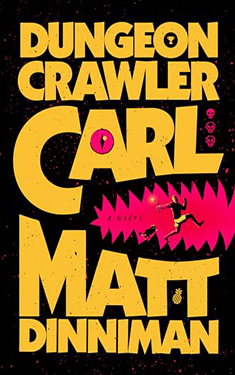
Dungeon Crawler Carl

Matt Dinniman
Completed 2/17/2026, Reviewed 2/18/2026
5 stars

This book was a hoot and a half.  It’s LitRPG, a hybrid genre of science fiction and/or fantasy with the mechanics of a role-playing game, like Dungeons and Dragons, where the characters are aware they are in an RPG.  It has quests, battles, loot, managing stats and inventory, and leveling up.  Being relatively new to DnD (only been playing consistently for two years) and never having read LitRPG before, I thoroughly enjoyed this.  It is a little cartoonish at times, but the main character has a well-developed character questioning the morality of the situation he is in.  It also has a snarky talking cat.  How can you not love that?

In the middle of the night, Coast Guard veteran Carl goes outside to fetch his possibly soon-to-be ex-girlfriend’s prize-winning cat, Princess Donut, which is up a tree.  Suddenly, every building within sight collapses into a pancake.  Only people who were outside at the time of the collapse survived.  The two enter a stairwell down which takes them into a dungeon, complete with exploding goblins, maniacal llamas, and goo slugs.  They find out they are in an RPG game along with all the other survivors of Earth.  It’s run by aliens and broadcast throughout the galaxy to trillions of viewers.  But this reality game show has a twist: when players die, they really die.  And if anyone survives all the way to level 18, that person will inherit the Earth.

While this book is really fun, it’s also quite gruesome.  Yeah, there’s gore, but the really unsettling part is that players die by the millions.  Also, some of the monsters were originally humans or aliens from a previous season.  There’s one particularly rough scene where Carl and Princess Donut are trying to kill a particularly horrifying and dangerous monster when Carl realizes it’s a woman begging for her life in Spanish.  At one point Carl and Donut come across a group of people from a senior nursing home who survived the apocalypse because their home was on fire.  They join the home’s four employees in trying to keep them alive until they can level up in level 3 and gain some powers.  I was surprised and impressed by these scenes.  Dinniman did a great job of integrating Carl’s morality into his situation.  It’s not just any action-adventure story.  It has heart.  Specifically, Carl has heart.

Princess Donut is also great.  Rather than just being categorized as a pet to Carl’s character, she gains the ability to speak, as well as special powers.  She becomes a playing character.  Dinniman keeps Donut in the mindset of a cat while still acquiring some human emotion.  She has many funny scenes in dialogue with Carl, namely whenever she references other men who come over when Carl is at work and moan and growl with his girlfriend behind closed doors.  She has no idea that she’s making Carl more miserable than the potentially fatal RPG situation he’s in.  

Another funny and gut-wrenching scene is when the two are pulled out for interviews, just like the behind the scenes interviews on shows like Survivor and American Idol.  While funny, they give Carl more opportunity to feel icky about his task at hand, i.e., killing to survive.  Note that there are a lot of funny scenes, but this aspect of Carl’s personality makes him much more three dimensional than your average action hero.

I’m going with five stars out of five on this book, only because it is so original to me, and as a DnD player, I could immerse myself in the story and into Carl’s character.  The action is fast paced, the writing is very readable, and the world building is marvelous.  Friends had been telling me I had to read this series.  I’m glad I finally did, even though it was for my online book club.  Now I’ve got to figure out how to fit the next seven books in the series into my ever-expanding TBR list.


Monday, February 9, 2026

The Sword of Shannara

Terry Brooks
Completed 2/9/2026, Reviewed 2/9/2026
2 stars

Ugh, what a slog!  This book was so derivative of Lord of the Rings that I couldn’t help myself from comparing the two through the whole read.  It was very overdramatic with almost no comic relief.  And while LOTR at least had three women characters, Shannara only had one, with a smaller role than Arwen.  I only liked three characters, a heroic and selfless dwarf, a rock troll, and a thief modeled after a character from The Prisoner of Zenda (per Wikipedia).  The book appears on a couple of “Best of..” lists.  My guess is because it was one of the first epic fantasy novels since LOTR to hit the mainstream, feeding the new generation of LOTR fans hungry for more of the same.  If I read it back when it was published in ’77, I might have liked it more.  But nearly fifty years later, it simply feels like sloppy fan fiction.  

Two diminutive brothers are visited by a strange Druid.  Allanon (whose pronunciation I could never divorce from the nearly identically spelled twelve step program) info dumps on the two that Shea is Flick’s adopted half-Elven brother.  Shea is the last of the Shannara line who can wield the Sword.  However, the Sword has been stolen by the evil and ancient Druid Brona.  Brona is trying to take over the world by pitting all the peoples against each other.  Shea must find the Sword and destroy Brona.  Along the way, he picks up his best friend and prince named Menion.  Flick also comes along.  They end up in a fellowship with a surly king named Balinor, a Dwarf named Hendel, and Elven brothers named Durin and Dayel.  They are chased by dark Skull Bearers, gnomes, and trolls.  Eventually they break apart.  Shea gets captured by gnomes and rescued by a thief and a rock troll.  They go off in search of the Sword.  The others go in search of Shea and to help defend the Southern Kingdom from Brona’s massive army of gnomes and trolls.  Oh yeah, there’s an outcast gnome that has an obsession with the Sword.

So yeah, it’s like Brooks took the plot points and characters of LOTR, threw in a sprinkling of Zenda, jumbled them in a sack, and pulled the elements out at random.  He did throw in a couple of other ideas, like the Sword being for good, not evil; the benevolent rock troll; a Siren; and a princess named Shirl in distress.  However, these could not distract me from obvious LOTR parallels.  

I never warmed up to most of the characters.  I did like Hendel the Dwarf.  He seemed like a caring, compassionate soul who went farther than the others in putting himself at risk for Shea.  I also liked Panamon Creel, the thief.  Despite being a tempestuous, one-handed trickster, he added some humor to Shea’s situation.  Keltset, his mute Rock Troll sidekick, was obviously a gentle giant with more secrets than any other character.  The best scenes were when Shea, Panamon, and Keltset were traveling together.  

Secrets was a big theme in this book.  Despite the myriad of expositions, Shea never fully understood the journey he was on.  Then he kept what he did learn from other characters like Flick and Panamon.  Allanon was big secret holder.  Balinor kept a lot to himself, particularly at the beginning of the book.  Everyone was afraid of telling everyone the whole truth about everything to spare each other feelings of fear or despair.  Reading all that was frustrating.  There would have been less trouble if people just told each other the truth.  

Brooks also used a common ploy to get more words down on the page by having each of the characters going over and over their situations in their heads.  Rather than add to the characterization, I found it tedious.  And the info dumps were mind numbing.  

I could not get my heart in this book.  It took me nearly two weeks to read this doorstopper.  The only thing I really liked were the five illustrations by the Brothers Hildebrandt.  I loved their LOTR calendars in the mid ‘70s and the coffee table books of their art.  While they perpetuated ideas that were never mentioned in the books, such as the hobbits’ feet being oversized, Balrogs having wings, and Aragorn being broad and bearded, it was just great that someone had such detailed renderings of the events in the trilogy.  So when this book appeared in bookstores with a Hildebrandt cover, I was intrigued.  I bought the book as a teenager, but never read it.  Having finally done so, I can tell my younger self, “You didn’t miss much.”  Two stars out of five.