Theodore Sturgeon
Completed 4/26/2026, Reviewed 4/27/2026
4 stars
I first read this book in college. I picked it up at a supermarket in their paperback section. I thought it was brilliant. After rereading nearly fifty years later, I still find it brilliant, but it wasn’t as earth-shattering. Perhaps it’s because it was a reread, or perhaps I’ve been exposed to so much science fiction since then. I love the basic theme of the next step in human evolution being communal and psychic. However, I found some of the delivery tough to follow. And of course, this being from the early fifties, it has some cringy stereotypical male/female behaviors. Overall, though, I thought the inclusion of girls and boys, white and black persons, and the sentiment against inequality was great. At a time when sci fi was read mostly by white boys and men, Sturgeon made a concerted effort to reach beyond that demographic. This book came out in 1953, and it won a 2004 retro Hugo.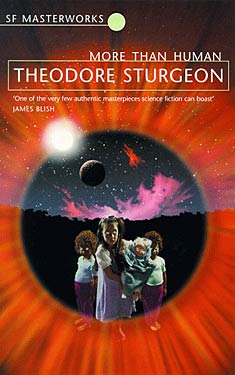
The story begins with a “half-wit,” basically, a person living on the street with no speaking ability and limited intellectual development. He begins to get visions and messages from someone else, which he doesn’t understand. Eventually, he meets this person and makes a connection. That goes awry, forcing him to flee. He finds a farm with a couple who have lost a child. They take him in, treat him like the son they lost, teach him to speak, and to become their farmhand. He accidentally takes the name of Lone. When the couple becomes pregnant, he leaves and eventually finds a girl named Janie with telekinesis and mute twin girls named Bonnie and Beanie who teleport. His own psychic abilities mesh with theirs. Later, he goes back to the farm and finds the couple did have a baby boy, but it is mentally disabled. The woman has left “to go east,” and the man is failing at keeping things together. Lone takes the baby back to the cave where the little group lives and they discover the baby is like an adding machine, that is, a high-powered AI computer. Together they form an entity that interacts psychically. It is a new level of human development: Homo Gestalt.
The book is in three chapters, each like a related short story. In the second chapter, they meet a boy named Gerry who can use all the gifts of the others to accomplish what he wants, namely, power and control. His own gift is the ability to control other people’s psyche through power of suggestion, absorb everything they know, and wipe their memories to hide the evidence. In the third chapter, they meet a man who can also psychically connect, but unlike the others, has a sense of morality and social ethics.
I remember being in awe of the coming together of a group of psionics to create a singular entity. I still find it fascinating and generally found the book very intriguing until the third chapter. Titled “Morality,” the first part of the third chapter is very hard to understand what’s going on. The main character of this chapter is roaming around with a huge chunk of missing memory trying to find a “dimwit” and some children, but he can’t quite put his finger on who or why. This section was incredibly complicated in trying to describe what he’s going through mentally. And physically, he’s a mess. It takes Janie to help him remember everything. But then, like many early sci-fi stories, Janie goes through a huge exposition to explain all the events up to that point. The saving grace is that the reader is so frustrated with the chaos of the main character’s thoughts or lack thereof, it comes as a welcome relief when Janie explains it all.
The character development is pretty good. The lumbering Lone is perhaps the easiest to like. He’s sort of a gentle giant who is basically the head of this new psychic body. Janie is brash, the twins are mischievous, and Baby is like a wild supercomputer. Gerry is dangerous and we learn about him in flashbacks during a psychiatric appointment. Hip Barrows, the main character of the third chapter is the most “normal.”
There are some memorable positive moments, such as when the group goes to live with Miss Alice, whom Lone knew from his past. She tries to force the twin black girls to eat with her maid while the others eat with her. Janie and Gerry threaten Alice until they are allowed to eat together. On the other hand, like in several classic sci-fi stories, there’s a scene where Hip shakes Janie, as is also depicted in a lot of old books and films. This is so cringy and it happens several times. I felt this went against character for Janie who was such a brash and precocious young child. I think it would have been more in character to have her throw off his arms and be more aggressive.
I really like the prose, something I’ve said of the previous books of his I read about 10 to 12 years ago. Godbody, Venus Plus X, and E Pluribus Unicorn are all very well written. I give this book four stars out of five, mainly because the first part of chapter 3 felt almost unreadable because of Sturgeon’s portrayal of missing memory. I’d like to read more of his short stories; an award for excellence in short fiction was named after Sturgeon. I remember when he came to our Fantasy Lit class in 1981. He read a story about a pleasuring toilet seat. It was very bawdy, reminding me he was also a dirty old man. But he was also a great writer and visionary, as this book demonstrates.

No comments:
Post a Comment