Tuesday, November 26, 2019

The Darkest Part of the Forest


Holly Black
Completed 11/26/2019, Reviewed 11/26/2019
5 stars

This book really knocked my socks off.  It was interesting, exciting, well-paced, and well-written.  Not one word was wasted.  It was sort of a young adult, modern, smaller scope take on Jonathan Strange and Mr. Norrell.  It’s about faeries in the woods near a present-day American town and the teenage girl and her gay brother who try to save it from them.  Everything about the book is satisfying:  the plot, the characters, the world-building, the dark tone.  It wasn’t nominated for any LGBTQ awards, unfortunately, but was nominated for a Mythopoeic Award. 
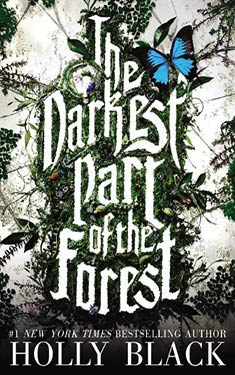
Hazel and Ben live in Fairfold, a small American town which is known for its proximity to a forest with a strange inhabitant, a horned, faerie prince who has been sleeping in a glass coffin for hundreds of years.  Both sister and brother are in love with the prince and much of the town is infatuated with him.  The local teenagers hang out at the site of the coffin, drinking and making out, sort of like any middle American town with a tourist attraction.  One day the coffin is smashed, the prince awakens, and strange things begin to happen.  Hazel and Ben have been fighting bad faeries with Ben enchanting them with his faerie given gift of music and Hazel as a wannabe knight.  But now things reach a climax as the fabled monster of the forest starts wreak havoc in town and it is up to Hazel, Ben, the prince, and a changeling to save the day.

Hazel is glorious as the dark, brooding teen.  At age 11, she made a deal with the king of the faeries, the Alderking.  In return for getting her brother into a prestigious music school in Philadelphia, she serves the Alderking at night.  However, her day self does not remember the night activities.  In the meantime, she kisses boys, and some girls, at teen parties while secretly pining for Jack, a changeling.  She’s also obsessed with the horned prince.  Despite being a quirky teenager, she’s a strong female lead with just the right amount of angst.

Ben, her brother, is also terrific.  He’s not very adept at the dating scene in this small town.  In fact, he’s more obsessed with the sleeping prince than with any human boys.  He would go to the forest, lie down on the coffin, and whisper his deepest, darkest thoughts and secrets.  When the prince awakens, he has to reconcile his fantasy with this new reality. 

Severis the prince and Jack the changeling are good secondary characters.  The whole changeling story is in itself quite interesting.  Even though Jack is the faerie, his human family keeps him even after they get their real son back.  So he is brought up by his human family and is sort of a twin to his human brother Carter.  Severis is the son of the Alderking and heir to the faerie throne.  However, there is some bad blood between the two of them, and his character arc intertwines with Hazel and Ben’s. 

The pacing really surprised me.  There’s no lag in the book.  Every scene gripped me.  Even Severis telling his story should have felt like tedious exposition, but it was as engaging as if it were part of the action.  This is a testament to the author’s writing skill.  The world-building was extensive, even for a three hundred page book.  We only go into the faerie realm twice, but both times are quite profound.  The forest is almost its own character as Hazel and Ben go in it, searching for missing people and fighting bad faeries.

This book a five star book.  It just felt perfect in every way.  I was totally engrossed by it, and whole-heartedly moved.  I wasn’t near tears, but I found it hard to come down from the book and sit still enough to write this review.  It revved me up and I didn’t want to put it down.  When it was over, I felt like I wanted it to keep going, just to remain in the world with Hazel and Ben. 

Saturday, November 23, 2019

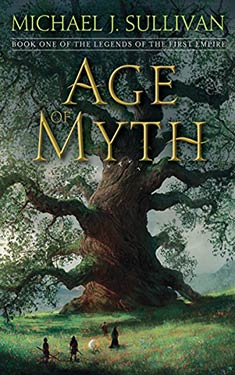
Age of Myth


Michael J Sullivan
Completed 11/23/2019, Reviewed 11/23/2019
3 stars

This was an okay book.  It’s the first of a six volume series and a precursor to one or two other series.  It was chosen by my book club on a night I didn’t attend.  It felt like standard fantasy fare with some interesting world building.  It dragged a little in the middle.  There were two climaxes and both were fairly exciting.  The clincher is that it really didn’t make me want to search out the rest of the series. 

There are two main races at the center of this book:  the Fhrey and the Rhunes.  The Rhunes are standard humans, with familiar life spans and no magical abilities.  The Fhrey are beings that live millenia, some of whom have magical abilities, called The Art.  The Rhunes consider the Fhrey gods and the Fhrey consider the Rhunes sub-human.  But that all changes when Raithe, a Rhune, kills one of the Fhrey.  In retaliation, the Fhrey go from tribe to tribe hunting down Raithe and killing all the Rhunes.

Persephone is the recent widow of a Rhune chieftain.  She was approached by a fourteen-year-old Rhune girl who has the gift of prophesy and surprisingly, some magical ability.  Suri tells Persephone that a great tragedy is coming upon her tribe, a prophesy which she divined by talking to trees.  Persephone asks Suri to take her to the trees so she could ask clarifying questions.  On their way, they are attacked by three warriors from her tribe.  Raithe and his companion happen to be nearby and save the day.  But one of the attackers escapes and claims Raithe and Persephone attacked them.  Now under suspicion of murder, Persephone must use her wits to keep her tribe alive in the foretold apocalypse.

The most interesting things about this book were Suri, the young seer, and her ability to talk to trees.  Initially, I was psyched about the book because on the cover is a beautiful drawing of a tree.  And that is a very cool part of the book, but it’s only a small part of it.  Suri’s arc is more about all her gifts and her relationship with Persephone.  Persephone is really the only person who believes Suri.  Even in this age of myth, and the belief that the Fhrey are gods, the general public does not much believe in this little prophet.  However, they do believe that Persephone is suspect.

Persephone is the main character and a good, strong woman in a time where women are still considered second-class citizens.  I did like her character.  The story wasn’t soapy, like being about falling in love with Raithe, although I could foresee that happening in a later book.  She was a take charge person in a tribe with a fairly impotent new chieftain.  I couldn’t help but think that her characterization was inspired at least a little by the iconic heroine Ripley from Alien and its sequels. 

There’s also an evil chief counsellor to the ruler of the Fhrey.  He’s deliciously evil and conniving.  In particular, he’s perpetuating a new myth that the only Fhrey worth anything are those with the gift of The Art.  All the other Fhrey are second-class, barely a few steps up from the Rhunes.  And of course, he wants to rule the Fhrey. 

All in all, it wasn’t a bad book, but I thought it could have been better.  It felt like there was something missing, and the whole middle was just filler to get to the two exciting climaxes at the end.  Sure there was world-building, and the introduction of a few other interesting characters, but it felt like a hundred pages could easily have been edited out and you might have had a better, fast-paced book.  I give the book three stars out of five. 

Saturday, November 16, 2019

Naked Lunch


William S Burroughs
Completed 11/16/2019, Reviewed 11/16/2019
3 stars

I’m glad I read some summaries and reviews of this book as I picked it up.  It helped me understand that there is no plot and that it’s a collection of loosely related vignettes.  I kinda got it and I kinda didn’t.  I realize that this book is about the author’s drug addiction and the vignettes are a mixture of actual events, hallucinations, and fantasies.  It was very hard to follow.  It’s very stream of consciousness.  I gave up trying to understand it and just reveled in the author’s word choices and creative sentences.  The book is beautiful, grotesque, offensive, funny, pathetic.  And in the end, I feel like I don’t know what I’ve read.


I have no plot summary for this book, because there is no plot.  I can say that it takes place in New York, Tangiers, and a strange hallucinogenic place called the Interzone, the first two being places where he actually lived.  There’s a lot sex, mostly homosexuality, and violence and it is all disturbing.  One might even conclude that Burroughs was obsessed with drugs, sex, and death.  It is definitely a transgressive work. 

I can’t say that I actually enjoyed the work.  At times, I thought that the way Burroughs strung together these random thoughts was genius and other times just lazy.  He plays a lot with mixing tense and number.  At the end of the book is a preface, which I thought might explain some of these choices, but it was as complicated as the novel itself.  In the preface though, is a great description of the book.  It’s a very long paragraph, so I’ll only include the beginning here (all words are exactly as written, and not typos):

“This book spill off the page in all directions, kaleidoscope of vistas, medley of tunes and street noises, farts and riot yips and the slamming steel shutters of commerce, screams of pain and pathos and screams plain pathic…”

I can’t say that I’d recommend this book to anyone but the adventurous reader.  Maybe if you liked other stream of consciousness works such as “Ulysses”, you might get this.  As I said, I kinda did and kinda didn’t.  So I give this book a questionable three stars out of five.  I saw the film “Naked Lunch” many years ago, and thought it would help me understand this book a little better.  It didn’t.  In fact, I was a little disappointed that there wasn’t a scene between the narrator and a giant talking insect like there was in the film.

Tuesday, November 12, 2019

Honeyed Words


JA Pitts
Completed 11/11/2019, Reviewed 11/12/2019
3 stars

This is the second book in the Sarah Beauhall series.  I didn’t realize that until I started reading it and then looked more closely on-line about it.  The author does a decent job of bringing you up to speed, but I think there’s a lot of world building I missed out on.  This book has elves, dwarves, and shape shifting dragons, and is in a lot of ways, high fantasy despite being urban.  I think I would have enjoyed it more if I read the first book, which hopefully provided more descriptions of the denizens of the world.  This book was nominated for the Endeavor Award, a Pacific Northwest award given at the Oregon Science Fiction Convention, and won the Gaylactic Spectrum Award in 2012. 

In the first book, Sarah is a blacksmith and a member of a small film company crew who slew a dragon and fought with her sexual identity.  In this book, she’s out of the closet, has a girlfriend, and is fighting her guilt over the deaths of so many people which may have been avoided if she hadn’t reforged the magic sword, Gram.  The reforging of the sword is what brought out the dragon in the first place.  Now there is relative quiet, until a filker is kidnapped by dwarves.  Then Sarah continues her blacksmithing apprenticeship under the strange Anezka whose home seems to be filled with strange and evil powers.  Although it takes a long time, the kidnapping is connected to the evil at Anezka’s home and once again, Sarah is thrust into a battle between good and evil.

It was actually difficult to come up with that plot description.  The book meanders quite a bit for more than half its length.  The kidnapping happens early, but nothing seems to come of it for a long time.  Sarah spends most of that time fighting her guilt, her one grounding force being her relationship with Katie.  Eventually, Sarah meets Anezka and things start to get weird.  Anezka has a companion named Bub, short for Beelzebub, a demon who is indentured to her.  Then she seems to have terrible bipolar swings, causing Sarah and Bub to somehow care for her.  The mental illness seems to be related to the terrible forces which surround the house.  That’s where the book starts to become more interesting, but it still doesn’t pull everything together until the final showdown between Sarah and the evil forces. 

Bub is the most interesting and fun supporting character in the book.  He starts out by attacking Sarah, but comes to be friends with her, even though he basically wants to eat her.  He actually eats anything, regular food, the dishes, people, but Anezka and Sarah keep him under control by feeding him hamburgers and burritos.  He helps Sarah take care of Anezka when she goes off the deep end. 

The other characters are good too.  There’s a lot of character development even though most of the characters first appeared in the first book.  They didn’t seem wooden or one-note.  And their dialogue was pretty natural.

The book is told mostly in first person by Sarah.  While the plot meanders, her narrative is pretty easy to follow.  Unfortunately, there are injections of third person narrative concerning the other dragons of the area and the dwarves who captured the filker.  By the way, filk is a type of music whose lyrics have themes in science fiction and fantasy.  The music may be a parody of a popular song, or may have its own original tune.  These third person breaks were hard to follow and sometimes didn’t seem to have anything to do with the plot.  I found them more distracting than informative.

All in all, the book was okay.  I liked Sarah, although she spent an awful lot of time in self-doubt.  I thought from the book blurbs that she was going to be a kick-ass leading character.  It’s not until the end that she gains the confidence she needs to continue her role as a defender of good.  And despite the book’s meandering, it was pretty easy to follow.  It was just hard to see where it’s going until the very end.  And the end leads into the third book.  There are four books so far in the series.  I give it three out of five stars.  If you are going to read this, I think it would be best to start with the first book. 

Sunday, November 3, 2019

Starfarers


Vonda N McIntyre
Completed 11/2/2019, Reviewed 11/3/2019
4 stars

This book starts out incredibly slowly, so slowly that I never thought I’d get through it.  I could barely get ten pages read a night before passing out from exhaustion and well, boredom.  Very little happened and I couldn’t see where it was going.  Then Saturday came and I picked it up after a good night’s sleep.  What I thought was boring was well over a hundred pages of character introduction and world-building.  It slowly began to pick up its pace and then finished with a hundred pages of breakneck action.  It’s the first of a four part series and this book serves as the introduction to the remaining three books.  With a title like “Starfarers”, you’d think this book was about space travel.  Well, since it’s an introduction, it’s everything that leads up to the space travel part.  You could easily see this book as the first season of a TV series with terrific cliffhanger for the last episode. 

The plot is fairly simple.  The Starfarer’s mission was to seek out alien life.  Due to a change in the presidency and increased tensions in the Middle East, the US wants to repurpose the ship for the military.  It’s up to a scrappy polyamorous, multi-cultural trio to save the ship from this change of plan.  There are a host of side characters with subplots, some smaller, some larger, that come into play.  The most interesting is that of JD, the alien specialist who is enamored with divers, genetically modified humans who live underwater as well as on land.  Her subplot weaves in and out of the main plot as her diver friend Zev is chased by the military on Earth while she is integrating herself into the crew of the Starfarer. 

The polyamorous, multi-cultural trio, Victoria, Stephen Thomas, and Satoshi, are main characters of the book.  Victoria is the commander of the Starfarer.  She’s black and Canadian.  Stephen Thomas is a blond hunk of mixed ethnic background.  Satoshi is a Japanese-American.  They are, of course, bisexual.  There was a second woman, bringing the relationship member count up to four, but she died in an accident.  The three are learning to live without her, but it is difficult because she was the relationship manager.  The character development was pretty good, though the book only takes place over the course of a few weeks at the most.  At first, I thought the characters were a bit wooden, but McIntyre fleshes them out pretty well.  JD is also a pretty good character, being described as a bigger woman, though she can swim with the divers.  All in all, a pretty diverse cast of characters for a book written nearly thirty years ago.

There are several other minor characters worth noting.  Kolya Cherenkov is a former Soviet cosmonaut who is basically stranded on the Starfarer because there is a death edict out on him from the Middle East.  If he returns to Earth, he’ll be killed.  He is mostly a hermit, but has an interesting perspective on the events happening around him.  There’s also an old woman whose name I can’t remember who adds some levity as well as intensity to their situation.  She’s there as part of the Grandparents Initiative, a movement to get older people up to the ship to increase the age diversity of the crew.  Lastly, there’s Griffith, the bad guy.  He’s a government man, posing as someone who works for the GAO, but is probably part of the military as it plans its takeover of the Starfarer.  He would have been a two-dimensional character, except for his infatuation with Cherenkov, which is the only thing that can divert him from his primary purpose. 

The plot is pretty thin, but as I mentioned before, this book is really an introduction to the characters and world-building.  I’m guessing the rest of the books have more of a plot than this one.  Still I thought this book held its own once it got going.  I was going to give it three stars, but the terrific climax and the setup for the rest of the series made me up it to four stars.  I must say that I’ve enjoyed everything I’ve read by McIntyre, which amounts to two books now.  Her Hugo and Nebula Award winning Dreamsnake was one of the best books I read back in my quest to read all the Hugo winners.  This book isn’t award worthy, but I agree with her quote that this was her best TV series never made.

Sunday, October 27, 2019

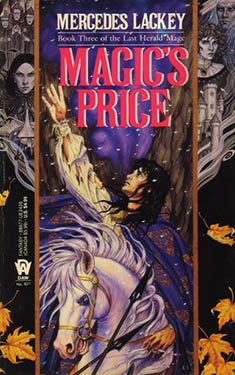
Magic’s Price


Mercedes Lackey
Completed 10/27/2019, Reviewed 10/27/2019
5 stars

This trilogy far exceeded my expectations.  The third and final book is every bit as deep and exciting as the first two.  Picking up this third one was like hanging out with an old friend.  The prose continues to be as warm as in the first two.  Perhaps it was because I read all three in order and without interruption that I felt like I really knew the main character Vanyel.  I was cheering for his new relationship while at the same time, completely empathizing with his hesitancy.  At first I thought that more about him couldn’t be revealed, but he continued to grow, albeit slowly, in his new relationship, with his family, and with his power.  This book won the Lambda Literary Award for Science Fiction/Fantasy in 1991.

Like the first two books, this one was half personal life, half professional.  It starts out with him slowly falling for a new young Bard named Stefen.  Stefen is in love with Vanyel, and it’s not just hero worship.  At this point in the book, Vanyel is larger than life, being the most powerful Herald-Mage in the land.  So Vanyel tries to discount Stefen’s affections.  But Vanyel falls in love with Stefen as well, and it takes a visit to his family to realize that.  Yes, there is a third visit to Vanyel’s family, and his relationship with his father, Withen, turns in another new direction, as Withen comes to terms with his son’s orientation and career choices.  While at home, there is an assassination attempt on Vanyel’s mother’s life, also endangering Stefen.  This forebodes a plot not only to destroy Vanyel, but also the whole country.  So Vanyel must leave once again to get to the bottom of this new sinister conspiracy.

A lot of the first half of the book is about Stefen.  At first I didn’t like him, but he grew on me as he also grew on Vanyel.  At first, Vanyel brushes off Stefen’s advances, but it becomes a fun game as Stefen tries to find ways to get Vanyel into bed.  It also seems like Stefen is trying to add another notch on his bedpost at first, but the desire quickly becomes love and Stefen lifebonds with Vanyel.  Vanyel still hold a candle for his first and only real love, so the game frustrates Stefen and all the other major characters.  Vanyel does grow though, and he eventually comes around to the inevitability of a new relationship. 

The book becomes very sad as a major character as well as other minor characters are murdered.  Vanyel has to deal with his emotions, trying to control his powers, using them for good rather than for the desire to seek vengeance.  This is a recurring theme in the books: with great power comes great responsibility.  Vanyel gets a huge dose of this when he is captured and abused by the enemy forces.  He strikes out at his captors but then is revulsed by his uncontrolled emotional revenge.  So when he finally confronts the evil Master Dark in the end, he tries to use his powers in the least emotional way.

As a reader, you really get the sense that Lackey wrote these books in order, one after the other.  The tone and style are the same throughout the works.  It is an exceedingly pleasant read throughout all three.  I can see why there are so many fans of the author out there.  She has a wonderful voice, has interesting plots, and develops great characters who actually grow through the action.  While each book is not standalone, each wraps up nicely.  My only complaint with this volume is that it ends rather abruptly, but I felt it was better this way, rather than dragging out all the emotions of the bitter-sweet ending. 

I give this book a resounding five stars out of five.  The whole series was phenomenal.  I don’t think I’ve enjoyed a series as much in a long time.  I was truly enrapt in it from start to finish.  I didn’t get bored with it, thoroughly enjoying it every time I picked it up.  In fact, I forced myself to stay up to read the last ten pages, as I was nodding off in my usual late night fashion.  I had to know how it ended, and couldn’t wait until the morning for that last little bit.  I highly recommend this series and will now put Lackey down as one of my favorite authors. 

Sunday, October 20, 2019

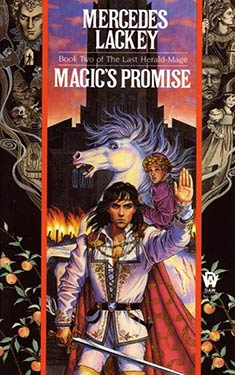
Magic’s Promise


Mercedes Lackey
Completed 10/20/2019, Reviewed 10/20/2019
5 stars

Magic’s Promise is the second installment in the Valdemar: Last Herald-Mage trilogy.  It picks up over a decade after the first book.  Vanyel visits his family after four years away and confronts many of his own demons as well as real demons in this highly enjoyable follow-up.  In the first half of the book, there is really no action, only the encounters with his family and the household employees.  Yet Mercedes Lackey writes it really well, with all the immediacy and pacing of a well-crafted adventure novel.  I found myself plowing through it as it held me emotionally and intellectually. 

Vanyel is now the most powerful Herald-Mage in the land and has just finished a terrible tour of duty at the front lines of a war, exhausted, gaunt, and ready for a leave.  He doesn’t really want to go to visit the family, but if he stays at the Mage center, his alma mater, he’s concerned he will be called on another mission, and he simply does not have the stamina for that.  He goes home with much trepidation as his relationship with his family is pretty strained.  But it has been four years since his last visit and he feels it is his duty to visit.  There, he has numerous confrontations with his father and Jervis, the abusive armsmaster.  Halfway through the book and his visit home, his Companion Yfandes (a horse with the soul of a woman) hears a terrible cry for help in the neighboring land.  Vanyel and Yfandes rush to the scene where a horrible bloodbath has taken place.  The only survivor is a near-catatonic teen who is being blamed for the tragedy.  Recognizing that something is very wrong with the scenario, Vanyel escapes with the teen to his home farm and tries to find out if the boy killed everyone or if something even more nefarious is going on. 

As I stated above, the first half of the book could be considered somewhat slow, but it is written so well, it completely had me enrapt.  Lackey knows relationships and character development.  The confrontations between Vanyel and his father and Jervis are remarkable.  Even though he’s twenty-eight years old now, Vanyel still feels like the awkward, closeted teen when he goes home, trying to gain acceptance.  But he’s maturing in front of their eyes, taking a stand for himself and not letting anyone get away with bullshit.  His biggest problem turns out to be his mother who thinks that if he found the right woman, it would make him straight.  So she puts it in the mind of the one of the household staff who has been in love with him since he was a boy to pursue him at all costs.  This makes for some laughable and embarrassing situations.

Yfandes comes out as major character as his Companion.  Companions are horses but contain the soul of a woman.  They choose Heralds and Mages and become lifelong companions, as their name implies.  As long as the Herald and/or Mage has some psychic ability, the two can communicate with each other.  Companions also communicate with each other acting as a go between for people who do cannot Read each other.  I really liked Yfandes and her role with Vaneyl.  She acts sort of as a guardian angel, giving advice and often keeping her Chosen’s feet in reality the way no one else can. 

Jervis’ character was a big surprise to me.  I don’t want to give away too much, but he is so much more than the cardboard character from the first book. 

I have to say I am still really enjoying this series.  I thought this one would be a little boring because the first half of the book is simply family dynamics.  But it was riveting.  I was almost sorry to see the plot of the bloodbath come up.  However, as with the first book, Lackey uses the mystery and the action to enhance the characters while still making it exciting reading.  Even the boy who is near catatonic at the beginning of this sequence has moments of growth.  I give this book five stars out of five.  It’s unusual for me to give two books in a row five stars, but I was once again very emotionally involved with this book.  I could feel the interactions between Vanyel and his father and Jervis in my gut.  And thanks to my usual insomnia, I read almost the whole book yesterday through this early morning.  I can’t wait to read the third and final novel in this trilogy.