Saturday, July 20, 2019

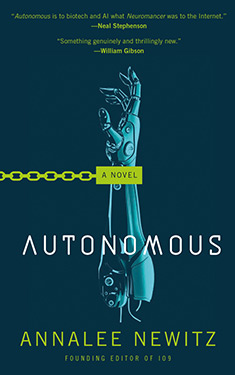
Autonomous


Annalee Newitz
Completed 7/20/2019, Reviewed 7/20/2019
3 stars

This book was nominated for three awards, including the Nebula, and won the Lambda Literary Award for SF/Fantasy/Horror.  It’s received rave reviews.  My expectations of the book were fairly high.  It began well, but quickly became a fairly average chase through the world of biotech hacking.  It has robots, an antihero, and everyone is both a little good and a little bad.  It didn’t become a slog to read.  It just wasn’t that exciting. 

Jack Chen is a female pirate in the pharma world.  She reverse-engineers medication, makes her own from the formulas, and sells them cheap to the poor.  Sort of a Robin Hood pharmacist.   One of the drugs she has recreated makes people love their work so that they are more productive.  The side effect is that it causes people to become addicted to it.  They become obsessed with their work, often killing themselves from lack of food, drink, and sleep, and sometimes taking other people down with them.  Jack feels guilty, but also angry that the side effects were never published by the manufacturer.  She decides to figure out an anti-addiction drug to cure people of their highly addicted state.  Because of the deaths, the government is stepping in to try to capture Jack.  They send Eliasz, a man, and Paladin, a gender neutral robot, to track her down.  Most of the book is about the two trying to track Jack down while she tries to elude them on her way to finding the cure and giving the manufacturer its just reward for making such a terrible drug.

The plot sounds really exciting from the summary.  I think the problem was the writing.  It didn’t take me to any action nor provide me with any suspense.  Even the subplots did not draw me in.  One of the biggest disappointments was that Eliasz falls in love with his robot sidekick, but is afraid of his feelings because “he’s not a faggot”.  Jack’s history as a subversive, anti-patent activist is kind of interesting.  In her past, we find out she’s bisexual, falling in love with other activists as they work against big pharma.  But even her story is kind of lackluster.  Again, I think it’s the prose.  It simply didn’t grab me.

There’s another interesting subplot which isn’t explained very well.  This is the near future, and it appears that global warming has made the arctic habitable.  A lot of the action takes place in the far northern Canadian city of Yellowknife.  We also find out that there are levees and pumps to keep the water out of midtown Manhattan.  But there’s no emphasis on any of these.  Lastly, Jack travels around the northwest passage in a submarine.  That in itself should be intriguing, but she ditches it early on to travel by land as she tries to elude her would-be captors.

I give this book three stars out of five.  It was okay, but I think the author could have used a lot better feedback to get the story pumped up more.  It’s a shame because there were so many good ideas in here.  It just wasn’t executed well.  I think it won the Lammy for its representation of Jack as bisexual, and for the genderless, borderline transgender, portrayal of Paladin.

Wednesday, July 17, 2019

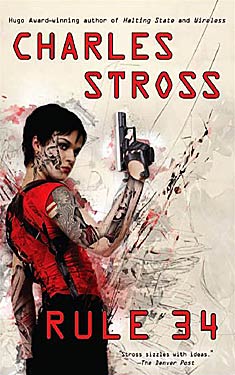
Rule 34


Charles Stross
Completed 7/17/2019, Reviewed 7/17/2019
4 stars

This is a sort of sequel to Halting State, a book I read several years ago for book club and didn’t enjoy.  What annoyed me most about that book was that it was written in second person present and had an awful lot of gamer jargon in it, most of which I didn’t understand.  This book is similar to Halting State in that it’s also written in second person and has a lot of computer and cop jargon, much of which went over my head.  But upon rereading my review of Halting State, I found I liked this book for many of the same reasons I hated that book.  Whereas I slogged through the first book, here I ate it up, finding it a quick exciting read.  And it was nominated for a Gaylactic Spectrum Award in 2012 for positive LGBTQ content in genre fiction, as well as for a slew of other science fiction awards.

The story begins with Liz Kavanaugh in Edinburgh, Scotland, one of the cops from the first book, working in Rule 34 Squad, monitoring the internet for people engaged in illegal activities.  She gets assigned to a suspicious death and soon finds that it is just one of several suspicious deaths that all happened around the same time.  In the meantime, Anwar Hussein, recently out of prison, happens upon a job as an honorary emissary for a new Asian republic that has declared independence from Kyrgyzstan.  But the job doesn’t appear to be what one would think a consulate employee would do.  Coincidently, Liz collared Anwar in the fake ID scam that landed him in jail.  Lastly, there’s John Christie, aka the Toymaker, who, also coincidently, was going to do business with the first murder victim, which puts him on Liz’s radar.  But are there really coincidences, and do all these things add up to some more nefarious internet scheme?

So yes, the book is written in second person present.  Unlike the first book, I found it easy to keep my head in the characters.  The point of view changes with each chapter, but for some reason, I kept the characters clearly delineated.  The jargon was also pretty overwhelming, but I was able to stick with it and got the gist of what was going on.  Lastly, the use of Scottish words like “nae” and “ken” was a bit confusing, but I was able to handle that as well.  Somehow, I hit the tipping point of understanding this book whereas I didn’t in its predecessor. 

At its core, this book is a police procedural.  It’s gritty and complex.  It’s set in the near future.  Despite the self-driving cars and the internet glasses with terrific download speeds, you get the feel that this could be happening today. 

For me it was the characters that made this book.  I really like the hapless Anwar.  Everything was always going wrong for him.  Yet he was likeable in his schlemiel-ness.  He’s a closeted gay man who’s married to a woman and has two children.  He does programming on the side for his brother-in-law for a sketchy dating site.  And he simply has a propensity towards making bad choices.  What’s not to like?

I give this book four stars out of five.  I read it voraciously, even though it was difficult reading.  I don’t know if it was actually written better than the first book, or if I was just in a better mindset for multi-character second person perspective.  It just struck me as a much better book even though I still had to work hard at keeping up with the jargon.  I think maybe too the characters voices were better than in the first book.  And lastly, I might have had a better perspective myself going into this book because I saw the author at Westercon a few years ago and he was a hysterical panelist. 

Sunday, July 14, 2019

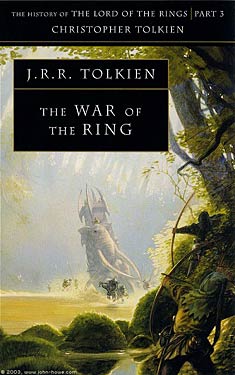
The War of the Ring


JRR Tolkien
Completed 7/14/2019, Reviewed 7/14/2019
4 stars

It’s been over a year and a half since I last read a book in the History of Middle Earth (HoME) series.  So it was time to pick up the next in the series, the eighth.  “The War of the Ring” is also the third in the subseries of the History of the Lord of the Rings.  This book was a tougher start than most of the other books in this series that I’ve read.  I had a lot of trouble getting back into the swing of the purpose and format of the book.  It was probably because this book begins with the conclusion of the battle of Helm’s Deep and it had been so long since I had read the beginning of it.  Nonetheless, I eventually got into the rhythm of the book and settled down into a week and half of heavy but informative and interesting reading.

This book takes us through the second half of The Two Towers and the first half of TheReturn of the King.  It follows Frodo and Sam from their meet up with Gollum and goes through their confrontation with Shelob.  Shelob was initially Ungoliant, the ultimate evil spider from the The Silmarillion and other HoME books.  Instead Tolkien chose to make the spider one of Ungoliant’s children.  As always, this book is filled with origin texts and manuscripts, so we get a lot of the development of the characters, the plots, the dialog, and the world-building.

We also spend time with the rest of the Fellowship, in Rohan and Gondor and along the way in between.  We are introduced to Faramir, who initially is not Boromir’s brother.  But as Tolkien writes the text, it just appears that he is Boromir’s brother and he becomes an important part of the plot.    Eowyn shows up from the Rohan parts of the story.  Initially, a romance was supposed to blossom between her and Aragorn, as there is still almost no mention of the existence of Arwen.  She was also supposed to die in the original drafts, but Tolkien changed his mind, as he did so much during the development of the book.  A lot of time is also spent on the palantirs.  It took a while for Tolkien to figure out just what these seeing stones did and didn’t do. 

Christopher Tolkien spends a lot of time on the geography and chronology that his father struggled with during the writing of LOTR.  Some of that got quite boring, particularly the dates.  But it showed me how much effort his father took in getting the internal world-building right.  This is most evident in the depiction of the phases of the moon.  With the breakup of the Fellowship, it was important that when references to moon were made that they were internally consistent based on how many days away they were from each other.  The geography changes also got a little tedious.  The names of the locations changed a lot, just as they did in the development of the First Age in the early books of the HoME series.  And their positions on the map changed quite often.  I can see how Tolkien was so concerned with the minutiae of his world that every detail be just right.  It makes one wonder how Tolkien ever got anything published, let alone this epic tale of fifteen hundred pages.  It also makes one realize why he never published “The Silmarillion” in his lifetime.  He included so much detail in his original world that he could not get it just right. 

I give the book four stars out of five.  Once again, I followed the book along with most of the discussions by The Tolkien Professor, Corey Olsen, and it really helped me understand and appreciate the book more than I think I would have just reading it alone.  And once again, I only recommend this book for the die-hard fan who is interested in a detailed behind the scenes look into the world of Middle Earth.  I’m still really enjoying it and look forward to the conclusion of the Lord of the Rings subseries in the HoME series.

Friday, July 5, 2019

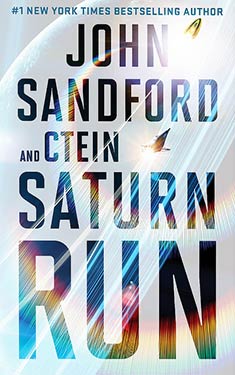
Saturn Run


John Sandford and Ctein
Completed 7/4/2019, Reviewed 7/5/2019
3 stars

I was worried about reading this book club selection because it sounded like space opera.  It turns out it wasn’t exactly space opera.  It was more like a spaceship captain’s log with character development.  The narrator is third person omniscient, and the perspectives are from a multitude of characters.  But it generally had a dry reporting style, even during the few exciting scenes.  I didn’t dislike the book, and in the end, I finally felt immersed in the world and the people.  But it was slow going through most of it.

The story begins with the discovery of an object approaching Saturn and slowing down.  Natural objects don’t slow down, so it must be an alien spacecraft.  Further analysis reveals it has stopped in one of the gaps in Saturn’s rings.  The object leaves shortly afterwards using antimatter propulsion.  It’s discovered that some alien artifact remains in the ring gap.  The US decides to build a spaceship to travel to this location and meet the aliens, or whatever is there.  They try to keep it under wraps, but everyone else also sees the antimatter trail.  China decides to retrofit a Mars colony ship for a journey to Saturn, and the race is on.  The tale is about the Americans’ journey there and their confrontation with China when they arrive. 

As I stated earlier, the book reads like a captain’s log, or a combination with an engineer’s entries.  There’s lots of hard science, and there’s a fair amount of character development.  There are a lot of characters and the author does a pretty good job of developing them in between the hard science.  What’s really missing is action.  It begins with some excitement, but the rest of the first half or so reflects the drudgery of a long space mission.  That’s where the hard science comes in.  The authors spend a lot of time explaining the physics of the different aspects of space flight and life in space.  If you are not scientifically oriented, this could be a slog.  Even I found it slow-going.  But it was still readable.  I simply felt like nothing was happening for the majority of the book.

Finally towards the end, when we reach Saturn, things begin to happen.  But even here, the book was rather slow paced.  And again, the journalistic style of the writing was a little dry.  This book is touted as a science fiction thriller, and thrillers are what Sanford is known for, but it’s not really much of a thrill ride.  It feels simply like someone is reporting the events to the reader.  Interestingly enough, there is a reporter and a cameraperson in the American crew, though the story is not their reporting.

The characters were pretty good.  There are some stand-outs, like Becca Johansson, the brilliant engineer with a forceful personality that she developed so people would take her seriously.  Sandy Darlington is the cameraperson, who on the surface appears to be a slacker surfer dude waiting to inherit his family’s massive fortune, but hides a secret that gives him much more substance than he incites.  The book has a good female/male balance where there are almost no issues of sexism, although there is a pool to guess when Sandy, known for his sexual appetite, beds the reporter he works with.  Once the ships get to Saturn, we are introduced to some Chinese characters as well.  At first, I was concerned that introducing so many new characters at the end of the book would be overwhelming.  But it turned out that only a few of them took the forefront and their names were different enough to easily differentiate between them. 

I give the book three stars out of five.  I think I could have given it four stars if there was a little more going on throughout the book, rather than keeping it all for the end.  Perhaps my expectation for a book by an author known for his thrillers (Sanford) tainted my enjoyment of it.  Overall, I’m glad I read it and would recommend it to people who aren’t afraid of a little, ok, a lot, of science. 

Saturday, June 29, 2019

The Child Garden


Geoff Ryman
Completed 6/29/2019, Reviewed 6/29/2019
4 stars

Geoff Ryman’s imagination is quite a force.  In this book, he has imagined a bizarre dystopian future which he explains at the beginning in about four pages.  Then he goes on to create a strange novel based on this world in the next four hundred.  It’s an interesting form, building a world quickly and then setting a story in it.  The story however, is as complex as his world.  This is not a quick book.  It takes effort and concentration to understand what’s going on, and in the end, I don’t know if I got it all.  But I found it to be beautifully written, and enjoyed what I could grasp of the complex plot.  It won the Arthur C. Clarke and John W. Campbell awards for science fiction in 1990.


The book takes place in a future London after a world-wide communist revolution.  There is a hive mind called the Consensus which is created by Reading the minds of all children at the age of ten.  At this time, all socially unacceptable behavior is destroyed.  Unfortunately, this includes all talent and imagination.  Also, cancer has been cured, but the cure has cut the average lifespan to the age of thirty-five.  To make people mature more quickly, they are infected with viruses that impart all the knowledge they’d ever need.  This, in combination with being Read, creates a population that knows a lot but has no passion or appreciation for knowledge and particularly, the arts. 

Milena is an enigma.  As a child, she was immune to the viruses so she had to learn on her own and at ten she wasn’t Read.  She goes through early life feeling less than.  She is placed in life as an actress, but has no real passion for it.  Everything is rote for the other actors and for the children they perform for.  They do not appreciate the plays she performs.  One day, she meets a genetically engineered human, in the form of a polar bear, so created to be able to work in the Antarctic.  GE’s are not infected with viruses and are not read.  This polar bear person, named Rolfa, loves to sing opera and secretly sets literature to music.  Milena befriends Rolfa and falls in love with her, but their love is never actualized.  She discovers Dante’s “The Divine Comedy” set to music and sets out to orchestrate and direct a holographic production of it in the sky.  But in the process of getting it produced, Rolfa gets Read and loses her talent and is cured of her lesbian orientation. 

The form of the book is almost as complex as the world-building and the plot.  It’s divided into two books.  The first book is fairly straight-forward.  It follows Milena as she meets and loses Rolfa, stops being an actress, and begins being a director.  The second book is more convoluted.  Its timeline is non-linear as Milena remembers her childhood and works on getting the opera produced.  I was very fortunate to have read a review of the book that pointed this out, so I was prepared for the effort required to follow the multiple plot threads through the jumping timeline.  However, it was still pretty difficult to follow.  This second book is the section where it requires a lot of effort to keep up with the subplots. 

My only complaint with the book is that there was a strange relationship between Milena and her first choice as lighting designer for the opera.  After not choosing her to do the lighting production, the woman stalks and harasses Milena through holographic projections.  At first it made me angry, which I believe was the intended response to the scene.  But then I became quite bored with it as it dragged on.  The harassment gets worse and worse, but it didn’t seem to have anything to do with the rest of the book, and these scenes were very long.  I eventually became annoyed with it, wanting desperately to get back to the other subplots.  Without this, I think the book would have been about fifty pages shorter and I would have maybe had a better chance of keeping the other subplots straight in my head. 

Otherwise, the book is beautifully written, building this complex world with wonderful word and expression choices.  Ryman’s imagination was simply amazing to me.  I give this book four stars out of five.  I think this book would be lost on hard-core science fiction fans because the plot is so out there, but I think it is one of the most creative dystopias I’ve ever encountered in my reading. 

Sunday, June 23, 2019

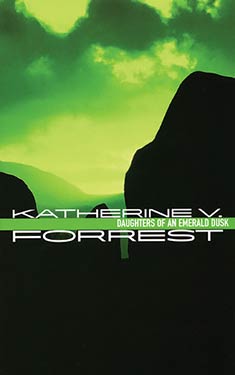
Daughters of an Emerald Dusk


Katherine V. Forrest
Completed 6/23/2019, Reviewed 6/23/2019
4 stars

This book is a wonderful conclusion to the trilogy which began strongly in Daughters of a Coral Dawn and continued weakly in Daughters of an Amber Noon.  Like the first, it is written from several voices’ perspectives, weaving a complete narrative that is active rather than expositional, which was my biggest problem with the second book.  The theme is that the best intentions can have unintended consequences, as the women’s utopia created on the planet Maternas gets thrown for a loop by the very odd behavior of its younger generations.  It brings in Gaia theory, that is, the theory that a planet is a self-regulating, complex system where living organisms interact with their inorganic surroundings to maintain and perpetuate the conditions for life on the planet.  The introduction of the Unity, the now ten thousand women who settled on Maternas from Earth, has tipped the balance of Maternas and the planet is now fighting back.  This book won the Lambda Literary Award for Science Fiction/Fantasy/Horror in 2006, and I think it was very deserving.

The book begins with the arrival of more women from Earth on Maternas, including Olympia and Joss, two of the narrators from the second book.  They find it beautiful but notice strange behavior of the young people.  With the return of Megan the original emigrants’ leader, Minerva the historian, and Mother back to the planet, the council calls a meeting to discuss the problem with the new generations of daughters.  Due to a time warp for the people who traveled to and from Earth, fifty-five years have passed, and there are two generations of daughters who do not communicate and have left the utopia built by the founders to live on the continent of Amazonia on the equator.  The parents are distraught and have stopped having children until something can be figured out.  What follows is a journey to the heart and mind of a planet that is out of balance and doing anything it can to repair itself.

The narration this time is by Minerva, Olympia, and Joss.  There is no third person narrative line.  It works a lot better.  As I mentioned before, this book doesn’t rely as much on exposition, only in the beginning at the council where they catch the travelers up on what they’ve missed.  The voices of the narrators are much clearer this time as well.  Whereas in the second book it almost seemed like the author was popping up saying, “Now I’m Joss” and “Now I’m Africa”, the narrators here are much more distinctive and the characters are much more developed.

I’ve read some reviews where the readers thought that the book was kind of campy, but I didn’t find it exaggerated or over-the-top.  Sure, the strange children trope can get kind of campy and has been done may times, but I found it to be exciting and wonderfully weird.

It also seems that the author kind of does a one-eighty on the separatist theme.  I really can’t go into too much detail because that would be a spoiler.  But suffice it to say that she perhaps has grown a bit since the publication of the original book and has become more of an inclusivist rather than an exclusivist.

I give this book four out of five stars.  It was a short book, under two hundred pages.  Except for the fact that I had to sleep, I could barely put it down, reading it in two days.  I’m glad I read the whole trilogy.  Even though this book begins with a rundown of the basic facts from the first two books, it doesn’t begin to give you the experience that I had reading them. 

Saturday, June 22, 2019

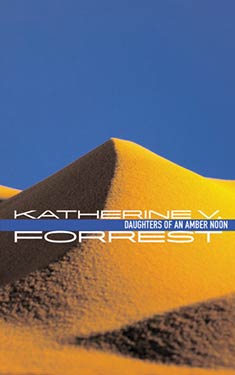
Daughters of an Amber Noon

Katherine V. Forrest
Completed 6/22/2019, Reviewed 6/22/2019
3 stars

This is the second book in the Daughters trilogy.  In the first book, Daughters of a Coral Dawn, four thousand descendants of Mother leave Earth to form a women’s utopia on a distant planet.  Two thousand of their sisters remain on Earth for various reasons.  This book follows their story.  I didn’t find it as gripping as the first novel.  Even though this book came out eighteen years after the first, it feels like sophomore slump.  There was a lot of exposition.  Rather than showing me what happened, it was a lot of telling me what happened.  Even the ending had epilogue-like chapters explaining what had happened rather than taking me through the events as they unfolded.

The book follows the two thousand descendants of Mother who remained on Earth.  In the first book, the political and social structure was hostile toward women.  Now, a new dictator, Theo Zedera, has taken over the world and things have gotten even worse.  Specifically, he’s hunting for the remnants of Unity who have left society and are hiding in the desert.  As with the women who emigrated, these women are especially gifted.  So, they’ve built an enclave hidden by a volcano which is practically impenetrable and unfindable.  One of the women in particular, Africa, was a close friend and personal advisor of Zed before he became dictator.  She is now working to make this refuge a utopia, but bears tremendous guilt for fostering Zed’s maniacal and narcissistic ways.  The question is, how long can they remain hidden before Zed finds them?

The narrative is more or less similar to Coral Dawn.  It is told from the journal entries of several women.  This time the women include Olympia, one of Mother’s nine daughters who has taken over the role of historian for the Unity; the aforementioned Africa; and Joss, a woman assigned to Africa as a sort of personal assistant and is secretly infatuated with her.  In addition to these, there is also a third person narrative from the perspective of one of Zed’s generals which gives you behind-the-scenes insight into the workings of Zed and his henchmen.  I found the narratives of the women less distinctive than in the first book, and their characterization less formed.  I didn’t feel like I was in any of their heads, and they all more or less sounded the same.  They gave a lot of history of the women but explained rather poorly who they really were.  As characterization goes, Zed and his henchmen were better drawn than any of the narrating women.  And it was not hard to imagine the hateful workings of a narcissistic despot considering our current political climate.

I give this book three stars out of five.  It’s decent, but not nearly as good as its predecessor, which I nearly gave five stars.  It was drier with none of the cheeky humor that Mother provided.  I found it a little tougher to read, with not much going on until the end.  And the ending does wrap things up rather nicely and somewhat astonishingly.  I’m still looking forward to the final book, which won the Lambda Literary Award, though I hope it was on its own merits rather than a lifetime achievement award for someone who wrote a book that has become a classic of lesbian science fiction literature.