Saturday, April 27, 2019

Karen Memory


Elizabeth Bear
Completed 4/27/2019, Reviewed 4/27/2019
4 stars

I’m not a huge steampunk or western fan, but I really enjoyed this cross between the two.  The book is about a prostitute with a heart of gold in the Pacific Northwest during the Washington territory days in the 1800s.  It’s mixed with a Jack the Ripper style murder mystery where women are found in alleyways flogged to death.  It was nominated for the Gaylactic Spectrum Award in 2016 for positive LGBTQ content in Science Fiction/Fantasy.

The book is told in first person narrative by Karen Memery, like memory but with an e.  She’s an orphaned girl doing the best she can in Madame Damnable’s high-class bordello in a town called Rapid that’s a sort of amalgam of Seattle, Vancouver, Portland, and San Francisco, servicing the mariners and the gold seekers before they head up to Alaska.  All is relatively normal until one day, an injured girl named Priya shows up on the doorstep.  Turns out she’s from India and was abducted and forced into prostitution by the evil competing bordello.  Taking her in creates a war between the two houses.  At around the same time women begin appearing in alleyways flogged to death.  The owner of the other house has a mind-control device that he uses to control his indentured prostitutes as well as influence the people of the town against Madame Damnable.  Also coming into the story are a black Lone Ranger type with an American Indian sidekick who are searching for the murderer.  Together they all try to solve the murder mystery while surviving the attacks from the competing house.

The story is really well done.  It’s told in old west style, low-educated grammar.  At first I found it a little annoying, then appreciated it for giving us a sense of who Karen is.  It’s just the right touch of quaint without being too difficult to read.  There aren’t a lot of flashbacks into Karen’s past but she conveys her life experience as well as her hopes and dreams.  In particular, she tells us about how she is falling in love with Priya and wants to settle down on a ranch of her own with her.  She’s been saving up money to buy land, as working in the Hotel Mon Cherie pays pretty well.  We get to know a lot about Priya, as well as several of the young women working at the bordello as they all interact as a family.  The characterization is really well done.

In the steampunk category, there are dirigibles, the mind-control device, a Nautilus-type submersible run by a captain nicknamed Nemo, and a walk-in sewing machine/automaton that Karen uses as a sort of coat of armor.  This walk-in sewing machine was the only thing I didn’t quite get.  I got that it was like having armor that enhances the musculature of the wearer, but I never got how it was used for sewing.  It didn’t ruin the story for me in any way, it just made me wonder what it’s for besides escaping from burning buildings or busting people out of jail. 

Readers of my blog may note that I’ve been reading this book over two weeks.  It’s not a long book, and it’s quick reading.  I was just distracted by gaming.  If I wasn’t playing games for two solid weeks, I would have read more than 20 pages a night.  The action is well described and fast paced.  I would have finished this book a lot more quickly if I hadn’t been playing so many games. 

I give this book four stars out of five.  It’s not my usual brand of excellent, but it was really well written and thought out.  I liked Karen, the book’s setting, and its plot.  It’s pretty fun, and I think would have been a fast read under normal circumstances. 

Thursday, April 11, 2019

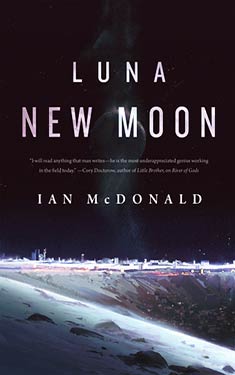
Luna: New Moon


Ian McDonald
Completed 4/10/2019, Reviewed 4/11/2019
4 stars

This book is the definition of space opera.  It’s sort of a cross between a prime-time soap opera and The Godfather set on the Moon.  It’s about five families, known as the Five Dragons, who control five different mega-corporations on the Moon and their wars with each other.  At first I didn’t care for the book.  I was overwhelmed with the number of characters (of which there is a three- or four-page glossary before the book starts) and the constant changes in perspectives among many of them.  Somewhere after about a third of the way through, I got hooked into the story and found it a fascinating and engrossing thrill-ride.  It’s the first book in a three-part (so far) series that ends with a bang, but also leaves you hanging for the sequel.  The book won the Gaylactic Spectrum Award in 2016 for positive portrayal of LGBTQ themes in SF/Fantasy.

The majority of the story centers around the Corta family, led by the matriarch Adriana.  Hailing from Brazil, they control the extraction of Helium-3, fulfilling the energy demands of the Earth.  She is old, and there is tension between two of her children, Rafa and Lucas, over who will have control of the company when she dies.  More immediately, there is a sort of lukewarm war between the Cortas and another family, the McKenzies, who run a mega-mining operation.  There are assassinations and attempts, arranged marriages to create alliances, vendettas, and all sorts of intrigue within and between each family.  All this in an environment where the line between life and death is razor sharp.  In fact, people must pay for the Four Elementals:  water, air, carbon, and data.  People pay per breath.  Become unemployed, and soon you will suffocate from not being able to afford your breathing.  But this is a minor issue for the ultra-rich Five Dragons.

The world created on the Moon is one of extreme capitalism run amok.  There is no law but contract law.  You can murder, steal, cheat on your spouse, and so on, as long as you have not signed a contract forbidding it.  And when contract breaches come to court, they can be settled by a duel.  There are no guns on the moon because of the chances of puncturing holes in the protected environments, so the duels usually involve knives.  And there is no democracy, no government of any kind.  Everything is basically controlled by the Five Dragons. 

Like a TV show like Dallas or Dynasty, almost all the characters are part of one of the five families, or work for them.  We don’t get a taste of what it’s like to be poor on the Moon, except through the eyes of one character, Mariana, a fairly recent immigrant who with her friend (or lover, I was never sure exactly which) are within pennies of running out of breaths.  Fortunately, she gets a job with the Cortas, but not before her friend dies from lack of payment.  However, Mariana’s struggle with poverty really only occurs at the beginning.  Once she is employed, we don’t experience what the lower classes experience ever again.  This is too bad, for though it would make the book much longer, it might have made the world a little more fully developed.

I was really surprised that I liked the characters in the Corta family even though they had their share of moral repugnance.  They’re not the good guys.  They are just most three-dimensional characters of the book.  There is a machismo that runs through the men of the family, which is a fatal flaw for many of them, particularly Carlosinho and Lucas.  I liked Lucasinho, Adriana’s mostly gay grandson.  At seventeen, he attempts to run away from home and live without his family.  He has to learn to live by his wits since his father Lucas cuts him off from his accounts.  I also liked Ariel, Adriana’s daughter who is a lawyer and an asexual.  And lastly, I was intrigued by Wagner, Adriana’s youngest son, who is a “wolf”.  He lives in a pack and is influenced by the full Earth in the sky.  The concept of a wolf seemed to be a little hokey, but it intrigued me and I wish there was a little more description of what being a wolf actually entails.

I give the book four stars out of five.  It took a while to grab me, but once it did, I wanted to keep on reading.  However, I don’t necessarily feel compelled to follow the story into the next books.  The prose is decent, but I didn’t like how the perspective changed numerous times through a chapter.  This was especially problematic in the beginning when there are so many characters being introduced.  I recommend this book to anyone who likes space opera. 

Sunday, March 31, 2019

Just One Damned Thing After Another


Jodi Taylor
Completed 3/31/2019, Reviewed 3/31/2019
3 stars

This was a fun, light, time-travel novel.  The author is British and the humor is quite snarky.  I enjoyed it for the most part, but I liked Connie Willis’ time-travel books better.  This is the first of a fairly long series, but I don’t think I’ll be reading any more of them unless I see them on sale, or I’m in dire need of something light. 

The story revolves around Dr. Maxwell, a woman fresh out of her doctorate studies in history.  She meets an old elementary school teacher who gets her an interview at a history institute.  All things are hush-hush about what the job actually entails until she signs some pretty serious non-disclosure statements.  She finds out that the job involves going back in time to do research that is then used by the parent university.  She enthusiastically agrees and begins an intensive training program.  Her first assignment is to go back to the Crustaceous Era and film and study the flora, fauna, geology, and night sky.  At the end of the trip, things go horribly wrong, and then it’s just one damned thing after another.

The best thing about the book is that it is generally fast-paced and action-packed.  Five years goes by rather quickly.  I wasn’t quite sure when the five years had passed.  That was pretty unclear, but the book kept me reading anyway and I just ignored the timeline (pretty ironic for a time-travel novel).

The characters were also pretty fun.  The main character, Maxwell, was fairly well created, but most of the other characters were less than three-dimensional.  But this one- or two-dimensionality was part of the fun.  It made for a goofy cast with clear-cut bad guys. 

There is one part I definitely didn’t like.  At one point, the plot gets rather soapy, as Maxwell falls in love with someone she works with closely at the institute.  While the relationship was okay, I didn’t think it was necessary to add what amounted to a melodramatic twist. 

I don’t have too much more to say about this book.  If I did, it would give away a lot of the twists and turns in the plot.  And it’s just not the kind of book you want to analyze too closely.  I believe that to enjoy it, it’s best to take it at face value.  I give it three out of five stars.  It’s good, it’s fun.  I recommend it as light fluff to almost everyone. 

Wednesday, March 27, 2019

Passing Strange


Ellen Klages
Completed 3/27/2019, Reviewed 3/27/2019
5 stars

Last year, I read 94 books and gave out ten five-star ratings.  The last one was in September.  This year, it took 24 books and nearly three months before awarding another five stars.  I was so moved by this novella that I had to walk around the apartment to work off the emotions that had settled in my gut.  I loved this story about queer women in 1940 San Francisco.  It tells of lesbian love in a time rife with homophobia and racism.  And there’s a little magic thrown in the mix.  If the magic were more subtle, I would have called it Magical Realism, but really, it’s fantasy.  The book won the Gaylactic Spectrum Award for positive LGBTQ content in speculative fiction, won the World Fantasy and British Fantasy Awards for Best Novella, and was nominated for the Nebula Award for Best Novella and the Mythopoeic Award.


The story begins with Helen, an old lawyer with a terminal illness who possesses the last painting by the acclaimed artist Haskell.  She spends her last day selling the painting and divvying up the proceeds among friends and charities before taking pills to end her life.  This is not a spoiler; it’s the first chapter.  The book then goes back to 1940 where a circle of lesbian friends gathers for a dinner party.  There we meet Helen as a young woman, Franny, Babs, Haskell, and newcomer Emily.  The group regularly hangs out at Mona’s, a bar where women dress as men, and is frequented by the lesbian community as well as straight Midwest couples who come to gawk and be amazed at the drag kings show.  One night after the dinner party the group goes to Mona’s where Haskell is astounded to find that Emily is the star of the nightly show as her alter ego Spike.  Haskell and Emily fall in love and the two become a couple.  Of course, life for lesbians is not easy in 1940, even in San Francisco.  It’s even more complicated by the fact that Haskell is still married to a man.

As I mentioned above, this is a novella, under 220 pages.  Yet it finds a way to encompass a romance while presenting hard facts about homophobia and racism.  There’s a scene where Spike’s female piano player is roughed up and arrested by the police for wearing men’s clothing without wearing the required three articles of women’s clothing.  There’s also a scene in a Chinatown supper club that caters to whites where the host is chock full of racist jokes at the expense of the Asian performers.  Times were hard for people of color and for the queer community.  The author did a lot of research on old San Francisco and it’s evident in how she captured these issues in these scenes.

I can’t really discuss the magic in the story as it comes to play at the climax of the story and would be a spoiler.  And if there’s any criticism one could have for the book, it would be that the magic system is not fully elaborated upon, except for the fact that it’s old-country magic.  In that sense, it is a bit like Magical Realism, that is, magic in a real-world or mundane setting.  But I think Magical Realism often uses myth or allegory, and this book does not.  Still, it’s wonderful how it’s presented.

One of the best things about the book is how it portrays this group of friends.  It captures a common occurrence in the LGBTQ community, where friends become family when biological families reject them.  The whole middle part of the book is about Haskell and Emily, but we get enough of a sense of who the others are so that it is only natural that they all come together to help the lovers in their time of need.

My requirement for giving a five-star rating is that the book is excellent AND moves me emotionally in some profound way.  I didn’t cry at the end, but the book made my whole insides quiver.  The prose was elegant without being overbearing.  The dialogue was realistic and natural.  At the end, I wished I could have stayed with these women longer, gotten to know them all much more deeply.  But if it were longer, it may not have been the perfect little book that I won’t be able to stop gushing about for days. 

Sunday, March 24, 2019

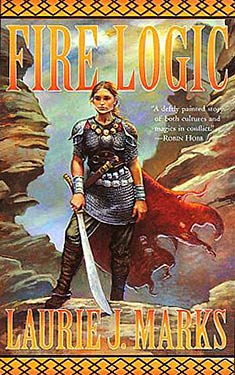
Fire Logic


Laurie J. Marks
Completed 3/23/2019, Reviewed 3/24/2019
3 stars

Most of the fantasy I’ve read is high fantasy, urban fantasy, and other common subgenres.  This was what I guess could be called low fantasy.  There are no kings, elves, fairies, or fantastical magic.  This book was a gritty story about more or less everyday-type people trying to make a difference in their world.  There’s a little magic, elemental as the title implies, but it’s very fundamental, organic, and appears mostly by way of healers and seers, at least in this first book of the Elemental Logic series.  It won the 2003 Gaylactic Spectrum award for positive LGBTQ content in SF/Fantasy, as did its sequel in 2005.  But despite good writing, I found it hard to follow where the author wanted to go with the plot.  It had many moments, but they didn’t sum up to a great whole. 

The book revolves around characters in the country of Shaftal.  It’s been invaded by the Sainnites.  Zanja’s tribe was wiped out; she’s the only survivor.  She’s a fire elemental and a lesbian person of color (Note: the book cover is whitewashed, sigh).  Most of the story is told from her perspective.  She meets and falls in love with Karis, a half-giant who is addicted to a deadly drug called smoke.  Karis is an earth elemental, a metalsmith, and a powerful healer, but the drug is slowly taking its toll.  Zanja also meets Emil, a gay officer fighting in the Shaftal resistance.  At one point, she joins Emil’s paladins on a guerrilla quest to route the Sainnites from part of Shaftal.  The story is also told from Karis’ and Emil’s POV, but the majority of our experience of them is through Zanja’s eyes.

The character development is quite amazing.  I really felt like I was in the skin of the three main characters.  Most of the time we are in Zanja’s head.  One of the most interesting things about her is that she gets hurt in battle and once by the other paladins.  She gets healed physically, but it takes time to recover from the psychological damage done by the hurt.  Karis’ character is also quite a revelation.  Her descent into oblivion from smoke is devastating.  The author did a terrific job getting addiction down as well as the dangerous withdrawal from it.  Emil is great as Zanja’s guardian and cheerleader.  He’s also a scholar who treasures books. 

The part of the book that baffled me was the main plot arc.  It didn’t seem to have a specific direction.  I thought it just meandered with Zanja first surviving her people’s holocaust, then meeting Karis, then joining Emil’s paladins, and so on, until the end.  I felt like I was on her journey, but I didn’t know why.  This made the book sometimes tough to get through.  The ending was pretty good, even exciting, but I wasn’t sure how I really got there.  Despite all this, the prose was stupendous.  There were moments that were simply inspired, and I enjoyed reading it.  But again, I felt like I didn’t know the reason we were on this journey. 

I give the book three stars out of four.  It had all the makings of a four star book, but in the end, I didn’t know how I had gotten there.  I’m still going to read the first sequel, as it is an award winner and on my LGBTQ Speculative Fiction Resource List on Worlds Without End.  But unless the second book has a stronger plot, I don’t think I’ll finish the series. 

Friday, March 15, 2019

Norse Mythology


Neil Gaiman
Completed 3/15/2019, Reviewed 3/15/2019
3 stars

This is a collection of short stories about the Nordic gods.  The stories are based on Prose Edda and the Poetic Edda, the two existing ancient books on the gods.  I know very little about Norse mythology, and this was a good introduction to it.  It focuses on Odin, Thor, and Loki, but also has some of the other gods as well as many giants.  The book is very easy reading.  In fact, I would almost consider it YA based on the writing style.  I love Gaiman’s writing, even when he writes to younger audiences. 

Normally, when I review a collection, I give a brief description of a few of my favorites.  This time, however, none really stood out, except some of the last few, which is probably because I read them last.  All the stories were good, most containing a little humor and a lot of action.  Thor really stands out because he is a big lug who almost always wants to kill someone or something with his hammer.  Of course, Loki also stands out because he is the trickster and certainly the source of most of the conflicts and problems that occur amongst the gods. 

The stories more or less follow a time line, with the beginning recounting of the creation of the world and end about Ragnarok, the end of the gods.  We hear the stories of how Odin gained his wisdom and lost an eye and how Thor got his hammer.  Giants play a large part in the stories.  They are almost always the nemeses to the gods, even though some of them are children of giants and some have children with them.  Unfortunately, there are only a few mentions of dwarves and elves.

Despite the focus on the three gods, there is very little characterization.  I didn’t really feel that I got to know who they were, just what they did.  I don’t know the source material at all, but I’d bet there wasn’t much characterization in them either.  This is the one area where I think Gaiman could have done a better job, enhancing the characters so that they were more than mere cardboard cutouts. 

The prose is really good.  The flow of the simple language made for an enjoyable reading experience.  It’s an easy book to pick up at any time and begin reading.  I never felt like, ugh, I don’t want to read this.  Even when I was tired, I always felt like I wanted to keep reading and not put the book down.  I think it’s because each story was entertaining, even the darker ones.  When I was young, I enjoyed reading Greek and Roman mythology.  Perhaps it was the books I had available to me, but sometimes they felt so heavy handed, much like reading the Bible.  Gaiman’s touch was light and never failed to make me glad I picked up the book.

I give this book three stars out of five.  Even though I enjoyed it, at the end, my response was, “Gee, that was a nice book” rather than “Wow, that was a great book”.  I was certainly glad I read it, as I always am with a Gaiman book.  I would recommend this book to anyone who wants an introduction to the Norse gods. 


Saturday, March 9, 2019

The Fire’s Stone


Tanya Huff
Completed 3/9/2019, Reviewed 3/9/2019
3 stars

This was an okay book.  It’s very standard fantasy.  It’s about three young people on a quest to save a city.  There’s nothing that remarkable about the quest or the characters except that two are bisexual males, one is an asexual female and they all have baggage.  The most interesting thing about them is how they find each other.  There’s a fair amount of action in the book which keeps it moving, but nothing really kept me that interested except wondering if the two bisexuals ever get to admit that they love each other. 


The plot revolves pretty equally between the three characters.  Aaron was born a clan chief’s heir, but is on the outs with his father.  He ran away from home after his father beat his cousin to death.  He’s now an accomplished thief in the city of Ischia.  He decides to steal the emerald on the king’s staff, but is caught.  That is how he meets the next character.  Darvish is a prince, the third in line to the throne of Ischia.  Being third in line means he has nothing to do except drink, practice swordplay, and sleep around.  He’s been betrothed to Chandra, our third character, for political reasons though neither of them wants the marriage.  Chandra is a princess who is a very powerful wizard and wants to remain unmarried to hone her skills and retain her power.  She secretly travels to Ischia to try to convince Darvish not to marry her.

The city of Ischia sits on the edge of an active volcano.  There is a magical stone that took nine years to create by nine powerful wizards which keeps the volcano at bay.  Someone steals the stone and Darvish is assigned the task of finding and returning it.  Aaron and Chandra accompany him on the quest.  On the way, the are confronted by guards, pirates, and other wizards.

Even though the characters were fairly cardboard, the one that really stood out for me was Darvish.  He’s a terrible alcoholic.  On the quest, he is forced to sober up.  The description of the DTs he experiences is very vivid.  His battle against drinking afterwards is very realistic, because as one might assume from a standard fantasy, wine is everywhere.  He has to constantly struggle with the thought that he deserves a drink and the fight against that is torturous.

Aaron is the most wooden of the three.  He has completely closed off his feelings for Darvish because of the religious sexual oppression beaten into him from his childhood.  As a result, he is stoic, but tortured by the tapes of his father in his head.  This got very old after a while.  Chandra, on the other hand, is a little more three dimensional.  Her baggage is less traumatic and she doesn’t wallow in it.  She’s the most level headed of the team, and also the most insightful.  It’s fun to watch her roll her eyes every time Aaron and Darvish can’t bring themselves to express their love for each other.

I give this book three out of five stars.  I can’t think of a better adjective for this book than okay.  The plot is okay, the prose is okay, and the characters are okay.  Nothing is really remarkable about the book except the realistic account of Darvish’s alcoholism.  I have one more Tanya Huff book to read on my quest to finish the Worlds Without End LGBTQ reading list.  It’s another fantasy and gets higher ratings than this book.  I’m hoping it will have a little more substance than this one.