Thursday, September 26, 2013

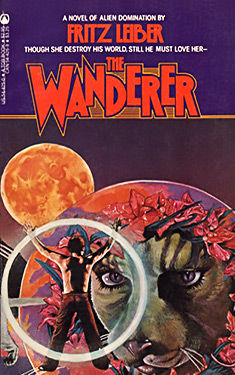
Hugo Winner Review: 1965 The Wanderer

Fritz Leiber
Read 2/2013, reviewed 4/13/2013
2 stars

This is disaster porn at its best.  It reads like an Irwin Allen or Roland Emmerich script.  The story line has a planet suddenly appearing the orbit of the moon, disrupting the earth by its gravitational force.  There are a few major characters who have major plotlines.  In addition, there are lots of minor characters with lots of disparate subplots.  There are so many characters, I could easily see it as a poster for a 70’s disaster film with the line of stars headshots at the bottom, like Towering Inferno, Earthquake, and Airport. 

I liked the basic premise.  However, the execution eventually just became boring.  Its appeal is mostly to my love of disaster porn films. 

I had a love/hate relationship with Tigerishka, the alien.  She was too cartoonish.  The name itself is too hokey.  The characterization was obviously an anthropomorphism of the basic housecat:  sexy, devious, toying with her prey.  To me, it is the big mistake of the hack science fiction writer.  Leiber creates an alien based on human experience and interpolation of a similar creature, here, the housecat.  It assumes an extrapolation from an earth creature, rather than the result of an extraterrestrial evolution.  I find this to be just trite.  There are other examples of where it works much better:  Nessus and Speaker-to-Animals in Ringworld.  Yet I still liked Tigerishka, particularly the development of her relationship with Paul. 

I liked the science of the book:  the destruction of the moon and the geophysical disruption of the earth.  I actually thought the disaster descriptions could have been more extreme.  And given our world’s recent experience with major phenomena like the 2004 Indonesian and 2010 Japanese earthquakes and tsunamis and volcanism in the past few decades, if this book were written now, it would probably have reflected more devastation.  As an example, compare the disaster sci-fi of the 50s and 60s with the Emmerich films “The Day After Tomorrow” and “2012.”


I gave the book 2 stars because that seems to be the average rating of just about all disaster porn movies.  Kudos for effects, boos for the soapiness.

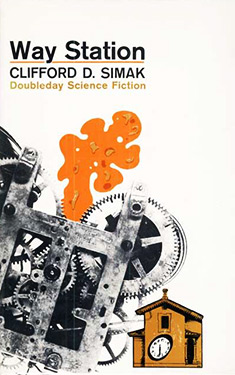
Hugo Winner Review: 1964 Way Station

Clifford D. Simak
Read 3/2013, reviewed 4/13/2013, updated 9/26/2013
5 stars

Okay, so if you read many of my reviews, you’ll notice that my biggest problem is that I find it difficult to put together cohesive thoughts for books I love, especially when I began writing reviews in April of 2013.  “Way Station” was one of the first books in my Hugo quest that moved so deeply that I didn’t want to leave it.  It’s been a while since I’ve read it and can’t really add to the review with much more insight.  So I’ll just let you read my original text and let you revel in my stream of conscience gush:

I loved this book.  I loved the main character, Enoch.  I loved the deaf-mute neighbor girl.  I loved the plot, that Enoch is the custodian of a Way Station for travelling aliens.  I loved his interaction with the aliens.  I was totally enrapt by the government spying and conspiracy.  I was emotionally gripped by the struggle to keep the white trash neighbors away and to keep the deaf-mute girl safe.  And OMG, what an ending! 

I can’t describe my excitement about this book in any other way.  It totally entranced me.  This is what great fiction, and great science fiction, should be. 

I had a taste of Simak when I read his novelette, “The Big Front Yard.”  It also won a Hugo.  Out of the Volume 1 Hugo Winners collection, it was my favorite.  Way Station has the same feel of a gorgeous, peaceful landscape with an isolated home, occupied by a simple man with a wild secret.  His writing style just draws you into his setting and into immediate empathy with his main characters.  The science is not that hard, but it’s not as relevant as the fact that the peaceful existence of a simple person is being disrupted in some amazing way. 

When I am done with the Hugo winners, I will definitely read more books by Simak!  This is a 5 star book! 


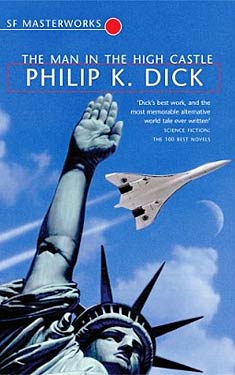
Hugo Winner Review: 1963 The Man in the High Castle

Philip K Dick
Completed around 4/5/2013, reviewed 4/13/13.
3 stars

SPOILER ALERT!  This review contains a spoiler to the ending.  DO NOT READ this if you intend to read the book.

I enjoyed this book.  It was a great example of an alternative universe novel.  The plot takes place in a universe where the WWII axis powers have one.  The US, was well as other nations, are divided between Germany, Japan, and Italy, with a few neutral exceptions.  The story follows several interconnected characters who are exposed to a book about an alternative universe where the Allies won.

I loved the alternative universe within the alternative universe device.  I was confused, though, at the great reveal at the end.  HERE'S THE SPOILER ALERT:  Juliana Frink and the book’s author reveal that the book is the truth, not the reality around them.  I found this to be highly confusing.  My only thought was that at that point, the characters are made self-aware, that they are merely characters in a book about an alternative universe.  I’m not sure this is correct, but that’s how I read it.

My only problem was the grammar of the narration by the Japanese characters, and the speaking of the American characters in the Japanese accent.  It made it occasionally difficult for me to follow. 


I give this book 3 stars because while I thought it was a great universe, I found the characters all a bit boring.  As described in another blog, the book well describes the despair of being a conquered people.  But I think that is what made them a bit boring.  Once I met the characters, I wasn’t really interested in what else happened to them.  I was distracted by all the subplots which did not follow the journey of Juliana.

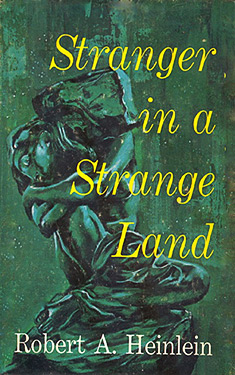
Hugo Winner Review: 1962 Stranger In a Strange Land

Robert A. Heinlein
Completed Feb 2013, reviewed 4/13/2013
3 stars

I enjoyed this book, but I’m not sure if I actually liked it.  I liked the basic premise: a human, Valentine Michael Smith, born and raised on Mars by Martians comes back to Earth and becomes a new Messiah.  The writing was good; it kept my interest and kept me reading.  My biggest problem with the book was that it felt like two very different books mashed together.  The first “book” is a chase, trying to free and hide the human Martian.  The second half is an in-your-face polyamorous hippie commune-based messiah story.  At times, I found the long dialogues arguing and supporting the polyamorous society to be not much more than well-written propaganda.  And there’s quite a style difference between the two halves.

From my research, I've found that it was quite shocking when it was first published.  I am a little perplexed that this book is now located in the young adult fiction section at the library.  While not shocked by the polyamory, I find it amazing that our conservative vocal minority, even in my liberal town, doesn't meet nightly at libraries with torches, ready to burn the book, or at least keep it out of the young adult section.

All of Heinlein’s books can be seen as, in some way or another, simply essays on war, libertarianism and polyamory.  But Heinlein does it so well!  If the book weren't so well written, I wouldn't have given it the stars I did.

Of course, the female characters never seem to make it above being secretaries or supporting wives.  At least they were a little more fleshed out than Starship Troopers or Moon is a Harsh Mistress.  This is most evident with Gillian Boardman, a nurse who discovers and rescues Valentine Smith from the government, starts out as a strong woman in the first half of the book, but her character’s strength dissipates in the second half.  The homophobia and racial slurs also caused me trouble.  As usual, I have to step back and realize who wrote it and when.

I really love that in all three of these books, Heinlein uses the device of the old smart man.  In Moon and Troopers, he’s a professor.  Here he’s an old writer/lawyer/doctor, kind of a Deus ex machina, all-wise and compassionate, having tons of money, and getting the main characters out of trouble.  I liked him more than Smith, who almost becomes a caricature by the end. 


I gave the book 3 stars.  Because it is so well written, I wanted to give it 4, but I knocked off a star for the significant change in writing style between each half of the book, for how he just had to put down gays and other minorities, and for turning all the strong women into Ivory Soap Girls.

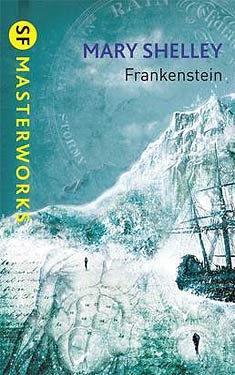
WOGF: Frankenstein, or, The modern Prometheus

Mary Wollstonecraft Shelley
Completed 9/25/2013, Reviewed 9/26/2013
5 stars


Shortly after beginning my personal challenge to read all the Best Novel Hugo winners, I read a collection of essays by Isaac Asimov on SF.  In many of the essays, he referred to “Frankenstein” as the first SF novel.  So when I began the Women of Genre Fiction 2013 Challenge, I saw it as a wonderful excuse to read “Frankenstein.”  Initially, I was nervous.  In my youth, I never enjoyed reading classic literature.  I usually found I couldn't stay focused on lengthy, rambling, descriptive prose.  And besides, who talks like that?  So I avoided classic lit for many, many years.  To my surprise, “Frankenstein” completely changed my mind.

The joy of “Frankenstein” is the prose.  It is a delight to read.  Rather than fighting the prose, I found myself wrapped in it like a warm blanket.  Modern posers like Michael Chabon should take a lesson from “Frankenstein” in how to use description in a more organic, less pompous way. 

The copy I borrowed from the library contained essays and critical analysis of the book.  The analyses regularly reference an original manuscript of the story that still exists, though not complete.  It shows that Mary Shelley’s husband, Percy, edited the original text for her, making hundreds of changes to her word choices.  Apparently, her text is rawer, more Anglo-Saxon.  His changes Latinized her language.  I was horrified.  It was afraid that what I loved was Percy’s editing rather than the Mary original work. 

To ease this cognitive dissonance, I had to step back, and realize that it shouldn't matter.  I’m not  on a scholarly quest.  I had to take the book on face value and allow myself to enjoy the pleasure I had in reading it.  Percy-fied or not, Mary Shelley wrote an amazing story and I can revel in it.

Another technical note about the book is that I read the 1818 version.  In 1931, a second edition was printed, with Mary making drastic changes to the text.  Based on the analyses, I’m glad I chose the 1818 edition.  (You’ll have to read some of these understand all the differences).  However, someday, I’d like to read both the 1831 edition, and what remains of the original manuscript and then re-read some of the analyses comparing the texts. 

As you will always hear, the book is nothing like any of the movie versions ever made.  The book is about fear, guilt, and wretchedness.  It is not hard SF; there is no laboratory, no electricity, no hunchbacks.  The creature is borne of un-described chemistry.  There is obsession and remorse.  There is innocence and anathema.  This is my type of SF.  It’s about the relationships and fortunes of the people as a result of the science.    

One of the most interesting essays in this edition noted how easy it is to overlay any theme on the book:  feminism, homophobia, etc.  I found myself reflecting on the bullying and hatred I endured in middle and junior high school, and the outright maliciousness of high school classmates.  Like the monster, I perpetuated the bullying by abusing others, rather than breaking the cycle of abuse.  Unlike the monster, I did not consciously choose to be abusive.  But maybe that’s part of the moral of this theme.  Hate begets hate; abuse begets abuse; something must die for transformation to occur.

I also found the theme of the nature of god rummaging around in my mind.  Certainly, there are the comparisons to Prometheus and Adam.  But I considered the nature of humanity, the fact that evil exists and we are condemned to live with it.  What did humans do to deserve such evil?  Catechism teaches us that it is the Original Sin of Adam and Eve, that God really does love but we brought this upon ourselves.  So if God is omniscient, why would it have created us if in its omniscience, it already knew we would sin and have to suffer through life.  Is this love, or is it abuse?  The monster’s despair is the existential crisis resulting from this conflict.  God is flawed, God has abandoned us, God hates us, and ultimately, God is dead.  The monster receives no salvation, no relief from his wretched state, and is condemned to die in despair.  That is the horror of this story.

Okay, enough heaviness.  “Frankenstein” is a great read whether you see deeper meanings in it or not.  The characters are amazing, the plot is tight, and the twists, exciting.  And despite the wretchedness of the main characters and the horror it induces, I was moved by its beauty whenever I sat down and opened the book.  This is a 5 star book.


If you are interested in reading this edition with the essays and analyses, here’s the info: “Frankenstein: the 1818 text, contexts, nineteenth-century responses, modern criticism;” edited by J. Paul Hunter, New York: WW Norton, c.1996, a Norton critical edition.
Wednesday, September 25, 2013

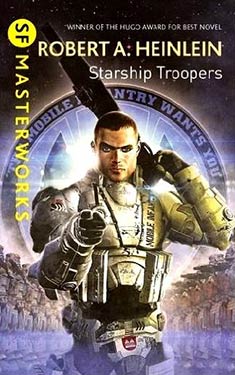
Hugo Winner Review: 1960 Starship Troopers

Robert A Heinlein
Read 2/2013, reviewed 4/13/2013
3 stars

This book is exactly the reason I don’t enjoy war novels.  It’s filled with descriptions that I can’t relate to.  It contains military slang I don’t understand, and situations that I wouldn't put myself in, physically or intellectually. 

The book is well written, as is everything I've read by Heinlein.  From my browsing through the internet, it’s apparently the standard by which all novels of this genre are judged.  But I just didn’t enjoy it. 

Like all his novels, though, I love and hate his political and social soapbox scenes.  He writes them so well.  Usually, while I may not necessarily agree with him, like the poly-amorous structures in "Moon is a Harsh Mistress" and "Stranger in a Strange Land," I can buy into it being a premise of the novel.  Here, however, the constant proselytizing of war becomes offensive.  That and the fact that only veterans can vote becomes too much to take.

I give this book three stars because it is written well.  But I just didn’t like it.  Having read quotes by critics in Wikipedia (assuming they are true), I agree that the main character Rico is just a sounding board for Heinlein’s politics and philosophy.  There’s no characterization here.   He’s just an automaton of a military industrial complex that glorifies war and deifies soldiers.  I think I would have hated being Heinlein’s wife.


Oh yeah, and the book was better than the movie.

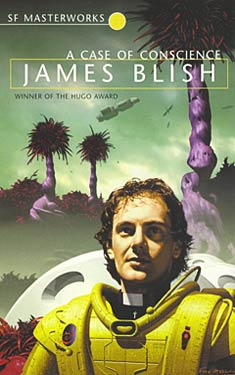
Hugo Winner Review: 1959 A Case of Conscience

James Blish
Read 2012, reviewed 4/22/2013, updated 9/25/2013
4 stars

This is one of my favorite types of SF: a study of religion/theology in a futuristic context.  A priest has to decide if a race of intelligent aliens have souls.  The beginning and end of this book deal specifically with this theme, and they are the best parts of the book. 

I loved the whole question of the religious establishment determining whether or not aliens are part of  God’s creation.  Are they also made in God’s image?  Are they washed in the same Original Sin as us?  Do they require redemption?  Does a Church have the right to determine this?  It made me think about pop SF films like the original film version of “War of the Worlds,” where a minister walks towards one of the Martian ships with a Bible in his hand ready to spread the Gospel.  It also called to mind the emphasis on God and the religious terrorist in “Contact.”  Is this how we’ll react when we finally find out we are not alone?

The middle part is odd.  One of the aliens becomes a new messiah who is just the toast of the town.  At one point, there’s a party for the alien with a roller coaster-type ride which is just plain weird.  It’s like a deconstruction of the Masque of the Red Death.  A group of decadent people are at a party, and there is a device to get us through a bunch of rooms with odd scenes.  I didn’t get it.  However, I loved the contradiction of a new messiah who may not have soul.  Does this mean he’s the Antichrist?  Could the Antichrist be an alien?

As much as I loved the book, I couldn’t give it 5 stars because of the weird middle, even though I was quite moved by the book in general.  I settled on 4.  In retrospect, this book was probably initially published in a magazine and the three parts were the issue divisions.  This book is on my reread list.  I’m hoping that a reread will make the parts I find incongruous a little clearer.  


It should also be noted that it is almost a year between my reading of the book and this review.  I’m responding mostly to memory of my reaction to the book.  I am trying to avoid relying too much on other people’s synopses and reviews and giving my opinion without outside influence.