Wednesday, January 8, 2020

Death by Silver


Melissa Scott & Amy Griswold
Completed 1/4/2020, Reviewed 1/7/2020
4 stars

I was surprised by this book.  I haven’t liked the Melissa Scott books I’ve read in the past, and I’m not a big fan of the murder mystery genre, but I really enjoyed this.  It was interesting, suspenseful, and had a little magic in it.  It’s an alternative history Victorian London where magic is taught in schools and everyone has at least some access to it.  The murder mystery plot was well-devised and even though I guessed who it was early on, I enjoyed the journey in getting to the big reveal.  It won the Lambda Literary Award for Sci Fi/Fantasy/Horror back in 2014. 
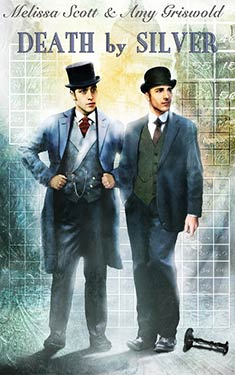

Ned is a metaphysician who is approached by the father of an old boarding school bully who tortured Ned in high school to discern whether or not his silver possessions are cursed.  After Ned finds that they are not, the man is murdered by an enchanted silver candlestick.    The man’s son, the bully, hires Ned to find the killer.  Ned brings in his old private investigator friend, Julian, who was also bullied by the man’s son, to help him with the investigation.  Sure enough the candlestick is enchanted and now Ned and Julian must find out how it was made so, after Ned originally found it to be clean, and who the murder is.  In the meantime, Ned and Julian are friends with benefits, each with deep feelings for each other.  Of course, they are very Victorian British and can’t quite get to the point of broaching the subject, causing all kinds of miscommunication.  Somehow they still work together, getting through their uncomfortableness with each other and their torturous memories of adolescence to solve the mystery.

The plot was really fun.  Many reviewers liken it to classic murder mysteries like the works of Agatha Christie and Sir Arthur Conan Doyle.  What kept my interest is that the investigations were peppered with Ned and Julian’s memories of the torture they endured in school from the bully, and the anticipation of the two trying to get over their Britishness and admit that they love each other.  And even though I figured out who the murder was, there was still some doubt because many of the suspects had their own motives.

There weren’t a ton of character.  There were just enough to really flesh them out.  Ned and Julian are marvelous, with depth behind their staid exteriors.  Even the bully, who begins the story on one note, develops through the story. 

I find it difficult to review a murder mystery because everything I want to say gives away key points in the plot.  So I’ll just leave this a short review.  I give the book four stars out of five.  I enjoyed it so much, I will probably eventually read the sequel, of which there is just one as I write this review. 

Wednesday, January 1, 2020

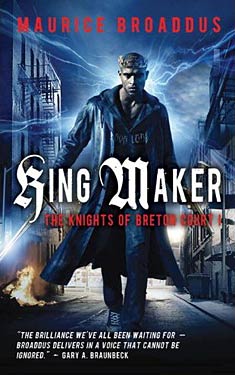
King Maker


Maurice Broaddus
Completed 12/31/2019, Reviewed 12/31/2019
3 stars

This is an urban fantasy reimagining of the Arthurian legend set in African-American ghetto of Indianapolis.  It basically works and I basically enjoyed it.  It’s the author’s first novel, so I could forgive him for the problems I had with it, and there are some.  But overall, it was a lofty idea and I give him kudos for the attempt.  The book won the Kitschies Golden Tentacle Award for debut novel in 2010, an award for progressive, intelligent, and entertaining genre fiction. 

The plot is relatively simple.  A street hustler named King tries to bring together the drug dealers and gangbangers of the neighborhood to fight for a common good.  What’s complex is all the background stories of all the characters, and there are a lot of them, as there are in the Arthurian legend.  And Broaddus does a good job of making their names more contemporary.  There’s Lady G (Guinevere), Percy (Percival), Merle (Merlin), Lott (Lancelot), Wayne (Gawain), and many others.  There are prostitutes, heroine addicts, crack heads, drug lords, dealers, and assassins.  Some are adults and some are teens.  They all come from the same basic neighborhood, Breton Court, so their stories intertwine.  No one has a good life in the hood, so King fights an uphill battle.

My biggest problem with the book is that there is very little fantasy.  It’s there, but it’s limited to short sections and the end.  It involves a little magic from Merle, some faeries, ley lines, junkie zombies, a dragon, and the evil Green, as in the Green Knight.  But it doesn’t all come together too well.  It doesn’t flow naturally.  You wait for almost the whole book for the fantasy to kick in, but when it does, it just doesn’t seem right.

There is some time line jumping that gets kind of confusing.  It’s in a different typeface so you know something’s different, but the timeframe isn’t very clear.  The character development is uneven as well.  I got a little confused by the bad guys and their stories.  It took most of the book for me to keep straight who was who and who they were working for.

On the plus side, the world building is very good.  I felt immersed in the environs of Breton Court and the surrounding slums.   The language is realistic and the interactions of the characters seem very authentic.   Everyone has a hard edge and is suspect of one another, even the “good guys”.  They grew up in a terrible situation and have little trust in humanity.  Yet, they strive to the right thing. 

I give this book three stars out of five.  I found it hard to put down, but at times, I also found it hard to keep track of things.  Perspective of the narration changes a lot and doesn’t always work well.  But the attempt to place Arthur and his knights in the modern slums of the inner city is well done.  I think a few more rewrites or better editing would have made this an outstanding book. 

Sunday, December 29, 2019

A Companion to Wolves


Sarah Monette and Elizabeth Bear
Completed 12/28/2019, Reviewed 12/29/2019
3 stars

This was a very peculiar book.  It was a bit reminiscent of the “Dragonriders of Pern” series, but with wolves instead of dragons and set in a Viking like culture.  Instead of threads, they fight trolls and instead of it being an honor to be in this wolf community, it has fallen into disfavor.  What was most peculiar about the book was that there is a lot of m/m sex, but there is almost no gay content.  The characters are mostly straight, or maybe bisexual.  Because the men are psychically bonded with wolves, both male and female, the men have sex with each other when the wolves do.  So if you’re expecting a m/m romance, this is not that book.  It is sexual politics with no sexuality. 


The plot however was simple but interesting.  Njall is the son of a powerful landholder who is heir to his father and sexually active with women.  One day a member of the wolf community comes with his companion wolf and demands that the father, Gunnar, tithe his son to the community as is the custom.  Gunnar is adamant that he will not for two reasons.  First, the community has fallen out of favor because the troll threat has greatly lessened, and second, because of the rumors of the man on man sex that happens.  However, Njall is dramatically drawn to the wolf, disobeys his father and joins the community.  There, he takes a new name, Isolfr, and pairs with a she-wolf who is destined to be a queen.  Together they fight a new wave of invading trolls.

Then it gets sexually weird.  When his she-wolf goes into heat, the male wolves become sexually aroused.  The same goes for the human companions of the wolves.  When the she-wolf chooses a mate, the associated human companions also have sex.  The thing is, Isolfr is basically straight and is not interested in man on man sex.  However, because he is driven to a sexual frenzy by his wolf-sister, he accepts the passive role, actively participating in it, but at the same time wishing it were over.  He never bonds with his sexual partners.  In fact, he is promiscuous with the women who work in the community (in traditional women’s roles) and even fathers a child with a local woman.  I was a little uncomfortable with these scenes.  While there is consent, it is a bit dubious.  Isolfr and others bonded with she-wolves accept their duties as their companions, but they are not necessarily gay or even bisexual.  It made for some uncomfortable reading. 

Another problem I had with the book is that there are a lot of characters, human and wolf, and they all have difficult, unfamiliar names.  There is no real differentiation in the names of each type, except that some of the men have “fr” at the end of their names.  I found it very confusing.  I often didn’t know who was a man and who was a wolf.  And the charater development of the minor characters is not that great.  So it was tough to tell who was through much of the book. 

The best things about the book are the world-building and the trolls.  The world-building is quite extensive, being a Nordic-like culture with references to the Nordic gods and the complexity of the social structure of community.  The trolls are pretty cool and even they have a social structure and some humanity, though that is not made evident until late in the book. 

I give this book three stars out of five for the world-building and the trolls.  It is a highly readable book, though the myriad of names slowed me down some.  The complexity of the wolf social structure and their companions was really well done.  I think I could have given this four stars if it weren’t for the sexual aspect. 

Thursday, December 26, 2019

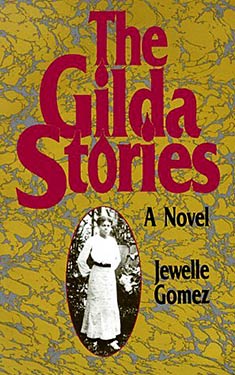
The Gilda Stories


Jewelle L Gomez
Completed 12/26/2019, Reviewed 12/26/2019
4 stars

This is not your typical vampire story.  While most vampire literature focuses on the sexy and the bloodthirsty, this book does so only subtly.  It focuses more on the main character’s search for self and relationship with other vampires and the world around her.  Gilda is a benevolent black lesbian vampire, made in 1850, who travels across the country at various times through the present and future.  The stories are vignettes that take place over a two-hundred-year span. At each stop, Gilda tries to build or integrate into a community of other vampires as well as the ordinary humans around her and struggles with whether it is worth the risk to bring someone else into the fold simply to help her with her own loneliness.  I found the book to be very readable with great prose and subtle takes on racism, feminism, dominant culture, the environment, and sexuality.  The book won two Lambda Literary Awards in 1991, for general lesbian literature and for lesbian sci fi/fantasy/horror (back when the sf/f/h category was separated into gay and lesbian). 

The plot is not really that grand, as the book is divided into different stories at specific points in time over a two-hundred-year span.  A slave girl in 1850 Mississippi runs away from her master when her mother dies.  She is found by a vampire named Gilda and brought to live and work in a brothel as a housekeeper.  Eventually, the vampire and her companion, a Native American named Bird, turn the slave girl into a vampire like themselves.  Bird acts as her mentor, teaching her to read, write, and about life in general and as a vampire.  She acquires her name from Gilda, her maker, when the older Gilda takes the voluntary of death of staying out in direct sunlight.  Unable to accept the older Gilda’s death, Bird eventually returns to her people to rediscover her own family and culture, leaving the younger Gilda to make her way in the world alone.  Eventually, she comes across others like her, and develops tenuous relationships with normal humans. 

Gilda spends most of her time as an artist, whether it be as a hairdresser, a theatrical worker, a writer, or a singer.  At one point she’s also a farmer.  The thrust of her existence though is to find a community for herself.  She does meet up with other vampires with whom she does maintain relationships with throughout the cycle of stories.  But her primary goal is to find someone who she can make a vampire to call brother or sister.  The caveat though is to make sure she finds someone who understands what they are getting into and to make sure the feeling is mutual, that she is not doing it for selfish reasons.  Even the code of the vampires’ eating habits is about mutuality: life for life.  When feeding, the vampire must give something in return, usually a psychic peace or resolution.  Never does a vampire feed to the death of their victims.  There are some vampires, however, who do not live by the code and Gilda does encounter one in the 1955 story. 

As I noted above, there is not a grand overarching plot through the stories.  Each one has its own plot.  The main theme is about finding community, or home.  Gilda, being the main character, is the best developed, though the secondary characters are well-drawn for being present for short periods of time.  The real star of the book is the prose.  Gomez is a terrific writer.  She doesn’t bang you over the head with issues.  She presents them subtly in the stories, making you care about them by caring for Gilda and her plight. 

I liked this book very much.  I was hard to put down.  My only problem with it was that I felt one step removed from the action.  But in a sense, I understand this reaction I had because Gilda always feels one step removed from the action herself.  She is always the observer, never feeling fully integrated into either the human or the vampire community.  This is something I can relate to myself, as I never feel fully a part of either the straight or the gay community.  I play the observer, only very cautiously letting someone close to me.  So I could really identify with Gilda at that level.  I give the book four stars out of five.  It’s a terrific read, and I’d highly recommend it to people who don’t like the classic vampire story. 


Saturday, December 21, 2019

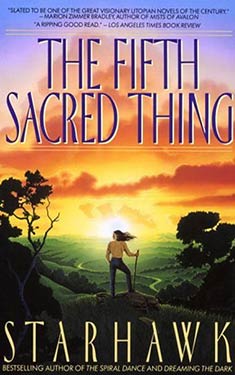
The Fifth Sacred Thing


Starhawk
Completed 12/21/2019, Reviewed 12/21/2019
4 stars

I was first introduced to Starhawk in Matthew Fox’s “Original Blessing”, a book about Creation Spirituality.  She had written several books on the topic as well on Goddess worship.  This is her first work of fiction.  It encapsulates a lot of the spirituality she espouses in the context of a future utopian society fighting against a dystopian power trying to overtake it.  It took a long while for me to get into the book, but I found myself drawn in by the world building and eventually became very engaged with it.  It won the Lambda Literary Award in 1994. 

The utopia of the book is in what was formerly known as San Francisco.  Everyone is free, everyone has a voice in what is going on, everyone works at what they want to do, and everyone pitches in to help each other.  Racial and religious diversity are supported.  Most people are polyamorous.  This is counter to the oppressive regime in the dystopia to the south, where women and minorities are repressed, sexual diversity is punished, and everyone must conform to the purity laws.  Those who transgress against the norm are told they have lost their immortal soul and are conscripted into the army or sexual slavery. 

The plot of the book isn’t that ground breaking and at times, I found it a little boring.  But Starhawk makes it all very real with warm, simple prose.  I found myself enjoying every return to the pages of the book, even when I felt like I didn’t know where the plot was going.

The characters were all very well drawn.  And the two main characters are black, which I found very refreshing.  Madrone, one of the main characters, is a healer witch.  She works with the local doctor to heal through spiritual energy and herbal concoctions.  One of her lovers, Sandy, just died from an epidemic that ran through the community, which may or may not have been biological warfare from the south.  One of her other lovers is Bird.  He’s been imprisoned in the south for ten years and it is not known if he’s alive or dead.  The story follows the two of them in alternating chapters for most of the book.

The one fault I have with the book is that it didn’t seem to really move.  Reading it was a slow process with little direction towards where it was intending to go.  Now that’s not to say that there was not action, because there was.  It just didn’t have any urgency.  That was why I needed the first hundred pages or so to get into the book.  I had to be immersed in the world and the characters before I started to care for them.  Eventually, I was, and I couldn’t stop reading it, even at that slow pace.

The book has a lot to say about what we could be doing to make this world a better place.  Peace, love, acceptance, patience.  And the passive resistance tactic when the army from the south comes to invade the utopia is really quite impressive.  I found it quite profound, especially because the choice between passive and active resistance is debated quite a lot throughout the invasion. 

I was going to give this book three stars at first, but I found myself really enjoying the heck out of it.  I had come to be totally immersed in its world, appreciating the characters and the philosophy it expounded.  I finally had to admit that it was really a four star out of five book.  Some may find it a little dated with concepts that came to the forefront during the New Age movement, but it describes many truths about human nature and what we can achieve if we can just get along.

Saturday, December 7, 2019

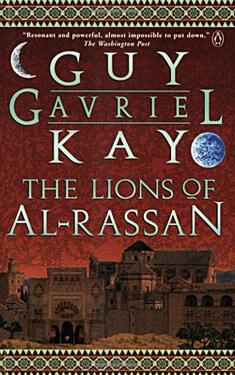
The Lions of Al-Rassan


Guy Gavriel Kay
Completed 12/7/2019, Reviewed 12/7/2019
5 stars

This was my first book by Kay.  At over five hundred pages, it’s one of the longest books I’ve read in a long time.  I was dreading it at first, but as I got past the first fifty pages or so, I became enchanted by the prose.  There are a lot of characters and city-states, and there is a lot of politics.  Usually I lose my way in this type of book.  But the prose was so glorious that the reading of it became easy and I didn’t have that hard of a time following the kings, the religions, the politics, and the warring.  It helped that I read some reviews first so I didn’t go cold into the book.  So I knew ahead of time that the setting is an alternative Medieval Spain, conquered by a people like the Moors, with the old Christian-like states pushed north, and a Jewish-like minority throughout.

The setup is fairly complex.  The Asharites control about three-quarters of the peninsula.  They are a desert people whose god is revealed through the stars and their prophet Ashar.  Once united as Al-Rassan, the land has degraded down to a collection of city-states.  Ammar ibn Khairan is an Asharite.  He’s many things, including a poet, a kingly advisor, and an assassin.  The Jaddites live in the north and some in the east.  Rodrigo Belmonte is a military captain of a band of mercenaries working for one of the Jaddite kings.  The Kindath live throughout Al-Rassan, but are generally quartered in ghettos, and are highly suspect by the Asharites.  In the Jaddite territories, they are often slaves.  Jehane bet Ishak is a doctor who treats all people.  Through a series of unusual events, these three characters end up exiled to one of the Jaddite kingdoms where they become strong friends despite their religious differences in a world inching closer and closer to a holy war. 

This book is really about relationships between people and their similarities and differences as a metaphor for how the world should get along.  It is about love, honor, and respect in a world with too little of these.  The complexity of the world and the relationships of these three main characters simply took my breath away.  There are good guys and bad guys, but the point of view of the book is told from many people from the three religions and the different city-states, leaving a lot of moral ambiguity.

There are many featured characters besides the three main ones.  Some of their names were similar so that made things a little hard to follow at times.  However, Kay makes sure to restate who people are which made it a little easier to remember.  They were all very well developed.  No one seemed like a cardboard cutout. 

My only complaint about the book is that it’s considered fantasy.  There are two moons and one of Rodrigo Belmonte’s sons can see the future.  But that’s about it.  It’s really alternate history and it’s probably more appropriate to use the term speculative fiction than fantasy.  But that’s really a minor point. 

I give this book five stars out of five.  I was completely absorbed in it.  Everything about the book, the plot, the prose, the characters, the world-building, all combine to form one terrific novel.  The ending was quite a surprise and quite devastating.  This was one of those books where I had to chill after finishing.  I really felt like had been immersed in a different world, and coming out of it required a conscious transition.  Kay has some retractors, but a lot of people love him.  I guess I’m now one of the converted.  At some point, I’ll have to read Tigana, which is considered his best.

Friday, November 29, 2019

Briar Rose


Jane Yolen
Completed 11/29/2019, Reviewed 11/29/2019
4 stars

This book was a difficult read, not because of the writing, but because of the content.  It is a retelling of the Sleeping Beauty fairy tale set during the Holocaust.  It reminds us that gypsies and gay men were among other smaller populations that were also exterminated in the camps.  Any book or visual media that deals with the Holocaust really saddens me and makes me angry.  It also made me angry that I found so many reviews on Goodreads that condemned the book because of homosexual content and an out-of-wedlock pregnancy.  Wake up people!  Over two hundred fifty thousand gay men died in the concentration camps.  Their stories need to be told.  And there are some people that have sex (gasp!) outside of marriage.  Despite the sexuality references, there was no explicit sex in this book.  In fact, I found it very appropriate for teens.  Despite its short length, I thought it was really well done.  It was nominated for the Nebula and World Fantasy Awards and won the Mythopoeic Award back in the early ‘90s. 

Becca is a second generation American of Polish-Jewish descent.  As a child, she and her sisters were fascinated by their grandmother’s (Gemma) telling of Sleeping Beauty.  It wasn’t the Disney version, but more faithful to some of the original texts.  Years later, on her deathbed, Gemma asks Becca to find out her true origins, calling herself Briar Rose.  Becca’s investigations lead her back to Poland and the Holocaust. 

Despite this being a very short book of about two hundred forty pages, Yolen packs in an awful lot of plot.  However, the characterization suffered a bit.  The main characters are not very deeply drawn.  Josef Potocki, the old gay Pole who has a connection to Gemma has perhaps the best characterization.  He tells Becca about his life including his capture by the Nazis.  His story is very prosy, so we learn more about him, his life, and emotions than even Becca, the main character. 

I really liked the setting of the fairy tale in a concentration camp.  I thought it was really great that Yolen used the barbed wire fences of the camps as the thorn bushes that grew around Sleeping Beauty’s castle.  I read a lot of reviews that thought the metaphors were forced, but I thought they were well done.  It also brings to light the little-known camp at Chelmno which was where the Jews of the Lodz ghetto were exterminated, 320,000 of them.  They were interned there and then stuffed into vans which circulated the auto exhaust into the back of van, killing all the people packed in there.  Only two men where known to have survived the Chelmno camp.  It is believed that no women survived.

I give the book four stars out of five, despite the lack of character development.  It is one of a series of fairy tale retellings compiled by Terri Windling in the early nineties.  This is only one I’ve read, and I thought it was well done.  Jane Yolen was named a Grand Master by the Science Fiction and Fantasy Writers of America (SFWA) in 2017.