Friday, October 18, 2019

Magic’s Pawn


Mercedes Lackey
Completed 10/17/2019, Reviewed 10/18/2019
5 stars

Magic’s Pawn begins a trilogy set in the Valdemar universe, of which there are now many installments.  Not having read any of the other books in the series, I found this book to be self-contained.  It tells the story of a gay teen who is at odds with his macho, elitist father who wants a son to take over the family legacy.  Vanyel, the teen, wants to be a Bard, but turns out to possess powerful magical powers that have not yet been awakened.  This is my first Mercedes Lackey book and I loved it.  It was nominated for a Lambda Literary Award in 1990 and was quite deserving of the honor. 
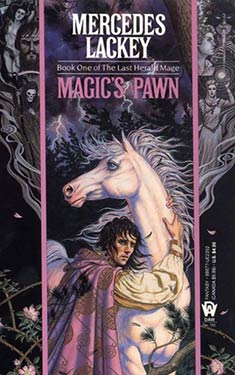
Vanyel lives on the family estate with his abusive father who is trying to make him a man’s man.  He never compliments his son, discourages the boy’s love of music, and forces him to train with a sadistic military trainer.  After an incident where the trainer breaks Vanyel’s arm in a particularly vicious attack, and not taking Vanyel’s side, the father decides to send him to his aunt who runs a boarding school where he thinks Vanyel will get more discipline and more serious fighting experience.  While this is true of the school, it also features academics and magic training.  Vanyel goes unwillingly, but soon realizes that this school, and his Aunt Savil, are much more liberal than he expected.  At the school Vanyel falls in love with Tylender, a herald-mage in training.  With Savil’s blessing, they pursue a relationship.  Vanyel excels in his academics and in love.  But a tragic turn of events seems to destroy everything in Vanyel’s life while at the same time, awakening the powerful magic which lay dormant within him.

This is the first high fantasy I’ve read in a while.  It features the classic trope of a school for magic.  When this book was published in ’89, it wasn’t quite the trope it has become since Harry Potter hit the market.  At first, Vanyel doesn’t like the school, believing he is there for punishment.  However, he soon comes to love it for its wide “liberal arts” academia and its supportive, non-sadistic combat training program.  Unfortunately, while being a decent musician, he is deemed not to have the gifts necessary to become a Bard.  This is the first of several incidents that throws Vanyel for a loop.  The other major incident of course is falling in love after repressing his true orientation.  Aunt Savil, who at first has no time him, begins to take a liking to him and becomes supportive of his scholastic and burgeoning sexuality.  She realizes the terrible childhood Vanyel’s father provided and tries to nurture him back to being a normal teen.

I loved the character of Vanyel.  He’s a bit whiney, but at the same time, I think his emotions and expression of himself is very typical of a gay teen who has been repressed for so long by a belligerent father.  He does a lot of second-guessing of himself, and is full of self-doubt.  It takes most of the book to work through his self-esteem issues.  But hence, we get some pretty phenomenal character development.     I also really liked the characters of Tylender and Aunt Savil.  Savil is Tylender’s mentor.  She is a great person, though it his hidden by the toughness necessary to run the school.  It is in her relationship with Tylender that we see her humanity.  Tylender is an all-round nice guy with one major flaw:  he is obsessed with the feud his family has with another family, and it is the one aspect of his personality Savil cannot seem to break.  But I just cheered when he and Vanyel finally get together. 

The world-building is excellent.  Despite having been the sixth (I believe) book published in the series, I didn’t feel like I was missing out on much.  There were a few times when a situation came up where I didn’t understand the reference, but it was explained a further in the book, namely, the colddrakes.  I have a feeling they appeared in an earlier series. 

I give this book five out of five stars.  I deeply connected with Vanyel’s character, despite his being kind of whiney.  His self-doubt tries to sabotage so many things in his life, but between Aunt Savil and Tylender, he has the support and encouragement to work through the pain.  There is some real tragedy in the book, which I did not see coming, and it made me want to weep.  Lackey writes emotions really well.  This is the kind of book where emotions take priority over the action.  The action is there to accentuate the character development.  I will be reading the rest of this series, as the third book in the trilogy is on my LGBTQ list on WWEnd.  I’m really glad I started with this origin story of Vanyel and not just jumped right into the third book. 

Sunday, October 13, 2019

Red Hood’s Revenge


Jim C. Hines
Completed 10/13/2019, Reviewed 10/13/2019
3 stars

On the cover of this book, there’s a quote from the Green Man Review that is very accurate.  It says that this book (or possibly the whole “Princess” series) “…brilliantly remixes fairy-tale elements with a modern action/adventure sensibility, as if the Brothers Grimm had been allowed to watch a ‘Charlie’s Angels’ marathon.”  That’s what you get: three powerful women trained in the marital arts and magic fighting fairies, demons, and evil in general.  There’s lots of sly remarks and funny asides, but basically, this is an action/adventure novel.  And it’s fluff.  Nothing about it is great, but there’s a lot of good stuff in it.  I once tried to read the first novel in the series for Book Club, and put it down.  It was too much fluff.  I gave this third entry in the series a better effort because it was nominated for a Gaylactic Spectrum Award in 2011.  I didn’t love it, but I liked it. 


The premise of the series is that Sleeping Beauty, Snow White, and Cinderella are three rough and tumble princesses who fight evil in their world.  In this book, Sleeping Beauty is being pursued by an assassin who turns out to be Red Riding Hood.  They capture her, find out who bought Red for this mission, magically bind Red to help them, and then attempt to confront the instigator.  But the plot is a little more complex than that, it turns out the instigator is a fairy feigning serving a queen who usurped Sleeping Beauty’s throne and commands an army of the undead, called the Hunt.  To get to the queen, the four must destroy the fairy and disperse the Hunt as it pursues them.

There isn’t much character development in this book.  Any that might have occurred probably happened in the previous books.  But I don’t expect there was necessarily a lot of it.  The characters are rather cardboard and cartoonish, not unlike “Charlie’s Angels”.  There is some depth to them, but they are basically strong, self-sufficient women.  Sleeping Beauty, whose real name is Talia, is a lesbian.  She has feelings for Snow (her real name), but comes across an old love during their travels.  Snow is straight, but feels a loss when Talia meets up with her old flame.  Cinderella, whose real name is Danielle has a husband and son.  Roudette (Red Riding Hood) is a hard-core assassin, with little need for emotions.  And that’s about all the emotional connection you get from them.  But what they lack in depth, they make up for in action.

Normally, this wouldn’t be my type of book.  I think if I wasn’t trying hard to read through the LGBTQ Spec Fic Resource list I curated for Worlds Without End, I would have put this book down, like the first.  But I stuck with it and I have to say it was kinda fun.  The books from this series would make great action flicks.  I give this book three stars out of five because it is good.  I probably won’t read any more from this series, though because straight-forward action/adventure is not my cup of tea, even with positive LGBTQ content and strong women characters, like this one has.  But for the average person, I would recommend this series as great fluff.

Friday, October 11, 2019

Shadow Man


Melissa Scott
Completed 10/11/2019, Reviewed 10/11/2019
2 stars

I went into this book with a lot of anticipation.  I have not been a fan of Melissa Scott’s works so far, but “Shadow Man” won a Lambda Literary award and is in the Gaylactic Spectrum Hall of fame.  As of this writing, she’s won four of the former award, two of the latter.  She seems to be the darling of the LGBTQ literary award circuit.  I thought this book would be different.  It’s about a planet with five sexes and nine sexualities, which was really intriguing.  Well, the author pulled off the world-building really well, but the execution of the story was terrible.  It was a slog to get through.  It was only three hundred pages long and nothing happens for the first two hundred.  But by the last third I was only barely interested.  I figure this book won its accolades for the concept, because the plot has a lot to be desired. 


First, the world-building:  It turns out that faster than light travel required a drug that causes sexual mutations.  So now the colonies of earth have five sexes because of the FTL mutation.  This one planet named Hara has been isolated from the rest of human colonization for several hundred years.  Only in the last hundred has contact been re-established.  During the period of isolation, Hara decided that persons with the mutation (mems, fems, and herms, as in mostly male, mostly female, and hermaphrodites) must pick a gender when they attain adulthood to maintain the binary gender system.  This is unlike the rest of the colonies where the other sexes have been accepted and integrated into society as themselves.  Now that Hara is in contact with the rest of humanity, called the Concord, they are receiving pressure from without and within to change their social order.  The governments and about half the people of Hara are resisting mightily.

Now, the plot:  Warreven is a herm who is a lawyer, specializing in defending mems, fems, and herms relegated to the sex trade because they don’t fit in with the rest of society.  Tatian is an off-worlder man, a corporate executive from the Concord.  The paths of the two cross.  Warreven becomes an Important Man in a rigged election, though he didn’t want the office, but uses his new role to try to bring sexual equality to the planet.  Tatian helps him with his mission.

That’s the plot, there’s not much more to it.  The first two hundred pages are about the political and corporate dealings that are going on on Hara.  They are inconsequential to the plot.  There’s basically nothing in the first two hundred pages that’s needed for the last third, except for the world-building.  At the best, it introduces characters and concepts, and gives a little character development.  At its worst, it’s just really dry reading.  Nothing interesting happens.  Even the dialogue is uninteresting. 

There were no real relationships in the book.  I was hoping that Warreven and Tatian would become intimately involved, just to make the book more interesting.  They only develop a friendship with cursory attractions to each other. 

There are a lot of Haran and Concord terms requiring two appendices.  I had an issue with lots of the Haran words.  They were kind of slurs and misspellings of English or French words.  There is baas for boss, baanket for banquet, and memore for memorial.  While I appreciate the use of new words in science fiction, these just seemed lazy.  One thing I do have to give props to the author for is the use of other pronouns for the mems, fems, and herms.  It was very inventive and used really well. 

I give this book two stars out of five.  Just having an interesting concept and world-building is not enough to carry a book.  The plot has to be interesting too.  You can’t have two hundred pages of filler to get a message across that could have been told in a hundred-page novella.  In my quest to read all the books on the LGBTQ Speculative Fiction Resource List I curated for Worlds Without End, I have two more Melissa Scott books to read, and from my experience with her in her other four, I’m not looking forward to them.

Sunday, October 6, 2019

Hero


Perry Moore
Completed 10/5/2019, Reviewed 10/6/2019
4 stars

This was a really fun book.  It’s a YA novel, and reads like one.  It’s not great prose, there’s a lot of exposition, and it’s not even that original.  But the plot and the characters made up for its shortcomings.  It’s a coming of age tale of a teen boy who turns out to be a superhero and gay and tries to hide his identity from his father who is both a failed superhero and homophobic.  The book was nominated for the Gaylactic Spectrum Award in 2008 and won the Lambda Literary Award for Children’s/YA novel in 2007.  Despite its accolades, it’s not a great book, but I really enjoyed the heck out of it. 


The plot revolves around Thom Creed.  He’s a pretty good basketball player in high school.  He lives with his dad, a former superhero who has been disgraced and works now as a blue-collar laborer.  His mother left the family a while before.  Thom has secrets, as mentioned above.  After being on a bus attacked by super villains, and performing his superpowers of healing on the victims, he’s invited to try out for the League, the big superhero team.  Unbeknownst to his father, he becomes a probationary member.  Teamed with several other new members, they go about practicing their superhero gifts in simulations, and eventually in real life.  Then, some great members of the League turn up dead, and it’s a race to find out the murderer before all hell breaks loose.

The plot is a little more complicated and multi-layered than that, but that’s the gist of it.  Thom tries to juggle his new-found career as a burgeoning superhero with school, basketball, two jobs, and volunteering, as well as keeping his sexuality and superhero training a secret, particularly from his dad.  Hal was a sidekick to a superhero, he had no powers of his own, but he did something that, while saving the world, cost the lives of 27,000 people (I think that’s the right number).  This got him exiled from the League and he became a national disgrace.  Now he resents the League and is a homophobe to boot.  Unfortunately, rumors are spreading about Thom being gay, which gets him kicked off the basketball team.  So there’s more for him to keep secret from his dad. 

Even though it’s what he’s always wanted to do, being a probationary member of the League is no picnic either.  Compared to all the other newbies, he’s still rather untamed, having seizures whenever he uses his powers.  He’s teamed with a motley crew, Typhoid Larry who gets people sick, Scarlett who controls fire, and Ruth, a chain-smoking old woman who can see the future.  The team is lead by Golden Boy, a seasoned hero.  The team is pretty awesome, with lots of quirks and tons of personality.  Some of their personal details were melodramatic, but it worked for me.  They were multidimensional and grew through the story. 

Thom has a love interest, although they start out as enemies, and the buildup is rather slow.  Like much of the book, you see it coming, but the journey is still fun.  For that matter, you see most of the twists in the story coming.  It’s not particularly inventive in that way, but I enjoyed it nonetheless.

The one thing I didn’t care for in the book was that the main superheroes were based on the DC and Marvel comic superheroes.  So Uberman was Superman.  There was a Wonder Woman-like character that was so like Wonder Woman, I forgot the actual character’s name.  I thought this lacked originality on the author’s part.  A few of the minor ones had cute, original names, but were only mentioned in passing here and there.  Even the League is so close to Justice League, I read the latter whenever I saw the former. 

I give the book four stars out of five despite its shortcomings because I thought it was so entertaining.  For a first novel, I give the author props for a job pretty well done.  Unfortunately, he died from an apparent suicide, mixing pain killers he was taking for back and knee pain.  Before he died, he was the executive producer of the Narnia movies, and had written and directed several smaller films with his partner.  I think this book shows a lot of potential and if he kept on growing in his writing, I think the author would have gone on to write some pretty great stuff. 

Wednesday, October 2, 2019

Before Mars


Emma Newman
Completed 10/1/2019, Reviewed 10/2/2019
3 stars

This was a book club selection and I wasn’t too excited about it.  It was selected on a day I wasn’t at book club, so I can’t complain because I didn’t vote.  However, it wasn’t too bad of a book.  It’s a mystery that takes place on a small research station on Mars.  I found the backstory of the main character to be a little tedious at times.  I kept thinking, let’s just get on with solving the mystery.  And the mystery part was good.  It’s just that the journey was not always exciting. 

The story begins as Anna Kubrin walks out of a spaceship and into the Mars research facility.  In her new quarters, she finds a note to not trust the facility psychiatrist, and it was painted by Anna herself, though she has never been to Mars before.  She goes to put on her wedding ring and she realizes it’s not her ring.  Then she notices discrepancies with the AI that runs the facility, images of Mars that the AI supposedly took that have stones in the wrong place and media antennae that disappear.  Is she going crazy or is there really some conspiracy afoot?

The reason Anna thinks she’s going crazy is because her father went crazy when she was twelve.  She also suffers from severe post-partum depression, which prevented her from bonding with her baby, for which she is wracked with guilt.  Lastly, she is in a loveless marriage ahead of which she puts her career.  All these things create a very unstable mental environment for Anna.  When she is alone, she plugs into immersion videos to remember the family she left behind on Earth, but that only causes more grief.  So when things don’t add up on Mars, she has to questions her own psyche as she tries to get to the bottom of the mystery.

Anna is a very well-developed character, as we get intense background on her.  There are times when she’s reflecting when she’s not even sure if it’s a normal memory or immersion psychosis (I think that’s the term the author used).  This sometimes makes the reality line seem tenuous at best.  It’s a great way to get the back story on a character.  However, I felt that it was too much, interfering with the flow of the mystery.  At one point I thought that if there was one more scene about how she didn’t love her baby enough, I would just not finish the book.  I felt it wreaked havoc with the pacing.  On the other hand, it’s the first story I’ve ever read with a character with post-partum depression.  So it was quite informative on what goes on in a woman’s mind when she’s afflicted with this terrible state.

The cast of characters is rather small, so there’s some pretty good development for their characters as well.  I was particularly fond of the non-binary person who used “hir” and “ze” for their pronouns.    It was pretty good preparation for a book I’ve requested through interlibrary loan about a civilization with five genders, using five different pronoun sets. 

In the end, I was glad I read the book, but overall, I felt the book was just okay.  I was going to give it two stars initially, but the ending was quite good.  And I had to give it props for tackling a serious mental illness that you don’t often find in fiction, particularly science fiction or fantasy.  So I ended up giving it three stars out of five.  The book was nominated for a British SF Award in 2018.

Sunday, September 29, 2019

Sauron Defeated


JRR Tolkien
Completed 9/28/2019, Reviewed 9/29/2019
3 stars

I have to admit book nine is the first History of Middle Earth (HoME) book that I haven’t finished.  I read about 385 pages out of about 440.  The last fifty odd pages were very dry, almost textbook-ish, reading.  I skimmed through it and got the general idea of what it was about.  In general, the book was very dry compared to the other books in the series.  It was in three parts: the conclusion of The Lord of the Rings, the Norton Club Papers, and the Fall of Numenor.  The Norton Club Papers was particularly difficult to read, it being different than anything else Tolkien or his son Christopher published so far.  Thank goodness for the Tolkien Professor’s podcast on this book.  While I haven’t finished all seventeen episodes yet, it really helped me a lot in understanding the Norton Club papers.  I found the majority of the book to be dry and not as interesting as the first eight in the series.  Even though I’ve been a big fanboy of these books, this one nearly had me stopped in my tracks. 


The Tolkien Professor is Corey Olsen, founder of Mythgard Institute and Signum University which is on its way to becoming an accredited on-line institution of learning of Tolkien studies, Anglo-Saxon and Norse studies, and Fantasy and Science Fiction.  His excitement for and knowledge of these HoME books made the reading of this book much more tolerable.  He does textual analysis of these books as well as other science fiction and fantasy novels as part of his free Mythgard Academy.  The podcasts are also available on youtube or you can login to his live shows and follow along each week.  These podcasts have made reading the HoME series very enjoyable.

The first part of this book was the last of the History of The Lord of the Rings.  You can tell it was the ending because most of the documents were very similar to the published LOTR.  There were only some minor differences.  I found the most interesting part to be an epilogue which was never published.  It features Sam with his children, finishing the red book and recapping everyone’s lives up to that point.  It’s a very sweet story and would have been an interesting though not quite as dramatic conclusion to LOTR. 

The next section is the Norton Club Papers.  It is a thinly disguised take on the Inklings, the little society of Oxford professors which included Tolkien and CS Lewis, who met and read each other’s writings and offered support and academic criticism.  This Club first has a conversation about Lewis’ Space series, particularly the second book, Perelandra, and the problems with space travel.  The conversation then moves into time travel through dreams and the strange communications members of the group seem to be receiving from a distant past.  This past concerns Numenor, the island where Men lived between Middle Earth and the undying lands.  The group members are getting information as well as language details.  

The last section of the book reviews the fall of Numenor, which is an extension of the Norton Club Papers.  It begins with the creation of Numenor, the emigration of Men to it, the coming of Sauron to taint the goodness of the place, followed by its Atlantean destruction.  It’s very interesting at first, but Christopher Tolkien gives three different texts of the story, each with more detail, followed by a fourth which just contains lines in the third text that were changed.  It’s then followed by analysis of the documents and lastly, one member of the Norton Club’s writings of the languages of Numenor he received in his dreams.  This was the part of the book where I stopped reading.  The writings about the languages were simply too dry and complicated for me to follow with any semblance of understanding.  I am looking forward to Corey Olsen’s lectures on that section to better appreciate it.  As much as I love learning about languages, this section was the driest of the book. 

I give this book only three stars out of five.  It’s jam-packed with information, but I found it not as interesting as the first eight.  The section concluding the LOTR did not have the magic of the first books, where Frodo was named Bingo and Aragorn was a wooden shoe wearing Hobbit named Trotter.  I found the Norton Club Papers to be very complex, with too many professors to really follow the conversation well.   A literary mystery examined by a group of Oxford dons may sound like fun, but I found it simply to be very tough to follow.  And lastly, the multiple drafts of the Numenorean story became boring quickly.  I still have three more books to go in the HoME series and I hope that they are more interesting than this one was.

Thursday, September 26, 2019

Rosewater


Tade Thompson
Completed 9/10/2019, Reviewed 9/10/2019
4 stars

I enjoyed this book immensely.  It takes place in Nigeria and deals with aliens and psychic abilities.  The location is unusual for science fiction as most of the books I’ve read, and in general what we have here in the U.S., have American and Euro-centric locales.  This provided a different point of view with different values and mores.  It’s the first book in a trilogy.  It has some loose ends but ends well enough that I didn’t feel like I was completely hanging.  It’s well written and pretty fast paced.  It was nominated for four awards, winning the Arthur C. Clarke Award, considered Britain’s most prestigious SF award.

The plot revolves around Kaaro, a sensitive who can read people’s minds in some form.  He begins life as a thief, stealing things that people value the most, figuring out where to find it and how to steal it by sensing it.  Over time, he abandons his thieving ways, for the most part, and is recruited to work for a government agency, Section 45.  His first mission is to try to find a dissident known as the Bicycle Girl.  All his work is done in the backdrop of a city known as Rosewater which surrounds a biodome placed there by aliens.  In the meantime, he meets a man who can fly and occasionally bursts into flames, alien floaters that want to devour him, and a woman posing as a butterfly who wants to have sex with him every time he enters the xenosphere.  It may sound complicated, but it makes perfect sense in the course of the book.

Kaaro is an interesting character.  He’s neither a hero nor an anti-hero.  He primarily has an ambivalent attitude toward work and life that keeps him doing what he does.  Towards the end however, he starts to stand up for himself, making decisions that may anger the S45, but finally coming to grips with his own wants and needs, and gaining a bigger perspective on the aliens. 

The book is told in first person from Kaaro’s point of view.  The narrative is told in two time lines, now, which is 2066, and then, which is his life as a youth up to 2055 when the alien biodome emerges, Rosewater develops as a city, and he is recruited by S45.  I found this switching of timelines confusing at times, particularly near the end.  Normally I can follow shifting timelines, but this time, I lost track a bit.

I really liked most of the secondary characters, most notably his boss at S45 and his love interest.  His boss is one dimensional for most of the book, but becomes more multi-dimensional towards the end.  She’s brassy and bossy, and Kaaro takes none of it, though he still does as she commands.  His love interest is the sister of the young man who flies and burst into flames.  I can’t go into too much detail on her, but suffice it to say, I thought she was very interesting.

I give this book four stars out of five.  The prose is great, but does not overwhelm the dialogue or the action.  The world building is also great, creating a near future Nigeria which suffers from superstitions, prejudice, and group hysteria.  I don’t know when I’ll get around to them, but I look forward to the rest of the trilogy.