Saturday, June 22, 2019

Daughters of an Amber Noon

Katherine V. Forrest
Completed 6/22/2019, Reviewed 6/22/2019
3 stars

This is the second book in the Daughters trilogy.  In the first book, Daughters of a Coral Dawn, four thousand descendants of Mother leave Earth to form a women’s utopia on a distant planet.  Two thousand of their sisters remain on Earth for various reasons.  This book follows their story.  I didn’t find it as gripping as the first novel.  Even though this book came out eighteen years after the first, it feels like sophomore slump.  There was a lot of exposition.  Rather than showing me what happened, it was a lot of telling me what happened.  Even the ending had epilogue-like chapters explaining what had happened rather than taking me through the events as they unfolded.
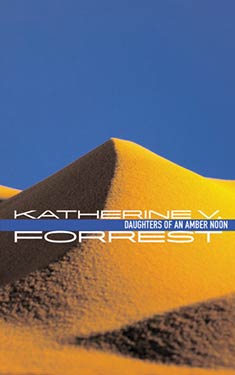
The book follows the two thousand descendants of Mother who remained on Earth.  In the first book, the political and social structure was hostile toward women.  Now, a new dictator, Theo Zedera, has taken over the world and things have gotten even worse.  Specifically, he’s hunting for the remnants of Unity who have left society and are hiding in the desert.  As with the women who emigrated, these women are especially gifted.  So, they’ve built an enclave hidden by a volcano which is practically impenetrable and unfindable.  One of the women in particular, Africa, was a close friend and personal advisor of Zed before he became dictator.  She is now working to make this refuge a utopia, but bears tremendous guilt for fostering Zed’s maniacal and narcissistic ways.  The question is, how long can they remain hidden before Zed finds them?

The narrative is more or less similar to Coral Dawn.  It is told from the journal entries of several women.  This time the women include Olympia, one of Mother’s nine daughters who has taken over the role of historian for the Unity; the aforementioned Africa; and Joss, a woman assigned to Africa as a sort of personal assistant and is secretly infatuated with her.  In addition to these, there is also a third person narrative from the perspective of one of Zed’s generals which gives you behind-the-scenes insight into the workings of Zed and his henchmen.  I found the narratives of the women less distinctive than in the first book, and their characterization less formed.  I didn’t feel like I was in any of their heads, and they all more or less sounded the same.  They gave a lot of history of the women but explained rather poorly who they really were.  As characterization goes, Zed and his henchmen were better drawn than any of the narrating women.  And it was not hard to imagine the hateful workings of a narcissistic despot considering our current political climate.

I give this book three stars out of five.  It’s decent, but not nearly as good as its predecessor, which I nearly gave five stars.  It was drier with none of the cheeky humor that Mother provided.  I found it a little tougher to read, with not much going on until the end.  And the ending does wrap things up rather nicely and somewhat astonishingly.  I’m still looking forward to the final book, which won the Lambda Literary Award, though I hope it was on its own merits rather than a lifetime achievement award for someone who wrote a book that has become a classic of lesbian science fiction literature. 

Wednesday, June 19, 2019

Daughters of a Coral Dawn


Katherine V. Forrest
Completed 6/19/2019, Reviewed 6/19/2019
4 stars

I thought this book was an excellent excursion into old-school lesbian feminist science fiction.  First published in 1984, it imagines a world where a group of women have escaped an oppressive sexist government and created their own utopia on a distant planet.  Then some men from their old world show up and they somehow have to deal with them.  It is really well written and well thought out.  Unfortunately, it is dated in that today, we are all about inclusivity, as opposed to separatism.  However, I think it is an important novel from an historical perspective, and as we see today how women’s right are slowly eroding, it still has some meaning for us. 

The book begins with an Earth man marrying an alien woman.  Although this union is illegal, the alien looks so much like an Earth human that she can pass as such.  They have nine daughters, all at once.  All the daughters are brilliant in some way.  As they mature and marry, they have more brilliant daughters.  They also live much longer than humans, so soon there are six thousand descendants.  The world they live in is very patriarchal and sexist, though these women have made their way to the tops of their fields.  At one point, “Mother” calls an enclave of all her descendants.  Called the “Unity”, they decide it is time to leave their repressive life on Earth and create a new homeland on another planet.  All is peaceful on “Maternas” until a damaged ship from Earth arrives and threatens their very existence.

The story is told from the point of view of several women, the primary two being Minerva, the historian of the Unity, and Megan, the chosen leader of the group.  Both are in journal form.  Their journal entries go back and forth to create the narrative.  Minerva is one of the elders of the group, one of the original nine daughters.  Her chapters give the history of the family and recounts the settling of Maternas.  Megan’s fills in the blanks, and give an insight into what it’s like to be a leader and a pledged celibate.  Minerva is quite likeable as the main voice of the story.  Megan’s character is a little dry at times, as she eschews emotional reactions and maintains a professional air.  But I began to like her character more as she became vulnerable when one of the women on the planet flirts with her.  You get to see some of her shell beginning to crack.

I also really liked Mother.  She added humor to everyone’s seriousness.  She had an insightful head on her shoulders and called them as she saw them.  She’s also the only heterosexual on the planet.  All the other women begin to form relationships. 

The one thing I seemed to have missed was how the lesbian couples were having children.  But they do continue to have progeny, all daughters, and soon the population of the planet goes from four to ten thousand.  (Only four thousand of the original six thousand actually leave Earth.  The rest stay on Earth and are the subject of the second in this series). 

I read quite a few reviews of this book and there are a lot of people who disliked it because of the separatist and men-hating attitude.  While I found it a little archaic, I didn’t find it much different from other books of this period, the most popular one being “The Handmaid’s Tale.  Being a man, I wasn’t put off or threatened by the book’s themes.  Rather, I felt it was an educational experience, getting a feeling for the separatist attitudes which came before our much healthier and contemporary energies of inclusivity and the fight against toxic masculinity. 

I give the book four stars out of five.  It was very nearly a five-star book, as the prose was beautiful without being overbearing, and the story, though not really original (there have been other lesbian science fiction utopia books before this one), kept my interest keenly.  But the emotional impact of the book was not as profound as I’ve usually experienced for a five-star review.  However, I look forward to the rest of the series and hope to get them all read successively.

Sunday, June 16, 2019

The Ophiuchi Hotline


John Varley
Completed 6/16/2019, Reviewed 6/16/2019
3 stars

This was John Varley’s first novel, from 1977.  It involves cloning of the protagonist until there are several of her running around the solar system.  It makes for complex plotlines following the clones.  I enjoyed it though.  It was a good first novel:  good writing and well thought out.  I did find it difficult to keep up with the plots as the main character was cloned, but in the end, it was worth it.  It’s the first of a series by Varley, of which he just published a fourth book last year. 

Hundreds of years in the future, the earth has been invaded by aliens simply known as the Invaders.  They basically ransacked all modern development, leaving green pastures and new sprouting plants.  In the succeeding years, ten billion people died of starvation.  Most of the remaining humans left the earth to live on our moon, Luna, as well other planets and moons in our solar system.  There, they are the recipients of new technological advances that are sent to them by aliens from somewhere in the constellation Ophiuchus via what’s been called the Ophiuchi Hotline.  But after several hundred years of this, the Invaders want payment for the information, throwing the eight worlds of humanity into chaos.

Lilo-Alexandr-Calypso is a genetics scientist who deals in genetic modifications.  She’s been working primarily on food but also works on humans, which makes her an enemy of the human race.  She is saved by a self-stylized Boss Tweed by cloning her and sending the clone to the gallows in exchange for working for him.  She agrees to this but soon finds out this is a prison of sorts.  She tries several escape attempts where she dies and is cloned back again.  Eventually, there are three clones of her each with their own plotline.  The main story follows her as she tries to find out what the payment is that the Ophiuchians want.

Lilo is a good character, but not particularly well defined.  We have some moments in her head, but not a lot.  I felt like I was always one step removed from her, rather than in her head.  She’s passionate about her work as well as escaping from the clutches of Boss Tweed and his clone minions.  But I think the three clones of Lilo added to my inability to stay in her head, because there were three different heads to try to get into.  On an interesting personal note, Lilo is bisexual, and in the future, there is a lot of gender fluidity.  It’s one of the reasons this book made it onto the WWE LGBTQ reading list.

This was a short book, at just over 200 pages, but it is jam-packed with excitement.  There’s a decent amount of good prose as well.  Ultimately, I felt the book suffered from the undertaking of too complex a plotline with the three clones. I’ve also read Varley’s Titan, which was written two years later, but I found it a much better book.  I give this one three stars out of five.

Wednesday, June 12, 2019

Earth Logic


Laurie J Marks
Completed 6/12/2019, Reviewed 6/12/2019
3 stars

This was a very hard book for me to read.  While I found the prose to be quite good, I felt that there wasn’t much of a plot.  That isn’t to say little happened.  A lot happened, but I couldn’t tell where the story wanted to go.  In the end, it all made sense, but the journey getting there was rather hard to follow.  Nothing was really riveting.  It’s the second book in the Elemental Logic series, the first being Fire Logic.  Like its predecessor, the book won the Gaylactic Spectrum Award for positive LGBTQ images in genre lit. 

The story picks up with Karis, the G’deon of Shaftal surrounded by her makeshift family of followers.  G’deon means she’s the ruler of the country.  She has not moved into that position because she’s waiting for a sign, something to signal that it is time to confront the invading forces, the Sainnites.  However, neither she nor her entourage know what sign they are looking for.  All Karis knows for sure is that she wants to bring about the end of the Sainnite occupation through peaceful means.

Karis isn’t really the main character of the book, though.  We do follow her in one of the narratives, but she doesn’t feel like the central part of the book, even though she’s the G’deon.  The much more interesting and profound character is Clement, a commander of the Sainnite army.  We follow her in the second narrative of the book.  Clement is a strong leader and had a complex personality.  She gives us a taste of what it’s like to be a leader of the invading force in a foreign land.  Zanja, who was a main character in the last book, has a major role in this book.  She’s not really a main character, but plays a pivotal role in the whole question of when Karis should make her move.  Specifically, she finds out through the reading of prophetic cards that she must die for Shaftal to be free.

As far as characterization goes, I didn’t feel like there was much character development except for Clement, she being the new character in this book.   In a supporting role was an interesting person named Gilley who was sort of her personal assistant.  He was deformed and unattractive, but helped Clement stay grounded in reality.  As much story as there was around the characters who appeared in the last book, there wasn’t much development in their personalities.  One had to rely on their memories of the last book to really get a sense of who they were in this book. 

There are a lot of plot details that are more exciting, but they all happen towards the end of the book, and I don’t want to give any spoilers.  In general, though, there isn’t that much excitement in the book until you get to the second half of the book.  I give this book three stars out of five.  While the prose was enjoyable, there wasn’t enough directionality to the book.  Even through the second half, I wasn’t sure where the plot was going.  The book was okay, but I’d expect more from an award winner.

Friday, June 7, 2019

Wicked Gentlemen


Ginn Hale
Completed 6/7/2019, Reviewed 6/7/2019
4 stars

The title of the book is deceiving.  To me, it invokes a farcical plot of British gentlemen doing dastardly things, or at least being ironic and smug.  Well, the plot is certainly about evil men, but it is not farcical at all.  It’s dark, it’s about humans and the descendants of demons, there are mysteries, but no one is foppish.  The setting invokes industrial age England, but it is much more than that.  Author Ginn Hale has created a very intriguing world with protagonists doing the best they can in deprecating circumstances.  I really enjoyed it despite the title, having gotten a taste of this world in her contribution to the last book I read, the anthology Devil Take Me.  The book won the Gaylactic Spectrum Award for positive LGBTQ content in genre fiction in 2008.


This book is about Belimai Sykes and Capt. William Harper.  Belimai is a Prodigal, the descendant of demons who repented and returned to earth, only to live as second-class citizens in an underground city.  Many of these beings still retain some magic, although many of these traits are being diluted in the generations.  For example, Belimai can fly, and can smell minute scents and taste the air around him.  Harper is a human priest in the order of the Inquisitors, a police force that keeps the demon spawn population under its thumb.  They meet when Harper and his brother-in-law Edward seek out Belimai to help them find Harper’s sister/Edward’s wife who appears to have been abducted.  In addition, there has been a rash of murders of Prodigals that Harper is investigating. 

The book is divided into two stories.  The plot of the first one is detailed above and it is told in first person, Belimai’s point of view.  The second one continues the relationship between Belimai and Harper but is told from Harper’s point of view, third person.  In this story, Harper happens upon the murder of a girl, apparently by her uncle, but the Abbot of the Inquisitors and another captain conspire with the uncle to cover it up and blame it on a flying Prodigal.  Since there are only a few flying Prodigals left, including Belimai, Harper must whisk him to safety and save the suspects and suspected consipiring humans from the powerful grasp of the Abbot. 

Hale’s prose is lovely, with just the right amount of description and dialogue.  It makes for quick reading but still provides for great world building and characterization.  Belimai and Harper are wonderfully drawn.  I felt like I was in the heads of both characters in their respective stories.  I particularly like Belimai’s sardonic wit.  Harper, though fighting for good, is hardly a saint, and has his own secrets and inner demons.  He reminded me a little of a strong, silent type noir-ish detective, not unlike Harrison Ford in “Blade Runner”.  And the chemistry between Belimai and Harper is very nicely developed, starting in fits and spurts, and smoothing out as the book progresses. 

I give this book four stars out of five.  I had the good fortune of leaving work early today and getting to read this relatively short book in a day.  It was an entertaining experience, being able to read it all in one sitting, and being able stay in the gritty world that Hale built.  I understand there are two short story sequels besides the one I’ve already read.  I’ll probably look them up and give them a read as they are apparently available for free as a lot of short fiction is these days.

Thursday, June 6, 2019

Devil Take Me


Jordan L. Hawk, et al.
Completed 6/6/2019, Reviewed 6/6/2019
4 stars

This is an anthology of gay urban fantasy with demons or the devil.  Most are about men who have sold their souls.  It features authors I’ve never heard of before, save one, and they are all women.  I really enjoyed most of these stories.  They’re all a little twilight zone-ish in their urban-ness, with their twists and surprises.  They are well written and entertaining, despite having similar plots and/or themes.   The book is a very different from what I’ve mostly been reading, edging closer to the horror side of the fantasy genre.  It was well worth the diversion. 

Infernal Affairs by Jordan L. Hawk is about a crossroads demon, that is, a demon who offers something in exchange for your soul.  But the demon in this story, Ralgath was tricked into giving superpowers to a non-binary person of color, Chess, who wanted to hunt monsters.  Demoted for giving an unauthorized gift, this demon is later given the chance to redeem himself by investigating who on Earth is capturing other crossroads demons.  Ralgath employs Chess to help him with this investigation by offering to return their soul.  This was a great, tight story, full of humor and intrigue.  Ralgath is a really colorful character, trying to prove himself after the debacle of letting his emotions get away with him.  It was an awesome beginning to the anthology.

Collared by T.A. Moore is about Jack, a former priest, who investigates mysteries that the regular police and PIs can’t or won’t figure out because of their demonic nature.  Jack has sold his soul to Math, a demon with whom he has an unhealthy sexual relationship.  The town in which the story takes place is full of demons who have left hell and settled in South Carolina.  This story was a very terse read.  It’s written like a noir PI mystery, but its prose was heavy which made the plot very confusing.  Even the torrid sex scene between Jack and Math was difficult reading.  It was a disappointment after the fun Infernal Affairs.

Counterfeit Viscount by Ginn Hale is about Archie, a man posing as a viscount after he returns from war.  He has sold his soul to Nimble, a Prodigal, that is, a class of people who are descended from devils who are treated as less than and live in an underground city.  Archie and Nimble become embroiled in a mystery where Prodigals keep disappearing and all evidence points to a fighting club that admits regular people and Prodigals as long as they are sponsored by a regular person.  Archie and Nimble are secretly in love and their relationship is put to the test as they investigate the disappearances.  It was a good story set in the world of Hale’s award winning “Wicked Gentlemen” which I just bought.  I had a little trouble understanding the world Hale built at first, but really enjoyed the characters.  I think I’ll enjoy her full “Gentlemen” novel based on my positive feeling towards this one.

11:59 by C.S. Poe.  Asuka sold his soul to the devil in exchange for being able to fight the monsters that have been invading the world.  In a strange reversal, the devil offers him his soul back if he can find a way to keep the monsters from eating the souls in the underworld.  With his new found boyfriend, Merrick, he tries to put an end to the monsters and the nightmares that have been afflicting the world for the past five years.  This was a short story, but very engaging.  It pulls you in at the beginning and holds you through its surreal ending. 

Wonderland City by Rhys Ford.  Another soul selling.  This time, Xander lives through the looking glass in Wonderland City where no one cares if he’s gay.  However, another little girl has slipped through.  We all know what happened the first time when Alice was in Wonderland.  Now, the devil offers Xander’s soul back in exchange for finding the girl and keeping her from unraveling the fabric of existence.  I thought this was an interesting take on the Alice story.  It had a lot of action which I found not tiresome, but riveting.  It had a similar feel to 11:59 but felt original nonetheless.

Dark Favors by Jordan Castillo Price.  One last soul selling story features Johnny, a bar owner who sold his soul when he was very young.  Nearly twenty years later, the devil returns to ask Johnny to kill a famous TV personality, but not harm her bodyguard, Adam.  This was a very well written, fast-paced story with a protracted steamy scene between Johnny and Adam.  The prose and dialogue was magnificent, with chapters alternating between 1961 Johnny and 1979 Johnny and Adam.  It works really well, with great character development.

I give this book four out of five stars.  I found most of the stories very gripping.  Anthologies with a single theme can get a little tedious, but this one didn’t.  Each author had a different take on the devil concept, even though there was a noir-ish feel to most of the narratives.  This book was one of those Kindle deals of the day.  Normally, I only buy those books I’m familiar with, but I wasn’t with this one.  I just took a chance on it and it paid off really well.

Wednesday, May 29, 2019

Yesterday’s Kin


Nancy Kress
Completed 5/27/2019, Reviewed 5/27/2019
5 stars

I loved this novella.  It was quick to capture my attention with a plot about aliens coming to earth with messages of hope and doom and the Earth’s response to them.  It was paced well, and had good character development.  It had the right amounts of alien-ness and humanity.  It’s my first book by Nancy Kress who has won several awards, including a Nebula for Novella for this work. 

The story revolves around Marianne Jenner, a microbiologist who just had a paper published in Nature magazine.  This is a huge deal because she’s a scientist working at a relatively small college.  Suddenly, she is whisked to New York to meet with the aliens who landed in the harbor some two months prior, because of this paper.  She meets them with the Secretary-General of the UN and representatives from China and Russia.  They come in peace, but also have a message of doom.  The Earth is about to pass through a cloud of dangerous spores, spores that the aliens have come across before, and want to work with Earth’s greatest scientists to try to discover a vaccine or a cure for it.  Earth’s response is of course it will help.  At the same time, people’s responses are not that great:  the market swings wildly, death cults form, religions tout the end of the world, suicides increase, and conspiracy theories and anger abound.

Threaded throughout this narrative is a second story line, that of Marianne’s three grown children.  There’s the successful and pleasant ecologist Ryan, the abrasive immigrations officer Elizabeth, and the drug addicted loser Noah.  Interactions with the three not only play a role in Marianne’s life, but also have implications with the relations with the aliens.

I thought the way the stories of the three children weave through the main narrative was brilliantly done.  Marianne and Noah are the main characters, so of course, they are the best developed characters.  Elizabeth is rather one-note, and Ryan is just sort of nice.  But they all work to create a wonderfully dysfunctional family.  If this were a longer novel, I’d bet that Elizabeth and Ryan would have been more fleshed out as well. 

The aliens were very interesting.  They are very human-like, but going beyond that gives too much away in this short piece.  They are much more advanced than us – they have interstellar travel after all – but they are not advanced enough in the biological sciences to conquer this doomsday threat.  It has already wiped out two of their colonies that were in the path of this spore cloud.  There’s nothing that would indicate that they had any nefarious intentions with us, but of course, we as suspicious humans can’t handle that and people rebel.  I really liked the aliens, as well as Kress’ depictions of how we would react to them. 

The biology is very interesting as well.  There’s just enough to make it harder science fiction, but Kress explains it well enough that I didn’t need to be a biologist to follow it. 

I kind of saw the end coming, but I was surprised by the reason why.  I thought it was a wonderful twist.  I give the book five stars out of five because it had me breathless for most of it and I couldn’t wait to get to the end.  I was glad I read this on my day off and could finish it in a few sittings, with breaks for a walk and food.