Sunday, May 26, 2019

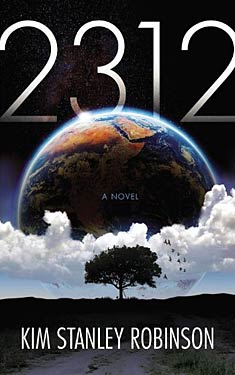
2312


Kim Stanley Robinson
Completed 5/26/2019, Reviewed 5/26/2019
3 stars

I’m not really a big fan of Kim Stanley Robinson, but I do recognize that his books are really well written.  The prose is usually outstanding and the amount of research and thought that goes into his books is extraordinary.  2312 is no exception.  I was continuously amazed at what he was writing about and how he was writing it.  However, I thought this book was short on plot and character development.  It took a long time to get around to advancing the plot, and I didn’t think it was all that interesting.  The characters were sort of interesting, but not very likeable.  I thought the real point of this book was a love letter to the solar system and positive thoughts on its colonization if we put our minds to it. 
The very basic plot concerns Swan Er Hong, the granddaughter of Alex, the Lion of Mercury.  When Alex dies, Swan is more or less thrust into some of Alex’s roles as a thinker and coordinator of efforts to advance living in the solar system.  However, Alex hardly kept any notes and left little for Swan to research.  Still, Swan becomes embroiled in trying to figure out who is sabotaging cities and operations on the planets.  Wahrum, an ambassador from Saturn and Inspector Jean Genette work with Swan to get to the bottom of this mystery. 

Swan is the main character.  She’s 135 years old.  She’s a hermaphrodite, but uses the she/her pronouns.  Many people are hermaphrodites in the future, and many people live to be well over one hundred years old.  Despite her age, Swan acts very childish in many respects.  I found it rather annoying, particularly in the beginning of the book.  One would almost have guessed she was a teenager by how she reacts to situations.  I found it difficult to like her, let alone identify with her because of her immaturity.  Yet, she’s been a mother and a father, but certainly doesn’t act like she’s ever been a parent. 

Wahrum is also a hermaphrodite and has fathered and mothered children.  He’s a spritely 115-ish.  He’s much more mature than Swan, but the two eventually end up romantically entwined.  But like the plot, this is slow in developing through the novel.

The real relationship in the novel is the romance Robinson has for the solar system.  Most of the book describes the inhabited planets and moons and how they were terraformed and settled.  It’s really good reading.  I found it much more interesting than the plot or the characters.  Robinson also spends time talking about how the Earth has changed with the effects of climate change and the animosity the eleven billion people still living on earth feel toward the spacers, who they consider deserters of the bad situation. 

The book felt very long.  I think this was due to the fact that very few chapters for the first two thirds of the book feel like they advance the plot.  There are a lot of scenes with Swan and Wahrum, but they don’t always have to do with the sabotage story line or their relationship.  Yet, they are very readable.  The form of the book is very interesting, with strange stream of consciousness lists, extracts that seem to come from papers and research adding color to the world building, and “quantum walks” which are also stream of consciousness, but much stranger.  I think those had to do with the AI implanted in Swan’s head.  The form reminded me of Stand on Zanzibar by John Brunner.  In fact, a lot of reviewers claim there are many references to older science fiction authors, particularly Heinlein, though I missed most of those. 

I was going to give this book four stars out of five when I got the end, but I spent most of time reading it thinking it was only a three-star book.  I recognized that I really liked reading the prose and was almost always fascinated by the astronomical and ecological passages.  However, I just couldn’t forgive it for not having such a basic plot and so little character development.  So I settled on three stars.

Thursday, May 23, 2019

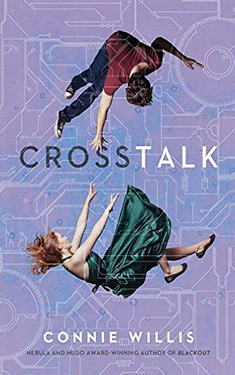
Crosstalk


Connie Willis
Completed 5/23/2019, Reviewed 5/23/2019
3 stars

I really like Connie Willis.  But I’m not so much of a fanboy to find this book’s pacing to be way too frenetic to maintain the excitement and mystery of the content.  The books of hers I’ve read tend to have a similar theme of people not communicating very well with each other, as well as a lack of boundaries.  This one was no exception.  At first, it was comical, but after a while, it became a little tiresome.  And that’s too bad because overall, I liked the book, but thought it could have better with some slower paced, more intimate moments, and few more people who would stop and listen to each other. 


In the near future, a new medical procedure promises to increase a couple’s empathy with each other.  Briddey, short for Bridget, has been asked to undergo this procedure with her boyfriend of six weeks, in preparation for his proposal to marry her.  She has the procedure, but instead of having any connection with her boyfriend, she ends up having a telepathic link to C.B., a strange genius who works in the subbasement of her offices.   The rest of the book is a madcap romp of trying to keep this power under wraps and to help Briddey understand and control her powers.  Complicating matters are her boundary-less family who constantly call her at work and at home with their problems as well as their criticism of Briddey, her new boyfriend, and this medical procedure.

The main characters of Briddey and C.B. are likeable.  C.B. is a disheveled, untrusted “Hunchback of Notre Dame” of the company, but quickly shows his true colors as a caring, helpful soul whose main intentions are to get Briddey to control her powers.  Briddey is pretty well developed as well, as a sort of hapless victim to her boundary-overstepping family.  The family is so obnoxious, they get to be hard to take after a while, particularly Mary Clare, whose helicopter parenting of her daughter Maeve seems downright pathological.  Maeve is pretty interesting, but at nine, she eventually gets obnoxious herself.  Most of all, Briddey’s boyfriend Trent doesn’t seem to listen to her very well either.  The only person who seems to have any interest in Briddey’s welfare is C.B., and for that I liked him.

The book runs at a furious pace.  That’s good for the first hundred pages or so, but it doesn’t let up.  I would have liked it to have settled down a bit.  When it seems to, it still runs at high speed.  The pacing makes for a fast read.  As a matter of fact, I read this 500 page book in three days while I was home sick, even though I was taking a lot of naps and occasionally couldn’t focus on the story.  When I was lucid, I zoomed through it.  However, this fast pacing makes the book feel like it lacks the heart of her other books, like The Doomsday Book and To Say Nothing of the Dog.  And it lacks the worldbuilding of those novels.  Granted, those are time travel novels, so there’s a lot of world to build, whereas this book takes place in the very near future.  The extent of the worldbuilding is references to pop culture, like Jay Z and Beyonce, and Brangelina.  Some of these references are already out of date in the three years since this book’s release.  Brad Pitt and Angelina Jolie were supposed to have the medical procedure done to enhance their relationship, but are already broken up in real life. 

Despite my issues with the book, I did enjoy it.  It has Willis’ signature style.  The basic premise is interesting and timely, in this world of too much communication.  I wanted to give the book four stars because it is an easily accessible read, but settled on three out of five because upon reflection, I was annoyed at the minor characters and the pacing a little too often.

Sunday, May 19, 2019

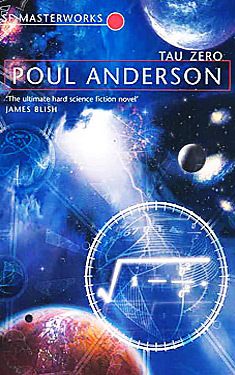
Tau Zero


Poul Anderson
Completed 5/19/2019, Reviewed 5/19/2019
3 stars

This book was very hard science fiction.  I understood a lot of it, but I studied some physics and astronomy in college and enjoyed relativity.  I think Anderson did a really good job of explaining the physics in lay terms, but it still might be tough for some people.  And that’s the bright spot of this book, the physics.  The human interaction, on the other hand, is not Anderson’s forte, at least not in this book.  It’s soapy and melodramatic.  The basic plot is good, but the subplots with the characters are lacking.  It made it a bit of a slog to get through because I never found myself caring for any of the characters.

The Lenora Christine is a spaceship carrying fifty people, half men half women, to a possible planet thirty-some-odd light years away for colonization.  If it turns out to be not habitable, they’ll turn around and come back.  The ship has a fusion engine and will approach the speed of light, so much more time will pass on Earth than does on the ship.  Then things go to hell in a handbasket when they pass through a nebula which knocks out their ability to decelerate.  They can’t repair the spaceship without going outside the ship, and doing so is immensely dangerous at the speeds they are travelling.  So, they must continue to accelerate until they reach deep intergalactic space where there is almost no matter with which they can accidently interact.  But because of time dilation, the universe around them is aging.  Besides the technical aspect, the question becomes whether the passengers aboard can cope with the thousands of years passing by them on the outside while only a few pass within.

My biggest problem with the book is the people.  They are very cardboard.  The characters do not feel very real and are not memorable.  Most of the problems that happen to them are interpersonal, which Anderson did not write very well.  There’s a little bit about people not coping well with the trials that afflict them on their journey, but I think these scenes could have been fleshed out more.  And the relationships just reminded me of a soap opera, melodrama without substance. 

I also had to do some willing suspension of disbelief regarding the science.  As they approach the speed of light, they go faster and faster, of course.  But by definition, the speed of light is the limit they can attain if they have no mass.  They can’t go faster.  That means they should be taking more than thirty years to get to their initial destination, not five, which is described in the book.  And later, they continue to accelerate and zip in and out of galaxies.  This is not possible unless they attain some sort of faster than light travel, like the use of wormholes for space dilation.  I had to put all this cognitive dissonance aside and allow for the book’s conceit that approaching the speed of light gets them around superfast. 

But besides this, the plot was well-conceived, that is, being stuck in space accelerating toward the speed of light and the problems that unfold.  The problems kept coming and the people had to cope and figure out ways around it.  I give the book three stars out of five for the plot, but fail to give it anymore because, well, it’s a soap opera aboard a lost ship.

Monday, May 13, 2019

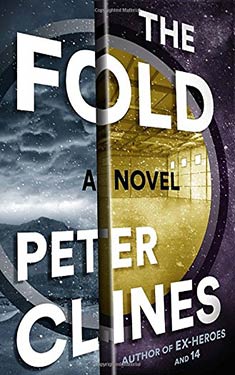
The Fold


Peter Clines
Completed 5/11/2019, Reviewed 5/13/2019
4 stars

I read this book after a very dense, intense novel.  Fortunately, it was mostly a fun, exciting mystery about a device that lets you travel several hundred feet in a few steps by folding dimensions, sort of like a wormhole.  However, something is wrong with the device and only one man has the ability to put the pieces together to solve the mystery.  It’s an easy read with lots of dialogue and a little science.  It’s not a profound novel, but it hit me just right at just the right time for me to give it a good review.

The man with the abilities is Mike Erikson.  He’s got an eidetic memory.  He can recall everything he’s ever seen.  He can pull that data and arrange it complex combinations to put pieces of puzzles together.  That’s why his best friend keeps on calling on him to join his projects.  So far, he’s never been able to get Mike to give up his job as a high school teacher to work for him.  This time however, his project is the aforementioned device, called the Albuquerque Door.  He wants Mike to review the project on site and make sure that everything is copacetic, and that all the money being poured into it is not being wasted.  Mike is intrigued and agrees to work on this project on his summer vacation.  It soon becomes evident that something is amiss and nobody on the project is helping Mike get to the bottom of things.

Mike is a very interesting character.  He likens his memory gift to a colony of ants, thousands of individual creatures all working in concert together.  At first the references to the ants are confusing, but it begins to make sense that that’s how he analyzes and compiles all the information in his head.  As a result of being different, he struggled with his gift most of his life, which is why he likes being a teacher rather than being a star researcher on government projects.  He also has trouble with interpersonal relationships, keeping people at a distance. 

The rest of the cast of characters begin a little one note, with everyone hostile towards Mike, thinking he’s there to shut them down.  They soon become more colorful, but why they do adds to the mystery surrounding the Albuquerque Door, as nothing seems to prompt their changes in attitude.  So at first, the characters all bled into each other, but as their personalities diverged, they became more distinct and a lot more fun. 

The mysteries of the Door encompass the first two-thirds of the book.  This is the best part.  It’s fun and exciting and pretty well written.  The last third was a little bizarre for me.  I can’t really explain why because that would be a major spoiler.  Suffice it to say, I found myself not quite as engrossed as I previously had been.  The end, though not a cliffhanger, leaves it open for numerous sequels. 

This is no profound piece of literature.  What it is is an enjoyable, readable romp through the concept of teleportation.  Actually, it’s not quite teleportation, but that’s defined in the book, and I’ll let you read that.  I give the book four stars out of five because I highly enjoyed the book, and wasn’t deterred by the last part.

Saturday, May 4, 2019

The Devourers


Indra Das
Completed 5/4/2019, Reviewed 5/4/2019
4 stars

This was an unusual novel, billed as a werewolf novel, but it isn’t exactly.  It’s a shape-shifter story which takes place in India now and several hundred years in the past.  It tackles issues of rape, gender-roles, identity, and love.  I was not consumed by this story within a story as I thought I’d be, but it does have glorious prose and its take on the shape-shifter trope feels fresh.  It won the Lambda Literary Award for SF/Fantasy/Horror and was nominated for the Tiptree Award.  Although I didn’t thoroughly enjoy the book, I feel that it is something special and worth a read.

The overarching plot Is about Alok, an Indian college professor who meets a stranger at a circus-like event.  The stranger confesses that he is not human, but something akin to a werewolf.  Alok is intrigued.  The stranger asks him to transcribe scrolls that contain the story of one such man-eating shape-shifter and the woman who he loves.  As Alok types out this story, he becomes obsessed with it and the stranger. 

The inner story is about Fenrir, a taken name based on the giant wolf of Norse Mythology.  He is in a pack of three shape-shifters.  Fenrir, despite having a sexual relationship with his pack mates, falls in love with a human woman.  Rather than having a normal relationship with her, he rapes her.  Love and sex with humans are forbidden by the shape-shifters’ tribes, and the pack breaks up rather violently.  The story then becomes the tale of the journey of the woman with one of the former pack mates, as she seeks her perpetrator and comes to grip with bearing a hybrid child.

As I mentioned at the start, the prose is wonderful.  It makes for an easy read and creates multidimensional characters.  I really liked Alok, who is basically a hapless, lonely, bisexual person struggling to find intimacy among his few friends.  His growing obsession with the stranger is a desperate cry for attention, despite the possibility of danger, assuming the stranger’s tale is real.  The stranger of course is interesting because of the mystery he weaves.  But the real star of the book is the raped woman who despite not trusting anyone since her mother died, and having just experienced this violence against her, comes to trust Fenrir’s pack mate.  Her anger is very real, and at times difficult to read because it is written so well.  The bulk of the story is about her and her journey to find Fenrir. 

There is a lot of violence in the book, and it has a very gritty feel to it.  The devouring of humans by the shape-shifters is very graphic.  There is also a lot of urinating to mark territory.  In general, there’s just a lot of bodily fluids in this book.  It’s hard to stomach at times, as the woman vomits a lot, but it all adds to the very vivid nature of her experience, as well as that of the shape-shifters.

I give the book four stars out of five.  I was going to give it three because I wasn’t that engaged with the book, but looking at it objectively, this is some fine writing and a fairly unique story.  I had to bump it up a star because of this.  The book has some action, but basically, it’s a study of issues and transgressions.  I recommend it to anyone who likes their books a little more philosophical and didactic.

Saturday, April 27, 2019

Karen Memory


Elizabeth Bear
Completed 4/27/2019, Reviewed 4/27/2019
4 stars

I’m not a huge steampunk or western fan, but I really enjoyed this cross between the two.  The book is about a prostitute with a heart of gold in the Pacific Northwest during the Washington territory days in the 1800s.  It’s mixed with a Jack the Ripper style murder mystery where women are found in alleyways flogged to death.  It was nominated for the Gaylactic Spectrum Award in 2016 for positive LGBTQ content in Science Fiction/Fantasy.

The book is told in first person narrative by Karen Memery, like memory but with an e.  She’s an orphaned girl doing the best she can in Madame Damnable’s high-class bordello in a town called Rapid that’s a sort of amalgam of Seattle, Vancouver, Portland, and San Francisco, servicing the mariners and the gold seekers before they head up to Alaska.  All is relatively normal until one day, an injured girl named Priya shows up on the doorstep.  Turns out she’s from India and was abducted and forced into prostitution by the evil competing bordello.  Taking her in creates a war between the two houses.  At around the same time women begin appearing in alleyways flogged to death.  The owner of the other house has a mind-control device that he uses to control his indentured prostitutes as well as influence the people of the town against Madame Damnable.  Also coming into the story are a black Lone Ranger type with an American Indian sidekick who are searching for the murderer.  Together they all try to solve the murder mystery while surviving the attacks from the competing house.

The story is really well done.  It’s told in old west style, low-educated grammar.  At first I found it a little annoying, then appreciated it for giving us a sense of who Karen is.  It’s just the right touch of quaint without being too difficult to read.  There aren’t a lot of flashbacks into Karen’s past but she conveys her life experience as well as her hopes and dreams.  In particular, she tells us about how she is falling in love with Priya and wants to settle down on a ranch of her own with her.  She’s been saving up money to buy land, as working in the Hotel Mon Cherie pays pretty well.  We get to know a lot about Priya, as well as several of the young women working at the bordello as they all interact as a family.  The characterization is really well done.

In the steampunk category, there are dirigibles, the mind-control device, a Nautilus-type submersible run by a captain nicknamed Nemo, and a walk-in sewing machine/automaton that Karen uses as a sort of coat of armor.  This walk-in sewing machine was the only thing I didn’t quite get.  I got that it was like having armor that enhances the musculature of the wearer, but I never got how it was used for sewing.  It didn’t ruin the story for me in any way, it just made me wonder what it’s for besides escaping from burning buildings or busting people out of jail. 

Readers of my blog may note that I’ve been reading this book over two weeks.  It’s not a long book, and it’s quick reading.  I was just distracted by gaming.  If I wasn’t playing games for two solid weeks, I would have read more than 20 pages a night.  The action is well described and fast paced.  I would have finished this book a lot more quickly if I hadn’t been playing so many games. 

I give this book four stars out of five.  It’s not my usual brand of excellent, but it was really well written and thought out.  I liked Karen, the book’s setting, and its plot.  It’s pretty fun, and I think would have been a fast read under normal circumstances. 

Thursday, April 11, 2019

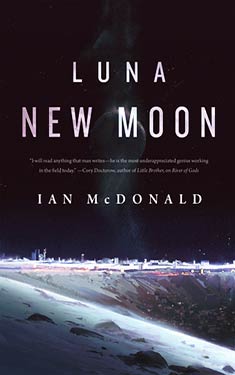
Luna: New Moon


Ian McDonald
Completed 4/10/2019, Reviewed 4/11/2019
4 stars

This book is the definition of space opera.  It’s sort of a cross between a prime-time soap opera and The Godfather set on the Moon.  It’s about five families, known as the Five Dragons, who control five different mega-corporations on the Moon and their wars with each other.  At first I didn’t care for the book.  I was overwhelmed with the number of characters (of which there is a three- or four-page glossary before the book starts) and the constant changes in perspectives among many of them.  Somewhere after about a third of the way through, I got hooked into the story and found it a fascinating and engrossing thrill-ride.  It’s the first book in a three-part (so far) series that ends with a bang, but also leaves you hanging for the sequel.  The book won the Gaylactic Spectrum Award in 2016 for positive portrayal of LGBTQ themes in SF/Fantasy.

The majority of the story centers around the Corta family, led by the matriarch Adriana.  Hailing from Brazil, they control the extraction of Helium-3, fulfilling the energy demands of the Earth.  She is old, and there is tension between two of her children, Rafa and Lucas, over who will have control of the company when she dies.  More immediately, there is a sort of lukewarm war between the Cortas and another family, the McKenzies, who run a mega-mining operation.  There are assassinations and attempts, arranged marriages to create alliances, vendettas, and all sorts of intrigue within and between each family.  All this in an environment where the line between life and death is razor sharp.  In fact, people must pay for the Four Elementals:  water, air, carbon, and data.  People pay per breath.  Become unemployed, and soon you will suffocate from not being able to afford your breathing.  But this is a minor issue for the ultra-rich Five Dragons.

The world created on the Moon is one of extreme capitalism run amok.  There is no law but contract law.  You can murder, steal, cheat on your spouse, and so on, as long as you have not signed a contract forbidding it.  And when contract breaches come to court, they can be settled by a duel.  There are no guns on the moon because of the chances of puncturing holes in the protected environments, so the duels usually involve knives.  And there is no democracy, no government of any kind.  Everything is basically controlled by the Five Dragons. 

Like a TV show like Dallas or Dynasty, almost all the characters are part of one of the five families, or work for them.  We don’t get a taste of what it’s like to be poor on the Moon, except through the eyes of one character, Mariana, a fairly recent immigrant who with her friend (or lover, I was never sure exactly which) are within pennies of running out of breaths.  Fortunately, she gets a job with the Cortas, but not before her friend dies from lack of payment.  However, Mariana’s struggle with poverty really only occurs at the beginning.  Once she is employed, we don’t experience what the lower classes experience ever again.  This is too bad, for though it would make the book much longer, it might have made the world a little more fully developed.

I was really surprised that I liked the characters in the Corta family even though they had their share of moral repugnance.  They’re not the good guys.  They are just most three-dimensional characters of the book.  There is a machismo that runs through the men of the family, which is a fatal flaw for many of them, particularly Carlosinho and Lucas.  I liked Lucasinho, Adriana’s mostly gay grandson.  At seventeen, he attempts to run away from home and live without his family.  He has to learn to live by his wits since his father Lucas cuts him off from his accounts.  I also liked Ariel, Adriana’s daughter who is a lawyer and an asexual.  And lastly, I was intrigued by Wagner, Adriana’s youngest son, who is a “wolf”.  He lives in a pack and is influenced by the full Earth in the sky.  The concept of a wolf seemed to be a little hokey, but it intrigued me and I wish there was a little more description of what being a wolf actually entails.

I give the book four stars out of five.  It took a while to grab me, but once it did, I wanted to keep on reading.  However, I don’t necessarily feel compelled to follow the story into the next books.  The prose is decent, but I didn’t like how the perspective changed numerous times through a chapter.  This was especially problematic in the beginning when there are so many characters being introduced.  I recommend this book to anyone who likes space opera.