Sunday, October 22, 2017

The Name of the Wind

Patrick Rothfuss
Completed 10/21/2017, reviewed 10/22/2017
5 stars

Wow, what a terrific book.  I really needed a killer book like this one right now.  It’s the first book in a long time that I can say produced a deep emotional response for me.  Everything came together for me: the writing style, the story, the characters.  It was simply one of my best experiences reading in a long time. 
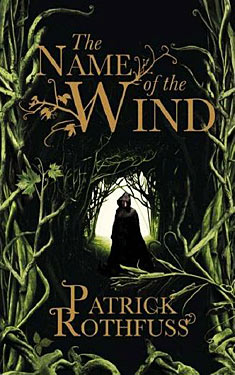
I have to admit, the book started slowly.  It’s a story within a story and the framing was a bit dry.  It begins with a pub and some of the people in the pub.  I found this rather dry.  A friend of mine actually put the book down because of this beginning.  Fortunately, we find out that the owner of the pub has a hidden past.  A Chronicler enters and the owner, Kvothe, dictates his story to him.  This is where the book really picks up.

This story within a story begins with a boy who lives with his family in a traveling acting troupe.  Life is pretty good.  They meet a mage who joins the troupe and teaches Kvothe how to do magic, aka sympathy.  Kvothe has a real gift for sympathy, as he does for many things.  This all comes in handy when his life is shattered and he must forage on his own.  He becomes an orphan, living in the seamy side of the city, trying to bide his time until he can get accepted into the University, which he sees as his only hope for having a future.

The book is really long, over 700 pages (though not as long as the sequel, which is over a thousand pages long).  However, I found it all to be very necessary.  The world building and the character development are marvelous.  It’s all done at a really good pace and it’s done in the context of the action.  The author conforms to the show me, don’t tell me rule of world building.  Hence, there aren’t long passages of prose describing things.  Now, I like my prose, but in a book this long, I want there to be a lot of action and dialogue to keep me going.  And Rothfuss provides that.  I found only one part to drag.  It was towards the end and involved a lot of waiting. 

I even liked the way the book ended.  It’s the first of a trilogy.  The second book is out, but we are still waiting for the third.  Normally, I don’t like finding out a book doesn’t end.  I like the books of my trilogies to be self-contained.  However, I had ten years of knowing about the book and knowing it was the first of a series, so I was prepared for an episodic-type ending. 


So all the hype about this book is worth it to me.  It’s a long, but easy read about a likable but cocky teen learning about life the hard way.  It has just enough magic to be a fantasy.  The University setting has drawn comparisons to Harry Potter, but it’s not like the Potter series at all.  If anything, it’s reminiscent of the style of The Lies of Locke Lamora.  It’s warm and intimate.  In fact, I found myself nearly in tears a few times over the plight of Kvothe.  I felt very personally attached to the character even though he’s often full of himself.  I give this book five stars out of five because I got so involved with Kvothe, and also, because it’s the first book I read in a long time where I didn’t zone out in parts.  This book gripped me.

Sunday, September 24, 2017

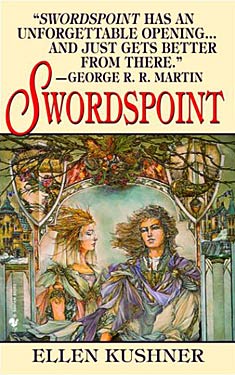
Swordspoint

Ellen Kushner
Completed 9/23/2017, reviewed 9/24/2017
2 stars

I guess I’m not much of a fan of a melodrama of manners.  I found this book to be quite boring.  There’s not much action even though it’s about a swordsman in a land where nobles hire such people to duel for them.  The plot is more about the fine line between killing during a duel and out and out murder.  Richard St Viers is the swordsman.  He’s the best there is and is very difficult to hire.  A noble kidnaps St Viers’ lover to blackmail him into dueling for him.  St Viers does not put up with this and thus we have our melodrama. 

The characterization is very light.  I didn’t get much of a sense of most of the characters.  St Viers is quiet and aloof.  His lover Alec is sarcastic and cynical, a former scholar who now gambles too much and gets into all sorts of little scrapes.  There isn’t much that holds them together except the fact that they are together.  But I think that’s also because of the writing style.  I get the feeling that Kushner wanted to keep the relationship low key, but the side effect is that there isn’t much to explain why they remain together.  There isn’t even that much kissing.  So if you want a book with M-M relationship but none of the romance, this is the book for you.  I included this book in a list of LGBTQ themed books for Worlds Without End because it was inducted into the Hall of Fame of the Gaylactic Spectrum awards.  I believe it was inducted because it was an early book where the gay theme was an integral part of the book and yet handled as a non-issue.  I just wish there was a little more romance between St Viers and Alec.

The noble characters all bled together for me.  There wasn’t that much to differentiate them.  Plus I’m one of these people who can’t handle getting a bunch of similar characters at the same time and then trying to keep them separate throughout the story.  There was a whole lot of treachery and intrigue between the nobles, but since they all ran together for me, I had a tough time keeping track of who wanted to kill whom.  I soon found it to be as convoluted as a space opera, of which I am generally not a fan.


The book is relatively short, although it took me a long time to get through it.  I simply didn’t find it all that interesting.  There is no fantasy in the book, other than it being sort of a lightly alternative history of a Renaissance-ish period.  I was disappointed in that.  I would have liked to have seen some fantasy element make its way into the novel.  I give this book two stars out of five.  

Tuesday, September 12, 2017

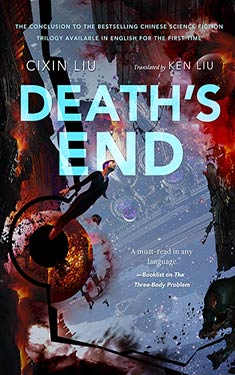
Death’s End


Cixin Liu
Completed 8/27/2017 Reviewed 9/12/2017
4 star

Wow.  This book was so huge and sweeping it’s hard to get my thoughts together for a review.  It took me a while to get through it, considering I get most of my reading done on weekends.  It was excellent, although there was so much, I occasionally got lost.  I think there’s a lot of things and connections I missed.  The science fiction is hard, so there are sections that are tough reading.  It’s a space opera, but I found the politics intriguing rather than annoying.  It took a long time, but I’m glad I read it.

The story takes place after the Doomsday battle of the previous book.  There is something akin to a Cold War between humanity and the Trisolarans.  Luo Ji, also from the previous book, is the Swordbearer.   He has his finger on the button that will destroy the Trisolarans, but probably also destroy the Earth.  Enter Cheng Xin, an astrophysicist from our time who awakens from hibernation to help with a near speed of light propulsion spacecraft.  Even though that appears to fail, she becomes beloved by the world and is voted to take Luo Ji’s place when he gets too old.  The Trisolarans attack and Cheng Xin must decide what to do: allow the attack or destroy the Trisolarans and possibly the Earth.

But it is much more complex than that simple summary.  Cheng’s relationship with the people around her and the world are complicated by the fact that she goes in and out of hibernation.  So the world and its politics change over and over again each time she appears.  There has been some criticism in the review literature that she is a Mary Sue.  I think this is incorrect.  She, like the novel is so much more complex.  She does not always make the right decisions and does suffer through that. 


I don’t have much more to say about the book.  Saying more would be mega-spoiling.  My only criticism is that, like the previous novels, there’s an emotional component lacking.   I would have given this book five stars if I could have become more emotionally attached to the characters.  If I gave out half stars, I would give this a 4.5.  So I’m rounding down to a four out of five.  I think the whole series is worth the effort, if you can get past the hard science fiction.  

Sunday, September 10, 2017

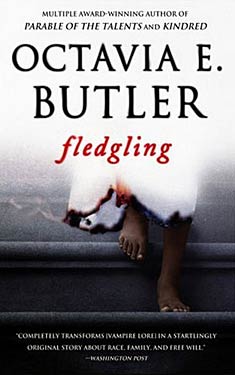
Fledgling

Octavia Butler
Completed 9/9/2017, reviewed 9/10/2017
4 stars

I’m not a voracious reader of vampire novels.  In fact, I’ve only read a few.  I picked this one up because it was by Octavia Butler and it was nominated for a Lambda Literary Award.  I’ve not read a Butler novel yet and this one seemed like an easy first read.  It was in fact a fairly easy book with strong messages about race, sexuality, and relationships.  It has some of the classic vampire tropes, but with different twists.  I found it enjoyable, and at times gripping. 

Shori is the main character.  She’s a 52-year-old vampire but looks like an 11-year-old girl.  She’s part African-American and part human.  She was an experiment to give the vampires the ability to exist in the daylight.  The problem is that she has amnesia from a terrible attack on her family that left her badly burned and with broken bones.  She doesn’t know who she is, and barely knows what she is.  However, she finds other parts of her family who help her understand herself.  As her awareness grows, she tries to find out who keeps attacking her family, while building a family of symbionts from who she can feed and maintain support.

Concerning the vampires, they’re not undead humans.  They are a different species from humans.  They call themselves Ina and don’t actually know what they’re origin is.  However, they rely on human blood for survival and do this by creating families of symbionts.  These symbionts could be called Renfields to help better understand their nature.  Though they are not depraved like Renfield, the symbionts do become addicted to their “masters”.  The Ina live sexually segregated because of dominance of the female, although their symbionts can be male or female.  The Ina mate to produce offspring and several generations of one sex live together in family units.

Shori is very interesting.  She looks like a child and is considered an Ina child.  Despite her youth, she is perhaps one of the most adult characters in the book.  She learns quickly what it means to have a symbiont.  It’s not just about sucking blood.  It’s about love and relationship as well as addiction and dominance.   And needless to say, she’s angry and desperate to find out who has been killing her family and is trying to kill her. 

Of course, there is a sexual component to the relationship between the Ina and its symbiont.  Since the symbiont can be a male or female human, the sexuality of the Ina would be seen as bisexual.  Hence the Lammy nomination.  But the obvious bisexuality is not as important to the story as the more latent concept of needing to have multiple symbionts to satisfy the hunger of an Ina. 

The concept of race is also important to the story, as Shori is dark skinned compared to the rest of the gauntly pale Ina.  However, the real racism doesn’t come out until towards the end of the book, which I don’t want to spoil.

I really enjoyed the story.  It’s different take on the vampire myth was interesting.  The attacks on Shori’s family are gripping.  The whole ending is quite intense.  I think this was as good an introduction to Butler’s writing as I could have found.  A lot of her other works are series, so this was a good stand-alone novel.  It makes me want to dive into her other works, though with my TBR pile for the rest of this year, I may have to hold off on her other books until next year.    


Sunday, September 3, 2017

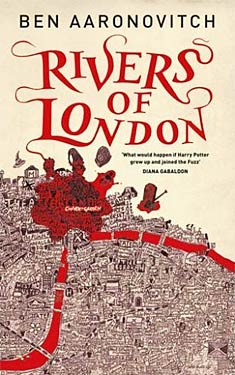
Midnight Riot

aka Rivers of London
Ben Aaronovitch
Completed 9/3/2017, Reviewed 9/3/2017
3 stars

This book was a disappointment.  I was told to expect something like a British version of The Dresden Files.  Perhaps my expectations were too high, but I thought I would be getting some urban fantasy which was darkly humorous, or even of the goofy British comedy sort.  Instead, it was a run of the mill police procedural with some fantasy thrown in.  It wasn’t bad, it was simply “meh”.

Peter Grant is a probationary constable who is assigned to a special detail that deals with supernatural crimes, all because he admits to seeing and communicating with a ghost who was a witness to a brutal murder.  He takes to the assignment like a hand to a glove.  The case grows as there are more murders of similar kind.  Mix in some gods, goddesses, water nymphs and an ancient evil and you should have the potential for a very intriguing book.  Alas the parts did not make a terrific whole.

Grant is an okay character.  He takes to his magical assignment a little too eagerly for me.  There wasn’t a lot of time spent on unbelieving.  Maybe it’s because this is England where there are a lot more ghosties, or at least a lot more history for them.  But I would have liked to have seen more initial resistance to the idea that he’s a prime candidate for a supernatural assignment. 

As I say, the parts of this book are better than the whole.  One part worth mentioning is that the gods and goddesses of the River Thames and its tributaries are featured characters.  It is almost reminiscent of “American Gods”, except that the gods are not disappearing.  In fact they are entering a conflict that Grant has an opportunity to be negotiator for.  One of the goddesses, Beverly Brook, who was also described as a water nymph, actually helps him with the murder case.  It’s an interesting way to blend the different aspects of the story together.

Another part of the book that was intriguing was the ancient evil.  I won’t say more because it would be a spoiler.  But it is very creative and surprising.  It makes for an interesting ending. 


So you put all these interesting things together and it should make for something better than a three out of five stars.  There are interesting components and a decent ending, but somehow I did not find myself drawn into this universe.  I was close at times, but never pulled all the way in.  I think my expectations of it were too high.  And I was expecting something a bit more wry.

Saturday, August 5, 2017

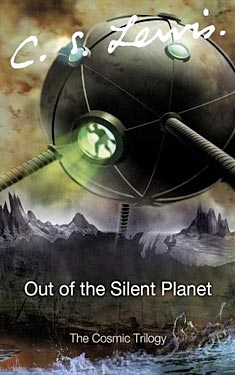
Out of the Silent Planet

C.S. Lewis
Completed 8/4/2017, reviewed 8/5/2017
2 stars

I never read the Narnia series.  I didn’t even know about it until college.  So needless to say, I haven’t read any Lewis before.  This being my introduction to him, I was pretty disappointed.  I think I expected something really profound.  Instead I thought it was pretty dull.  This book was written in 1938, and science fiction was still in its infancy.  Still I would have expected something a little more interesting, exciting, adventurous, something that had a little life in it.  Instead, most of the book is analogous to a “stare in wonder at the special effects” film.  And the special effects aren’t really that good. 

The plot of the book is that a philologist named Elwin Ransom is kidnapped by two other professors and taken aboard a spaceship that goes to another planet.  He escapes from the professors and finds himself alone, hungry, thirsty, and afraid.  Eventually he meets an indigenous sentient creature, a hrossa.  Being a philologist, i.e., a student of language in written historical sources, he finds a way to communicate with the alien, eventually learning its language.  He becomes part of the hrossa society.  He also meets the two other sentient species of the planet, the seroni and the pfifltriggi.  Eventually, he is urged to leave the group and find Oyarsa, the high spiritual entity of the planet.

The aliens are pretty cool, mostly because they are quite different from earthly animals.  They are not anthropomorphized animals, like so often used in early SF.  I cringingly am reminded of Tigerishka, the cat-like alien from “The Wanderer”.  And there are three sentient species, not just one.  I think this is an interesting construct because what we normally see in SF is that like earth, the planet of other SF books only has one, unless of course, it’s an uplift story. 

The flora of the planet is pretty interesting as well.  However, I found that the descriptive scenes were quite dull.  I was astounded by the lack of adjectives.  The prose had a lot to be desired.  The book being relatively short, I think I expected the prose to be concise and stronger than it was.  The book wants you to look at this planet in wonder.  Instead, the word choices just leave you rather bored. 

There is a theological dialogue at the end of the book between Weston, who is one of Ransom’s abductors, and Oyarsa.  I also found it dull.  I kept waiting for something really profound to happen to tie the book together, but nothing did.  It was like a little theology was thrown in in an attempt to elevate the book above pulp status.   


Needless to say, the book left me nonplused.  I’m still going to give the whole trilogy a try because the third book is “That Hideous Strength”, which was a book I opted not to read for my Fantasy Lit class in college (the other option was The Earthsea Trilogy, which I did read).  I give this book two stars out of five.  It was just too dull for me to appreciate.  

Sunday, July 30, 2017

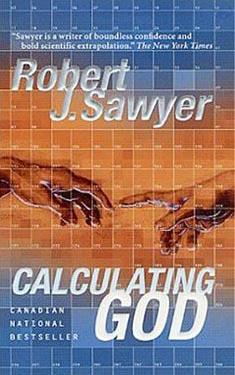
Calculating God

Robert J. Sawyer
Completed 7/29/2017, reviewed 7/30/2017
4 stars

An alien appears outside the Royal Ontario Museum and asks, “Take me to a paleontologist.”  It turns out that this alien represents one of two alien races that had extinction events at the same time we had ours on earth.  This is just one of the reasons the two alien races believe that the universe was intelligently designed.  Combine this with the atheist paleontology curator at the museum who is dying of cancer and you come up with a very intriguing mix of morality, science, spirituality, and religion. 

Despite its heavy content, the book is a fairly easy mélange of philosophical discussions.  The discussions between the main character Thomas Jericho and the alien Hollus get fairly intense as well as some of Jericho’s own reflections.  But it is fairly easy to follow.  It is all made much more intense with Jericho’s plight as a cancer victim.  With less than a year to live and as one of the ambassadors to two alien races, he is thrown into an existential crisis.  The basic question is, if there is a god, why does it appear to be indifferent to us. 

Thrown into this mix is a subplot where two fundamentalist Christian terrorists blow up an abortion clinic, killing someone.  They flee to Toronto where they decide to destroy the evil fossils that Hollus is examining with Jericho so that Hollus can be saved.  Of course, just believing in God isn’t enough, you have to be “saved”.  This subplot is sort of clunkily thrown into the story, but it makes an interesting point:  there is a God, but we’ve got it all wrong.  And on top of that, our morality is all screwed up.  For example, why should we need abortion when we have contraception?  This is just one of the topics discussed in the book. 

Ultimately though, the book’s argument comes down to why God only seems to act on the cosmological scale.  It is the argument for intelligent design, but against fundamentalism.  The book is nicely executed in presenting this, but I never felt the proof that the aliens had for the existence of God was ever adquately explained. 


I give the book four stars out of five.  This was another book for my Theology in Genre Fiction reading challenge.  It was right up my alley in the conflict between religion and science.  It seems like people are pretty divided on this book, but I found it interesting and well executed.